

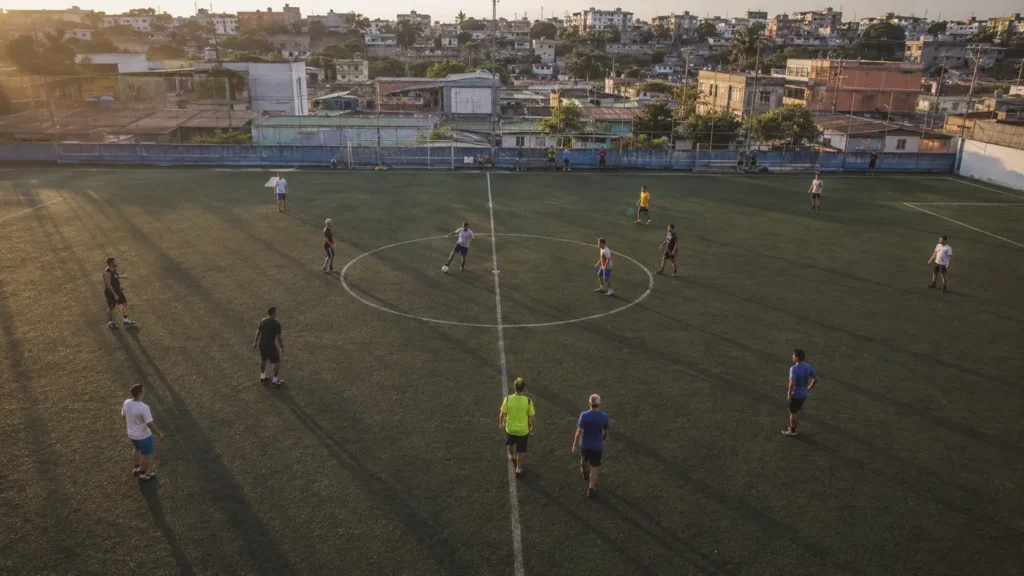
Two people can film the same match with the same phone and end up with completely different footage. The difference is almost never the device. It is where they stood, how high they held it, and which side of the pitch they picked before kick-off. This covers the angles that make amateur football readable, the ones that quietly ruin it, and how the answer changes for goals, set pieces and goalkeepers.
If you want the full setup rather than just the angle, how to record your soccer game covers the whole process. This page is about the single decision that matters most.
The Angle Somebody Already Solved
Venues that install a camera put it exactly where this article says it should go, permanently, and nobody has to think about it again. VISU turns what it captures into a clip you can share.
The Short Answer
Stand at the halfway line, on the touchline, as high as the venue lets you, with the sun behind you, filming horizontally. That single position produces better football footage than any other choice available to someone holding a phone.
It works because it is the only place where both halves of the pitch stay within reach of a small turn, rather than requiring you to walk. Every other position optimises for one part of the pitch at the expense of the rest, which is fine if you know that is the trade you are making and a problem if you discover it afterwards.
The rest of this article is why, and what to do when the halfway line is not available, which happens more often than you would think.
Height Changes Everything
Of all the variables, height does the most work. Filming from ground level at standing height puts the camera in the same plane as the players, so they overlap into a single mass and you cannot tell who has the ball. Raise the camera even slightly and they separate.
The gains are steep at first, then flatten. Going from waist height to eye level is a large improvement. Going from eye level to standing on a bench is another noticeable one. Beyond about three metres, extra height mostly stops helping and starts making players look small.
You will not get much, and that is fine. Realistically your options are: hold the phone at eye level rather than chest, stand on a step or a bench, or use the first rows of a stand if the venue has one. Each of those is worth taking. None of them require equipment.
Tilt down, not across. Once you have some height, angle the phone slightly downward so the pitch fills the frame rather than the sky and the car park behind it. A frame that is half sky wastes half your resolution on nothing.
Which Side of the Pitch
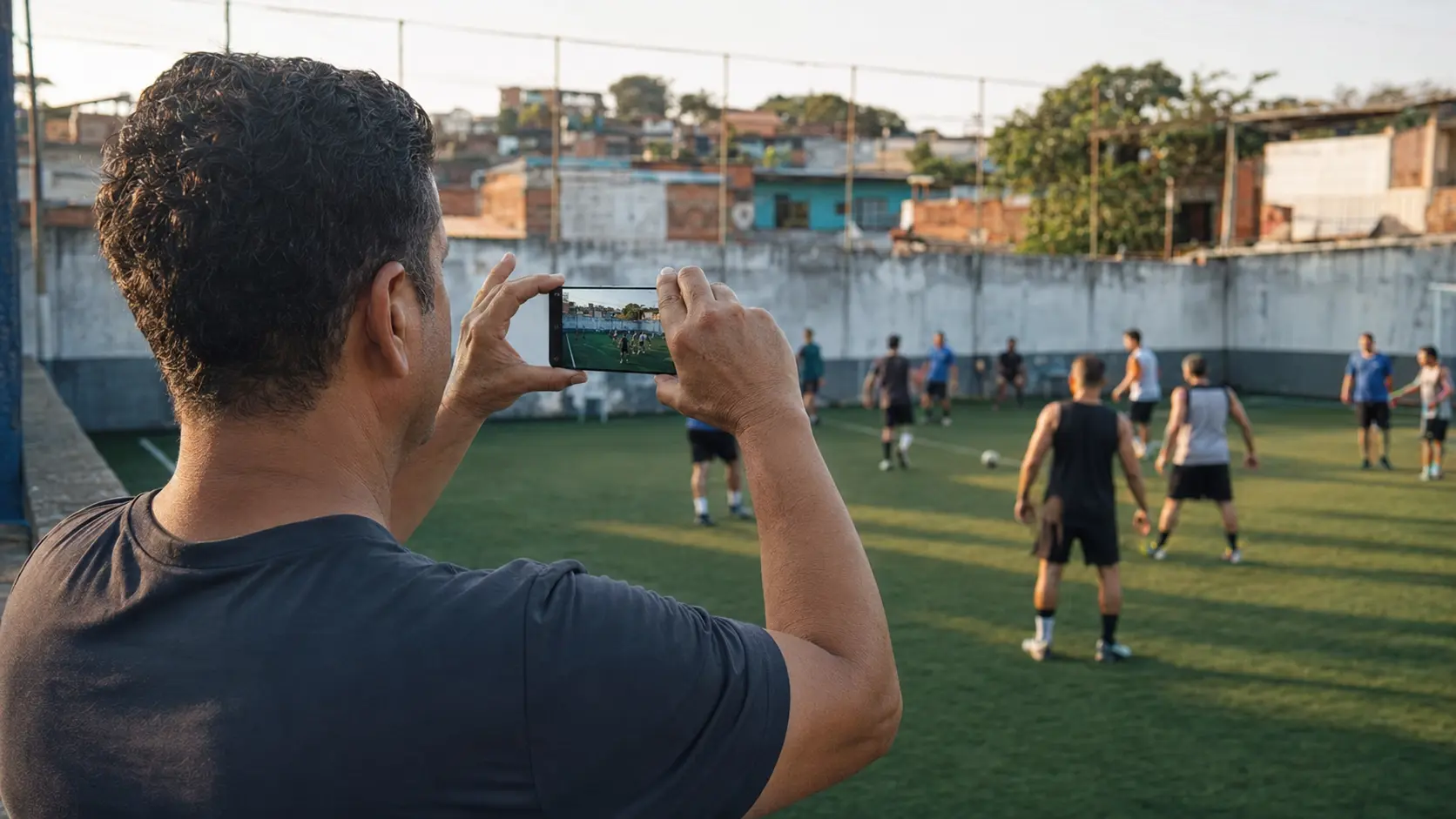
This decision is made in about five seconds before kick-off and determines whether the footage is usable. Two factors decide it, and they sometimes conflict.
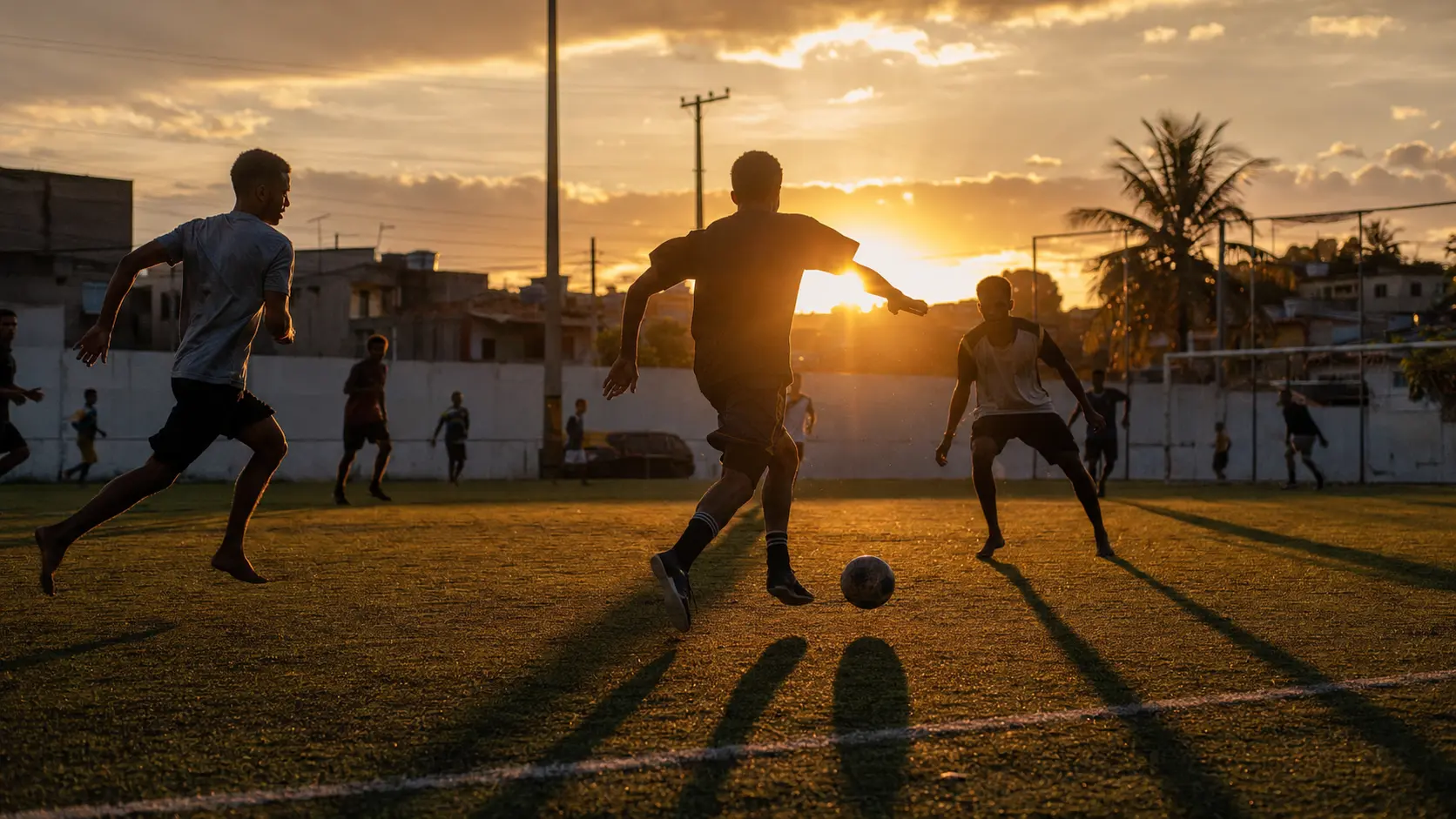
The sun comes first, always. Stand so the sun is behind the camera, meaning it lights the players rather than shining into your lens. Get this wrong and everyone becomes a silhouette, which no editing recovers. In practice this means checking where the sun is, not where the good view is.
Then the side with something to stand on. If one touchline has a bench, a step, a low wall or a stand, that side wins on height. If both sides are flat grass, pick by the sun and forget it.
When they conflict, the sun wins. Backlit footage from a great vantage point is worse than eye-level footage that is properly lit. Silhouettes are unrecoverable; slightly low camera position is merely not ideal.
Under floodlights the calculation changes. There is no sun to avoid, so pick purely on height and on not pointing directly into a light. Position so the floodlights are behind or beside you. Indoor venues have a related but different problem, covered in filming indoor courts.
The Angles, Compared
Every position is a trade. This is what each one actually gives you.
| Position | What it captures well | What it loses | Use when |
|---|---|---|---|
| Halfway line, touchline | Both halves, build-up play, most goals | Detail at either end | Default for everything |
| Behind the goal | Finishing, goalkeeper, penalties | The entire other half | Penalty shootouts, keeper training |
| Corner of the pitch | Nothing especially | Depth, far side, scale | Only if nothing else exists |
| Elevated, halfway | Tactical shape, movement off the ball | Faces, expressions, close detail | Reviewing rather than sharing |
| Following on foot | Whatever you point at | Stability, cuttability | Never, if the phone is unattended |
Behind the goal is the tempting mistake. It produces spectacular footage of finishes and nothing at all of the other three quarters of the match. It is the right choice for a penalty shootout and the wrong choice for a normal game.
The corner is the worst common position because it flattens depth without gaining anything. Players at the far end become indistinguishable and the near touchline eats a third of the frame.
Two angles are worth combining if you have two phones. One at the halfway line covering the match, one behind the goal your team attacks. It is the only realistic way to get both the build-up and the finish, and it costs nothing beyond a second person willing to leave a phone somewhere. Most groups have a spare handset sitting in a bag anyway.
There is one position not in the table because almost nobody has access to it: directly above the halfway line, looking down. It is what broadcast uses for tactical replays and what installed cameras approximate, and it is the reason venue footage looks different from anything you can produce standing on the grass. You are not going to replicate it with a phone, but it explains why the answer changes completely once a camera lives at the venue rather than in someone's hand.
If You Run the Pitch
A camera fixed at the halfway line means every group that books gets this angle without thinking about it, every week. It is also the reason players start choosing one venue over another.
For court and venue owners.
Goals, Set Pieces and Goalkeepers
The general answer covers a full match. Specific moments have better specific answers, if you know they are coming.
Penalties and free kicks. These are the only moments where you know exactly where the action will happen and have time to move. Behind the goal, slightly off centre, captures both the strike and the keeper's dive in one frame. Move back to the halfway line afterwards.
Goalkeeper work. If the point is the keeper rather than the match, film from behind their goal at an angle rather than straight on. Straight on flattens the dive; a diagonal shows how far they actually travelled.
Celebrations. These happen after the goal, in a different part of the pitch, and are usually the part people rewatch. Keep filming for a few seconds after the ball goes in rather than stopping at the finish. The best soccer moments to share covers why the celebration often travels further than the goal.
If you are filming to improve rather than to share, the useful angle is higher and wider than the one that looks good, because you need to see shape and movement off the ball. That is a different job, covered in reviewing your own soccer game.
The Angles That Ruin Footage
Filming into low sun. The single most destructive mistake, and it takes five seconds to avoid. Late afternoon football with the sun behind the play produces silhouettes that no phone and no editing can recover.
Chest height. Comfortable to hold and terrible to watch. The players merge and the ball disappears behind them constantly. Raising to eye level costs nothing.
Vertical framing. Football is a wide game and vertical throws away the sides of the pitch, which is where the play develops. Film horizontal and crop later if you want a vertical clip.
Moving position mid-match. Even to a better spot. The two halves of your footage will not cut together, and the good moment always seems to happen while somebody is walking.
Standing behind the substitutes. A row of people between the camera and the pitch is invisible to you and extremely visible in the footage. Check what is in front of the lens, not just what is beyond it.
Sound is worth a thought too, since a clip with clear audio of the shout after a goal feels alive in a way a silent one does not. Audio in sports video covers what actually helps, and how long a clip should be covers the other half of making footage watchable.
For the general principles that apply across every sport rather than just football, the amateur sports video guide is the wider version, and continuous recording versus triggered clips explains why venue cameras solve the angle problem differently.
One Angle, Set Once, Every Week
Where a pitch has a camera installed, the angle is already decided and nobody has to stand on a bench holding a phone. That is what a fixed soccer camera does for a court, session after session. Sharing the clip costs nothing. Watching it in full and downloading happens in the VISU app.
FAQ: Camera Angles for Soccer
What is the best camera angle for filming a soccer game?
The halfway line on the touchline, as high as you can reasonably get, with the sun behind the camera, filming horizontally. It is the only position where both halves of the pitch stay reachable with a small turn. Every other angle favours one part of the pitch at the expense of everything else.
Should I film from behind the goal?
Only for penalties, free kicks or goalkeeper-focused footage. Behind the goal captures finishing beautifully and loses the other three quarters of the match entirely. For a normal game it produces long stretches where nothing visible happens, then a sudden goal at the far end you cannot make out.
How high should the camera be?
Higher than chest level, which is where most people naturally hold a phone. Eye level is a large improvement, and standing on a step or bench is better still. Beyond roughly three metres the gains stop, because players start looking small and you lose expression and detail.
Which side of the pitch should I stand on?
The side that puts the sun behind the camera. That decision outranks everything else, because backlit players become silhouettes and no editing recovers them. If both sides are equal for light, pick the one with a bench, step or stand to gain height.
Does the angle change under floodlights?
The principle stays the same but the sun stops being a factor. Choose on height instead, and position so the floodlights are behind or beside the camera rather than in front of it. Pointing into a floodlight creates flare and forces the exposure down, darkening the players.
Should I move to follow the action?
No, if you want footage you can cut. Deciding a position before kick-off and staying there produces material that edits together cleanly. Moving mid-match means the two halves do not match, and the interesting moment tends to happen exactly while you are relocating.