

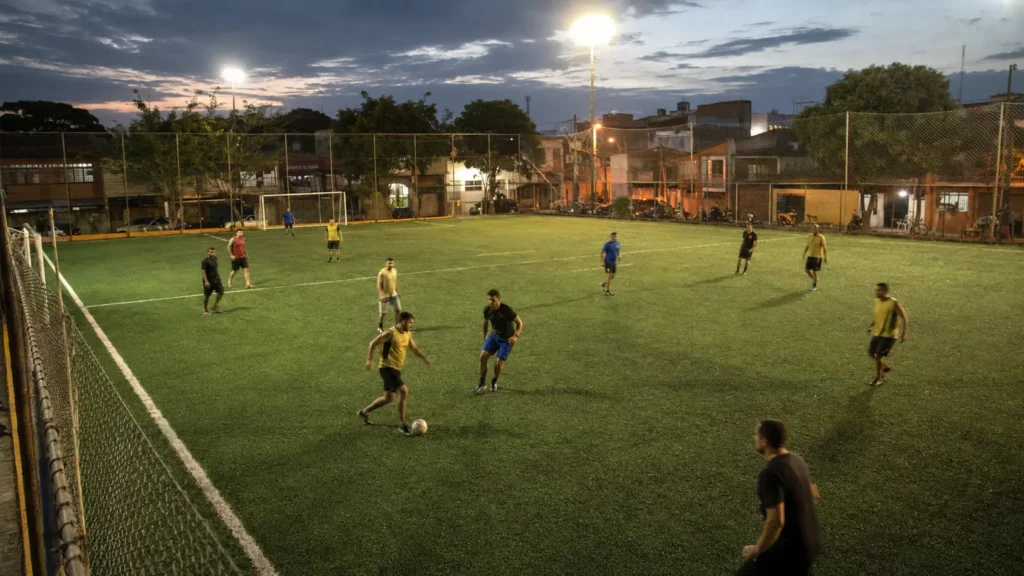
A football pitch is too big for one camera, and pretending otherwise is why most amateur match footage is unwatchable. The players end up as distant specks, the ball leaves the frame every ten seconds, and the goal you wanted is somewhere in a fifty-minute file nobody will open. This guide covers what actually works on a full-size or five-a-side pitch, given that you have a phone and no camera crew.
The short version: get high, sit at the halfway line, film wider than feels right, and accept that you are covering a zone rather than a whole match. Everything below is why, and what to do when the pitch or the light will not cooperate. The general principles across all sports live in the amateur sports video guide.
Nobody Has to Sit Out
Some pitches already have a camera pointed at the play, so the person who would have filmed gets to play instead. VISU turns the moment that just happened into a short clip you can share.
Why Football Is the Hardest Sport to Film
Padel and futsal have walls that define exactly where the ball can go. Football does not. A full-size pitch is around a hundred metres long, the play moves end to end in seconds, and a single fixed camera physically cannot hold both goals in a usable frame.
So there is a trade you cannot avoid. Frame wide enough to catch everything and the players become too small to identify. Frame tight enough to see faces and you lose the ball constantly. There is no setting that solves this, only a choice about which failure you prefer.
The right answer for amateur football is to film a zone. Pick the area where most of the action happens, usually the middle third plus whichever goal your team attacks more, and let the rest go. A clip of a goal is worth more than a complete record of a match nobody watches. The wider point about phones and sports is in why your phone films sports badly.
Where to Put the Camera
Every metre of height helps, and you rarely get many. Filming at standing height from pitch level flattens everything: players overlap, you cannot tell who has the ball, and the far side becomes a blur of legs. You are not going to install a mast, but small gains are real. Standing on a step, a bench or the first row of a stand already separates the players noticeably.
Halfway line, always. Filming from behind a goal captures one penalty area beautifully and the other not at all. From the middle of the touchline, both halves stay in reach and you only have to turn, not walk. If the pitch has any kind of stand, the middle of it is the best position available and it is usually empty during amateur games.
Realistically, someone is holding the phone. That is how amateur football actually gets filmed: a substitute, someone injured, a partner or a parent on the touchline. It produces the best footage of any method, because a person tracks the ball better than any fixed frame. The cost is that this person is not playing, which is exactly why nobody volunteers twice.
If you do leave the phone somewhere, keep it still. A bag on a bench, a water bottle as a prop, a jacket rolled up under the phone. Whatever you improvise, the phone should stay put and let the play move through the frame. Picking it up to follow the ball produces footage that is nauseating to watch and impossible to cut.
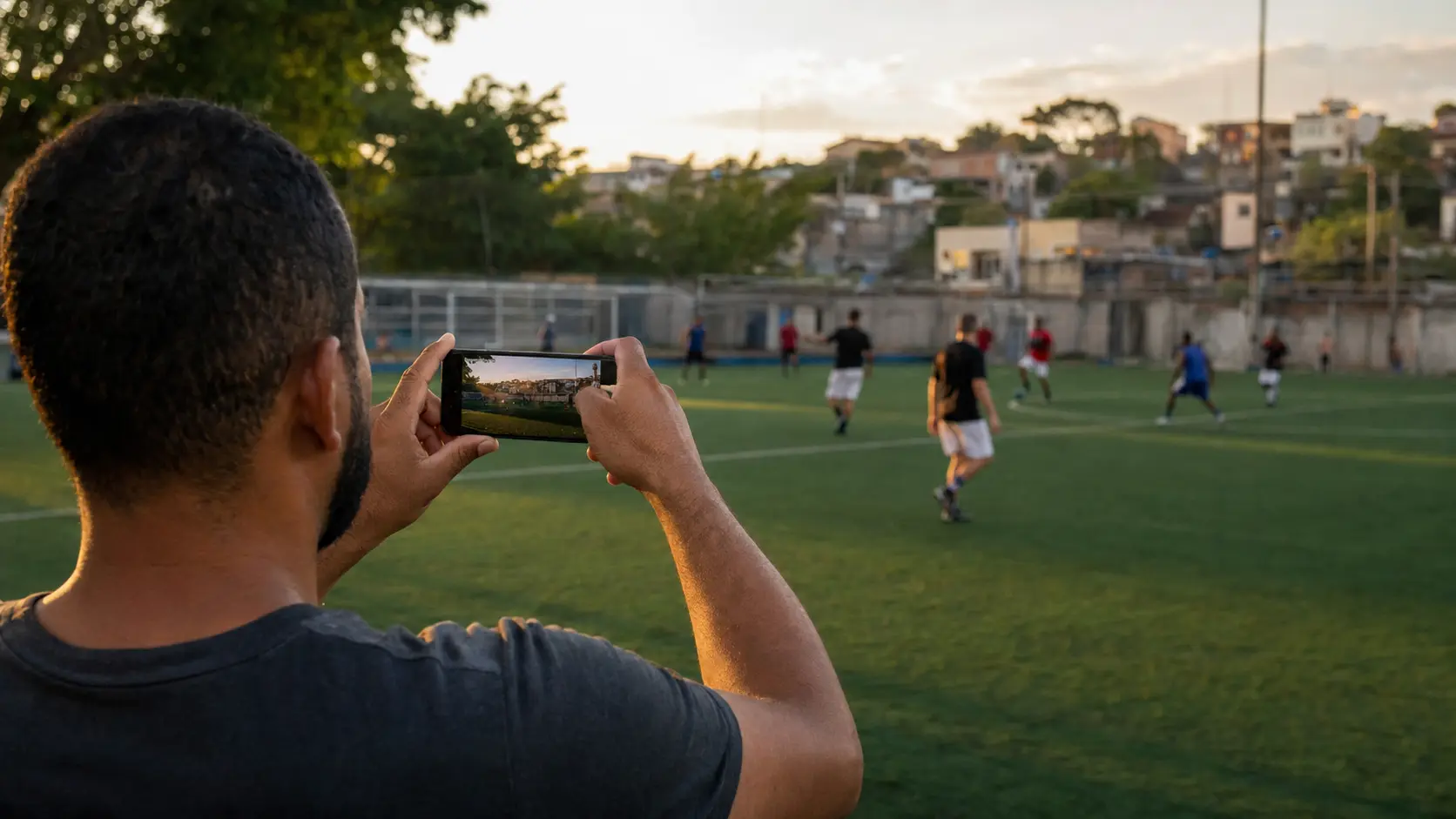
The full breakdown of angles, including what changes for goalkeepers and set pieces, is in the best camera angle for soccer.
One more thing about position that people discover the hard way: whoever films should decide before kick-off and stay there. Moving halfway through, even to a better spot, means the two halves of your footage do not cut together, and the clip you wanted usually sits right at the moment somebody was walking.
Full-Size Pitch vs Five-a-Side
These are genuinely different problems and the same setup does not serve both.
| Five-a-side / society | Full-size pitch | |
|---|---|---|
| Can one camera cover it? | Yes, usually | No |
| Where to place it | Halfway, standing or a step up | Halfway, from a stand if there is one |
| What you get | The whole match | A zone, plus whatever passes through it |
| Biggest problem | Fence and net in the way | Players too small to identify |
| Fix | Film over the fence, not through it | Accept the zone, or film from a stand |
Five-a-side is the easy case and most amateur football now happens on one. The pitch is short enough that a phone at the halfway line genuinely captures the entire game, even handheld. This is also why fixed cameras work so well at these venues: one position covers everything, permanently.
The fence is the enemy, not the size. Filming through mesh puts a permanent grid over your footage and confuses autofocus, which hunts between the fence and the players. Hold the phone right up against an opening in the mesh, or film from the gate where there is a gap. A few centimetres closer to the fence makes the grid disappear from the shot.
If You Run the Pitch
A camera fixed at the halfway line solves this for every group that books, permanently, without anyone bringing equipment. It is also the cheapest reason players have to talk about your venue.
For court and venue owners.
How Wide to Frame
Wider than feels comfortable. The instinct is to fill the frame with players, and it is wrong in football. If your framing is tight enough to look good in the moment, the ball will leave it within seconds and the footage becomes a record of empty grass.
Never use digital zoom. It crops the sensor rather than getting you closer, so you lose resolution and gain nothing. If you need the players bigger, move the camera, not the zoom.
Film horizontally. Football is a wide game, and vertical framing throws away the part of the pitch where the play develops. You can always crop a horizontal video to vertical for social later; you cannot recover width you never captured. More on that choice in what makes a good sports clip.
Lock the exposure if your phone allows it. Otherwise the camera rebalances every time it pans between shaded and sunlit parts of the pitch, and the footage pulses brighter and darker throughout.
Floodlights and Late Afternoon Sun
Most amateur football happens in the two conditions phones handle worst: low evening sun, and floodlights after dark.
Late afternoon sun is the bigger threat. If it sits low and behind the play, every player becomes a silhouette and the footage is unrecoverable. Check where the sun is before choosing your side, and film with it behind the camera. This is a thirty-second decision that determines whether the whole session is usable.
Floodlights are more forgiving than they look, with one condition. Modern phones handle floodlit pitches reasonably well, but only if the camera is steady. Handheld footage under floodlights blurs because the phone lengthens its exposure to compensate for the low light, so small hand movements smear. Brace your elbows against your body, or rest the phone on a rail, and the same lighting produces a clean image.
Avoid filming straight into a floodlight. It creates flare across the frame and forces the exposure down, making the players darker than they need to be. Position so the lights are behind or beside the camera.
What to Actually Keep
You now have fifty minutes of footage. Almost none of it matters, and the part that does is roughly twenty seconds long.
Cut on the same day or you never will. The file sits in the camera roll, the enthusiasm fades, and six months later it is deleted to free up space along with the goal you wanted. Clipping the two or three good moments right after the match takes five minutes and is the difference between having footage and having a file.
Start the clip immediately before the action. Not with the throw-in that led to it, not with players walking into position. The build-up is only interesting to people who were there, and they already know how it ended. How long a sports clip should be puts numbers on this.
The goal is not always the best clip. A save, a tackle or a bad miss often travels further in a group chat than a routine finish, because it is funnier or more surprising. The best soccer moments to share covers what actually gets watched.
If you want the footage for improvement rather than sharing, that is a different edit and a different mindset, covered in reviewing your own soccer game.

Name the clips as you cut them, even roughly. In two years you will not remember which Tuesday that goal happened, and a folder organised by date is worth far more than the same clips sitting under whatever filename your phone chose. It is the least interesting advice in this guide and the one people thank you for later.
The last thing to accept is that some matches produce nothing worth keeping, and that is normal. Filming most weeks and getting one good clip a month is a perfectly reasonable ratio. The alternative, which is filming nothing at all, produces exactly what most amateur players have after a decade of playing: no footage whatsoever.
The Clip Without Losing a Player
Where a pitch has a camera installed, the goal that just happened becomes a short clip without anyone leaving the game to film it. Sharing costs nothing. Watching the full clip and downloading happens in the VISU app.
FAQ: Recording Your Soccer Game
Where should I put the camera to film a football match?
At the halfway line, as high as you can reasonably get, filming horizontally. Height separates overlapping players and makes the play readable, so standing on a step or the first row of a stand already helps. Filming from behind a goal captures one penalty area well and the other not at all. In practice someone usually holds the phone, which produces the best footage but costs you a player.
Can one camera film a whole football pitch?
On a five-a-side or society pitch, usually yes, from the halfway line. On a full-size pitch, no. The distance between goals is too great to keep both in a usable frame, so the realistic approach is to film a zone and accept that some of the match happens outside it.
Should I zoom in on the players?
No. Digital zoom crops the sensor rather than bringing you closer, so you lose image quality and gain nothing. In football specifically, tight framing means the ball leaves the frame every few seconds. Film wider than feels comfortable and crop afterwards if you need to.
How do I film a game under floodlights?
Keep the phone as steady as you can: brace your elbows against your body, or rest it on a rail. Floodlit pitches are manageable for modern phones, but the camera lengthens its exposure in low light, so small hand movements smear into blur. Avoid pointing directly at a floodlight, since the flare and the exposure drop both hurt the footage.
What is the best time of day to film football?
Anything except low sun directly behind the play. Late afternoon is when most amateur football happens and also when backlighting ruins the most footage, turning every player into a silhouette. Check the sun's position before picking your side of the pitch and keep it behind the camera.
How long should a football clip be?
Around fifteen to thirty seconds, starting immediately before the action. The build-up only interests people who were at the match, and they already know what happened. Cut the two or three good moments on the same day, because a fifty-minute file is almost never opened again.