

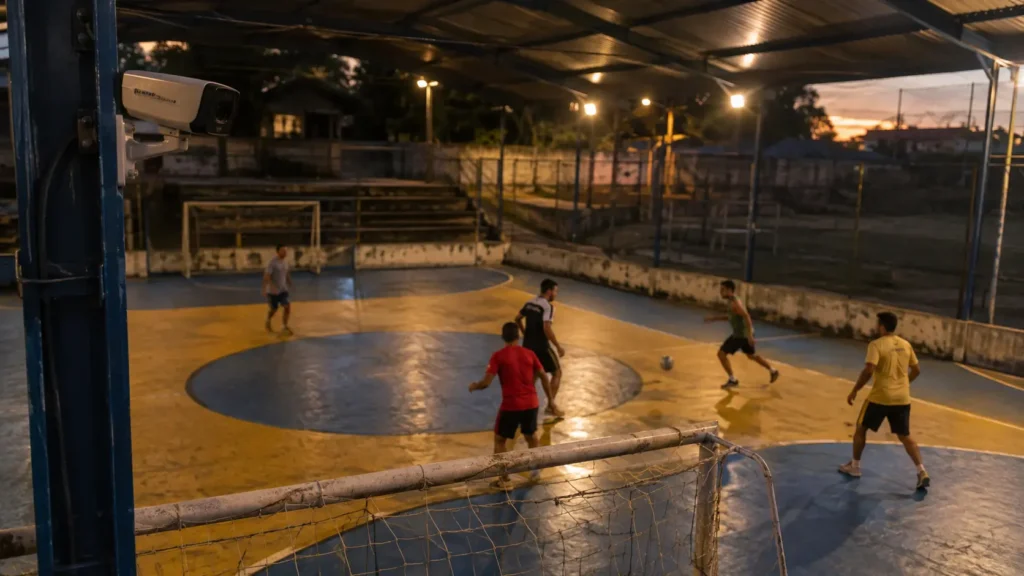
Somebody scores the best goal of their week, turns around, and finds that nobody filmed it. This happens every night on every amateur court in the world, and it is not because cameras are expensive. It is because a camera pointed at a court only helps if it was already running before the play, and nobody knows which play matters until it is over. That is the entire problem a replay camera exists to solve. For the wider picture, start with the guide to filming amateur sports.
The short answer: a replay camera is a camera that is already recording before the thing you want to keep happens, so the moment can be saved after the fact. Everything else about it follows from that one word, before.
The Play Is Already Recorded
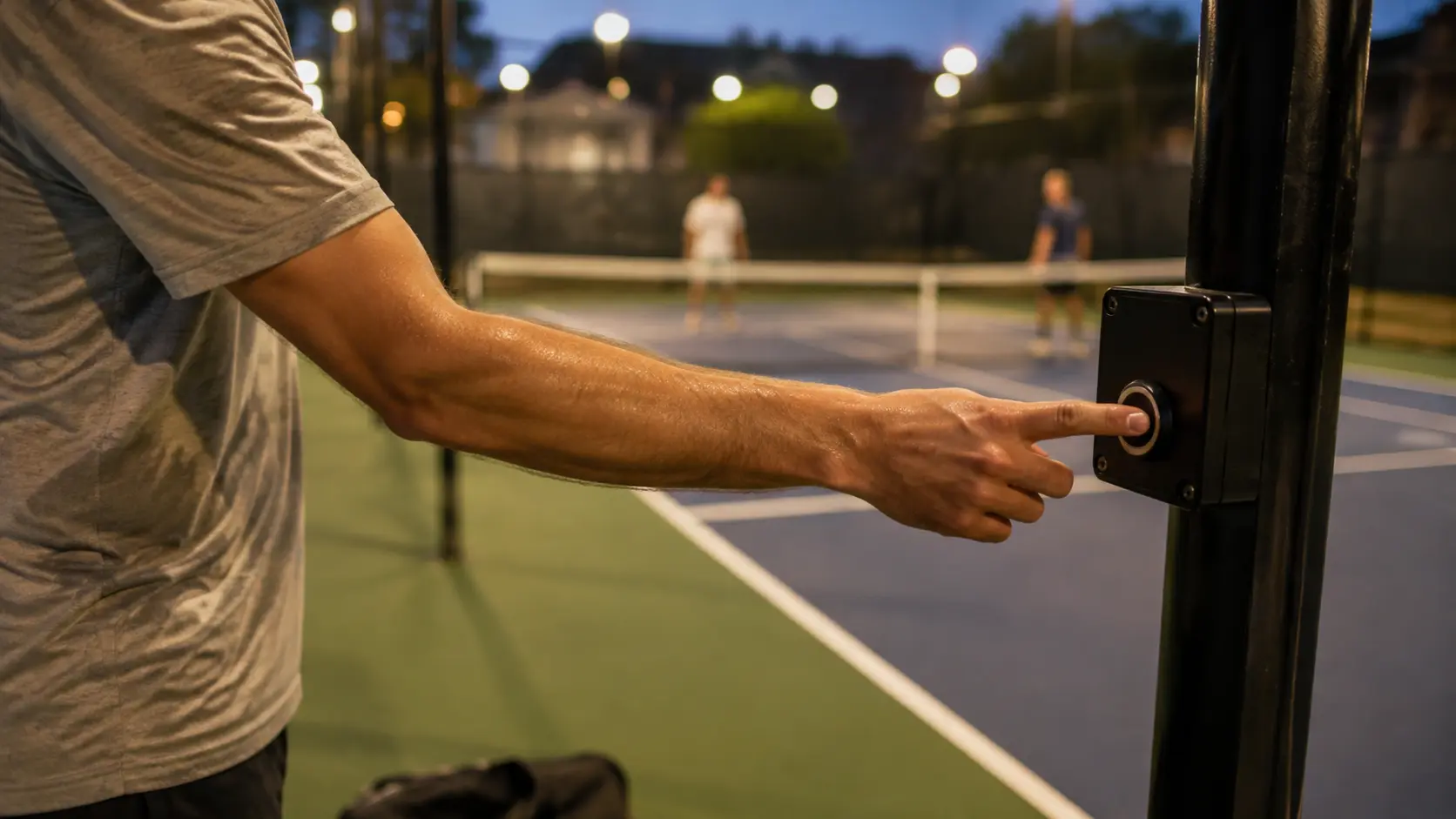
At a court with VISU Replay, the cameras run continuously. You press the button after the play happens and the clip is already there, cut and ready. Nobody has to stand on the sideline filming instead of playing.
What a Replay Camera Is
A replay camera is a camera that is already recording before the moment you want to keep, so that moment can be saved afterwards.
The load-bearing half of that sentence is before. An ordinary camera answers the instruction "record from now." A replay camera answers a different one: "give me what just happened." The category is defined by retroactive capture, not by image quality, not by how it is mounted, and not by artificial intelligence.
This is why the distinction matters in practice. Most people who have never used one assume a replay camera is just a good camera installed at a court. It is not. A very expensive camera that starts recording when you press a button is useless for amateur sport, because the play is already finished by the time anyone reaches for the button. A modest camera that was already running is worth more than a brilliant one that was not.
The Part That Makes It Work
The technical object underneath is a circular buffer, sometimes called a ring buffer or a pre-buffer. It is a fixed amount of storage that continuously overwrites its own oldest data. The camera records into it perpetually, and the overwhelming majority of that video is thrown away seconds later, forever.
So when you press the button, you are not starting a recording. You are promoting what is already in the buffer from "about to be discarded" to "saved." That single distinction is what allows the button to come after the play.
If this sounds exotic, it is not. You almost certainly own something that does it already, and several industries have shipped the same idea under their own names.
GoPro calls it HindSight. In GoPro's own words, it "allows you to record continuously but only saves the last 15 or 30 seconds to the SD card once you hit the [Shutter Button]."
The clearest everyday analogy is the horn in a Tesla. The owner's manual is unambiguous about the behavior: "When you press the horn, Dashcam saves a recording of the most recent ten minutes of footage." A human presses a button after something happens, and the system keeps what already occurred. Tesla documents what the feature does, not how it is built internally, so treat it as an analogy for the behavior rather than a statement about the code. As an illustration it is hard to beat, because millions of people already drive a car that does this.
Professional surveillance has had it for years under a plainer name. Axis documents setting a camera "to start recording to the SD card five seconds before it detects motion and to stop one minute after." Those five seconds before the trigger are the pre-buffer, and they are the same trick.
Replay Camera vs Security Camera
This is the closest technical relative, and the comparison is more interesting than most people expect. A security camera also records continuously, and as noted above it may well have a pre-buffer. The plumbing overlaps almost completely.
What differs is purpose and output. A security camera produces evidence for an operator. Somebody with access scrubs a timeline in a recorder, looking for a timestamp. The framing is chosen so a face or a plate can be identified, and the footage generally belongs to the venue, for the venue's protection.
A replay camera produces a shareable artifact for the person who was filmed. The player retrieves it themselves, the framing has to hold the run of play rather than one face, and the output is a clip that leaves with them.
Same plumbing, opposite consumer. This is worth stating clearly because venue owners sometimes assume the security cameras they already own can do this job. They cannot, not because the image is inadequate, but because nothing in that system turns footage into something a player can have.
Replay Camera vs a Phone on the Sideline
Here is the comparison that actually decides whether any of this matters, and the honest answer has little to do with technology.
Filming with a phone requires a human being who is present, awake, aimed at the right part of the court, and recording before the play. That is an impossible bet. Nobody knows which play is worth keeping until it is finished. So either somebody records the entire session, which means somebody is not playing, or they record selectively and miss the moments that were never announced in advance.
It is worth being realistic about how this looks on an ordinary night. Nobody is mounting a phone on a pole or clamping it to a fence. Somebody holds it: a player on the bench, a teammate carrying an injury, a partner who came to watch, a parent on the sideline. Or it gets propped against a bag on the floor. Real height gain means standing on a step or on the first row of the bleachers.
Every one of those setups is unstable, most of them drift, and all of them have the same cost. The person holding the phone is not watching the game. They came to play or to watch, and instead they are running a camera.
That is the honest reason a fixed camera at the venue wins, and it is not about resolution. It removes the requirement that somebody sacrifice their own match so that everyone else can have a clip.
Find Out If Your Court Has It
VISU Replay only exists where it has been installed, so the useful first question is whether the place you already play has cameras. Courts that do let you take the clip home the same night.
Replay Camera vs Broadcast Replay
The same word covers something very different in professional sport, and it is worth separating because the two meanings share a search result and nothing else.
Broadcast replay is an operation. The NBA runs a Replay Center in Secaucus, New Jersey, connected to all thirty arenas, with twenty-three workstations and a dedicated Replay Operator assigned to each game. In football, the IFAB defines the video assistant referee as "a match official, with independent access to match footage," used only for a clear and obvious error or a serious missed incident.
That system is staffed, multi-angle, and built to produce decisions. A replay camera at an amateur court is unstaffed, and it produces memories. Nobody reviews anything. No call is overturned.
The cleanest way to hold the difference in your head: broadcast replay decides what counts. A replay camera decides what you keep.
Replay Camera vs Action Cam
An action camera is the closest thing in behavior, since HindSight keeps a rolling window and saves backwards from the button, and the furthest thing in placement.
An action cam is mounted on a body or a helmet. It serves one user, runs on a battery, and has to be remembered, charged, mounted, switched on and retrieved. GoPro is candid about the cost of leaving the buffer running: "the camera is recording the entire time, significantly impacting battery life."
A venue camera is fixed, powered from the wall, always on, and serves everyone who uses the court without any of them owning or carrying hardware. It is the same mechanism moved from the athlete to the building, and that move is what makes it practical for a place where dozens of different people play every week.
What Actually Matters in the Image
For sport, frame rate does more work than resolution. Axis puts the reason plainly: "A higher frame rate gives you smoother motion, more images and improve the chance of not missing out on something happening in the scene." The trade is real, though, since a higher frame rate needs more bandwidth and more storage.
Indoor courts add a second problem that gets blamed on the camera unfairly. In low light the shutter has to stay open longer, and as Axis notes, "a possible side effect of this is motion blur, where moving objects become blurred." A poorly lit futsal court at night is a harder job than a sunny outdoor pitch, whatever the sensor.
Coverage and camera count deserve their own treatment, and they get it in the piece on how many cameras a venue needs. If the question on your mind is what an installation costs, that is answered in the cost breakdown.
What It Gives a Player
At a court running Replay, the cameras are permanently installed and recording continuously. After a play happens, you press the button and the clip is already cut. There is nothing to set up, nothing to bring, and nobody has to give up their game to operate anything.

What you get is a short clip of the play, not the whole session. On the web you see a ten second preview of it, and the clip itself runs about twenty-eight seconds. Sharing it is free and has no gate, so sending it into the group chat costs nothing. Downloading it and watching the full video happen in the app.
The practical consequence shows up at the end of the session rather than during it. With a phone, the work starts when the game finishes: somebody has to find the moment inside a long file, cut it, export it and send it. Most people do that once and never again, which is why so much amateur footage exists and so little of it ever gets watched. Pressing a button in the moment moves that work to before the clip exists, and there is nothing left to do afterwards.
It is worth saying what it is not. It does not follow the ball, it does not decide anything, and it does not generate statistics about your game. It records the court, and it lets you keep the parts you were in.
That modesty is the point. The camera is not trying to analyze your performance or replace a coach. It is solving a much smaller and much more common problem: the best thing you did this week happened in front of people who were all busy playing, and until now that meant it was gone.
Keep the Play, Not the Whole Match
The clip that gets shared is the one that was easy to get. Press the button after the play and it is already waiting, framed and cut, ready for the group chat.
FAQ: Replay Cameras
Is a replay camera the same as a security camera?
They share most of the underlying technology, including continuous recording and a pre-buffer, but they serve opposite people. A security camera produces evidence an operator retrieves by scrubbing a timeline, framed so a face can be identified. A replay camera produces a clip the player retrieves for themselves, framed to hold the play. Security cameras already installed at a court cannot do this job, because nothing in that system turns the footage into something a player can take home.
How can it record the play if I only pressed the button afterwards?
Because it was already recording. The camera writes continuously into a fixed block of storage that overwrites its own oldest data, so at any moment it holds the last stretch of video and is about to forget it. Pressing the button saves that stretch instead of discarding it. The button does not start the camera, it stops the camera from forgetting.
Do I need to bring or install anything?
No. The cameras belong to the venue and are permanently installed. This is also the honest limitation of the whole category: a replay camera only exists where somebody has put one. If the court you play at has no cameras, nothing you carry in your bag changes that.
Does someone have to film the match?
No, and that is the entire point. Filming with a phone requires somebody present, aimed and already recording before a play nobody can predict, which means that person is not playing or not watching. A fixed camera removes that requirement.
Is it the same technology as VAR?
No. VAR is an officiating operation with match officials reviewing footage to correct clear and obvious errors, and the NBA runs a comparable center with dedicated operators for every game. A replay camera at an amateur court has no operator and reviews nothing. Broadcast replay decides what counts, a replay camera decides what you keep.
Can I share my clip?
Yes, sharing is free and there is no gate on it. Downloading the clip and watching the full video happen in the app. On the web you see a ten second preview, and the clip itself runs about twenty-eight seconds.
What is the difference between a replay camera and a GoPro?
The mechanism is genuinely the same, since GoPro's HindSight keeps a rolling buffer and saves the previous fifteen or thirty seconds when you press the shutter. The difference is placement. A GoPro is yours, runs on a battery, and has to be charged, mounted, switched on and collected. A venue camera is fixed, mains-powered, always on, and serves everyone who plays there without anyone carrying equipment.
Does it work on an indoor court at night?
It works, but lighting is the real constraint rather than the camera. In low light the shutter stays open longer, which is what produces motion blur on fast movement. A well lit court gives a noticeably cleaner clip than a dim one, and that is true of any camera pointed at the same scene.