


Most advice about vertical and horizontal video is really advice about platforms: shoot vertical because that is what phones show. For sport, that answer skips the part that actually decides your footage. A pitch is a wide shape, and turning the phone upright throws away a fixed and surprisingly large slice of that width. This is a geometry problem before it is a platform problem, and the geometry is checkable. For the wider picture, start with the guide to filming amateur sports.
The short version: rotating the phone costs you about 44% of the horizontal field of view, no matter which lens you use. That number is a property of the aspect ratio, not of your camera, and everything else in this article follows from it.
The Framing Was Already Decided
A camera fixed at the court was mounted once, aimed at the whole playing area, by whoever installed it. You press the button after the play and the clip arrives already cut, framed the way that court was set up.
A Pitch Is a Wide Shape
Start with the shape of the thing you are filming. A futsal court is roughly twice as long as it is wide. A full size pitch is wider still relative to any person standing on it. Whatever the sport, the action spreads sideways far more than it spreads upward.
A phone sensor is not square. Held sideways it produces a 16:9 frame, wide and short. Held upright it produces 9:16, tall and narrow. Same sensor, same lens, rotated ninety degrees.
Here is the consequence, and it is fixed arithmetic rather than a matter of taste. Rotating from 16:9 to 9:16 retains 9/16 of the horizontal field of view, which means you lose 43.8% of the scene width. That figure does not change if you switch to the telephoto lens, or buy a better phone, because it is a property of the ratio itself.
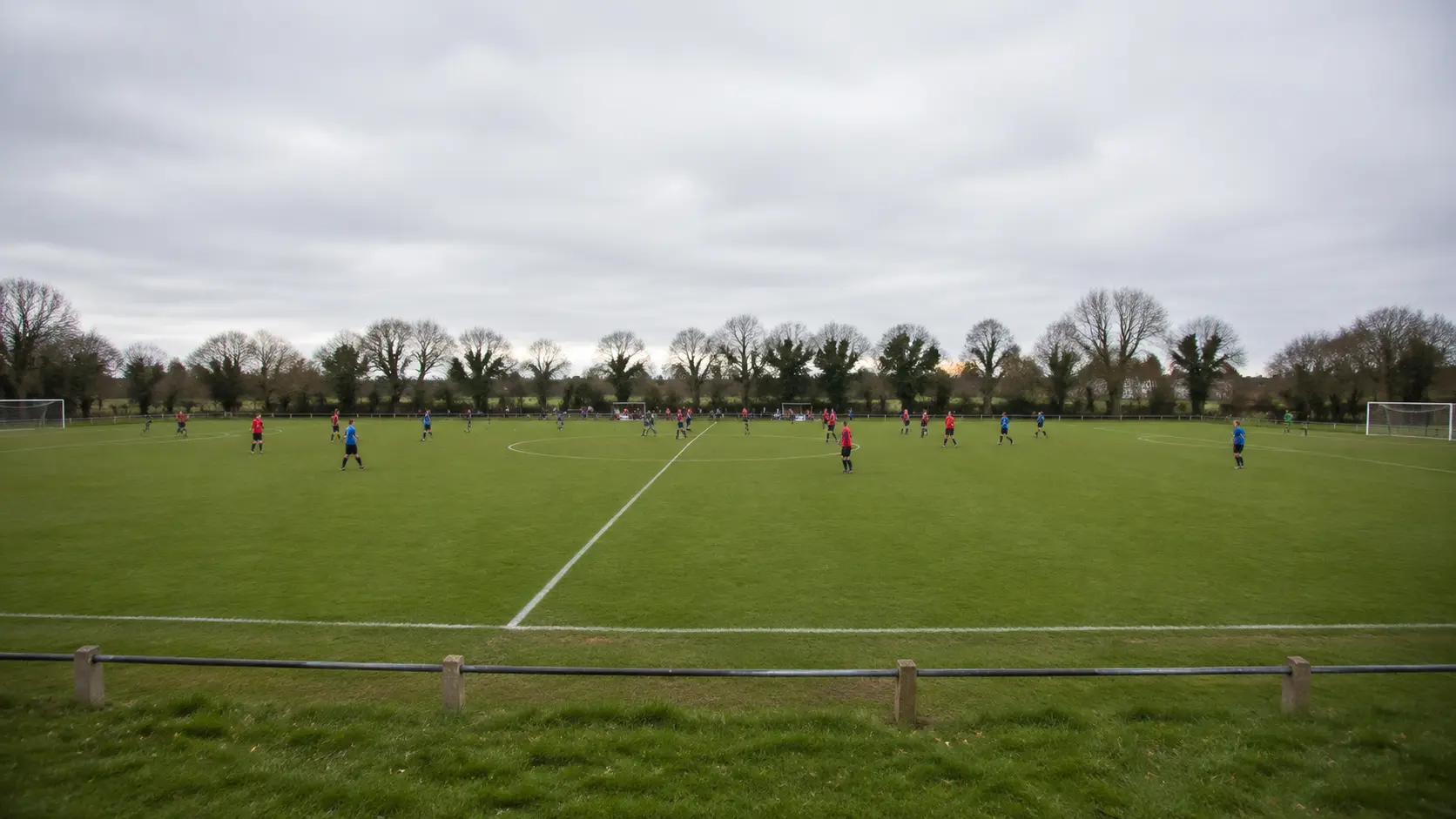
Put real distances on it. Filming from 40 meters with a typical main lens, a horizontal frame spans about 55 meters of scene width. Rotate to vertical and that becomes about 31 meters. On a 40 meter futsal court, the horizontal frame comfortably holds the full length. The vertical one does not.
There is a second cost that follows from the same rotation, and once you notice it you cannot unsee it. At that distance the vertical frame is spanning about 55 meters of scene height. Players are under two meters tall. So roughly 86% of a vertical frame is ceiling and floor, empty space above and below the action, while the action itself is squeezed into a narrow band across the middle.
What Vertical Does Not Do
It is worth correcting a claim that sounds right and is not, because getting this backwards leads to the wrong fix.
Vertical does not make the players smaller. At the same distance, a player is the same height in pixels whether you hold the phone upright or sideways. Rotating the phone moves the sensor's long axis to vertical, so you gain frame height in meters and pixel rows in proportion. A player 40 meters away occupies roughly the same number of pixels either way.
So if someone tells you vertical shrinks your subject, they have merged two different effects. The subject is the same size. What shrank is the width of the world you can see around them.
That distinction matters because it points at the real mechanism, which is the next section, and because a fix aimed at the wrong cause does not work.
Stepping Back Is What Costs You the Player
Here is where the damage actually happens.
You hold the phone upright, look at the screen, and see that half the play is outside the frame. So you do the natural thing and walk backwards until it fits. That step backwards is the mistake, and it is not optional: to cover the same width of play, a vertical frame has to sit about 1.78 times further away than a horizontal one.
Now the player really does shrink, and steeply. Framing a 25 meter slice of play, a horizontal shot from the closer position renders a player at roughly 131 pixels tall, about 12% of the frame height. The vertical shot, from the position it needs to cover the same width, renders that player at about 73 pixels, under 4% of the frame. Same phone, same lens, same moment.
On a court with walls, and on most amateur pitches, there is a harder version of this problem. To frame the full 40 meter length of a futsal court vertically with a standard main lens you would need to stand about 51 meters back, which is outside the building. Horizontally you need about 29 meters. The vertical shot is not worse in that case; it is impossible.
Framed for the Whole Court
A camera installed at the venue is positioned to cover the playing area, not squeezed into whatever angle a person on the sideline can reach. Nobody has to back away from the play to fit it in.
What the Platforms Actually Require
This is where most articles start, and it deserves a section, but it also deserves accuracy. Some widely repeated numbers turn out not to come from the platforms at all.
Instagram accepts horizontal video. Meta's own documentation gives a very wide permitted range and treats 9:16 as recommended rather than required, with cropping or blank space as the stated consequence of using something else. So "Instagram requires vertical" is not accurate. What is accurate is that a horizontal clip in a vertical feed occupies less of the screen.
Facebook Reels through the API is the strict one. There the documented requirement is an aspect ratio between 16:9 and 9:16, with a specific error returned for anything outside it, and a documented minimum resolution.
YouTube pads rather than rejects. A vertical video shown on a desktop layout gets padding at the sides, and YouTube explicitly tells creators not to burn black bars into the file itself, because the player handles the fit.
Two honest gaps. TikTok publishes upload mechanics in its developer documentation but I could not find an aspect ratio requirement in accessible vendor documentation, and the ubiquitous "9:16 required" figures trace to agency blogs rather than TikTok. WhatsApp likewise has no accessible documentation stating a ratio. In both cases the observable behavior is what you can rely on: TikTok's feed is portrait shaped, so wider video appears smaller within it, and WhatsApp is a conversation rather than a feed and does not force portrait at all.
Cropping Later Is Not Free
The obvious compromise is to film horizontal, keeping the full width, and crop to vertical afterwards for whatever needs it. That is usually the right call, but it is worth knowing what it costs.
Cropping a 1080p horizontal clip to a vertical shape keeps about 32% of the pixels and throws away the rest. To fill a vertical slot after that crop, what remains has to be enlarged by roughly 1.78 times, and enlargement does not add detail that was never recorded.
Filming in 4K changes the arithmetic in your favour. The same crop taken from 4K still leaves more pixels than a vertical slot needs, so instead of stretching the image you are reducing it, which costs nothing visible. If you know a clip may end up vertical and your phone can record 4K with enough light, that is the version of this trade worth making.
The one thing to avoid is the reverse: filming vertical and then wishing you had the width. That width was never recorded, and no crop, zoom or edit recovers it.
When Vertical Genuinely Wins
Everything above argues for horizontal on a wide space, so it would be dishonest to leave the impression that vertical is simply wrong. It is not. It is wrong for the wide shot, and right for a specific and common case.

Close in, the geometry inverts. From four to eight meters, a vertical frame covers roughly three to six meters of width and a good deal more height than that. A single player fits that shape well, and so does a movement that uses height: a serve, a jump, a block at the net, a fighting stance, a skill drill. Basketball belongs on that list too, since the shot and the rebound resolve above head height, which is part of why recording a basketball game is its own framing problem.
The usable rule: vertical wins when your subject fits inside about three to six meters of width and uses vertical space. One player, close, doing something tall. The moment the subject is two players and the space between them, you are back to needing width.
Which is why the honest answer to "vertical or horizontal" is not a preference but a question about what you are filming. A whole play involving several people is a wide subject. One player doing one thing is not.
What a Fixed Camera Gives You
It is worth being straightforward about how this works at a venue with cameras installed, including the part that is a limitation.
A camera mounted at a court is installed horizontal, because its job is to cover a wide playing area. A clip from it arrives in that orientation. It does not produce a vertical version, it does not follow the ball, and it does not crop itself around a player. If you want a vertical version for a story, you crop it yourself afterwards, with the same trade described above.
What the installation does settle is the part players get wrong most often. The orientation and the position were chosen once, for that specific court, by whoever mounted it, instead of being re-decided every session by whoever happened to be free and standing wherever they could. It covers the playing area rather than as much of it as someone could fit from the sideline. And because it is already recording, nobody has to walk backwards through a car park trying to fit the pitch into a frame.
Coverage and how many cameras a court actually needs are treated separately in the piece on camera count, and what makes a clip worth sharing at all is covered in what makes a good sports clip.
Stop Choosing Between Width and Distance
At a court with VISU Replay the framing was settled at installation. Press the button after the play and the clip is ready to send, without anyone standing at the far end of the pitch to fit it in.
FAQ: Vertical or Horizontal for Sport
Should I film my game vertical or horizontal?
Horizontal for anything involving more than one player or the space between them, because a pitch is a wide shape and vertical throws away about 44% of the scene width. Vertical for a single player doing something tall and close: a serve, a jump, a skill. The question is not where the clip will be posted, it is how wide the subject is.
Does vertical make the players look smaller?
Not directly, and this is the part most people get backwards. At the same distance a player occupies roughly the same pixel height in both orientations. What shrinks is the width of scene you capture. The player only shrinks when you walk backwards to fit the play into the narrower frame, and that step back is what costs you, roughly halving the player's height in the image.
Can I crop a horizontal video to vertical afterwards without losing quality?
You lose about 68% of the pixels, and from a 1080p source what remains has to be enlarged about 1.78 times to fill a vertical slot, which softens the image. From a 4K source the same crop still leaves more detail than the vertical slot needs, so it costs nothing visible. Filming horizontal and cropping later is the right compromise, and 4K makes it close to free.
Does Instagram require vertical video?
No. Meta's documentation permits a very wide range of aspect ratios and treats vertical as recommended rather than required, with cropping or blank space as the consequence of using something else. Facebook Reels through the API is stricter and does require between 16:9 and 9:16. YouTube pads vertical video on desktop and tells creators not to burn bars into the file.
Why does my vertical clip have so much empty space?
Because the frame is spanning far more scene height than the players occupy. From 40 meters a vertical frame covers roughly the same number of meters vertically as horizontally, and people are under two meters tall, so most of the image is floor and ceiling with the action compressed into a band across the middle.
What orientation do venue cameras record in?
Horizontal, because they are installed to cover a wide playing area. A clip arrives in that orientation, and it does not auto-crop or produce a vertical version. If you want vertical for a story you crop it yourself. What the installation settles is that the framing was chosen once for that court rather than improvised from the sideline each session.