

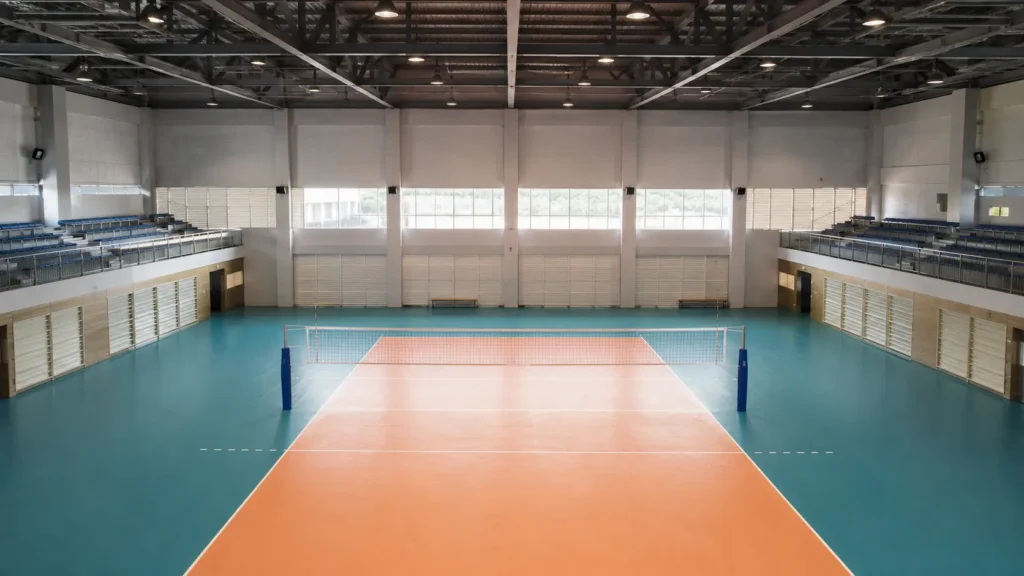
A volleyball recording succeeds or fails on the space above the players. A low camera may show every approach and still lose the ball at the top of a set, while a sideline phone can spend the decisive moment looking through a row of rotating bodies.
The practical goal is not a broadcast. It is a complete view of the rally, from serve to point, without asking a teammate to leave the court. That means choosing height and position before worrying about settings, then deciding whether a phone, a fixed camera, or an installed replay system fits the way your group plays.
The Rally Is Already Recorded
At a court with VISU Replay, fixed cameras record the session. Press the button after the rally and the clip is already there, cut and ready, without anyone leaving the game to film.
Why Volleyball Is Hard to Film From the Sideline
Volleyball puts a net across the middle of the picture and sends the ball well above it. The action does not merely travel from left to right. It expands upward during the set, compresses at the spike, and changes direction at a block or dig. Framing only the players leaves too little room for the flight that connects those actions.
The official FIVB basic rules describe six players on court who rotate clockwise after winning back the serve. For a camera, that rotation matters because the person you want to follow does not stay in a familiar lane. A hitter moves away from the net, a setter starts from a different part of the formation, and another body may occupy the sightline that was clear during warm-up.
The sideline adds another problem. Players, substitutes, officials, benches and people walking through the gym can all cross a low frame. The closer the camera is to that traffic, the larger every obstruction becomes. A useful volleyball angle therefore depends less on proximity than on separation: get above the bodies, keep the net visible, and leave enough space for the ball.
Rallies also end abruptly. Nobody knows in advance which receive will become the point worth saving. If a person starts recording only when the attack looks promising, the serve and first touch are already gone. The reliable unit is the rally itself, not the final spike.
Where to Put the Camera for a Volleyball Game
The strongest general position is elevated behind an end line, centred enough to see both sides of the court. It shows the serve, the defensive shape, the set and the attack in the same frame. It also makes the net a horizontal reference instead of a wall that divides near players from hidden players.
The dimensions explain why height matters. The FIVB Official Volleyball Rules define the playing court as a rectangle measuring 18 by 9 metres. The same rules set the top of the net at 2.43 metres for men and 2.24 metres for women. Those are competition specifications, not a promise about the exact court where you play, but they reveal the geometry: the ball and hands repeatedly occupy space far above a phone placed on the floor.
If the end view is unavailable, use a high lateral position near the plane of the net. This angle reads a block and a spike clearly, but the net post can hide the centre and players on the near side can cover the far side. Move just enough to keep the post from cutting through the main action, then check both back corners before leaving the camera.
A position directly behind the line is better for team shape. A slightly offset position may protect the camera from servers and foot traffic. Safety and venue rules come first: never balance equipment on an unstable rail, block an exit, or put a support where a player can run into it.
Avoid the ground-level corner unless it is the only safe option. It exaggerates the nearest player, makes the far court small, and invites the ball to leave the top of the frame. Raising the camera usually improves the picture more than moving it closer.
Phone on a Tripod: What You Get and What You Lose
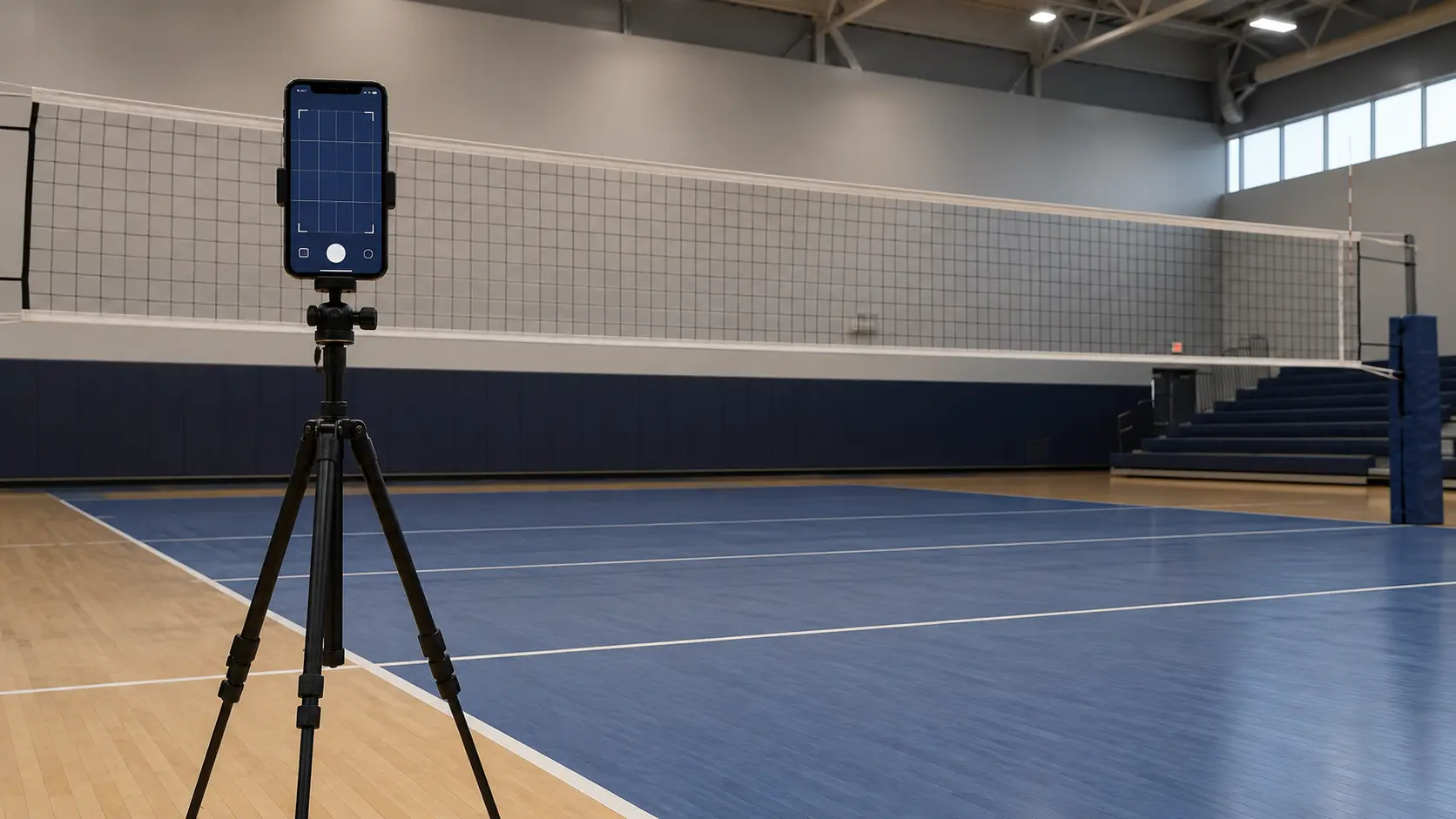
A phone on a tall, stable tripod is the simplest setup you control. It can hold a wide frame for the whole rally, and the screen makes it easy to confirm that the sidelines, net and overhead space are visible. Put it where nobody needs to touch it during play, start before the serve, and make a short trial recording while players move through both halves.
The compromise is attention. Someone must start the recording, confirm that it continues, protect the tripod from traffic and stop the file afterward. Battery, storage, incoming interruptions and heat remain the responsibility of the group. The recording may be technically complete yet still fail because the support moved or the lens was blocked.
Framing wide enough for the full court also makes individual players smaller. A phone cannot follow a hitter and preserve the whole formation at the same time when nobody operates it. Decide whether you want team movement or a tight personal highlight before the match. The broader comparison in tripod versus fixed camera for sport helps separate setup flexibility from unattended coverage.
Find Out If Your Court Has It
VISU Replay only exists where it has been installed, so the useful first question is whether the place where you already play has fixed cameras and a replay button.
Filming in a Gym: Light and Ceiling
A gym may look bright to the eye and still challenge a small camera sensor. Players cross pools of light, the floor reflects fixtures, and a ball can pass close to a bright ceiling before dropping into a darker part of the court. Automatic exposure and focus may react to those changes instead of staying with the rally.
Keep the camera away from a direct fixture in the centre of the frame. Make the trial recording with players moving and the ball travelling high, then watch the saved file rather than trusting the preview. If faces become silhouettes or the ball disappears against the ceiling, change the position before changing every setting.
Indoor lighting deserves its own diagnosis, so use the guide to filming indoor courts and lighting for exposure and flicker. For this volleyball setup, the priority is simpler: preserve the ball against the ceiling, keep the net readable, and avoid a bright lamp dominating the picture.
Fixed Camera and Replay Button: Nobody Leaves the Court
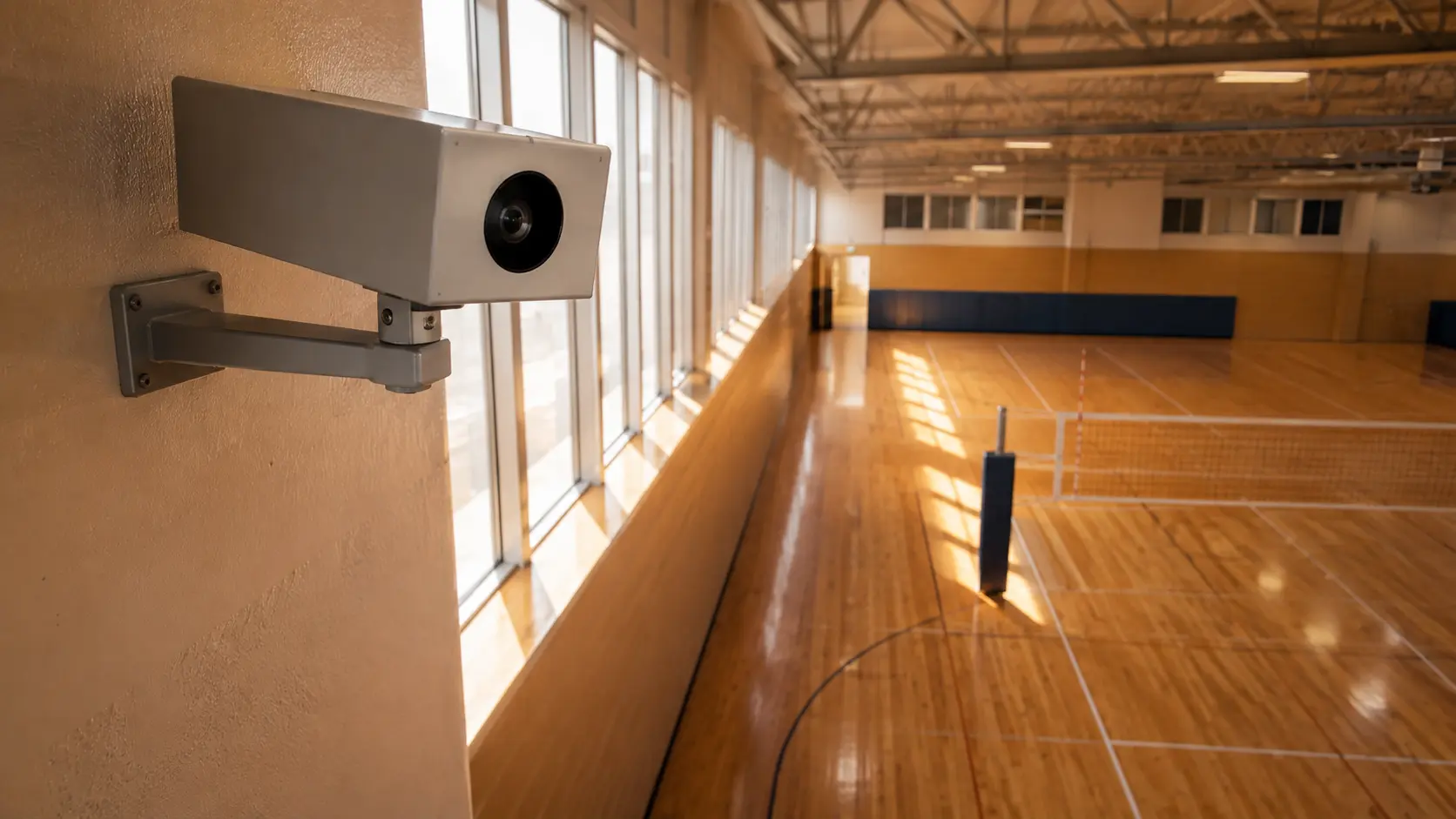
A fixed camera changes the task because the group no longer builds a temporary filming position for every game. At a venue with VISU Replay, the camera records the session from its installed view. After a rally, a player presses the replay button and the system saves a retroactive clip that is already cut.
The order matters. The button does not ask the camera to begin after the point. It saves the action that has just happened, so the player can wait for the rally to finish before deciding. The guide to how the replay button works explains that retroactive window in detail.
This solves the participation problem, not every visual trade-off. A fixed view still needs enough height for the set and enough width for both sides. It cannot turn one angle into a close-up of every player. What it removes is the teammate assigned to film, the repeated tripod setup and the long recording that someone later has to search.
The saved clip carries the court name. That matters when it leaves the player’s phone and enters a group conversation, because the place remains attached to the moment without anyone editing a title into the video.
How Much to Keep: The Whole Rally
Keep from serve to point. That boundary is understood by anyone who played the rally and does not require an editor to guess where the story began. Starting at the final approach may preserve the spike but remove the receive and set that made it possible.
Leave a little context around the action when cutting from a continuous phone recording. The viewer should see the server prepare and should see the point resolve. Do not make every clip the same duration. A clean side-out may be brief, while a rally with repeated digs needs its full sequence.
For Replay, press after the point rather than during the attack. The retroactive capture is designed around action that has already occurred. Waiting until the whistle, the ball landing or the error is clear prevents the button press from becoming part of the play.
Save the whole match only when you have a reason to review the whole match. For sharing, rally-sized clips are easier to identify, name and send without asking friends to search through a long file.
Beach Volleyball: What Changes
Beach volleyball needs a separate setup even when the desired clip is the same. USA Volleyball describes the beach discipline as being played in pairs and on a court shorter and narrower than an indoor court. With fewer bodies, a lower angle can remain readable, but the open environment adds sun, wind, sand and a background with no ceiling to define the ball.
Move farther back so the ball has room to rise without leaving the frame. A slightly lower position can work because there is less bench traffic and fewer players blocking one another, but do not put the camera where sand spray or a chase beyond the line can reach it.
Turn the setup so the sun does not sit directly behind the court if a safe alternative exists. Check the frame again as light changes, secure the support against wind, and protect every opening from sand. These are orientation principles, not a claim that the indoor position transfers unchanged.
Naming and Sharing Your Volleyball Clips
A useful filename should answer what happened without opening the file. Use the match or group name, the rally outcome and a short player reference that the group already understands. Avoid names that depend only on the order in which clips were downloaded.
Share the rally, not the entire recording, when the purpose is a group conversation or a saved highlight. Before posting beyond the team, ask the venue and the visible players what they permit. A gym can have its own camera policy, and consent from the people in the frame is a practical part of responsible sharing.
Keep the original clip if you plan to crop or add a vertical version later. Each new export can remove context or quality, while the original preserves the court view and the sequence around the point.
If Your Court Already Has VISU Replay
Start by separating the roles. The venue owner decides whether the fixed system is installed and how the court presents it. The player’s job is only to finish the rally, press the button, and open the resulting clip. Sharing happens afterward from the clip, not from the camera installation.
VISU Replay only exists where it has been installed. Do not assume that a venue has it because another court does. Ask the place where you already play whether there is a replay camera and where the button is located.
If it is available, learn the button position before the game so nobody searches during the next serve. Press after the rally you want, confirm the clip in the venue flow, and give it a useful name before it disappears into a folder of similar points.
If You Run the Venue
A fixed camera lets every booked group save a volleyball rally without bringing filming equipment, and each clip leaves carrying the name of your court.
FAQ
How do I record a volleyball game by myself?
Use a stable, elevated support behind the end line or high on the sideline, frame both halves plus the space above the net, and start before play. If the venue has an installed replay system, the fixed camera and button remove the need to manage a phone during the game.
Where should I put my phone for a volleyball game?
An elevated position behind the end line is the clearest general view. A high lateral position near the net can show attacks well but is more vulnerable to the post and near-side players blocking the far court.
How high should the camera be?
High enough that players on the near side do not cover the far side and the ball stays visible above the net. Use a safe stand, balcony or fixed mount, never an unstable rail or a support in a player’s run-off area.
Can I record a full volleyball match?
Yes, if the device has the battery and storage for the session and the venue permits recording. Make a trial file, confirm that it saves correctly, and check the recording during natural breaks without assigning someone to hold the phone.
How do I get clips of my spikes?
Record the whole rally, not only the approach. Keep the camera high enough for the set and wide enough for the receive. With a retroactive replay button, press after the point so the build-up and spike remain together.
Do gyms allow cameras?
Policies vary. Ask the gym or venue before setting up, follow any placement rules, and check with visible players before sharing the footage beyond the group. This is practical courtesy, not legal advice.
References
- FIVB Official Volleyball Rules 2025-2028. Official indoor court dimensions and net heights.
- FIVB: Basic Rules. Indoor team rotation and the relationship between the net, the ball and the rally.
- USA Volleyball: Rules of Volleyball. Practical distinctions between indoor and beach volleyball, including team format and court size.