

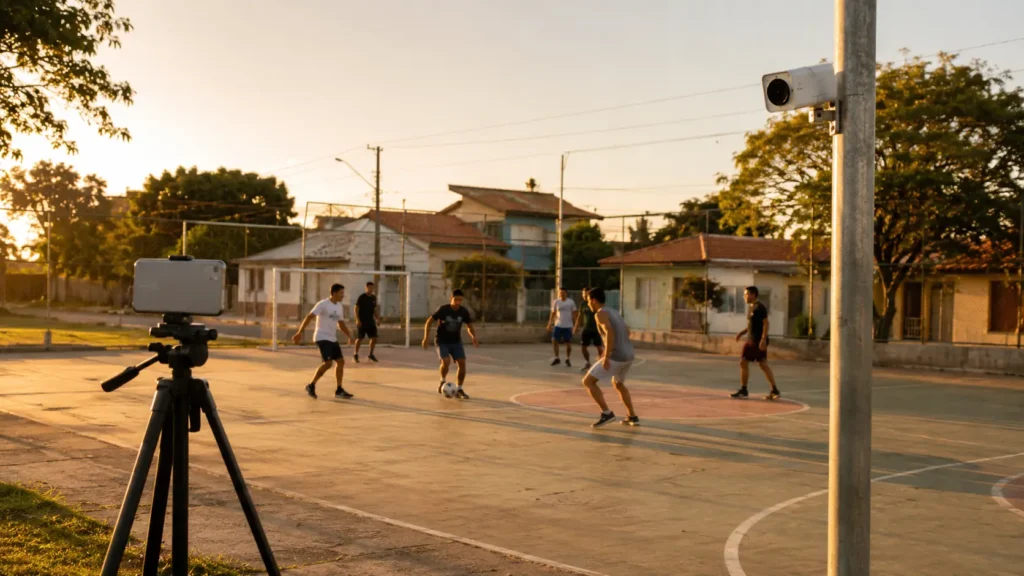
The honest version of this question is not which camera takes a better picture. Both options can produce a perfectly good image of a football pitch. The question is who is holding it, who is watching it, and whether it will still be there next Tuesday. That is what actually separates a tripod from a camera bolted to the wall of a venue, and it is why most people who buy a tripod stop using it after a month. For the wider picture, start with the guide to filming amateur sports.
Short version: a tripod is portable, cheap and yours, and it works anywhere you take it. A fixed camera asks nothing of you at all, but only exists where somebody installed one. Neither of those is a defect. They are different trades.
Nobody Has to Sit Out to Film
At a court with VISU Replay the cameras are already running. You press the button after the play and the clip is there, cut and ready, without anyone giving up their game to operate a camera.
The Question Is Who Is Holding It
On an amateur court, everybody who came is playing. That single fact decides more about your footage than any specification on a box.
A tripod does not operate itself. Somebody has to carry it, place it, aim it at the right part of the pitch, and keep half an eye on it for ninety minutes. If that person is a player, the cost is that they are not playing. If it is a partner or a parent who came to watch, the cost is that they are not watching. There is no version where the camera runs itself and everyone gets their game.
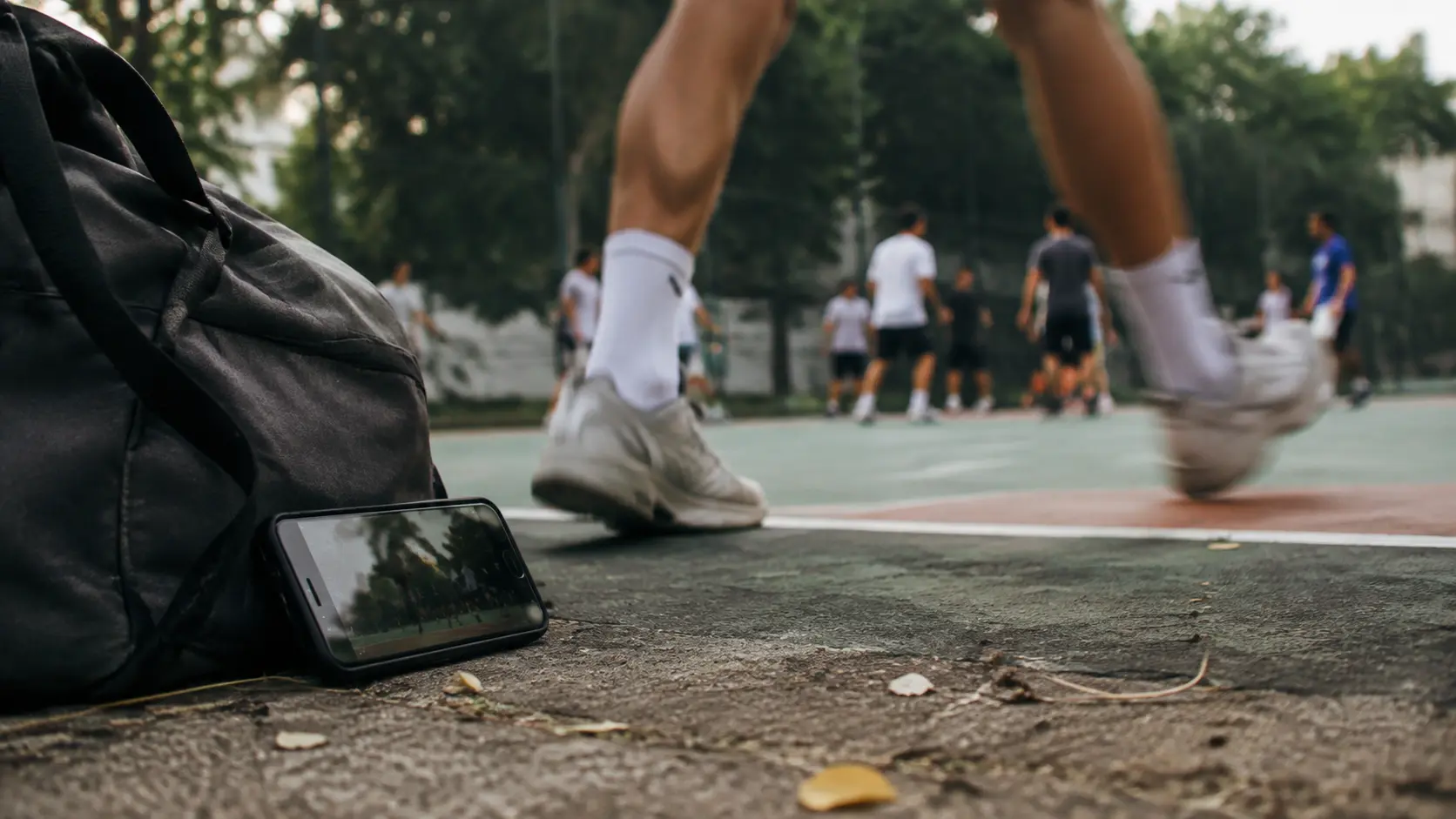
It is worth being blunt about how filming actually looks on a normal night, because a lot of advice written about this describes something nobody does. Nobody is clamping a phone to a fence post or raising it on a mast. Somebody holds it, or it gets propped against a bag on the floor. Real height gain means standing on a step or on the first row of the bleachers.
So when the comparison is framed as tripod versus fixed camera, the practical question underneath is whether the recording depends on a human being showing up and staying attentive. That is the axis everything else sits on.
What a Tripod Actually Does Well
A tripod deserves a fair hearing before any of its limits, because in several situations it is straightforwardly the right tool and no installation can compete.
- The venue has no camera. This is decisive and it covers most amateur venues. A fixed camera that was never installed records nothing at all.
- You move between venues. A tripod is yours and it travels with you. An installation exists at exactly one address.
- You want a specific angle. You pick the corner, the side and the height. A permanent mount has already chosen for you, and it chose for everyone.
- One-off occasions. A final, a tournament, a friendly at a rented pitch. Nobody installs infrastructure for one afternoon.
- You want the whole match. A tripod gives you continuous footage of everything, in your own storage, under your own control.
- Tactical review. A coach often wants the entire session rather than moments, and a wide continuous shot is genuinely the right format for that.
None of that is faint praise. If you play at a different place every week, or you need the full ninety minutes for analysis, a tripod answers a question that a venue camera cannot answer for you.
The Four Things That Stop a Tripod
What ends most self-filming is not image quality. It is four practical constraints that show up in order.
Somebody has to run it
Covered above, and it is the one that matters most. The tripod removes the shaking hand but not the human being. Someone still places it, aims it, and takes it home.
It stands in the path of play
A tripod at floor level, at the edge of a court where people sprint and balls travel, is in the way. It gets knocked. And if its owner is playing, it is unattended for the whole session. This is not a scare tactic, it is simply the reason people stop bothering after a few weeks.
Heat and battery
This is the constraint people discover the hard way, and it is documented by the manufacturer rather than inferred. Apple states that iPhone and iPad devices "are designed for use where the ambient temperature is between 0º and 35º C (32º to 95º F)," and that using a device in very hot conditions "can permanently shorten battery life." Apple names extended camera use in direct sunlight as a trigger, and lists what happens: the display dims or goes black, camera features may be temporarily disabled, and performance drops to lower frame rates.
Thirty-five degrees is below a normal summer afternoon on an uncovered court in much of Brazil. A phone filming a full session in the sun is being operated outside the range its own maker documents.
The file you never edit
A tripod records everything, which sounds like an advantage until the match ends. Then somebody has to move a very large file off the device, scrub through it to find the ten seconds that mattered, cut it and export it. Most people do this once. That is why so much amateur footage exists and so little of it is ever watched.
Framing the Whole Court Costs You the Player
There is a trade here that almost nobody mentions, and it applies to a tripod and a fixed camera alike.
To get the entire playing area into the frame, you either back away or go wider. Both choices make every player smaller in the image. Push far enough and the footage becomes unreadable in a specific way: you can see that a goal happened, but you cannot tell who scored it, and neither can the person you send it to.
Height is what buys you out of this, and it is the honest structural advantage of a permanent mount. A camera above head height, angled down across the play, keeps players separated from each other and from the background. A tripod on the floor tops out at roughly the height of the person who set it up, which is why so much amateur footage has players overlapping into a single mass whenever the action comes toward the camera.
The part that must be said plainly: a badly placed fixed camera suffers exactly the same geometry. Being bolted to a wall is not a magic exemption. What the installation buys is height and permanence, not a different set of optics. Coverage and camera count are their own subject, treated in the piece on how many cameras a venue needs.
Check Whether Your Court Is Already Covered
The cheapest camera is the one already installed where you play. If your venue has VISU Replay, the clip is waiting for you after the game with nothing to set up.
What a Fixed Camera Actually Means
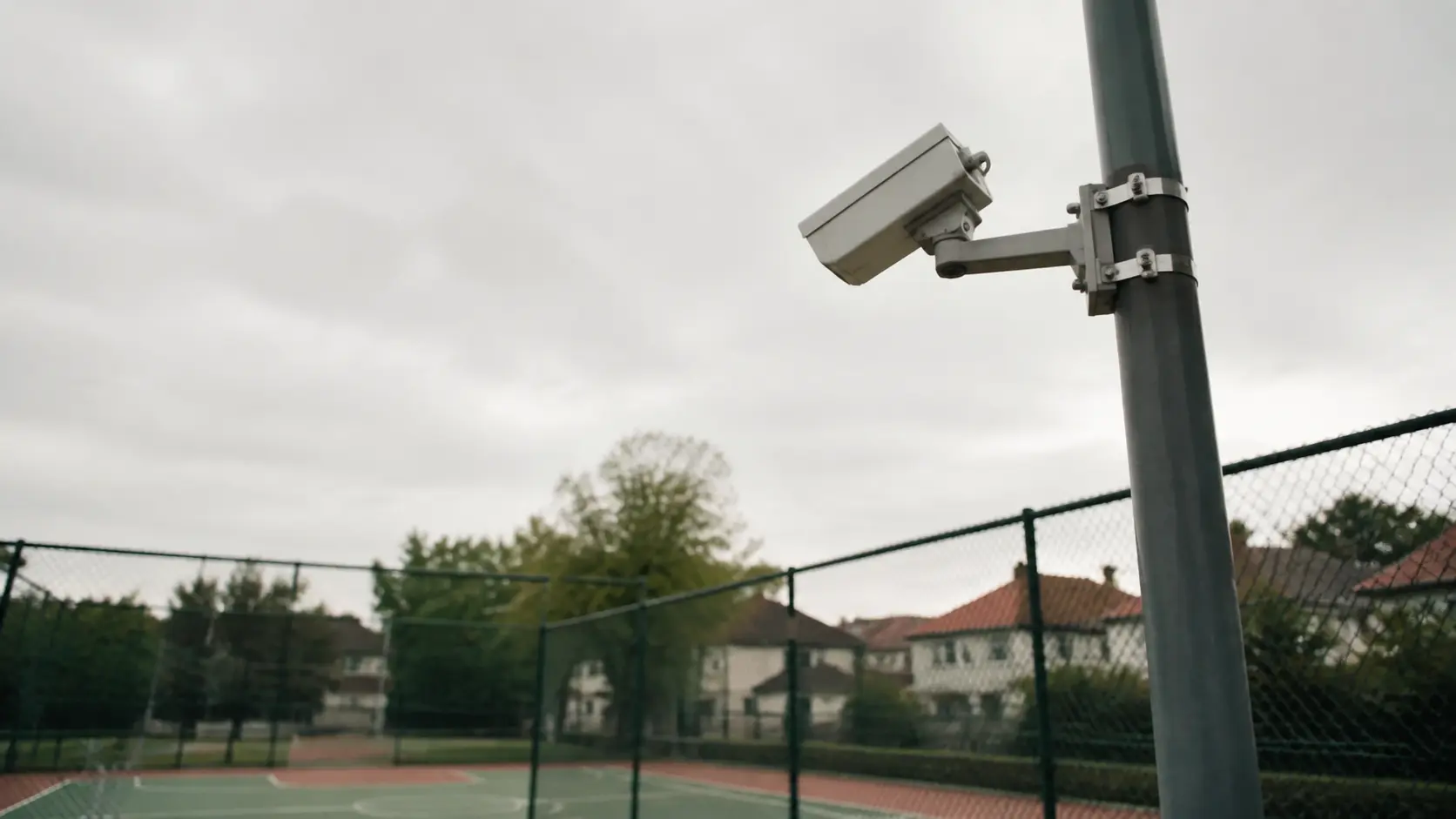
Installed cameras are built for a job a phone was never designed to do, and the specifications make the difference concrete rather than rhetorical.
Weather. Outdoor cameras are rated under the IP code defined in IEC 60529. A typical outdoor unit is IP67, and manufacturers list operating ranges well beyond consumer electronics. Hikvision, for example, specifies operation from minus thirty to plus sixty degrees Celsius for outdoor models, which is a vendor specification rather than an independent measurement, but it stands in obvious contrast to the zero to thirty-five degrees Apple documents for a phone.
One nuance worth knowing, since most articles get it wrong: the water ratings are not cumulative above IPX6. A device certified for immersion is not automatically certified against pressurised jets, and the standard tests are conducted with fresh water. So an IP rating is a description of specific tests passed, not a general promise of invulnerability.
Continuous recording. A purpose-built camera encodes at a few megabits per second precisely because it is expected to run all day. A phone uses a much higher bitrate because it is designed for short clips. That is a difference in design intent, not a verdict on quality, and it is why a session that would fill a phone barely registers on a recorder.
Height and placement. Mounted above head height, clear of the play, angled down across the area. The specific height depends on the building, and anyone quoting a single universal number for amateur venues is guessing.
Recording Everything vs Clipping Afterwards
This is the difference that changes what you actually end up with, and it is a difference in workflow rather than in hardware.
A tripod inverts the effort onto the end. You capture everything, then you do the work: transfer, scrub, cut, export, send. The clip exists only if you sit down afterwards and make it.
Retroactive clipping puts the work before the clip exists. The camera runs continuously, you press a button after the play, and the segment is saved instead of discarded. Nothing is left to do afterwards.
This pattern is not unique to any one product. GoPro ships it on action cameras as HindSight, which the company describes as recording continuously but only saving the last fifteen or thirty seconds when the button is pressed. GoPro is also candid about the cost: "the camera is recording the entire time, significantly impacting battery life." That cost is exactly why the approach suits a mains-powered installation and struggles on a battery device you carry.
At a venue running Replay, that is the arrangement. Cameras record continuously, you press the button after the play, and the clip arrives already cut. On the web you see a ten second preview and the clip itself runs about twenty-eight seconds. Sharing is free with no gate; downloading and watching the full video happen in the app.
So Which One Should You Use?
There is no single verdict, because the two options fail in different places. The decision is close to mechanical once you know your own situation.
Use a tripod when the venue has no cameras, you play at a different place each week, you need the full match for analysis, you want to control the angle yourself, or it is a one-off occasion worth the setup.
A fixed camera wins when everyone who turned up is playing, you play at the same venue regularly, you want moments rather than footage, nobody is going to edit anything, or the court is outdoors and exposed.
For most people who play the same weekly game at the same place, the tripod loses not because it takes a worse picture but because of a quiet cost that repeats every session: somebody has to bring it, place it, watch it and edit afterwards. Do that arithmetic across a year and the setup ritual is the expensive part.
There is also a version of this decision that is not either or. Plenty of people own a tripod for the occasional final or the away tournament, and rely on the venue camera for the weekly game. The tripod is a tool you deploy deliberately when the occasion is worth the effort. The problem only appears when a tripod is expected to cover a routine that repeats fifty times a year, because that is where the friction accumulates and where the footage quietly stops getting made.
The most useful question is therefore not which one is better in the abstract. It is how often you play, at how many different places, and whether anyone in your group is genuinely willing to sit out and film. Answer those three honestly and the choice usually makes itself.
Let the Court Do the Filming
If the place you play already has VISU Replay, there is nothing to carry and nothing to edit. Press the button after the play and the clip is ready to send.
FAQ: Tripod or Fixed Camera
Can I just prop my phone on my bag?
Yes, and it is the most common real setup, so it is worth knowing what it costs. You get floor height, which is the worst angle available, and the phone sits in the path of play where it can be knocked. It also cannot be adjusted once the game starts without somebody leaving the pitch. It works, but it produces the flattest and least readable footage of any option.
Does my phone overheat if I record a whole match?
It can, and this is documented by Apple rather than folklore. Apple specifies an operating range of zero to thirty-five degrees Celsius and names extended camera use in direct sunlight as a trigger for the device changing its behavior, including dimming the display, temporarily disabling camera features and reducing frame rates. On a hot uncovered court you are outside the documented range before you start.
How much space does a full session take?
More than people expect, because phones record at a high bitrate by design. An hour of high-resolution phone video runs to many gigabytes, while a purpose-built camera encoding at a few megabits per second covers the same hour in a fraction of the space. If you plan to film a full match on a phone, check your free storage before you leave, not at half time.
Is 1080p or 4K better for filming a court?
Higher resolution genuinely helps here, because the players are far away and detail is what you are short of. It is not free, though: more resolution means more storage and more heat, which are the two things most likely to end the recording early. If you have to choose, prioritise getting closer and higher over adding pixels.
Is a tripod worth buying?
For some people, plainly yes. If your venue has no cameras, if you play somewhere different each week, or if you need full matches for coaching, a tripod solves a problem nothing else solves. It is a poor investment mainly for the person who plays the same weekly game at the same venue, because there the setup ritual repeats forever and the footage usually goes unedited.
Do I have to edit the video afterwards?
With a tripod, yes. You end up with one long file and the clip only exists if you sit down and cut it. Retroactive clipping reverses that: the camera records continuously, pressing a button saves the seconds that already happened, and there is nothing left to do afterwards.