

Two players make the same play on the same court. One clip gets watched to the end and shared into three group chats. The other gets scrolled past in under two seconds. The play was identical. What changed is everything around it: where the clip starts, how long it runs, what is visible in the frame, and whether anyone can tell which player is you. This is the part nobody explains, and it has almost nothing to do with camera quality. For the full picture, start with the guide to filming amateur sports.
The short version: a good sports clip is not the one with the best action. It is the one that is instantly readable. If a viewer has to work out what they are looking at, they are already gone.
Your Best Play, Already Clipped
The hardest part of a good clip is catching it at all. Courts with VISU Replay record continuously, so you press a button after the play happens and the clip is already there, framed and cut. Nothing to set up, nobody standing on the sideline filming.
The First Five Seconds Decide Everything
There is now hard data on this, and it is not from a marketing blog. Researchers studying engagement across a large dataset of real short videos found that the useful measure of a clip is not views or likes but the engagement continuation rate: the proportion of viewers who watch for at least five seconds.
They chose five seconds for a reason. Viewers move through uninteresting content extremely fast and stay only on what holds them, so the drop-off at the start is where clips are actually decided. The same research notes plainly that the content of the first several seconds determines whether people keep watching at all.
Apply that to a match clip and the consequence is immediate. If your clip opens with eight seconds of players walking into position, nobody reaches the play. It does not matter that the goal at second eleven was excellent. The audience left at second three.
This is why the instinct to give a clip context almost always backfires. Context feels generous to the person who was there. To everyone else it is a delay.
Readable Beats Impressive
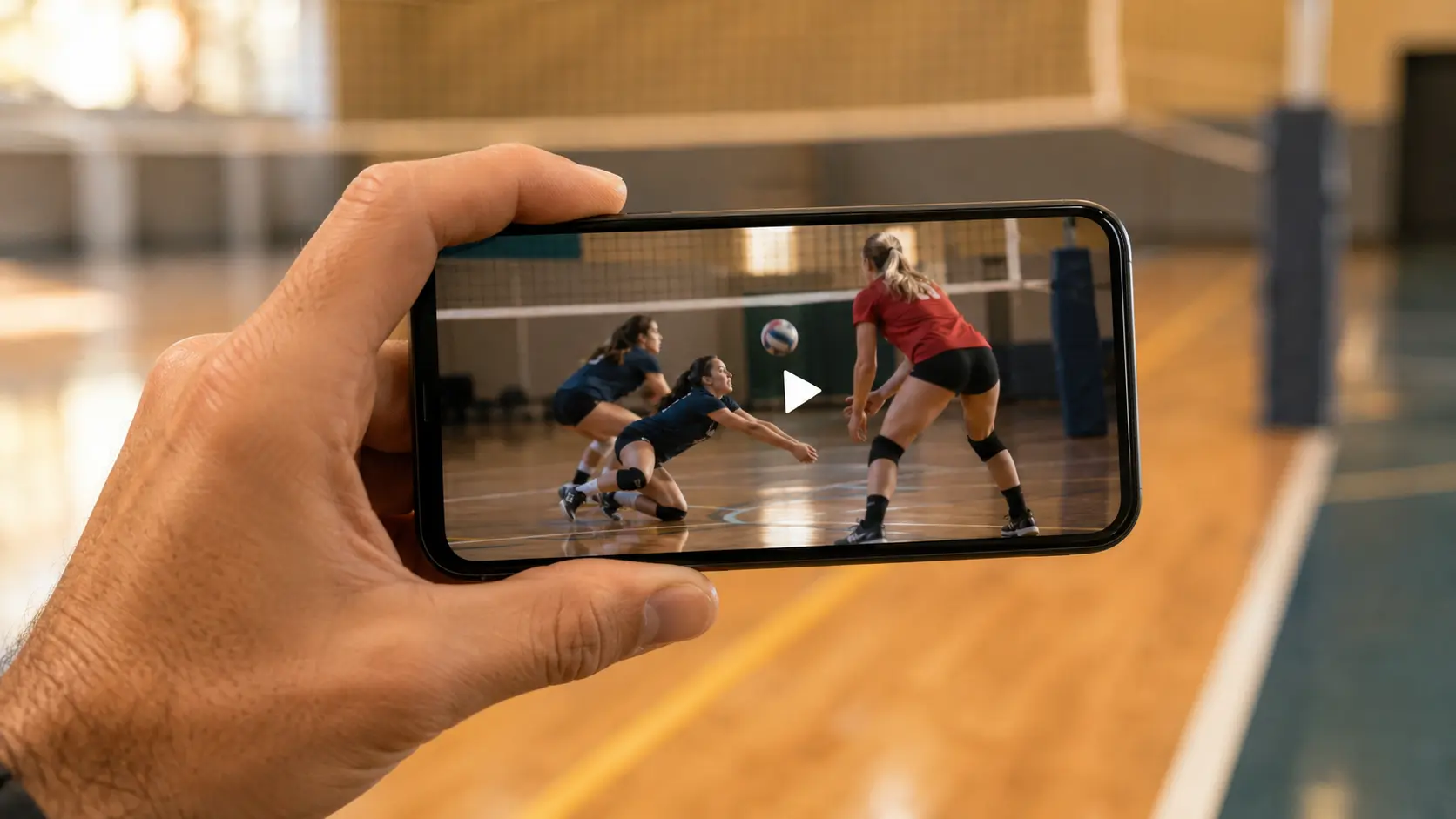
The most common mistake in amateur sports video is filming so wide that the play becomes unreadable. From far enough away every player is a coloured dot, and a viewer cannot tell who did what. The play might have been brilliant. It does not read.
The test is simple. Send the clip to somebody who was not at the game and say nothing. If they have to ask which player you are, the clip has failed, no matter how good the moment was.
Three things make a clip readable:
- Scale. Players should be large enough that body shape and shirt colour are obvious. Not portrait-tight, but not satellite view either.
- The ball stays in frame. A clip where the ball leaves the shot and comes back is confusing even when the action is good.
- The outcome is visible. A shot without its result is an unfinished sentence. The net, the block, the point landing — the ending has to be in the clip.
Angle carries most of this weight, which is why it gets its own treatment in the piece on camera angles. The short version is that height and position do more for readability than any camera setting.
Where to Start and Where to Stop
The two errors are symmetrical. Starting too early wastes the only attention you are guaranteed. Starting too late is worse: the viewer arrives mid-action with no idea what is happening, and confusion reads as boredom.
The ending gets less thought and costs more than people expect. A clip that runs on for six seconds after the point is over teaches the viewer that your clips are slow, and that lesson carries to the next one you send.
Duration follows from this rather than being chosen up front. You are not aiming for a number, you are cutting from just before to just after. If that lands at nine seconds, the clip is nine seconds.
For pickleball, the useful unit may be the whole rally rather than a single shot. Our guide to saving pickleball highlights explains how to keep the setup, recovery and finish visible without cutting away the sequence that makes the point understandable.
The Cut Is Already Made
Getting the start and stop right by hand means filming the whole match and editing afterwards. A VISU Replay court works backwards: the camera is always recording, you press the button after the play, and the clip arrives already cut around the moment.
The Six-Point Check
Before you send a clip anywhere, run through this. It takes about ten seconds and it is the difference between a clip that travels and one that dies in a group chat.
- Can a stranger tell which player is you? If not, nothing else matters.
- Does something happen in the first two seconds? Movement, not preamble.
- Is the outcome in the frame? The result, not just the attempt.
- Would you watch it twice? If you would not, nobody else will.
- Is it under twenty seconds? Longer needs a genuine reason.
- Does it work with the sound off? Most people watch muted.
That last one surprises people. A clip that depends on someone shouting to make sense is a clip most viewers will never understand, because they are watching in silence on a train.
Worth being honest about what this check is for. It is aimed at clips you send to other people. A clip you keep because it means something to you does not need to pass anything.
What Kills a Clip That Had Everything
After that, in rough order of how often they ruin otherwise good footage:
- Vertical video shot horizontally, or the reverse. Filming in the wrong orientation for where the clip is going leaves it letterboxed and small.
- Camera movement during the play. Panning to follow the action makes the clip harder to read, not easier. A fixed frame that loses the ball briefly beats a moving frame that keeps it.
- Filming a screen. Recording the replay off a television or another phone loses a generation of quality and every viewer notices.
- The wrong moment. Sometimes the best clip from a match is not the goal. The save, the reaction, the celebration — these often travel further than the score itself.
None of this needs better equipment. It is entirely about what you keep and what you cut.
If you want to combine several selected plays into one video, the guide to how to make a highlight reel covers choosing an audience, arranging the sequence, checking sound and exporting the finished file.

The wider habit matters too. Short video is now where most people watch anything: Ofcom found UK viewers spend around 39 minutes a day on YouTube alone, with younger audiences going there first. Your clip is not competing with other clips from your match. It is competing with everything else in the feed, and it is being judged by the same reflex.
Play, Press, Share
Every rule here is easier when you are not the one filming. VISU Replay courts record continuously and cut the clip around the moment you press for, so you get a readable, correctly-timed clip without anyone missing the game to hold a phone.
FAQ: What Makes a Good Sports Clip
How long should a sports clip be?
Usually between eight and twenty seconds. Rather than aiming for a duration, cut from about two seconds before the action to about one second after the outcome is clear, and let the length follow. Anything longer needs a real reason, because viewers decide within the first few seconds whether to keep watching.
Why do my clips get ignored even when the play was good?
Almost always because the clip is not readable or does not start fast enough. If a viewer cannot tell which player you are, or the first seconds are players walking into position, the quality of the play never gets a chance. Send a clip to someone who was not there and say nothing; if they have to ask what happened, that is the problem.
Does clip quality matter more than the camera?
Framing and timing matter far more than resolution. A well-framed clip from an ordinary phone outperforms a sharp clip filmed from too far away, because scale and readability decide whether the play is understandable. Camera specifications only become relevant once the framing is already right.
Should sports clips be vertical or horizontal?
It depends on where the clip is going. Vertical suits stories and short-video feeds, horizontal suits group chats viewed on a phone held sideways and anything watched on a larger screen. The mistake that costs most is filming in one orientation and posting in the other, which leaves the clip small and letterboxed.
Is it better to film the whole game or just the moments?
Filming everything guarantees you catch the play but leaves you editing afterwards, and most people never do. Filming selectively means you miss the unexpected moments, which are often the best ones. Continuous recording with a button that clips retroactively avoids both problems, which is why fixed court cameras work differently from a phone on a tripod.
What makes a clip worth sharing rather than just keeping?
A shareable clip is readable by someone who was not there. A clip worth keeping only has to mean something to you. Those are different standards, and confusing them is why group chats fill with clips nobody responds to. Apply the stricter test only to what you send.