

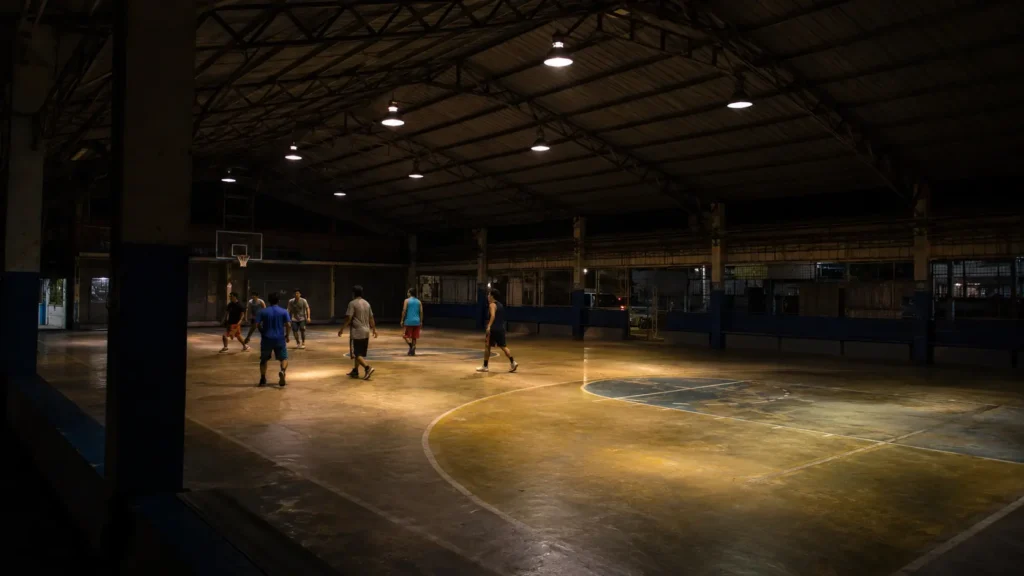
The same phone that produces a clean, sharp clip on a Sunday morning pitch produces a dim, smeared, oddly yellow one on a covered court on Tuesday night. Nothing about the phone changed. What changed is that you walked into a building where the lighting was installed so players can see the ball, and nobody in that decision was thinking about a camera. That single fact explains almost everything that goes wrong indoors. For the wider picture, start with the guide to filming amateur sports.
The short version: a covered court is not simply darker. It is unevenly lit, lit in more than one color, and lit from angles chosen for the floor rather than for the people standing on it. Those are different problems and they have different answers.
The Camera That Already Knows the Room
A camera installed at the court was positioned once, for that court, with its lighting. It does not get re-aimed every session by whoever is free, and nobody has to stand off the pitch holding it.
The Lights Were Installed for Players, Not Cameras
This is the sentence to keep in your head for the rest of the article, because every specific problem below is a consequence of it.
When somebody specified the lighting for a covered court, the brief was that players should be able to follow a fast ball, see a team mate on the far side, and not be dazzled while looking up. That is a legitimate brief and it was met. A camera has entirely different needs: it wants an even amount of light, arriving from a consistent direction, in one consistent color, with no bright source inside the frame. Nothing in the original brief was about any of that.
So the honest framing is not that your venue has bad lighting. It is that the lighting is good at its job and your camera has a different job. Once you see it that way, the fixes stop being about camera settings and start being about where you stand, which is the only variable you actually control.
The general physics of why phones struggle with sport, the shutter and frame rate trade, the flicker mechanism and rolling shutter, all of that is treated separately in why your phone films sports badly. This piece is about the building.
Where the Light Actually Falls
Two properties of a mounted lamp decide what your footage looks like, and neither is about how powerful it is.
The first is distance. Illuminance falls off with the square of the distance from the source, so a player directly under a lamp is lit dramatically more than a player two thirds of the way toward the next one. This is why one half of a court so often films noticeably worse than the other half: not because that end is broken, but because of where the fixtures happen to sit.
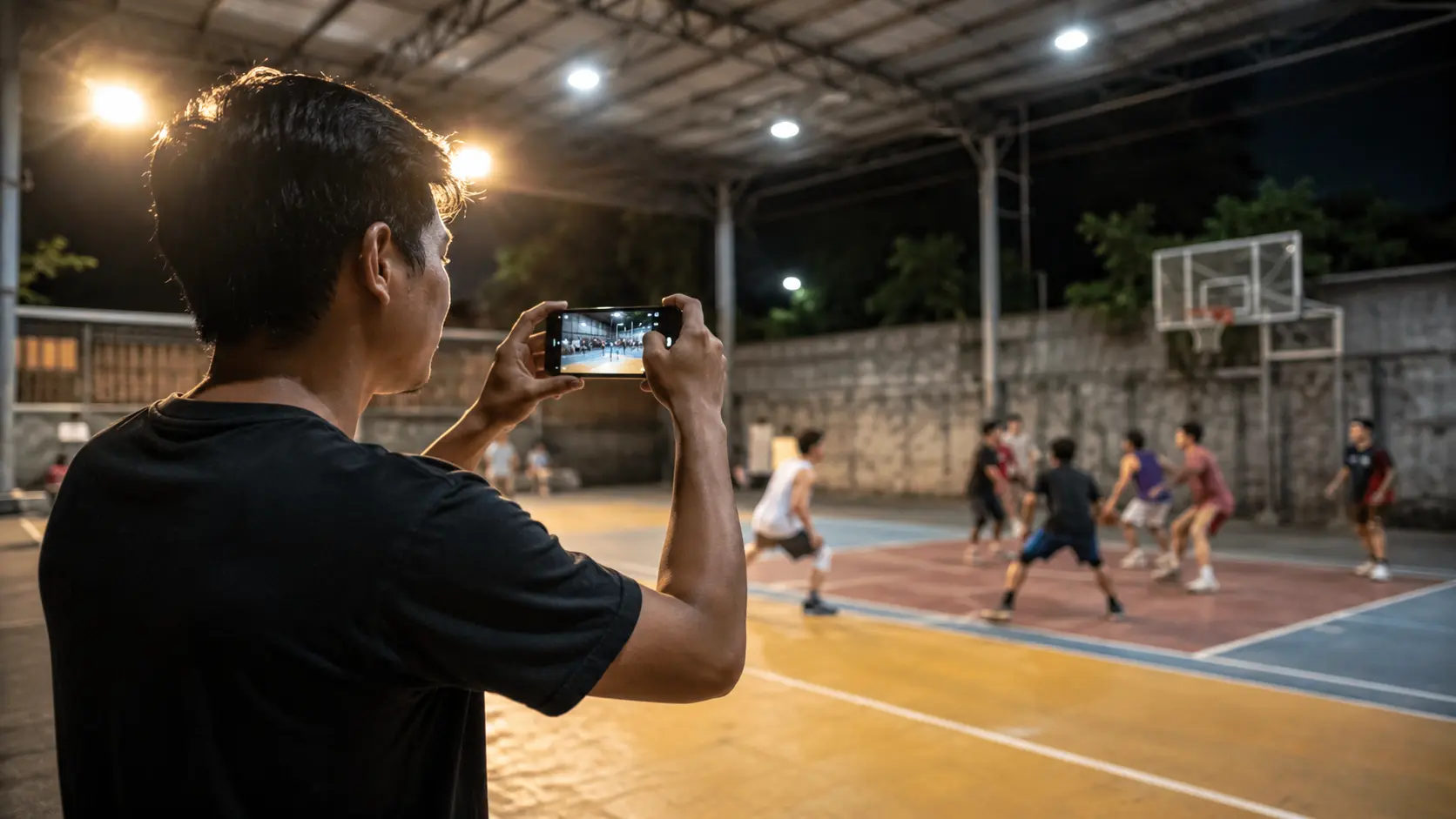
The second is angle, and it matters more than people expect. Illuminance on a surface depends on the cosine of the angle between the light and that surface. Court lighting is aimed at the floor, because that is the plane the game is played on. A standing player is not a floor. They are a vertical surface, lit at a glancing angle by fixtures pointed past them at the ground.
That is why indoor footage so often looks like brightly lit flooring with dim people moving across it. The floor is receiving the light square on. The players are catching it edge on, and the tops of their heads and shoulders take far more of it than their faces or their shirt numbers.
Mixed and Ageing Lamps Do Not Share a Color
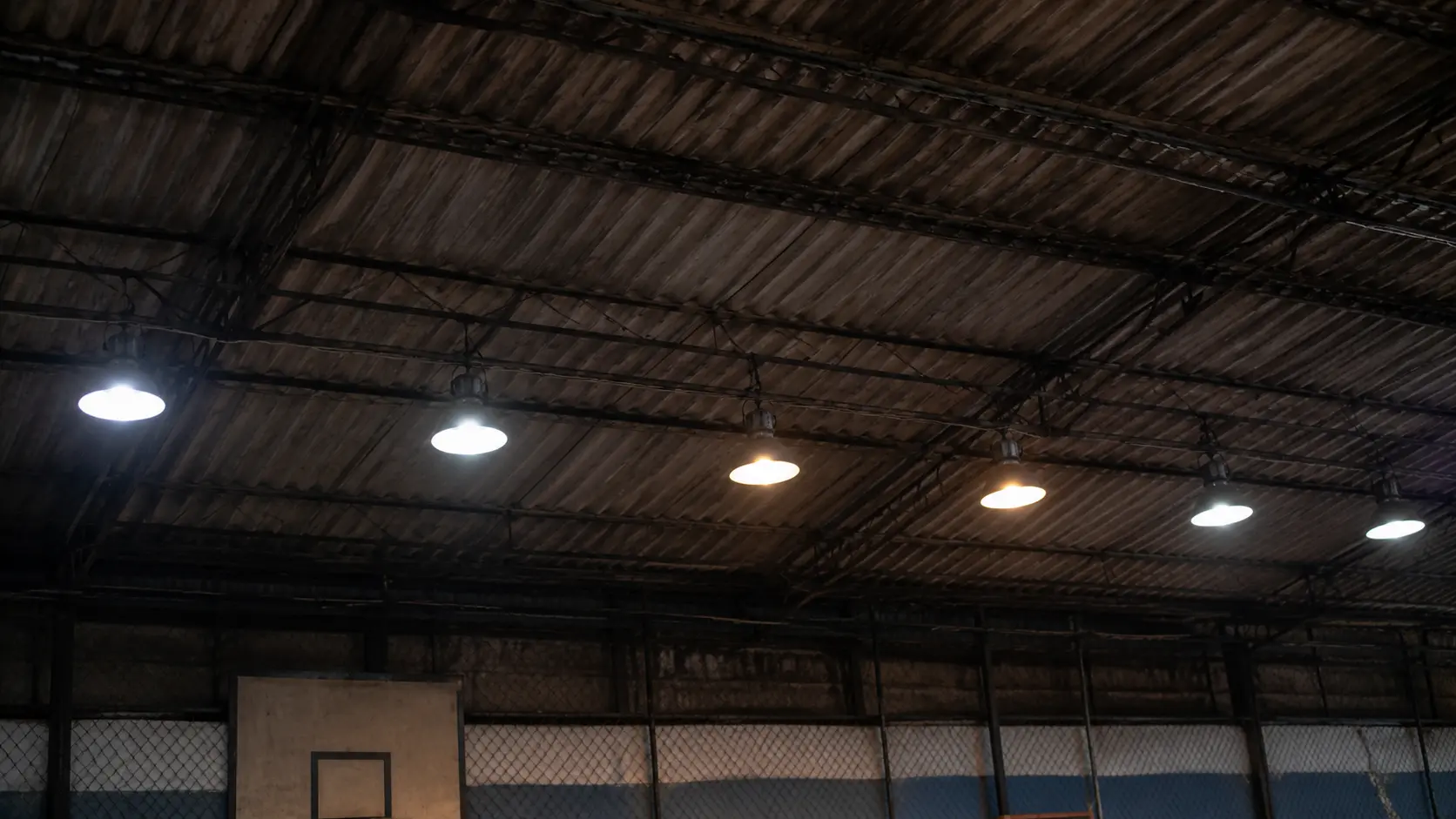
Walk into most covered courts and look up. If the fixtures have been replaced one at a time as they failed, which is how nearly every venue maintains lighting, you are standing under lamps of different ages and often different models.
For metal halide, which is still extremely common in older sports buildings, color temperature "can vary slightly from lamp to lamp, and this effect is noticeable in places where many lamps are used." It also shifts over the life of the lamp, with a major color shift toward end of life. And it changes while warming up: for several minutes after switching on, a metal halide lamp passes through different colors before settling.
Two practical consequences that nobody warns you about. The first is that a court lit by lamps of different ages does not have one color, so no single white balance setting is correct across the whole space. The second is that the first booking of the evening does not look like the third: if you film right after the lights come on, you are filming during the warm-up shift.
There is also a quality of light that matters for sport specifically and almost never gets asked about. The color rendering index, the CRI number a supplier quotes, is an average of eight reference colors, and the deep red sample and the skin-tone samples sit outside that average. As one reference notes plainly, many manufacturers do not publish the deep red score at all, even though it is a vital value for film and video lighting. So a lamp can advertise a respectable CRI and still render a red shirt and a human face poorly, which happens to be most of what a sports clip contains.
The Doorway Problem
Here is the most useful thing in this article, and it is not about how dark the court is. It is about the difference between the brightest and darkest thing inside your frame.
A camera has a limited range between the brightest and the darkest area it can record at once. Point it at a scene containing both a dim court and an open doorway to a bright outside, and it has to choose. It will almost always expose for the bright part, because that is what the metering sees, and your players become shapes.
The scale of this is larger than intuition suggests. In lighting terms, a back light roughly sixteen times more intense than the key light produces a silhouette. On a covered court, the open end of the shed, a doorway, or a row of windows behind the play is exactly that back light. You do not need to be filming into the sun to lose your subject. You only need the opening to be considerably brighter than the court.
Reflective surfaces make it worse in a way specific to certain sports. Glare reduces contrast not only when a light source is in view but also through reflection on the surface of a transparent medium such as glass, which describes a padel court's back wall precisely, and a freshly varnished indoor floor nearly as well. That means a lamp does not have to be in your frame to wash out your footage. Its reflection is enough.
One Position, Chosen Once
A fixed camera at the venue was placed with that court's lighting in mind and then left alone. It does not get re-aimed by whoever is free that night, and it is already running when the play happens.
A Covered Court at Night Is Not a Sports Hall
Both get called "indoor" and they behave differently enough that advice for one misleads for the other.
An enclosed sports hall is a controlled box. The light inside it comes from fixtures you can see, it does not change through the session, and whatever its faults are, they are consistent from the first minute to the last.
A covered court with open sides is a different animal. During the day it is often the harder of the two to film, which surprises people: the roof shades the playing area while the open sides frame a bright outdoors, so the contrast inside your frame is enormous even though the court itself is comfortable to play on. At night the same court becomes uniformly dark, which is technically worse light but far more predictable, and predictable is what a camera wants.
If you have a choice about when to film at an open-sided court, the counterintuitive answer is often the evening, not the afternoon.
What You Can Do Standing There
None of these cost anything, and they are ordered by how much difference they make.
- Put the lights behind you. Film with the fixtures at your back so they light the play rather than your lens. This single choice outperforms every setting on the phone.
- Do not pan across a doorway or window. Crossing a bright opening forces the exposure to jump mid play, and it will not recover before the moment is over.
- Pick the better lit half. Courts are rarely lit evenly. Stand where the light is and let the play come to you rather than following it into the dark end.
- Keep lamps and their reflections out of frame. Including the reflection in glass or a polished floor, which counts as a bright source even though the lamp itself is behind you.
- Lock exposure and white balance before the play starts. Locking exposure alone still leaves the color drifting as you pan across mixed lighting. Lock both.
- Do not change position mid play. Walking while recording asks the camera to re-decide exposure, focus and color at the worst possible moment.
- Brace the phone. Two hands, elbows to your ribs, or resting against a wall or a bag on a bench.
- Wipe the lens. Trivial, and more often the culprit than anyone admits.
Now the honest part. Every item on that list is about position, because position is the only variable a player controls. The color of the lamps, how evenly they are spread, whether they flicker, whether the open side faces west into the afternoon sun: all of that is a property of the building. You are working around it, not fixing it.
Which raises the obvious question, if you happen to own the building.
What the Venue Can Change
These are the questions worth asking a supplier, rather than a specification to hand over. The right answer depends on the building, and anyone who quotes you a single universal number for an amateur venue is guessing.
Ask about uniformity before power. A court lit evenly at a modest level films better than one with bright pools and dark corners at a higher average, because the camera exposes for the whole frame rather than for the average.
Ask for the deep red figure, not only the CRI. This is the cheapest high-impact question on the list. The headline CRI average excludes deep red and skin tones, which is most of what a sports clip contains, and many suppliers do not publish it unless asked.
Ask about the driver, not the word "LED". How steady a light is over time depends on the driver or ballast technology and on whether it dims by pulsing, and those behaviors also change as equipment ages. Switching to LED does not by itself guarantee anything about temporal behavior: the driver decides it.
Aim and shield so fixtures stay out of the playing sightline. A lamp that is not in the frame cannot blow out the frame, and the same shielding usually improves things for players looking up.
Replace in batches with matched models. One-at-a-time replacement is what produces a ceiling with two color temperatures. Doing a run at once costs more on the day and removes a permanent problem.
Treat warm-up time as an operational decision. If the lamps take several minutes to settle, switching on before the first booking rather than as it starts changes what every clip from that hour looks like.
There is a European standard that classifies sports lighting installations by level of competition, but it sits behind a paywall and every lux figure circulating online for it comes from vendor pages rather than the standard itself, so treat any specific number you are quoted as a sales claim until you have seen the source. Cost and coverage questions are handled separately in what replay cameras cost and how many cameras a venue needs.
One thing worth stating plainly, because the opposite is easy to imply and would be false: a fixed camera is not immune to bad light. It is the same building and the same kind of sensor, and it faces flicker, mixed color and contrast exactly as a phone does. What it does solve is narrower and more durable. Its position was chosen once, with that court's lighting in mind, instead of being re-picked every session by whoever was free. It sits above head height rather than at floor level. And it is already recording, so nobody has to stand in the dark half of the court holding a phone instead of playing.
Let the Court Handle the Hard Part
Bad lighting is a property of the building. A camera fixed in the right spot does not fix the lights, it stops making the problem worse. Press the button after the play and the clip is already cut.
FAQ: Filming on a Covered Court
Why does my indoor footage look yellow or green?
Because the court is probably lit by lamps of different ages, and often different models, installed as older ones failed. Color temperature varies from lamp to lamp and shifts across a lamp's life, so there is no single correct white balance for the whole space. Your eye adapts and hides this from you completely. The camera has to pick one setting and live with it.
Is it better to film during the day or at night on a covered court?
On an open-sided covered court, often at night, which surprises people. During the day the roof shades the court while the open sides frame a bright outdoors, so the contrast inside the frame is extreme and the camera cannot expose for both. At night the court is darker but uniform, and a camera copes better with consistently dim than with half bright and half dark.
Will switching the venue to LED fix filming?
Not by itself. How steady a light is depends on the driver or ballast technology and on whether it dims by pulsing, not on the word LED, and those characteristics also change as equipment ages. An LED installation with a poor driver can behave worse on camera than well maintained older fixtures. The question to ask a supplier is about the driver, not the lamp type.
Why does one end of the court always film worse?
Illuminance falls off with the square of the distance from a light source, so a player under a fixture receives dramatically more light than one between fixtures. Add that lamps are aimed at the floor rather than at standing people, and the far half of a court routinely lands well below what the near half gets. It is geometry, not a fault.
What single change helps most if I cannot buy anything?
Stand so the lights are behind you rather than in front. Filming toward a lit area with the fixtures at your back lights the play instead of your lens, and it costs nothing. Second to that: never pan across an open doorway during a play, because the exposure will jump and will not recover in time.
Do fixed cameras at the venue avoid these problems?
Not the lighting itself. A fixed camera is in the same building with the same kind of sensor, so mixed color, contrast and flicker affect it too. What it does avoid is the part that changes every session: its position was chosen once for that specific court, it sits above head height, and it is already recording, so nobody has to stand in the worst lit corner holding a phone instead of playing.
References
- Color rendering index: what the average includes and excludes
- Metal halide lamp: color variation between lamps, warm-up and end of life
- Flicker: dependence on driver and ballast technology
- Backlighting: the intensity ratio that produces a silhouette
- Glare: contrast loss including reflection on transparent surfaces
- Illuminance: distance and angle of incidence