

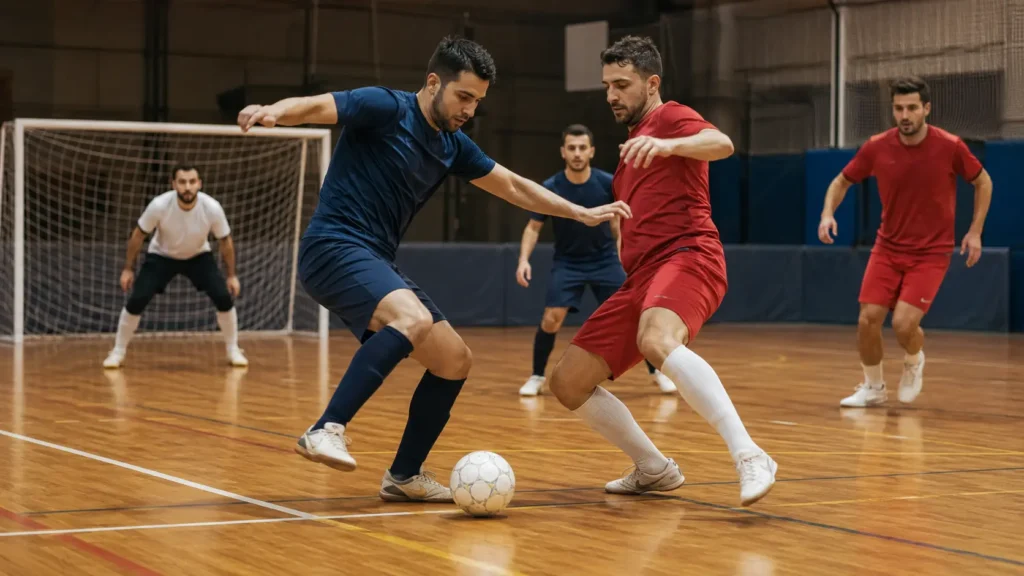
If your futsal clips come out dark, blurry and flickering, the problem is not your phone. It is the lighting in the hall. Futsal is played indoors under artificial light, at the fastest ball speed of any court sport in this guide, and those two facts fight each other inside a camera in a way that no setting fully fixes.
The scale of the gap is worth knowing. UEFA requires a minimum of 1,200 lux of vertical illuminance for its futsal competitions so that broadcast cameras can work properly. A municipal sports hall is a fraction of that. Your phone is being asked to freeze a ball moving at speed, in light designed so people can see each other, not so a camera can capture them.
Set Up Once for That Hall
A court with VISU Replay has the camera fixed and configured for the light in that specific space. You play, press the button, and the clip is already exposed correctly.
Why Futsal Is Hard to Film
Three things combine, and each one makes the other two worse.
The light is dim and it is artificial. A camera in low light has one move available: keep the shutter open longer. A longer shutter means a moving ball smears across the frame instead of freezing. This is why futsal footage looks soft even on a phone that shoots beautifully outdoors.
The ball is heavy, low-bounce and fast. Futsal uses a smaller, weighted ball on a hard surface, so it travels quickly and changes direction constantly. It is the exact motion profile a long shutter cannot handle.
The court is small and the players are close. FIFA specifies 38 to 42 metres by 20 to 25 metres for international matches, and amateur courts can be as short as 25 metres. Everything happens fast, in a confined space, with bodies constantly crossing in front of each other. Any camera position at player height will spend the match looking at someone's back.
Why this is not a phone problem. A better camera helps at the margin, but the constraint is physics. You cannot freeze fast motion in dim light without either more light or a more sensitive sensor. Understanding that saves you from buying your way out of something that positioning and settings handle better. Why phones film sport badly covers the underlying mechanics.
Where to Put the Camera
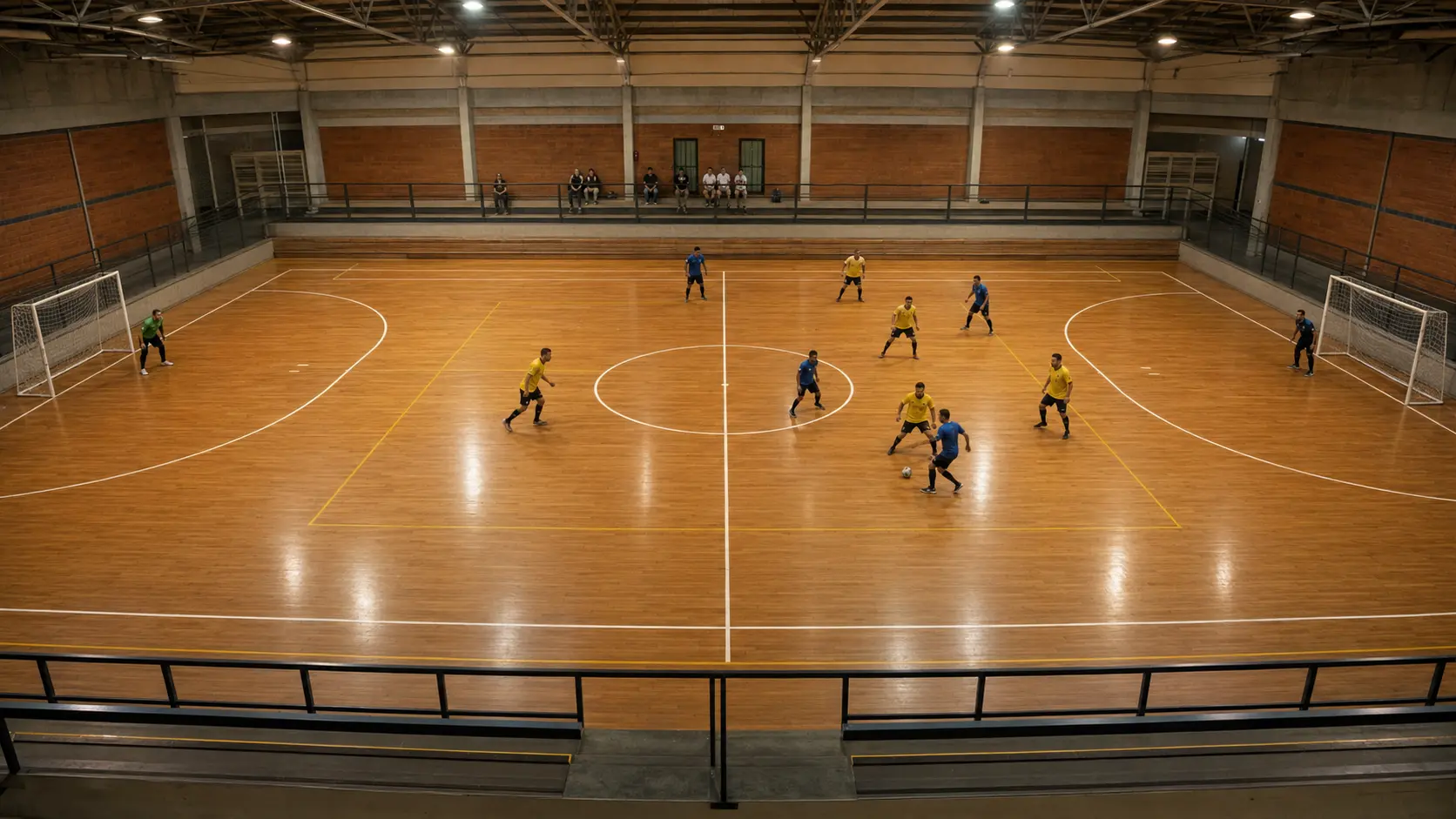
Elevated on the long side, at the halfway line. That is the answer for almost every futsal hall, and each part of it earns its place.
The long side, not behind the goal. Futsal is a possession game across the width of the court. From behind the goal you see one attack well and the other end as distant specks. From the side you get the whole game, including the movement off the ball that makes futsal what it is.
At the halfway line. The centre point keeps both goals roughly equidistant. Filming from near one goal means the far end is always small and always dark, because the corners of a sports hall are the worst-lit part of it.
Elevated, two to three metres. The most important variable. At player height, bodies overlap constantly on a court this small. Elevation separates them and, just as usefully, gets more of the bright floor into frame and less of the dark ceiling, which helps the exposure before you touch a setting.
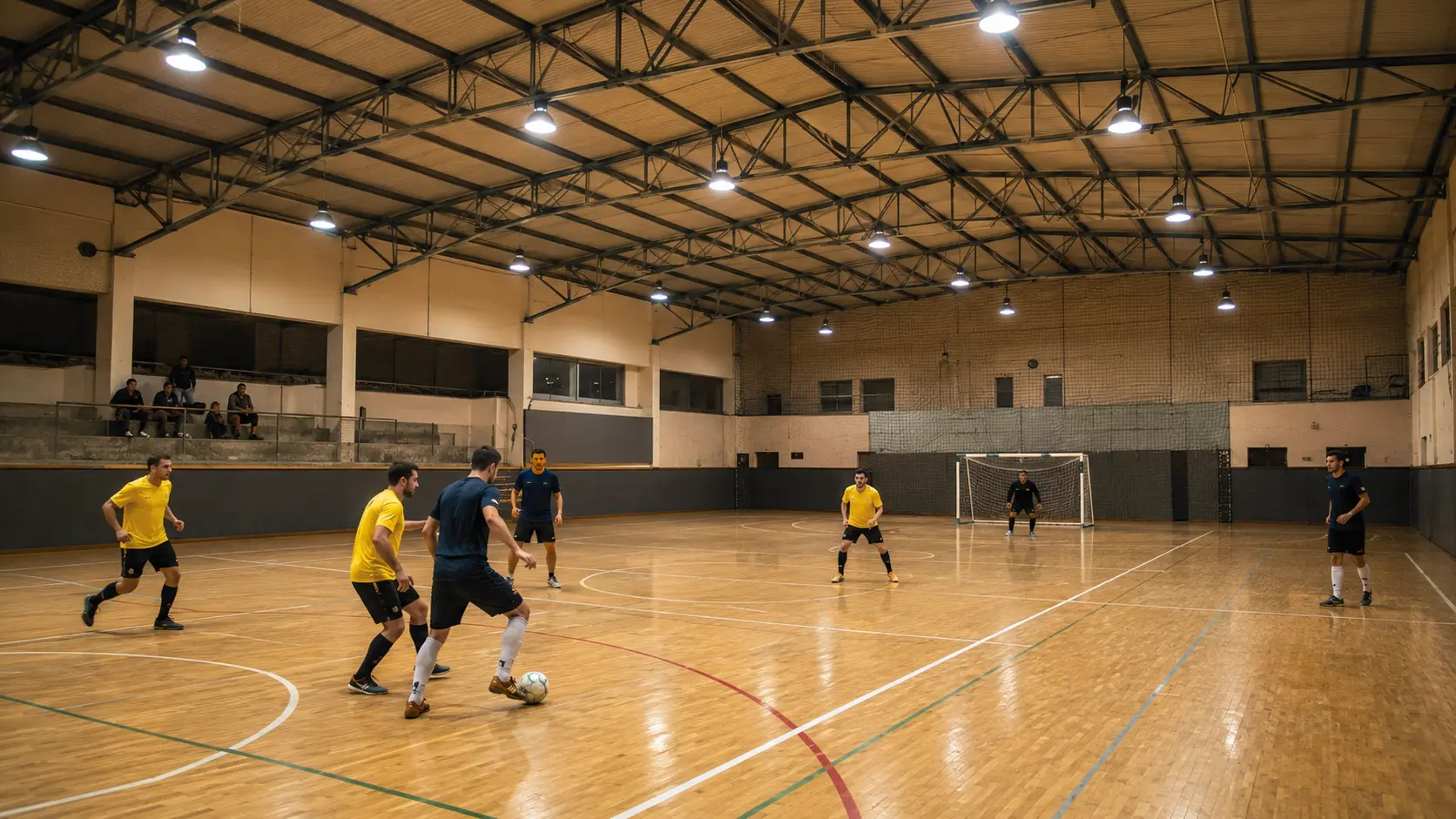
Use the seating if there is any. Many futsal halls have a few rows of bleachers on one side, which is exactly the height you want and already stable. This is the single easiest win available and most people ignore it in favour of propping the phone on a bench at ground level.
Away from the brightest lamps. Framing so a ceiling light sits inside the shot makes the camera meter for it, and everything else drops into shadow. Angle down slightly so the lamps are above the frame.
The Flicker Problem
The specific defect that makes futsal footage look broken, and the one nobody explains. If your clips have horizontal bands rolling through them or pulse light and dark, this is it.
What causes it. Mains-powered lights do not shine steadily. They pulse at the frequency of the electrical supply, which is 50 Hz in Europe and most of the world, and 60 Hz in North America and Brazil. The pulsing is too fast for your eyes and not too fast for a camera.
Why it shows up on video. If the shutter is not synchronised with that pulse, each frame catches the light at a different point in its cycle. Some frames land bright, some dark, and the result is either a flicker across the whole image or bands rolling vertically through it.
The fix, stated simply. Match the shutter to the mains frequency. Under 50 Hz lighting use 1/50 or 1/100 of a second. Under 60 Hz use 1/60 or 1/120. If your camera app exposes a frame rate choice instead, 25 or 50fps suits 50 Hz supply and 30 or 60fps suits 60 Hz.
Where to find it on a phone. Most default camera apps hide this. Look for an anti-flicker or anti-banding option in the camera settings, or use a pro or manual mode where the shutter is adjustable. It is worth finding once, because it is a permanent fix rather than something to redo each session.
Why the sports hall makes it worse. Cheap LED fittings pulse harder than good ones, and municipal halls are full of cheap fittings. The same phone that films fine under home lighting can band badly under sports hall LEDs.
Configured for the Lights Above It
A fixed Replay camera is matched to the lighting in that hall when it is installed, so flicker and exposure are solved before anyone shows up to play.
Settings That Change the Outcome
Short list, in order of how much difference each one makes indoors.
Anti-flicker, matched to your mains. Covered above and worth repeating as the first item, because it fixes a defect no amount of good framing compensates for.
Lock exposure on the court, not the ceiling. Tap and hold on the playing surface with players in frame. Without this the camera re-meters every time someone crosses a bright patch of floor or a dark corner, and the clip pulses through the rally.
Lock focus too. Fast movement toward and away from the camera makes autofocus hunt continuously, and hunting in low light is slow and visible. Lock on the far side of the court and leave it.
Resist the urge to raise frame rate. This is the counterintuitive one. Higher frame rates need shorter exposures per frame, which means less light per frame, which means darker and noisier footage. In a bright outdoor game 60fps buys you slow motion. In a dim hall it costs you image quality for slow motion you will not use. Stay at 30fps unless the hall is genuinely well lit.
Do not zoom. Digital zoom crops the sensor, and a cropped sensor in low light produces visibly worse noise. Frame wide, crop later if you need to.
Which Moments Are Worth Keeping
Futsal produces a specific set of moments that survive being watched by someone who was not in the hall.
The finish after a passing sequence. The signature of the sport. Three or four quick touches ending in a goal reads clearly on video and shows why futsal players make good footballers.
Goalkeeper saves at close range. The small court means shots come from distances that would be unusual elsewhere, so saves happen fast and look dramatic. They also happen near the camera if you are at the halfway line, which helps in low light.
Skill moves in tight space. A turn or a nutmeg against a defender a metre away is the most shareable thing futsal produces, precisely because the space is so confined.
The goalkeeper as an outfield player. Common in amateur futsal when a team is chasing a game, and completely unfamiliar to anyone who only watches football. Worth keeping because it is unusual rather than because it is skilful.
Not the whole match. A futsal game is continuous and mostly transitional, so the honest ratio of watchable moments to elapsed time is low. Four or five clips from a session is a good return. How long a sports clip should be explains why short survives sharing and long does not.
What Goes Wrong
The phone on the bench at floor level. The default and the worst option. Players block the view constantly, the frame fills with legs, and the ball leaves the shot every time it is lifted. If there is any elevated surface in the hall, use it.
Filming from behind the goal because that is where the bench is. Position gets chosen by convenience, and one end of the court ends up permanently distant and dark.
Shooting into the lights. A ceiling lamp in frame destroys the exposure for everything else. Angle down.
Someone has to sit out. The structural problem in every sport in this guide, and worse in futsal because rotations are constant. Whoever holds the phone is missing their shift, and rotating the filming duty means the framing changes every ten minutes.
Ball to the phone. A futsal ball travels fast in a small hall and phones placed at court level get hit. Elevated positions are safer as well as better framed.
The structural answer. Everything above assumes someone brought a phone, found a height, matched the flicker setting and is not playing. That is why fixed cameras took over on courts that take video seriously: the setup happens once, by the venue, tuned to the lighting in that specific hall, and everybody gets the clip without anyone missing a game. Courts with video replay lists the places where it is already solved, and what VISU Network is explains the venue side.
Everyone Plays, Everyone Gets the Clip
VISU Replay removes the person who has to stay off the court. The camera is fixed, matched to the hall's lighting, and the clip comes from a button press after the goal you want to keep.
FAQ: Recording a Futsal Game
Where should I film a futsal game from?
Elevated on the long side, at the halfway line. The side view captures the possession play that defines futsal, the halfway line keeps both goals equidistant, and elevation of two to three metres stops players overlapping on a court this small. If the hall has bleachers, use them: they are the right height and already stable.
Why is my futsal footage blurry?
Because the hall is dim and the ball is fast. In low light a camera keeps the shutter open longer, and a longer shutter smears anything moving quickly. UEFA requires 1,200 lux for its futsal competitions so broadcast cameras can work; an amateur hall is a fraction of that. More light or a more sensitive camera are the only real fixes.
Why do my videos have bands or flickering?
Mains-powered lights pulse at the frequency of the electrical supply, 50 Hz in most of the world and 60 Hz in North America and Brazil. If the shutter is not synchronised to that pulse, frames catch the light at different points in its cycle. Set anti-flicker to match your mains, or use a shutter of 1/50 or 1/100 under 50 Hz and 1/60 or 1/120 under 60 Hz.
Should I film futsal at 60fps?
Usually not, which surprises people. Higher frame rates mean shorter exposure per frame, so less light reaches the sensor and the footage gets darker and noisier. Indoors that trade rarely pays off. Stay at 30fps unless the hall is genuinely well lit, in which case 60fps gives you usable slow motion on goals.
Behind the goal or from the side?
From the side. Behind the goal you get one attack clearly and the far end as distant specks, and the far end of a sports hall is also the worst-lit part. The side view at the halfway line keeps the whole court usable, which matters in a sport where the movement without the ball is most of the game.
Is it worth filming with a phone at all?
Yes, with the right position and two settings locked. Elevation, anti-flicker matched to the mains, and locked exposure fix most of what goes wrong. What a phone cannot fix is having to take someone off the court to hold it, which is why courts that take video seriously mount a camera instead.