

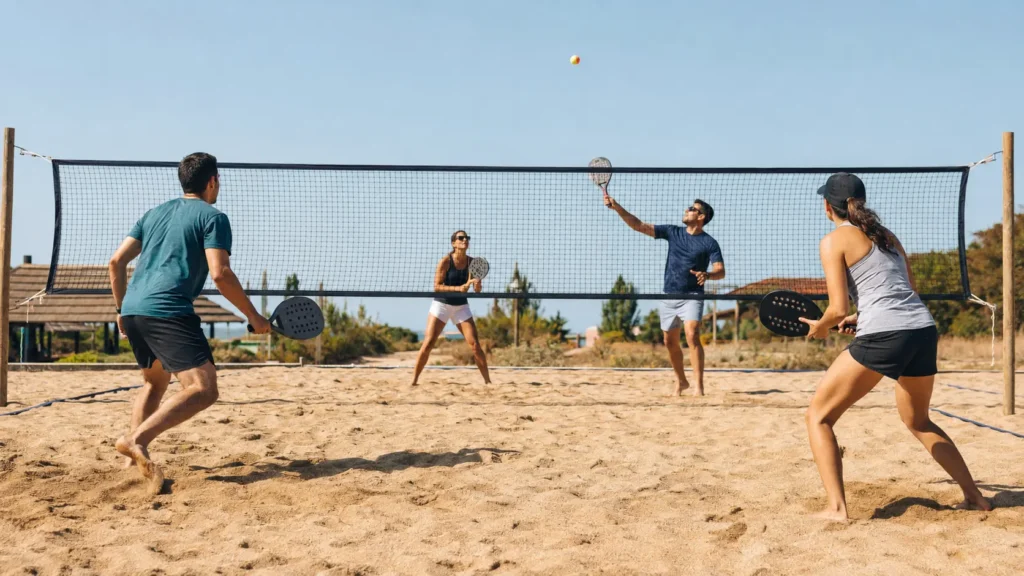
Beach tennis is the hardest sport in this guide to film, and it is not close. Everything that ruins amateur footage happens here at once: hard overhead sun, a bright reflective surface that confuses exposure, sand that gets into anything you put down, and a net so high that the ball spends most of the rally above the players rather than between them.
None of that is a reason to give up on it. It is a reason to set up differently than you would for an indoor court. The court is 16 by 8 metres with a net at 1.8 metres for men and 1.7 for women, per the International Tennis Federation rules, which is a much higher net over a much smaller court than most people realise. That single ratio decides where the camera goes and why the obvious position fails.
No Phone in the Sand
A court with VISU Replay has the camera already mounted, already exposed for the conditions, and out of reach of the sand. You play, press the button, and the clip is waiting.
The Three Problems, Together
Filming beach tennis badly is usually not one mistake. It is three conditions stacking, and fixing only one of them still produces unusable footage.
The sand is bright and your camera meters for it. A phone exposes for the largest bright area in frame, and on a beach court that is the ground. The players end up underexposed against a correctly exposed surface, which is why so many beach tennis clips show four silhouettes and a perfect patch of sand.
The net is high relative to the court. At 1.8 metres over a 16 metre court, the net sits high enough that a camera at chest height films a wall of mesh with legs behind it. Indoor sports let you get away with a low camera. This one does not.
The sun is directly overhead when people play. Peak beach tennis hours are peak sun hours. Overhead light means hard shadows straight down, faces in shade, and glare bouncing off the sand into the lens. It is the worst light of the day and it is exactly when the courts are full.
Sand goes everywhere and gets into everything. Practical rather than optical, and the one that costs money. A phone propped in sand takes sand into the ports and the lens housing. Anything you set down at ground level will be sanded.
Where to Put the Camera
Behind the baseline, elevated, slightly off the centre line. That is the short answer, and each part of it solves one of the problems above.
Behind the baseline, not from the side. The side view is the instinct, because it feels like it shows the whole court. It does not work here: the high net cuts the frame horizontally in half, and the far pair plays behind a band of mesh. From behind the baseline the net is a line you look over rather than a wall you look through.
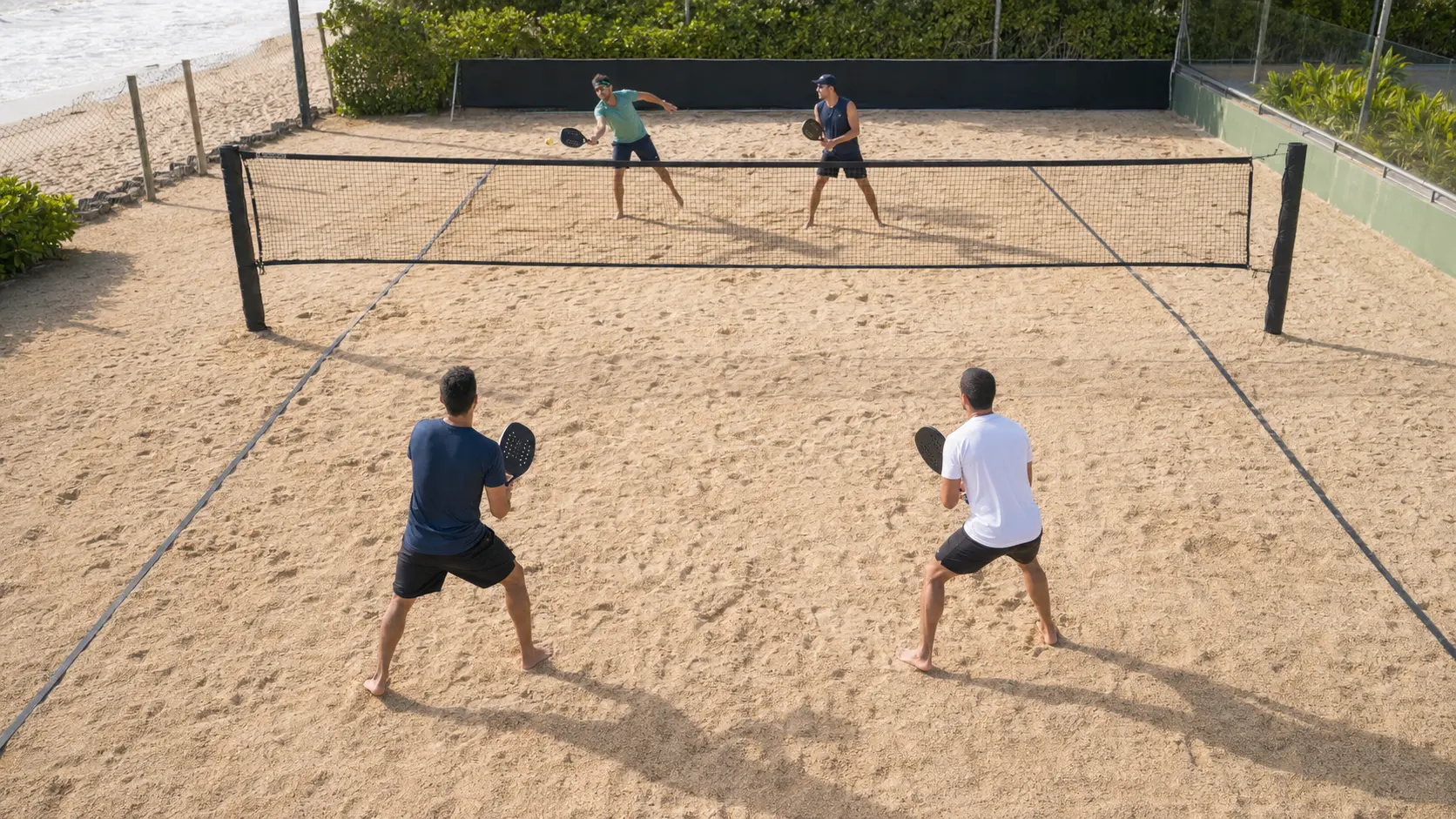
Elevated, at least two metres. Above the net line, looking slightly down. This is the single change that improves beach tennis footage most, because it converts the net from an obstruction into a reference line. It also puts more sand in the lower frame and less sky in the upper, which helps the exposure problem before you touch any settings.
Slightly off centre. Dead centre behind the baseline puts the near player directly in front of their partner during service. A metre or two to one side separates them without losing the symmetry of the court.
Not at ground level, ever. The position everyone defaults to, propping a phone against a bag. You get the net across the middle of the frame, the near pair blocking the far pair, and sand in the charging port. There is no version of this that produces a clip worth keeping. The same reasoning behind camera angles for soccer applies here, with the net making the height requirement stricter rather than optional.
Working With the Sun Instead of Against It
You cannot move the sun and you usually cannot move the match. What you can do is choose which side of the court you film from, which is a free decision most people make by accident.
Put the sun behind the camera, not behind the players. Filming into the sun gives you silhouettes and lens flare across the whole rally. Filming with the sun behind you lights the players' faces and the ball. Same court, same phone, completely different clip.
The best light is early and late, and it is not close. Low sun rakes across the sand and gives it texture instead of glare, and it lights players from the side rather than straight down. If you have any choice about when to film, this matters more than any setting on the phone.
Midday is survivable if you expose for the players. Tap the players on screen rather than letting the camera average the whole frame. The sand will blow out slightly. That is the correct trade: nobody watches a beach tennis clip to look at the sand.
Overcast is better than bright sun, not worse. It feels like worse conditions and produces better footage, because the light is even, the shadows are soft and nothing blows out. A grey day is the easiest beach tennis day to film.
Watch what is behind the court. Sea, wet sand and white buildings all bounce light back into the lens. A background of dry sand or vegetation gives you a cleaner frame than a background of glare off water.
Exposed for the Court, Not the Sand
A fixed Replay camera is set up once for the conditions of that court and stays that way. No metering for the sand, no silhouettes, no phone buried in a bag between points.
Settings That Actually Matter
Short list. Most camera advice is irrelevant here; these four are not.
Lock the exposure. The single most valuable thing you can do. Without it, the camera re-meters every time a player crosses the bright sand, so the clip pulses brighter and darker through the rally. Tap and hold on the players to lock it, then leave it alone.
Lock the focus at the same time. Beach tennis has fast movement toward and away from the camera, and autofocus hunts constantly on a low-contrast surface like sand. Locked focus at the far baseline keeps the whole court acceptably sharp.
Film horizontally, then crop. The court is wider than it is deep and the rally uses the full width. Vertical framing cuts off the tramlines, which is where a lot of beach tennis is actually won. Shoot wide and crop to vertical afterwards if you want to post it that way. Vertical or horizontal sports video covers the trade in full.
Higher frame rate if you have it. The one case where a setting genuinely helps: smashes and net exchanges are fast, and 60fps gives you usable slow motion for the two seconds that matter. It costs storage and nothing else.
Which Points Are Worth Keeping
Beach tennis produces a specific set of moments that survive being watched by someone who was not there. Most rallies do not, and that is fine.
The smash off a high ball. The signature shot and the most watchable. It reads instantly, even to someone who does not know the rules, which is the test for anything you want to share.
Long net exchanges. Two pairs volleying at close range with the high net between them is visually dense and specific to this sport. Nothing else in the cluster looks like it.
Retrieves at full stretch in the sand. Sand slows movement and exaggerates effort, so a dive or a stretched retrieve looks more dramatic here than the same shot on a hard court. The surface works for you.

The lob that lands on the line. Only if the camera is behind the baseline and elevated. From the side you cannot tell whether it landed in, which turns the best point of the match into an argument.
Not every point. The instinct is to keep everything and sort it later, and nobody ever sorts it later. Keeping four or five moments from a session is more useful than keeping the whole session. What makes a good sports clip goes into why short beats complete.
What Goes Wrong
Somebody has to sit out. The structural problem with filming any doubles sport. Beach tennis is four players, and the person holding the phone is a fifth who is not playing. That trade is bad enough that most people simply stop filming after a few sessions.
The phone in the sand. Propped against a bag, knocked over by a ball or a foot, sand in the ports. If you are going to put a phone down at ground level, put it in a bag with the lens clear, not directly on the surface.
Filming into the sun because that is where the bag was. The position gets chosen by where the bags happen to be rather than by where the light is. Thirty seconds of thought before the match saves the whole session.
Battery in the heat. Phones throttle and shut down in direct sun, and a phone recording video in 35 degree heat on a beach will get there. Keep it shaded between points if you can.
The structural answer. All of this assumes someone brought a phone, mounted it, exposed it correctly and is not playing. That is why fixed cameras took over on courts that take video seriously: the setup happens once, by the venue, and every player gets the benefit without anyone sitting out. Brazil alone has passed a million beach tennis players and now accounts for roughly 60 percent of the sport worldwide, according to figures from the national tennis confederation, so the courts that solve this are solving it for a very large number of people. Courts with video replay lists the places where it is already handled, and what VISU Network is explains the venue side.
Four Players, Four Playing
VISU Replay removes the fifth person. The camera is fixed above the net line, set for the light on that court, and the clip comes from a button press after the point you want to keep.
FAQ: Recording a Beach Tennis Match
Where should I film a beach tennis match from?
Behind the baseline, elevated at least two metres, slightly off the centre line. The height is what matters most: the net sits at 1.8 metres over a 16 metre court, so a camera at chest height films a wall of mesh with players behind it. From above the net line, the net becomes a reference line instead of an obstruction.
Why do my beach tennis videos come out so dark?
Because the camera is exposing for the sand, which is the brightest and largest area in frame. The players end up underexposed against a correctly exposed surface. Tap and hold on the players to lock exposure before the match starts. The sand will look slightly blown out, which is the right trade.
What is the best time of day to film?
Early morning or late afternoon, and it is not a small difference. Low sun rakes across the sand and gives it texture instead of glare, and it lights players from the side rather than casting shadows straight down. Overcast days are also much easier than bright midday sun, even though they feel like worse conditions.
Should I film from the side of the court?
No, and this is where beach tennis differs from most sports. The high net cuts a side-on frame horizontally in half, so the far pair plays behind a band of mesh for the whole match. Behind the baseline is the only position where the net stops being an obstruction, which is the opposite of the advice for lower-net sports.
How do I keep sand out of my phone?
Do not put it at ground level. A phone propped against a bag gets knocked over by a ball or a foot, and sand goes into the ports and lens housing. If you have no elevated mounting point, put the phone in a bag with the lens clear rather than directly on the surface, and keep it shaded between points so it does not overheat and shut down.
Vertical or horizontal for beach tennis?
Horizontal, then crop afterwards if you want to post vertically. The court is wider than it is deep and the rally uses the full width, so vertical framing cuts off the tramlines where a lot of the sport is actually played. Shooting wide and cropping later keeps the option open. Cropping the other way is not possible.