

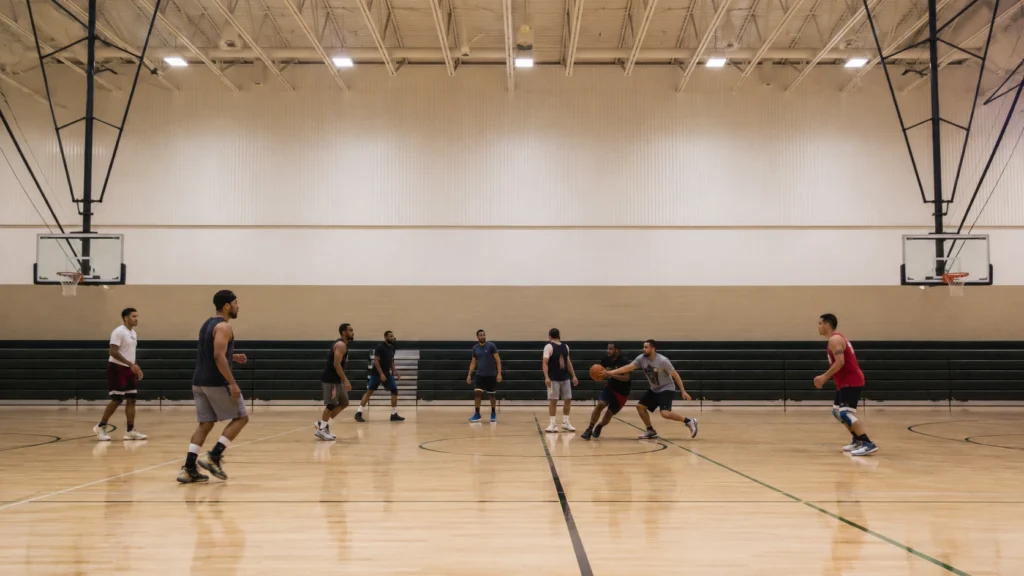
Basketball is the only sport in this cluster where the moment you came to film happens above everyone's head. The ball ends up at a rim 3.05 m off the floor, at one of two fixed points, and the side it ends up on changes every few seconds. That combination is what makes a phone propped against a bag produce footage nobody watches twice.
There is a number that explains most of the disappointment before any camera setting does. The FIBA Venue Guide recommends at least 300 lux for community facilities built for recreational play, and 2,000 lux in the direction of the main broadcast camera at televised games. The gym you play in was designed for roughly a sixth of the light the footage you compare yourself to was shot in.
Set Up Once for That Gym
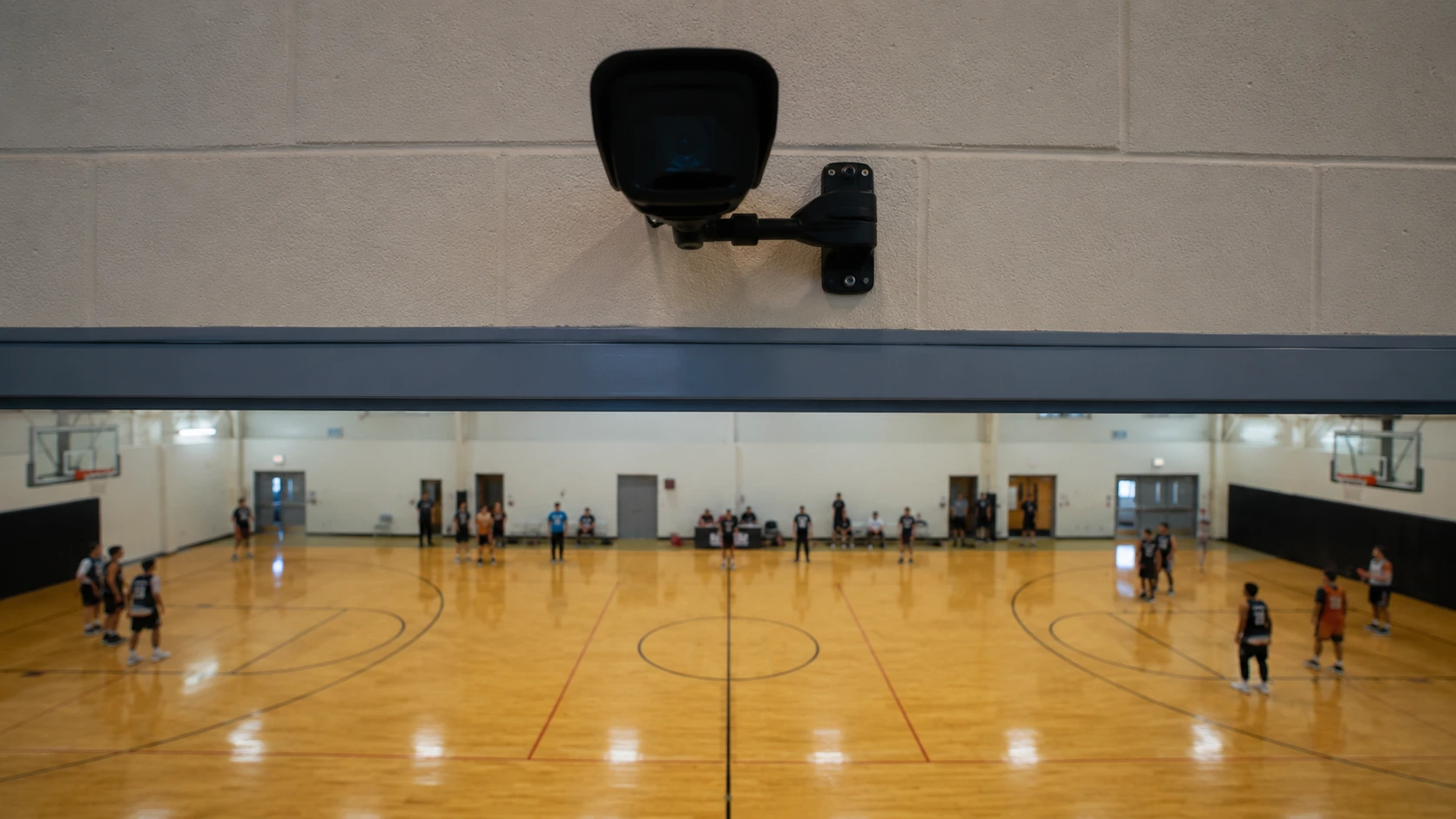
At a court with VISU Replay, the camera is already mounted, already pointed, and already set for that hall's lighting, so the play comes out exposed correctly without anyone adjusting anything.
Why Basketball Is a Two Ended Problem
Every other sport in this cluster gives the camera one thing to solve. Basketball gives it two at once, and they pull in opposite directions.
The first is horizontal. FIBA's Official Basketball Rules set the court at 28 m by 15 m, and possession flips ends constantly. A missed shot at one rim can become a layup at the other within seconds. Your subject is not drifting across the frame, it is teleporting between two zones roughly 25 m apart, over and over.
The second is vertical, and it is the one people never plan for. The rim sits 3.05 m above the floor, which is 10 feet. The shot, the block and the rebound all resolve above head height.
In futsal or soccer the decisive moment happens at knee or chest level, so a camera framed on the players catches it by default. In basketball, a frame built around bodies cuts off the exact instant that mattered. The camera has to hold two distant zones and keep air above the players at the same time.
Where to Put the Camera
Start from the side, at the halfway line, as high as you can safely get. From there the two rims sit at roughly equal distance, so neither end is favoured and neither goes soft. Move toward one baseline and you have quietly chosen a half to care about.
Height matters more here than in any other sport in the cluster. Low and flat, players in front block players behind, and the rim leaves the top of the frame. Raised above head level and tilted slightly down, bodies separate and the hoop stays in the picture. A balcony rail or a bleacher's top row beats a phone on a bench.
Behind the basket is the tempting option and usually the wrong one. FIBA's venue guidance sets 2.0 m of unobstructed space behind the endline as the standard, and drops to 1.0 m only in the exception where the basket is mounted on a ceiling or wall below elite level.
That exception is exactly what most amateur gyms have, so there is often a wall right there and nowhere to stand. Even where space exists, the far rim ends up 25 m away and unreadable.
Give the position as a proportion rather than a measurement, because most school and street courts are not 28 m. Halfway along the side, above the players' heads, angled to keep both rims inside the frame. That rule survives a court of any size. Which position is best, and by how much, is a comparison of its own.
One Camera, Two Baskets: What You Give Up
Here is the part most guides skip. On a court with two live rims, a fixed camera cannot deliver detail and the whole game at the same time. There is no position that gives you both, and pretending otherwise is how people end up disappointed with footage that was technically fine.
Frame tight on one half and you get faces, hands on the ball, a rim large enough to read. You also lose every possession at the other end, which is about half of them.
Frame wide from high at midcourt and you get the full game, both rims, the shape of the play. What you lose is scale. At that width a player is small, expression is gone, and cropping later only enlarges what the sensor already recorded.
Choose deliberately rather than by accident. For training review or tactics, wide wins and the lost detail costs nothing. For one player's highlights, tight on the half they attack is honest, and you accept the other end is not filmed.
This is where a fixed court camera earns its place. Replay does not remove the trade off, because no fixed camera can. What it removes is the setup: already there, already aimed, already tuned to that gym's light.
The Camera That Is Already Pointed
VISU Replay records continuously from a fixed position at the court and generates the clip after the play, so nobody has to hold a phone through four quarters.
Indoor Light: The One Number That Explains It
FIBA's Venue Guide recommends at least 300 lux for community facilities focused on recreational play, at least 750 lux for competition without broadcasting, and 2,000 lux toward the main camera at televised games. Your gym was lit for players to see the ball, not for a sensor to freeze a jump shot, and the gap is roughly a factor of six.
Everything about shutter speed, grain and color follows from that one number, and it is covered in filming indoor courts and lighting.
Settings That Change the Outcome
Let the light decide the frame rate. Basketball changes direction constantly, and 60 fps is what keeps a crossover or a block from smearing. But a higher frame rate means a shorter exposure per frame, so less light reaches the sensor, and in a hall lit for recreation that trade rarely pays off. Stay at 1080p and 30 fps unless the gym is genuinely well lit.
Lock exposure before tip off. A polished light colored floor is the brightest surface in the room, and automatic exposure re-meters as players cross it, so the picture pumps through the game. Set it with players on the court, then lock it.
Lock focus too. Backboards are glossy, and autofocus hunts on them. From a fixed side position the distance barely changes, so focus has nothing useful to do.
Leave headroom above the rim. A shot that arcs out of the top of the frame and returns is a clip you will not keep.
If the footage still looks worse than the game felt, the explanation is usually hardware rather than settings, which is the subject of why your phone films sports badly.
Which Plays Are Worth Keeping
Basketball hands you a cutting unit no other sport in this cluster has. Under FIBA rules a team must attempt a shot within 24 seconds of gaining possession, with a reset to 14 seconds in several situations. A full possession therefore has a hard ceiling.
That turns "where do I cut" into arithmetic. A complete play, from the rebound or inbound that started it to the shot that ended it, fits inside a predictable window. You are not scrubbing hopefully, you are finding the change of possession before the moment and cutting from there.
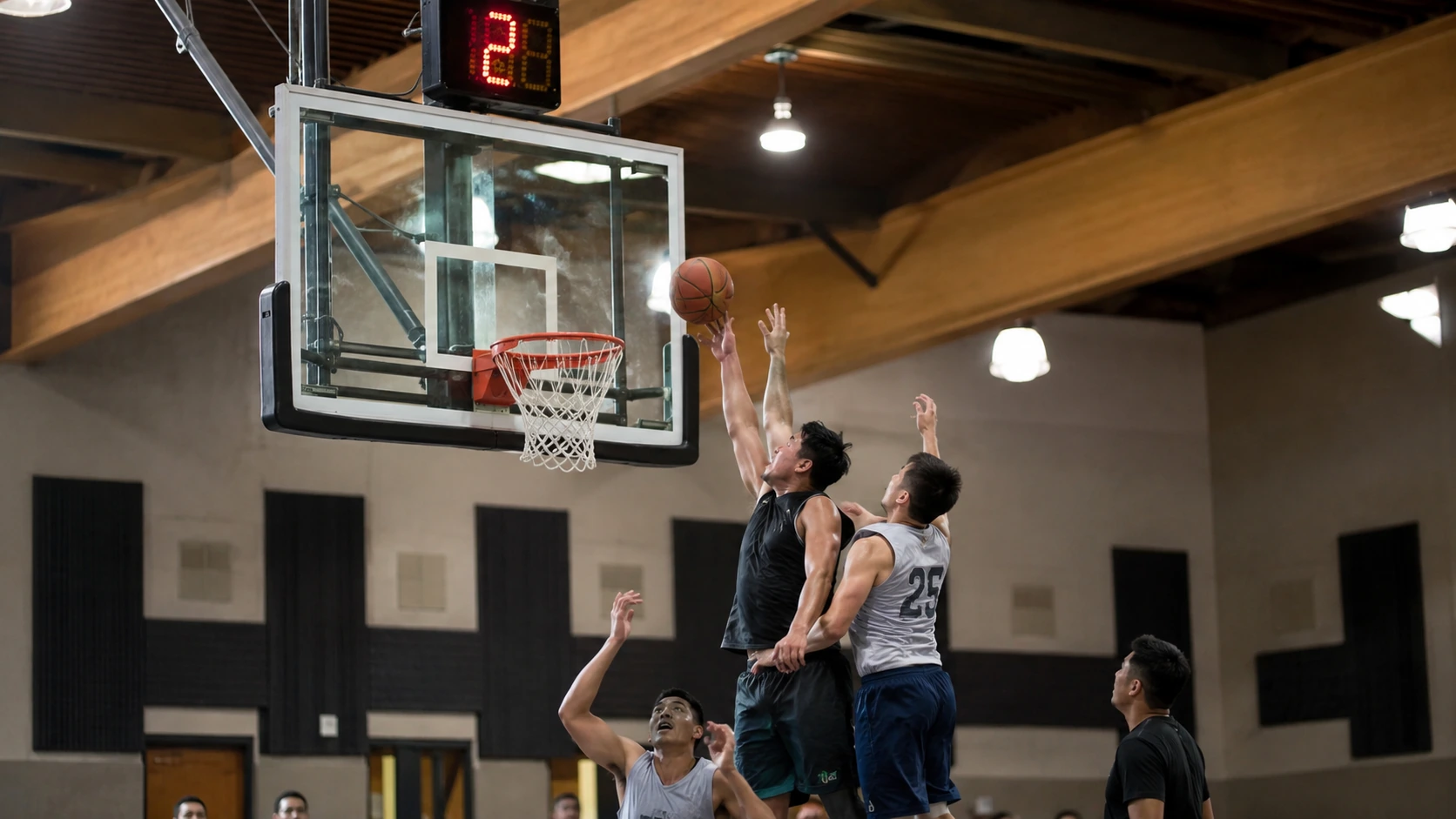
In practice most keepers are shorter than the ceiling. The three or four seconds before the shot carry the decision, and the two after carry the result. Anything before that is people walking the ball up.
Keep the plays where something was decided: the shot that broke a run, the block, the pass nobody expected, the rebound that turned into points at the other end. How long each should run is worked out in how long a sports clip should be, and what separates a keeper from filler is covered in what makes a good sports clip.
What Goes Wrong
Five failures cover almost everything, and four of them are decided before tip off.
The camera is too low. The most common one by far. At bench height the rim leaves the frame and the shot ends in blank ceiling. Everything else can be perfect and the clip is still worthless.
It sits behind the basket. One end looks excellent, the other is a distant blur, and half the game is unusable.
The whole game is recorded as one file. FIBA plays four quarters of 10 minutes, the NBA plays 12 minute periods, and with stoppages and a 15 minute interval a recording easily runs past an hour. Phones stop for heat, storage or a call, always in the fourth quarter. Restart at the quarter breaks.
Exposure was left automatic. The bright floor drags the whole picture around every time the play crosses it, and players end up as silhouettes.
Nobody checked the first minute. A test recording costs 20 seconds. Finding out afterwards costs the game.
Find a Court With Cameras
A camera mounted at the venue films every possession at both ends without anyone sitting behind it. See how the clip is produced.
FAQ: Recording Your Basketball Game
Where should I put the camera to film a basketball game?
On the sideline at the halfway line, raised above head height and tilted slightly down. From there both rims sit at roughly equal distance, so neither end is favoured, and the height keeps players from blocking each other while leaving room above the hoop. Treat the position as a proportion rather than a measurement in meters, because amateur and school courts vary a lot in size.
Can one camera cover both baskets?
Yes, but not with detail. A fixed camera high at midcourt holds both rims and every possession, and the cost is scale: players are small and expression is gone. Framing tight on one half gives detail and loses roughly half the game. No single fixed position delivers both, so choose based on whether you want tactics or highlights.
Why does my basketball footage look dark in the gym?
Because the hall was lit for playing, not for filming. The FIBA Venue Guide recommends at least 300 lux for recreational community facilities, while televised competition uses around 2,000 lux toward the main camera. At roughly a sixth of the light, the camera compensates with a slower shutter or more gain, which produces motion blur or grain.
Should I film basketball at 60fps?
Usually not in a dim gym. Higher frame rates mean shorter exposure per frame, so less light reaches the sensor and the footage gets darker and noisier, and most community halls are lit at around 300 lux. Stay at 30 fps unless the hall is genuinely well lit, and then 60 fps keeps crossovers, blocks and rebounds readable instead of smeared.
How long should a basketball clip be?
Shorter than a possession. FIBA gives a team 24 seconds to attempt a shot, with a reset to 14 seconds in several situations, so a complete play always fits inside a predictable window. In practice the useful part is the few seconds of decision before the shot plus the result after it, which is well under the shot clock ceiling.
Behind the basket or from the side?
From the side, in almost every amateur gym. FIBA venue guidance sets 2.0 m of clear space behind the endline as the standard, and allows 1.0 m only where the basket is mounted on a ceiling or wall below elite level, which describes most amateur halls.
That leaves a wall right there and nowhere to place a camera. Even where the space exists, the far rim ends up around 25 m away and unreadable, so you gain one end and lose the other.