

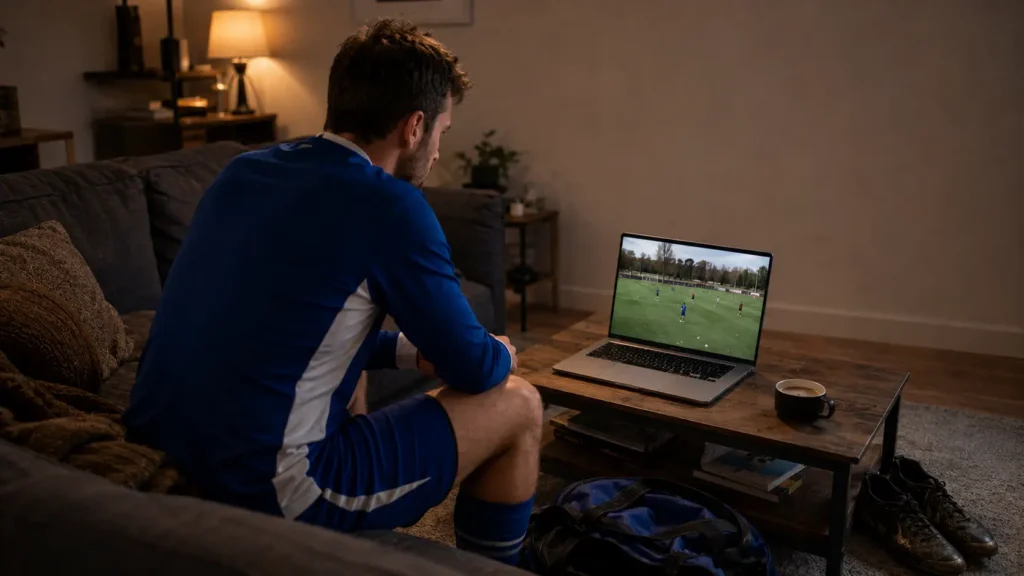
Getting the video is the part everybody talks about. Where to put the camera, which angle works, how to pull the file off the court. Then Sunday morning arrives, the match is on your phone, and nobody explains what to do with it. This article starts there, and it starts by admitting what most sports video content will not: one fixed camera is not a tactical analysis system.
What it does give you is narrower and genuinely useful. Your own positioning. Your decision when the ball arrived. The mistake that shows up three times in ninety minutes. That is enough to work with, as long as you know what the frame is not showing you.
The Video Has to Exist First
On a court with VISU Replay the recording is already there after the game, with nobody assigned to film. That removes the step where most amateur review dies.
What the Video Can Actually Tell You
Start by resetting the expectation. A single camera on the side of the court is not going to hand you a tactical breakdown of your team. It was never going to.
What it records well is narrower and more personal:
- Where you were standing when the ball came into your area.
- What you did with it once it arrived, and how long you took.
- The pattern you repeat, which you cannot feel from inside the game.
- Your body shape before receiving, which decides half of what happens next.
That last one is why review works at all. During a match you have no access to yourself from the outside. You remember the pass you played, not the two seconds before it where you were already facing the wrong way.
None of this needs professional equipment. It needs the file to exist and twenty honest minutes. If getting the file is still your bottleneck, that is covered in how to record your soccer game.
Watch It Once Without Pausing
Almost everyone does the same thing first. They open the file, drag the scrub bar to their own best moment, watch it four times, and close the app feeling good.
That is entertainment. Nothing wrong with it, but it is not review.
The first pass should run without stopping. You want the shape of the game: when your team pushed, when you disappeared, whether the second half looked like the first. Pausing breaks that. You cannot judge rhythm from stills.
Watch at normal speed, or slightly faster if the match is long. Take no notes. Leave with one thing only: which stretch is worth a closer look.
The Second Pass: Three Questions
Now the useful part. On the second pass you are allowed to pause, rewind and be annoying about it. But you need something to look for, because open ended watching turns into highlight watching within about four minutes.
There is a reason to be specific here. A systematic review of video feedback in physical education found that one of the studies had learners use a written observation sheet with key points to judge their own strengths and weaknesses. A structure, not a vibe.
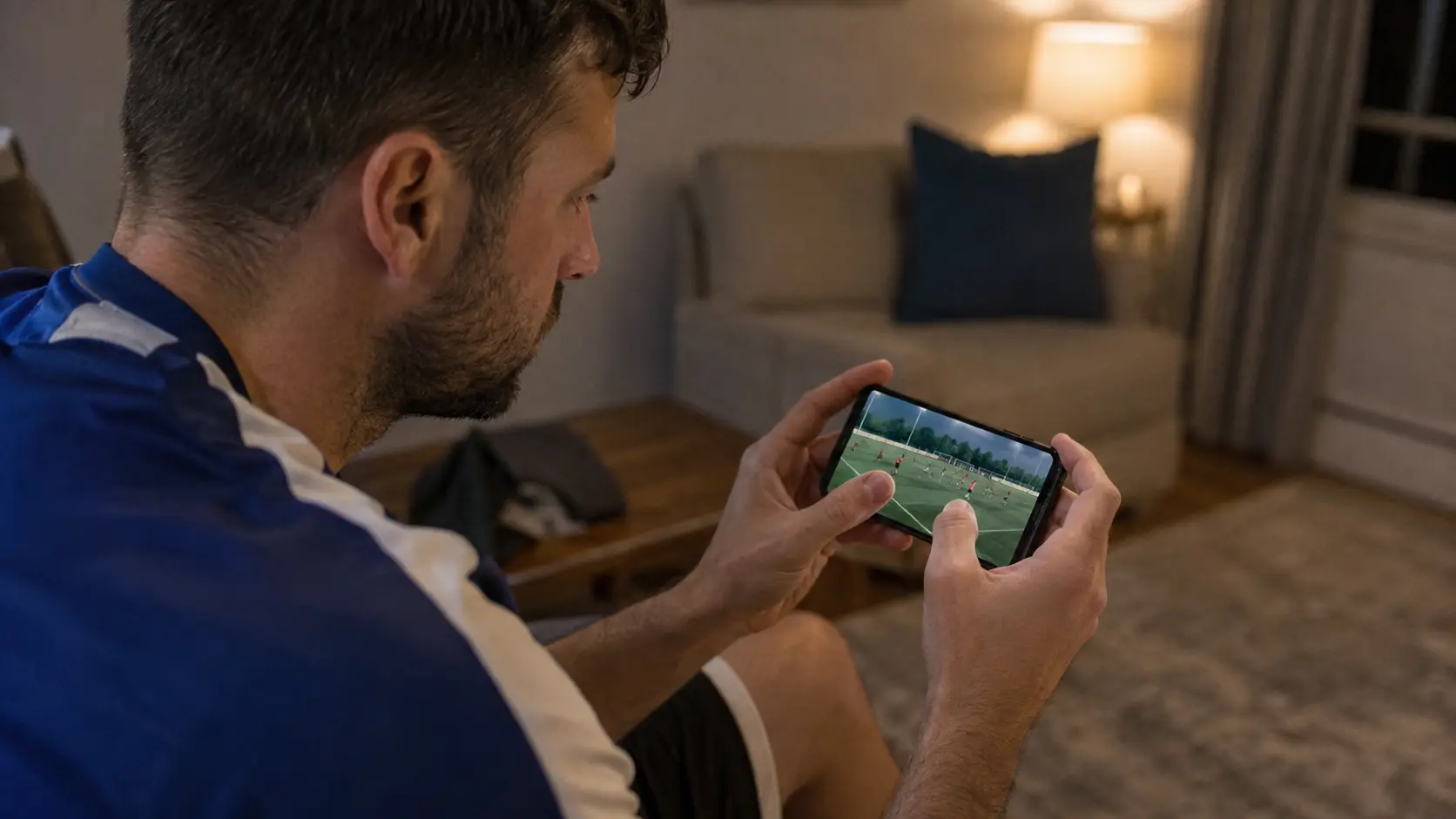
Three questions are enough. Use the same three every week so you can compare weeks.
- Where was I when the ball reached my area? Not where you ended up. Where you already were, two seconds earlier.
- What option did I not see? The camera sees the whole width you did not. This is the single biggest gap between what you felt and what was true.
- Which mistake showed up more than once? A one off is noise. The same error at minute 12, minute 40 and minute 71 is a habit, and habits are the only thing worth working on.
Write the answers down. Three lines is plenty. Next week you compare against those three lines rather than against your memory, which is generous and unreliable.
What One Fixed Camera Cannot Show You
This is the section most articles skip, and skipping it is what makes them useless.
A single fixed camera has one frame. Everything outside that frame did not happen as far as your review is concerned. Concretely, here is what you are not going to see:
- Marking off the ball on the far side. If the play is on the right and your man is drifting on the left, the frame is following the ball, not him.
- The run that was made and ignored. A teammate sprinting into space at the edge of the frame often reads as an empty corner of the picture.
- Distant players in useful detail. At the far end of the pitch bodies become shapes. You can tell someone is there. You cannot tell what they were doing with their shoulders.
- Anything behind the camera line. Obvious once said, easy to forget when you are hunting for a moment that was never recorded.
This is not an amateur equipment problem alone. A validity study of a professional multi camera optical tracking system lists occlusion, players who look alike, calibration error and lack of resolution on distant players as ongoing difficulties. That is a system with several synchronised cameras and a budget. One fixed camera on an amateur court has the same limits, in a larger degree.
So be clear about the trade. A fixed court camera wins on consistency: every match recorded, same angle, every week, nobody holding a phone. It loses on coverage: what leaves the frame is gone.
For reviewing your own positioning and your own decisions with the ball, that trade is fine. For full team tactical analysis, it does not replace multiple cameras.
Every Game Recorded the Same Way
Reviewing week over week only works if the footage is consistent. A fixed court camera gives you the same frame every session, without asking a teammate to film.
Why Watching Alone Is Not the Whole Method
Here is a detail from the research that gets quietly dropped in most advice about self review.
In the systematic review of video based visual feedback in physical education, eleven studies passed the inclusion criteria out of 2,030 examined. In ten of those eleven, the video did not arrive alone. It came with verbal feedback from someone pointing at errors and key points.
In other words, watching your own video in silence is not really the condition that was studied. What was studied is video plus guidance.
The same review reported that self modeling beat verbal only feedback in seven of eight direct comparisons, and that expert modeling combined with self modeling produced significant improvement in nine studies. The video is doing real work. It is just doing it alongside somebody talking.
For an amateur that means two options, either fine:
- Watch with a teammate and say out loud what you are looking for before you press play.
- Watch alone, but with the three questions written down before you start, so the list plays the role the coach plays in the studies.
The written list is the weaker of the two, and it is still much better than open ended scrolling.
Does It Actually Make You Better?
This is the paragraph where most content lies, so let me be careful.
A systematic review of video based training in football screened 5,749 articles and found 10 that qualified, covering 300 participants aged 14 to 25. In 8 of those 10 studies, players performed significantly better on anticipation or decision making at post test than at pre test. That is a genuine and reasonably consistent finding.
Now the caveat, and it is the most important sentence in this article. Only 1 of those 10 studies applied a transfer test to actual match play.
In the other nine, the improvement was measured in the testing environment, not on the pitch. So the honest claim is that video training improves how players read situations under test conditions. Whether that carries into a real Sunday league match is largely untested.
Anyone telling you that watching your games will make you better in games is going further than the evidence goes.
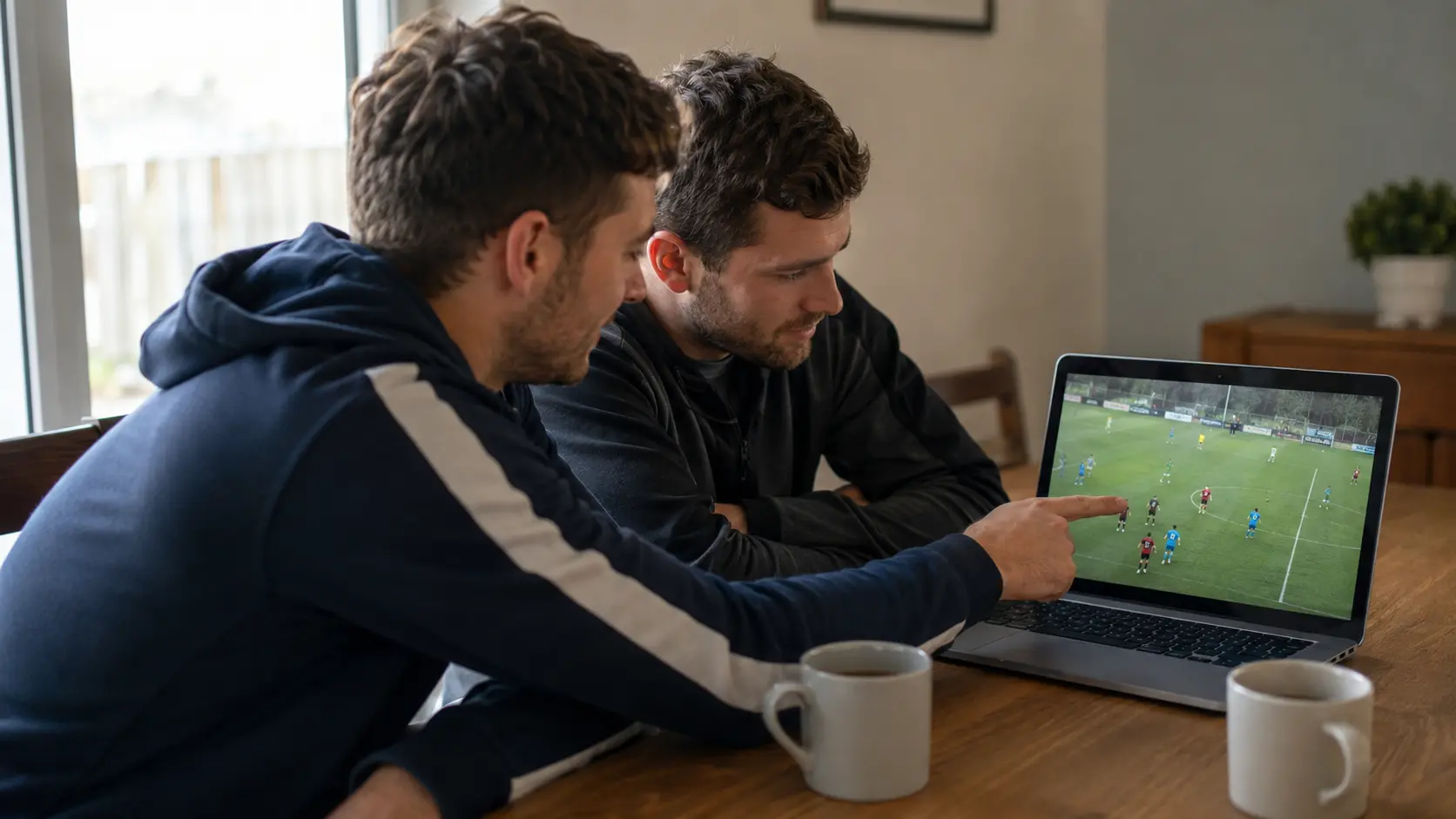
Two more things worth reporting accurately. The same review notes that most video based training does not couple a complex motor response, which limits the perception to action link. And the physical education review observes that experienced and older learners generally benefit more from visual feedback than beginners do.
One more study is worth naming for its mechanism rather than its statistics. Researchers compared video feedback against video modeling plus video feedback for soccer skills, and both improved static ball control against baseline. The sample was three children, two girls aged 10 and one boy aged 9.
Three participants. Treat it as an illustration of how the feedback loop works, not as a number you can apply to adult amateurs.
Put together: the mechanism is real, the effect on tested perception and decision skills is fairly consistent, and the jump to real match performance is not established. Review your games for information you cannot otherwise get, not because a study promised a result.
Bring the Clip to the Conversation
Reviewing with a teammate is easier when the moment is already a clip instead of a ninety minute file somebody has to scrub through.
A Twenty Minute Routine After the Game
Everything above collapses into something you can do on a Sunday morning with a coffee.
- Minutes 0 to 8. First pass, no pausing, no scrub bar. Note which stretch of the game to come back to.
- Minutes 8 to 16. Second pass on that stretch only. Answer the three questions. Pause as much as you like.
- Minutes 16 to 18. Write three lines. Position, missed option, repeated mistake. Same format every week.
- Minutes 18 to 20. Save one clip for yourself. Not for the group, not for a story. The one moment that shows the habit you are working on.
That last step is a personal archive, not a social post. Choosing what to send to people is a different job with different rules, and it lives in the best soccer moments to share.
Do this four weeks running and the value is not any single session. It is the stack of notes, where the repeated mistake either disappears or does not. That comparison only works because every match was recorded the same way from the same angle.
Twenty minutes. Once a week. No tactical software, no coach, no promise of results attached.
FAQ: Reviewing Your Own Game
How long should I spend reviewing a game?
About twenty minutes is realistic and repeatable. Roughly eight minutes for a first pass without pausing, eight minutes on the one stretch you flagged, and a few minutes to write down what you found. Attempting a full ninety minute breakdown is the most common way amateur review stops after one attempt.
Should I watch the whole match or just my own plays?
Both, in that order, and for different reasons. The full pass gives you rhythm and shape, including the stretches where you were not involved, which is often the useful information. The focused second pass is where you examine your own touches. Jumping straight to your own plays is enjoyable but tells you almost nothing you did not already know.
Can I analyze tactics with a single fixed camera?
Partially, and the gap is worth naming. One fixed angle handles your own positioning, your decisions with the ball and repeated patterns well. It does not handle marking off the ball on the far side, runs at the edge of the frame, or distant players in useful detail. Even professional multi camera tracking systems report difficulty with occlusion and distant player resolution.
Is it better to review alone or with a teammate?
With a teammate, based on how the research was actually conducted. In a systematic review of video feedback in physical education, ten of the eleven included studies paired the video with verbal feedback pointing out errors and key points. Watching in silence is not really the condition that was tested. If you are alone, write your three questions down first so the list does some of that work.
Does watching my games actually improve my performance?
The evidence supports improvement in tested anticipation and decision making, and stops short of proving match performance. A systematic review of video based training in football found 8 of 10 studies with significant post test improvement, but only 1 of those 10 tested transfer to real match play. The gains show up under test conditions. Whether they carry into your Sunday game is largely untested.
What should I write down after reviewing?
Three lines, in the same format every week. Where you were when the ball arrived, the option you did not see, and the mistake that appeared more than once. The value is not in any single week's notes, it is in comparing week four against week one to see whether the repeated mistake is still there.
References
- Zhao J, Gu Q, Zhao S, Mao J. Effects of video-based training on anticipation and decision-making in football players: a systematic review. Frontiers in Human Neuroscience, 2022;16:945067
- Mödinger M, Woll A, Wagner I. Video-based visual feedback to enhance motor learning in physical education: a systematic review. German Journal of Exercise and Sport Research, 2022;52:447-460
- Martinez SK, Miltenberger RG, Deshmukh SS. Comparing video feedback and video modeling plus video feedback for improving soccer skills. Journal of Applied Behavior Analysis, 2024;57(4):936-946
- Linke D, Link D, Lames M. Football-specific validity of TRACAB's optical video tracking systems. PLOS ONE, 2020;15(3):e0230179