

King of the Court is the name of two different formats. In volleyball, one side of the net is the king side and the other is the challenger side: the challengers serve every rally, only the team on the king side can score, and a challenger that wins a rally takes the king side without scoring. In pickleball and padel, the name usually means a court ladder: winners move up a court, losers move down, and partners usually split after every game. Below are the rules of both, with a rally-by-rally example, a 12-player rotation table, time limits, team counts and the fairness tweaks clubs add. To run the ladder version without paper, our free King of the Court organizer moves the players and keeps the ranking for you.
Every Rally on the King Side, Saved
At a court with VISU Replay, fixed cameras record automatically while the court is in use, and players find the clips of their game time in the VISU app.
One Name, Two Formats
Ask a beach volleyball player and a pickleball player what King of the Court means and you will get two different answers. Both are right. The volleyball version is a competition format with its own scoring, played by several teams on a single court. The pickleball and padel version is a way to organize an open play session across several courts so that players of a similar level end up playing each other. Before a session, say which one you mean, because the scoring and the waiting work differently.
| Volleyball (single court) | Pickleball and padel (court ladder) | |
|---|---|---|
| Courts | One | Two or more, ranked from top to bottom |
| Who plays | Fixed pairs (or teams), usually five per court | Individuals, four per court, extras wait |
| What a win does | A point on the king side; on the challenger side, a move to the king side | A move up one court |
| What a loss does | Back of the line of waiting teams | A move down one court |
| Partners | Stay together all session | Usually split after every game |
| Clock | Timed rounds, lowest score eliminated | Timed games or games to a set score |
| Other names | King or Queen of the Court | Queen of the Court, Up River Down River, Ladder, Waterfall |
A third, simpler habit also gets called King of the Court on a single pickleball or padel court: winners stay on, the next pair in line challenges them, and the losers leave. Clubs call that a challenge court. It is covered in the fairness section, because it needs a cap on how long winners can stay.
Volleyball King of the Court Rules
The competition format is best known from beach volleyball events. USA Volleyball describes it as five teams per session, two on the court and three waiting. Volleyball Ireland's tournament rules, written for a format the European federation (CEV) introduced, use the same core. These are the rules both describe:
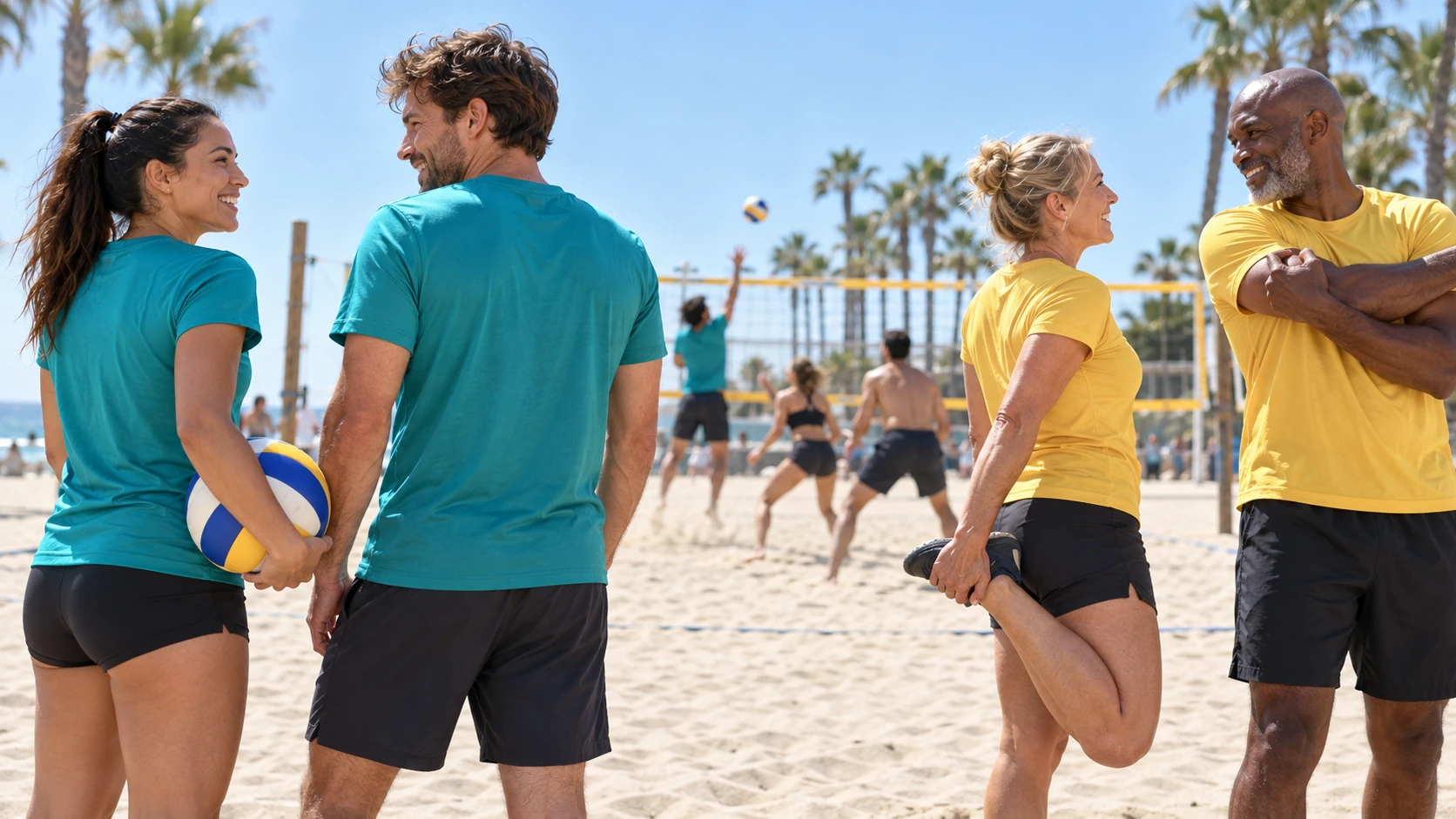
- The court has two sides with different jobs. One half is the king side (or queen side in women's play). The other half is the challenger side.
- The challengers always serve. Every rally starts with a serve from the team on the challenger side. In the Volleyball Ireland rules that team chooses which player serves, with no limit on how often the same player serves.
- Only the king side scores. If the team on the king side wins the rally, it gets one point and stays. The losing challengers go to the back of the line, and the next team in line steps onto the challenger side.
- A challenger win is a takeover, not a point. If the challengers win the rally, they move to the king side with no point added, and the team they replaced goes to the back of the line.
- Rounds are played against the clock. When time runs out, the team with the fewest points is eliminated, and the next round starts with one team fewer. The final round goes to the first team to 15 points, or to the highest score when time runs out.
USA Volleyball's summary compares it to sideout scoring, except that the side of the court matters, not who holds the serve. That is the part beginners get wrong: winning a rally on the challenger side feels like a point, but it only earns the right to defend.
Event rules add details you can borrow for a club session. Volleyball Ireland allows a maximum of 10 seconds between rallies and no team time-outs. A serving error by the challengers gives the king side nothing, except that three serving errors in a row give the king side a point, and in the last minute of a round every serving error counts as a point. The rally in progress when the horn sounds is finished, and its point counts. If two teams are tied for last when a round ends, the team that spent less time on the king side is eliminated. The starting order is drawn before the match.
Worked Example: 12 Rallies With Five Teams
Five pairs, A to E. A draw puts A on the king side, B on the challenger side and C, D and E in line, in that order. Follow the line column: whoever loses a rally goes to its end.
| Rally | King side | Challenger | Line | Rally won by | Points after the rally |
|---|---|---|---|---|---|
| 1 | A | B | C, D, E | A, +1 | A 1 |
| 2 | A | C | D, E, B | A, +1 | A 2 |
| 3 | A | D | E, B, C | D, takes the king side | A 2 |
| 4 | D | E | B, C, A | D, +1 | A 2, D 1 |
| 5 | D | B | C, A, E | B, takes the king side | A 2, D 1 |
| 6 | B | C | A, E, D | C, takes the king side | A 2, D 1 |
| 7 | C | A | E, D, B | C, +1 | A 2, C 1, D 1 |
| 8 | C | E | D, B, A | C, +1 | A 2, C 2, D 1 |
| 9 | C | D | B, A, E | C, +1 | C 3, A 2, D 1 |
| 10 | C | B | A, E, D | B, takes the king side | C 3, A 2, D 1 |
| 11 | B | A | E, D, C | B, +1 | C 3, A 2, B 1, D 1 |
| 12 | B | E | D, C, A | E, takes the king side | C 3, A 2, B 1, D 1, E 0 |
Two things stand out. First, B won three rallies (5, 10 and 11) and has 1 point, while A won only two and has 2: rallies won on the challenger side do not count. Second, E spent most of the time in line and has no points yet. If the horn sounded now, E would be eliminated. That is why the clock and the order of the line matter so much, and why the waiting teams should watch the line instead of the score.
Pickleball and Padel: The Court Ladder Version
In pickleball, King of the Court almost always means a ladder across several courts. PlayPickleball lists it as the same thing as Queen of the Court, Up River Down River, Ladder and Waterfall. Many padel and beach tennis clubs run the same ladder for social nights. There is no governing body rule for it, so what follows is the common pattern, taken from club format pages such as Pickleball Regina's, with the points where clubs differ:
- Courts are ranked. One end is the top court, the king court, and the other end is the bottom court. Which number is the top is a local choice: some clubs put the strongest players on the highest numbered court, others on court 1. Say it out loud before round 1.
- The first round is placed by level or by draw. Pickleball Regina places players by skill rating on the first round. Without ratings, a random draw works, and the ladder sorts people out after a few rounds.
- Winners move up one court, losers move down one. The winners on the top court stay there, because there is nowhere higher to go. The losers on the bottom court stay there too.
- Partners split. After a move, the two players who were partners go to opposite sides of the net, each paired with one of the two players arriving from the other court. Some groups let winners stay together; splitting is the more common rule because it stops a strong pair from camping on the top court.
- Games are timed or played to a score. Timed games keep every court moving at once. Pickleball Regina uses 13 minutes: when the buzzer sounds, the rally finishes and the team ahead wins; a tie is settled by one more rally. Untimed groups play to 11.
- Extra players wait their turn. In many groups they come in on the bottom court and the players who lose there step out. Pickleball Regina instead lets them line up behind a middle court of their choice, with no more than two waiting per court.

The ladder needs no bracket and no schedule: the results of each round build the next one. That is its appeal for mixed groups, and also its weak point, because one wrong move at one court breaks the next round for everyone.
Post the House Rules Where Everyone Can Find Them
A free VISU Link page can hold your King of the Court rules, the session times, the court address and the sign-up link, so nobody argues about the format at the net.
Worked Rotation: 12 Players on 3 Courts
Twelve players, three courts, court 1 as the king court. Round 1 is a draw. The table shows who plays where and who wins, and how the winners and losers are recombined for the next round. In each new pairing, the two players who arrive together are split across the net.
| Round | Court 1 (king court) | Court 2 | Court 3 |
|---|---|---|---|
| 1 | Ana + Ben vs Cris + Dani | Eva + Fran vs Gabi + Hugo | Ivo + Juli vs Kai + Leo |
| 2 | Ana + Gabi vs Ben + Hugo | Cris + Ivo vs Dani + Juli | Eva + Kai vs Fran + Leo |
| 3 | Ben + Cris vs Hugo + Ivo | Ana + Fran vs Gabi + Leo | Dani + Eva vs Juli + Kai |
Winners are in bold. Here is how round 2 was built from round 1:
- Court 1: Ana and Ben won, so they stay and split. Gabi and Hugo won on court 2, so they come up and split too. Result: Ana + Gabi vs Ben + Hugo.
- Court 2: Cris and Dani lost on court 1 and come down; Ivo and Juli won on court 3 and come up. Result: Cris + Ivo vs Dani + Juli.
- Court 3: Eva and Fran lost on court 2 and come down; Kai and Leo lost on the bottom court and stay. Result: Eva + Kai vs Fran + Leo.
Round 3 follows the same moves. Nobody in round 3 has the same partner as in round 1 or 2, which is the point of splitting. Ivo started on the bottom court and, with two wins in a row, plays on the king court in round 3.
If you also keep a ranking, one common house rule is to make a win worth more on a higher court: with 3 courts, 3 points on court 1, 2 on court 2 and 1 on court 3. After two rounds of the example, Ben has 6 points, Hugo 5, Ana and Ivo 3 each, Gabi and Cris 2 each, and Juli, Fran and Leo 1 each. The King of the Court organizer uses this weighting, does the splitting for you and handles players waiting in line.
Time Limits, Scoring and How Many Teams
There is no single official length. These are the numbers the sources publish, which make a sensible starting point for your own session:
| Who | Format | Time and scoring |
|---|---|---|
| King of the Court pro beach series (as described by Volleymob) | Five teams, then four, then three | 20 minutes with five teams, 16 minutes with four, lowest score out each time; final to 15 points or the highest score after 20 minutes |
| Volleyball Ireland tournament rules | Five teams per game | Three rounds of 15 minutes, lowest score out after each; one-minute time-out after 10 minutes; final round to 15 points or 15 minutes |
| Pickleball Regina (ladder) | Four players per court | 13-minute games, one extra rally to break a tie |
| PlayPickleball (ladder) | Four players per court | Timed games, or games to 11 |
How many teams on one volleyball court. With n teams, two are on court and n - 2 are in line. Five is what the event rules use. With four teams the waits are shorter and the game is more continuous. With seven or eight teams, each team spends most of the round watching, so split into two courts if you have them.
How many players on a ladder. Four per court is the ideal: 8 players for 2 courts, 12 for 3, 16 for 4. Extras wait their turn, and a cap such as Pickleball Regina's two waiting players per court keeps rest time even.
Scoring in a club session. In volleyball, the score is simply the points won on the king side during the round. On a ladder, most groups only track where each player finishes, or count wins weighted by court as in the example above. Whatever you choose, decide the tie-break before the first game: number of wins, then point difference is a common order.
Fairness Tweaks Worth Announcing
These are common house rules, not official ones. Pick the ones that solve a problem your group actually has, and announce them before the first serve.
- Protect the challengers from cheap points. In volleyball, a serve error should not hand the king side a point. Volleyball Ireland's three-errors-in-a-row exception, and the last-minute exception, are a good compromise: they stop teams from serving soft forever without making every miss a gift.
- Cap how long winners can stay on a challenge court. On a single pickleball or padel court where winners stay on, PlayPickleball notes that winners often have to leave after a set number of games, usually three, and Pickleball Regina makes winners leave after two. Without a cap, the strongest pair can hold the court all evening.
- Split partners on the ladder. It spreads the strong players around and makes every player earn the move up. Keep pairs together only if the session is meant for fixed partners.
- Finish the rally at the horn. The rally in progress counts. It avoids arguments about whether a ball was in the air when time ran out.
- Seed the first round when levels are very mixed. A draw is fine for friends. For a club night with beginners and advanced players, place the first round by level, as the pickleball clubs do, so beginners are not stuck on the king court for a whole round.
- Keep the line fixed. In volleyball, the order of the waiting teams is set at the start and does not change. Teams that cut in are the most common source of arguments.
- Switch to rally scoring when the first court finishes. When ladder games are played to 11 instead of timed, PlayPickleball notes that the remaining courts often go to rally scoring (every rally scores, whoever serves) once the first games end, so every court finishes close together and nobody waits long for the next round.
Running the Session: Scores, Pairs and Replays
The format falls apart when nobody knows the score or the order of the line, so give one person the job of tracking both. A phone works: the online scoreboard can keep the score of each court, which matters most in the volleyball version, where the score only moves on one side of the net.
For the volleyball version you need fixed pairs before the first rally. If you are forming them from a list of names at the court, a random doubles generator draws them in seconds. For bigger sides and pickup nights where the winning team keeps the court, our guide on how to make fair random teams covers balanced draws and the "winners stay on" bench rotation.
King of the Court also works as the social part of a bigger event: a ladder in the morning, a knockout in the afternoon. If you need the afternoon part, see how to make a tournament bracket, which covers byes, seeding and the court schedule.
If the session is at a venue with VISU Replay, the cameras record while the court is in use. Afterwards, players open the VISU app, find the court and their game time and download the clips. In a format where one rally decides who holds the king side, being able to watch that rally again is part of the fun.
Watch the Rally That Won the King Side
Courts with VISU Replay record automatically while they are in use, so players can download and share their best rallies after the session.
Frequently Asked Questions
Can you score on the challenger side in King of the Court?
Not in the volleyball format. Points are only won on the king side. A team that wins a rally on the challenger side moves to the king side without scoring and has to win the next rally there to get a point.
How many teams do you need for King of the Court volleyball?
Event rules use five teams per court: two playing and three waiting. Four teams also works and gives shorter waits. With more than six, waits get long, so a second court helps.
How long is a round of King of the Court?
It depends on the organizer. Volleyball Ireland plays three rounds of 15 minutes. The pro beach series described by Volleymob used 20 and 16 minutes, with a final to 15 points. Pickleball ladders often use timed games, such as 13 minutes at Pickleball Regina, or games to 11.
Do partners stay together in pickleball King of the Court?
Usually not. On a court ladder, the most common rule is that partners split after every move and each plays with someone arriving from the other court. Some groups let winners stay together, and on a single challenge court the winning pair stays as a team.
What is the difference between King of the Court and a round robin?
A round robin has a fixed schedule in which everyone meets everyone. In King of the Court the next opponent depends on the last result: the score decides the side in volleyball, and the court decides it on a ladder.