

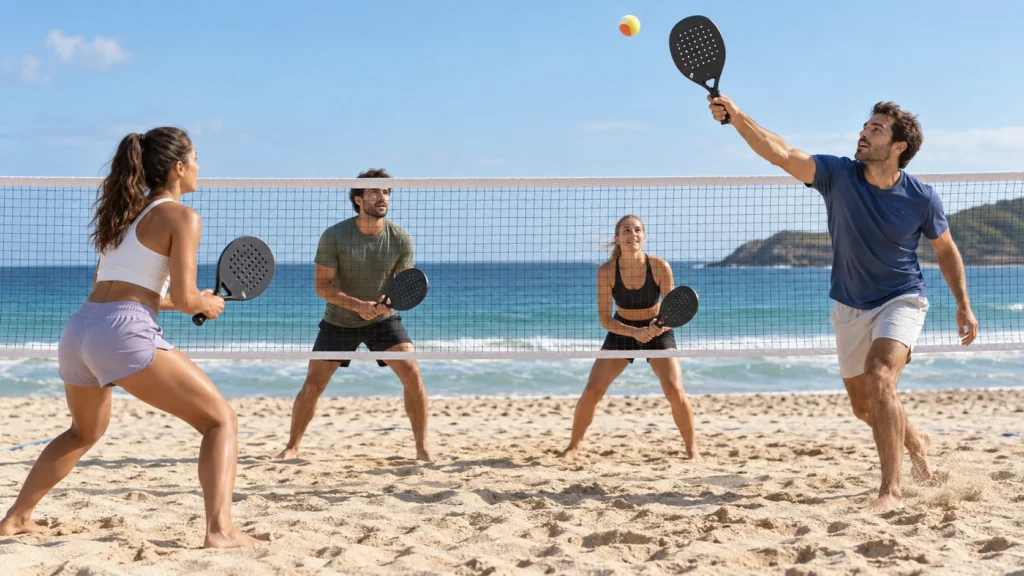
Almost nobody arrives at beach tennis with a blank slate. You show up carrying a mental model from tennis or from volleyball, and most first-game mistakes come from applying that old model to a game that quietly changed the rules underneath it.
So the useful way to learn is a list of differences: what this sport kept from the game you know, what it removed, and which error each change produces in a beginner.
The Play Is Already Recorded
At a court with VISU Replay, the cameras run continuously. You press the button after the play and the clip is already there, cut and ready, without anyone leaving the game to film.
A Hybrid, Not a Version of Tennis
Start with a category error. Beach tennis is not tennis played on sand, and it is not volleyball with rackets. It is a game combining elements of tennis and volleyball and played on a beach, and each half of that explains part of your first hour.
From tennis it takes the racket, the ball and the way points are counted. From volleyball it takes the ground: a sand rectangle with a net built for people jumping, not for people running along a baseline. The sport preserves most of the rules and scoring of traditional tennis, but the ball is not allowed to touch the ground, and other modifications have been made to adapt to movement around the sand court and to the faster pace of the game.
The typical beginner error: assuming you can transfer your tennis rhythm intact, then feeling clumsy within three points. Nothing is wrong with your coordination. You are running a routine designed for a bouncing ball in a game that deleted the bounce.
You are also joining something with a real footprint. Beach tennis is played in over 50 countries and by more than half a million people, with its greatest popularity occurring in Italy, Brazil and Spain. If you are reading this in Brazil, the crowded courts you walk past are not a coincidence.
The Rule That Defines Everything
If you remember one line, make it this one. The ball is not allowed to touch the ground. There is no bounce. A ball that lands is dead, and the point is over before you get there.
The consequence is that the game is played entirely with volleys, which makes for a quicker game than does traditional tennis. The stroke you spent years building, the one that waits for the ball to come up off the surface, has nowhere to happen.
It also changes what ends a point. Points start with a serve and end when the ball touches the ground, forcing players to dive to reach difficult plays in a similar manner used by volleyball players. The floor is sand, so falling is cheap and reaching a ball with your body is a normal play.
The typical beginner error: waiting. The tennis reflex is to let the ball drop into a comfortable strike zone. On sand that reflex loses the point in silence: you wait, the ball lands, and you are still preparing when your partner tells you it is over.
The fix is a posture, not a technique. Stand with the racket already up around chest height, weight forward, and treat every incoming ball as something to intercept.
A second consequence follows. The objective is to return the ball with only one hit so that it reaches the opposing side of the net. You get no setup touch, and neither does your partner, which makes calling the ball early far more important here.
The Court: Smaller Ground, Higher Barrier
Two things about the playing area surprise tennis players: the ground you cover is smaller, and the barrier you clear is higher.
The sport is usually played by two-person teams on a 16-by-8-metre beach tennis court. Under the 2026 ITF rules, the net is 1.80 m for men's and 18-and-under boys' events, and 1.70 m for women's, 18-and-under girls' and mixed doubles events. The sand court feels compressed beside a tennis court, and either net sits well above your waist, nothing like the low tennis net.
Because it is a beach volleyball court, the published dimensions are a useful reference: that court is 16 m (52.5 ft) long and 8 m (26.2 ft) wide, surrounded by a clear space, which is at least 3 m (9.8 ft) wide on all sides. Compared with the ground a tennis doubles pair covers, that is a small box, and reaction time matters more here than lateral running.

The typical beginner error: hitting flat and low, the way you would drive a passing shot in tennis. Against a net at that height, a flat drive is a net error most of the time. Lift the ball slightly and aim for depth rather than for the corner.
The second error is spatial. Two players who both drift to the middle leave two open alleys, and two who both hug their sideline leave a corridor down the centre. Neither is a violation, and both are how beginners lose points nobody hit well.
Find Out If Your Court Has It
VISU Replay only exists where it has been installed, so the useful first question is whether the place where you already play has cameras.
The Racket Has No Strings
Pick up a beach tennis racket and the difference registers before anyone explains it. There are no strings. The face is a solid panel, usually perforated, and the frame is short. It behaves nothing like a strung racket.
Strings do work for you in tennis: they grip the ball and let you brush across it for spin. A solid face does none of that. Contact is short and firm, the ball leaves quickly, and the spin you are used to applying largely does not appear.
The typical beginner error: a long, brushing swing. On a solid face that swing mostly adds error, and the extra motion means you arrive late for the next ball, which matters because there is no bounce buying you time.
Shorten everything. A compact punch from a high ready position, racket face doing the work and arm doing very little, is closer to a volleyball block than to a forehand.
The Ball Is Slower on Purpose
The ball looks familiar and is not. A depressurized tennis ball, which travels more slowly through the air than does a regulation tennis ball, is used for beach tennis to allow for longer rallies.
Read that as design intent. The sport removed the bounce, which shortens rallies, then slowed the ball down, which lengthens them again. The result is a game where points last long enough to be fun for people who have never played.
The typical beginner error: misreading pace as a reason to hit harder. A slower ball invites big swings, and big swings collide with a solid face and a high net. The rally is long because the ball is patient, not because you need to force it.
A practical corollary: if someone hands you a regular pressurised tennis ball on a sand court, it flies faster, rallies collapse, and everyone concludes they are bad at the sport. They are not. The ball is wrong for it.
Wind belongs here too. Beach courts are exposed, so play a few points before deciding anything about your technique: the same shot into the wind and with the wind is effectively two different shots.
The Serve Starts a Rally Immediately
The serve is where the borrowed mental model breaks most visibly, because a tennis player expects a pause and does not get one. Points start with a serve and end when the ball touches the ground, so there is no gap between serve and rally. The ball is live from your contact until it hits the sand, and the exchange is at full speed on the first shot.
Beginners serve over the shoulder, from below, or with a short flat push. What matters more than style is that a serve landing in play starts a rally. Ask your group what they play, because social courts often use a simplified serving convention.
The typical beginner error: serving as if the serve is a weapon. In tennis a big serve can end a point outright. Here you are launching a slow ball over a high net into a small court, at opponents whose rackets are already up.
The other error is standing still to admire it. With no bounce, the reply can come back before your feet have moved.

Doubles Is the Default
Singles exists, but the format on a public court is almost always two against two, and the geometry assumes it.
Doubles here does not work the way tennis doubles works. In tennis one player often stays back because the bounce makes a baseline position viable. With no bounce there is no baseline game. Both players are volleying, which pushes the pair into a shape closer to beach volleyball: side by side, both able to take a ball at height.
The typical beginner error: hanging back and letting a ball drop while your partner covers the front. That leaves half the court unattended at the height where the ball actually travels.
The second error is silence. Because only one hit is allowed, the middle ball is genuinely ambiguous, and two players both reaching for it is the most common way a beginner pair loses a rally. Decide out loud before the ball arrives, even if you decide badly.
Positioning also shifts with wind and sun. Sides are not equal on a beach at five in the afternoon, so sensible groups change ends, and if yours does not, ask.
Scoring Comes From Tennis
Here is the friendly part. Beach tennis keeps the tennis point names, love, 15, 30 and 40, but its standard game is No-Ad: at deuce, one deciding point wins the game. If that vocabulary is unfamiliar, learn it once away from the court rather than mid-rally.
The typical beginner error: assuming the format is standardised because the vocabulary is. Social groups shorten matches constantly, and the shortening is a house convention rather than a rule. Ask how long you are playing to before the first serve.
The other warning is about who keeps score. There is no umpire on a public sand court, so the server usually calls the score aloud before serving. Say it every point and disputes mostly stop happening.
Line calls work by agreement too. Sand leaves no clean mark the way clay does, so the convention that keeps social games pleasant is simple: if nobody is certain, replay the point.
Moving on Sand
No rulebook explains that you cannot push off sand the way you push off a hard court, but it will define your first session more than any regulation. The modifications to the game exist partly to adapt to movement around the sand court. The surface gives way under load, so the explosive first step you rely on elsewhere does not exist.
The typical beginner error: trying to run to the ball and arriving late and off balance. Sand punishes distance travelled far more than it punishes reaction speed. The players who look comfortable on a beach court are not faster. They are better positioned to begin with, so they move less.
Two adjustments follow. Stay lower and wider in your ready stance, and read the ball earlier, because your correction window is shorter here than anywhere else.
Falling is part of the game rather than a sign something went wrong. Points end when the ball touches the ground, which pushes players to dive for difficult balls, and sand is why that is reasonable.
Your First Game: What to Fix in Order
Corrections have an order, and beginners who follow it improve inside one session.
First, raise your ready position. Racket up around chest height before the ball is hit. This addresses the no-bounce rule, the high net and the speed of the exchange at once.
Second, shorten your swing. The solid face does not need help. A compact punch beats a full stroke, and the time you save returns to you as readiness for the next ball.
Third, lift the ball. The net is higher than your instincts expect. Aim over it with margin and let depth do the work.
Fourth, talk. One hit per side means the middle ball has to be claimed out loud.
Fifth, stop running so much. Sand rewards the player who never needed to sprint.
Notice what is missing: technique. Everything above is a decision rather than a skill, which is why beach tennis is easy to start and takes a while to master.
Once the rules stop occupying your attention, the next thing people want is to see what a point actually looked like. That is a separate subject, and our guide to recording a beach tennis match covers where the camera goes and what is worth keeping. This article is about how the game is played. That one is about how it is captured.
If You Run the Venue
A fixed camera means every group that books gets the clip without bringing equipment, and every clip leaves carrying the name of your court.
FAQ
Can the ball bounce in beach tennis?
No. The ball is not allowed to touch the ground, and a point ends when it does. Every shot is a volley, the single biggest difference from tennis.
Do I need a tennis background to start?
No, and in some ways it helps not to have one. Tennis players must unlearn waiting for the bounce. A volleyball player often adapts faster because the ready position and the sand movement are already familiar.
Is the racket the same as a tennis racket?
No. Beach tennis rackets are solid rather than strung: shorter contact, less spin, firmer feel.
Why does the ball feel dead?
Because it is meant to. A depressurized ball travels more slowly through the air than a regulation tennis ball, deliberately, to allow for longer rallies.
How is the score counted?
Beach tennis uses the familiar love, 15, 30 and 40 calls, but the standard game is No-Ad: at deuce, one deciding point wins the game. Social groups may shorten the match format, so ask what your group plays to before the first serve.
Is it a singles or doubles sport?
Both exist, but it is usually played by two-person teams, and the court and net are set up around that. Expect doubles on a public court.
Where is it most popular?
It is played in over 50 countries, with its greatest popularity occurring in Italy, Brazil and Spain.