

The attention economy.
Your time, in perspective.
Understand where your time goes, what you get in return and which choices are worth making. Start with your own attention.
Examples use the calculator’s method: 365 days and full days of 24 hours. Read the method →
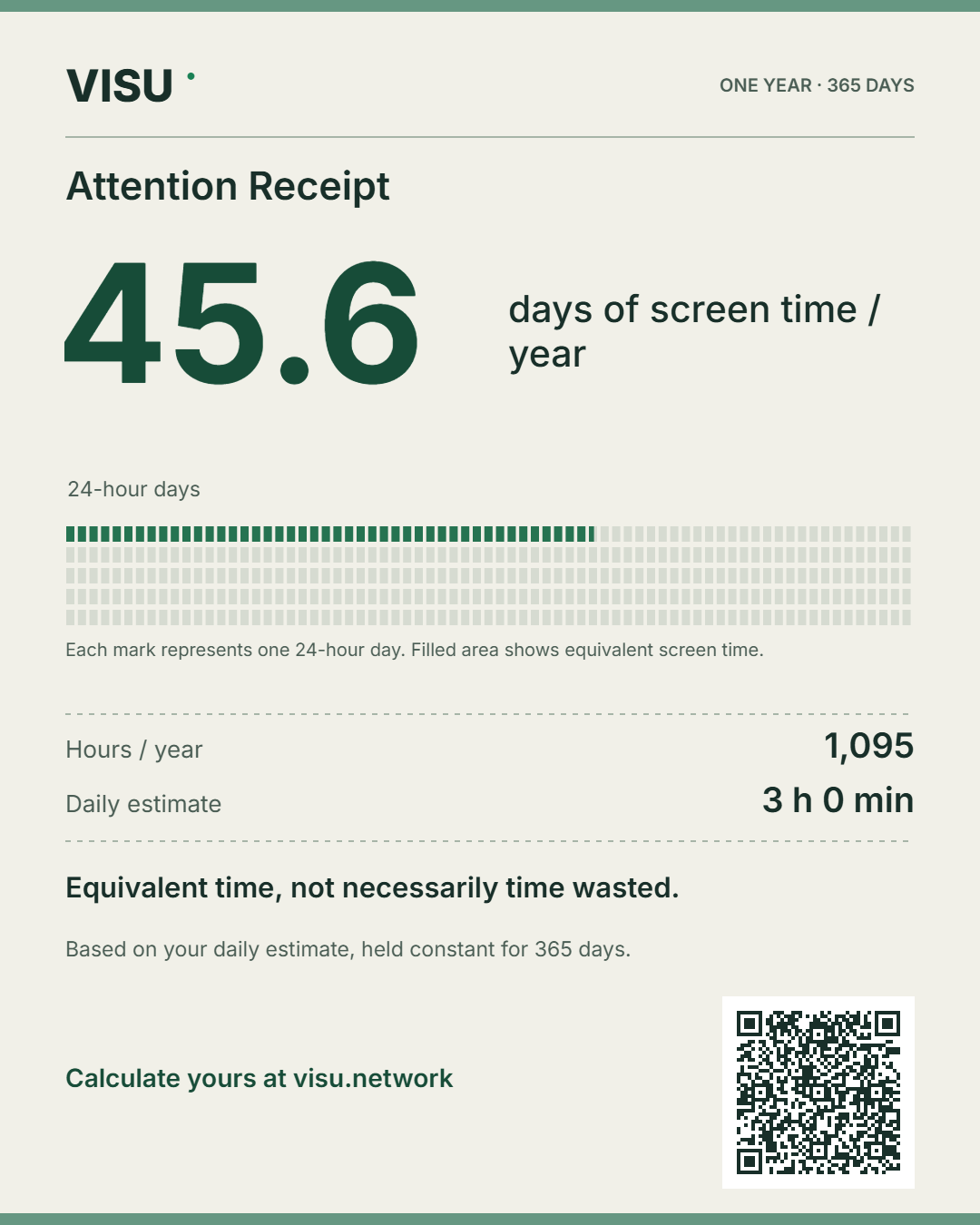
Example: 3 hours a day, repeated for a year.
What would you like to understand?
One question at a time. Choose a tool, make sense of your result and take it further.
Attention Tax Calculator
Turn hours and minutes into a year of screen time. Save a receipt with your result and its context.
Calculate your screen time3 h/day
45.6
full days / year
1,095 hours. A 365-day year.
Earning Personality Quiz
Seven questions about your habits and preferences. Explore a profile and activities that may suit you.
Discover your profileEXAMPLE PROFILE
The Urban Explorer
Movement · curiosity · discovery
A style of engagement, not an income forecast.
Reward Apps Comparison
Look beyond the headline reward. Compare activities, effort and redemption conditions before choosing.
Compare reward appsLOOK AT THE WHOLE OFFER
Time. Effort. Payout.
Country · eligibility · minimum withdrawal
Confirm current conditions with each app.
Attention Economy Glossary
Get familiar with verified attention, scan-to-earn and the terms behind the tools.
Explore the glossaryA TERM TO KNOW
Verified attention
An interaction checked against defined criteria.
Verification does not establish a universal hourly value.
Information is abundant.
Attention has a limit.
The attention economy describes competition for the time and focus people can give. A feed, a video and a local experience can all ask for a slice of the same day.
Your screen time is not automatically wasted time. Work, learning and connection can be valuable. The useful question is whether you are choosing how to spend it.
What if it were 30 minutes less?
At 3 hours a day, a year contains 1,095 hours of screen time. Reducing that estimate by 30 minutes a day changes the annual total by 182.5 hours: about 7.6 full days.
This is a scenario you can calculate, not a promise that every hour can become productive work or income.
Explore your own numbersDifference over a year
182.5 hours≈ 7.6 full days
Questions behind the numbers
What is the attention economy?
It is competition for human time and focus. Businesses may connect that attention to advertising, subscriptions, transactions or other forms of value.
Why is attention valuable?
There is a limit to how much we can pay attention to. What a person chooses to watch, learn or act on can matter to both that person and a business. There is no single price for an hour of attention.
How do platforms make money from attention?
Advertising is one model: a business pays for the opportunity to reach an audience. Subscriptions and transactions are other models. Time spent on a platform alone does not reveal its revenue from an individual.
Can people receive rewards for their attention?
Some offers reward a defined action under specific conditions. Availability, eligibility and redemption rules matter. Our screen-time calculator does not predict a reward or an amount owed to you.
What is verified attention?
An interaction checked using criteria such as an action or presence at a place. What is checked depends on the service. Verification alone does not prove a fixed monetary value.
Calculate your screen time.
Start with one estimate. Leave with a receipt you can save, share and think about.