
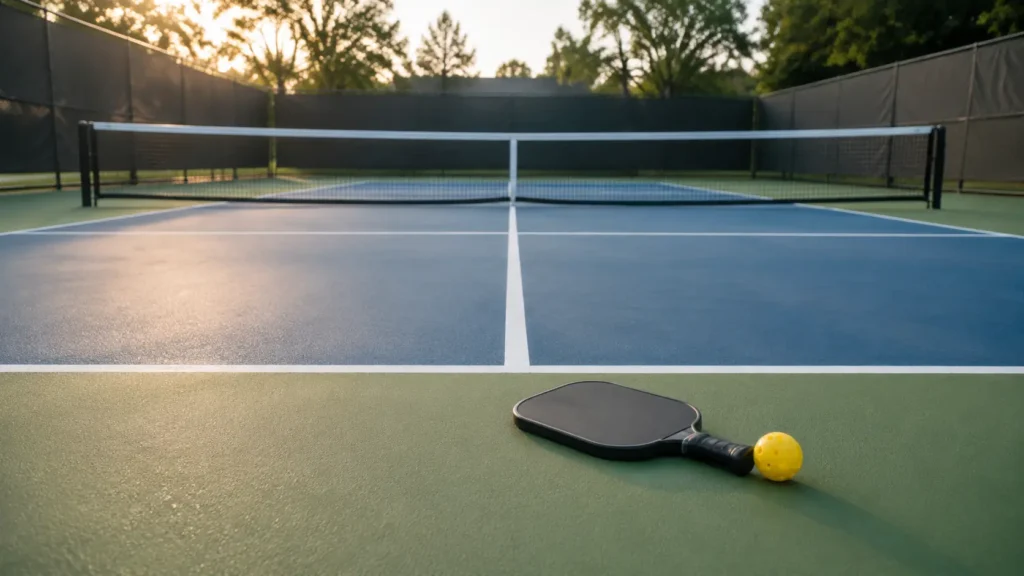
Playing games is the slowest way to fix the shots that decide most pickleball rallies. A drill isolates one shot, repeats it until it holds up, then puts it back into a point. The drills below are organised by fundamental: serve and return, dink, third shot drop, volley, footwork and positioning, and they run solo against a wall, in pairs, or with four players.
This is a training guide, not a rules guide. Where a term has an official definition, it is quoted from the 2026 USA Pickleball Official Rulebook or from USA Pickleball's own skills pages. The drills are instructions, verified by doing them; counts and times are suggestions. To film your drills and check your form, see our guide to filming amateur sports.
One Link for Your Practice Group
A short address you control, pointing to your court, your drill partners and the clips you want to keep.
Before You Drill: Terms, Space and Warm-Up
Four terms come up in every drill below, with their official wording.
- Non-volley zone, or kitchen. The rulebook defines it as "the 7-foot by 20-foot area of the court on each end of the net where players are not allowed to volley the ball." The line that bounds it is part of the zone.
- Volley. "A strike of the ball before the ball bounces." Rule 11.A adds that "all volleys must be initiated outside of the non-volley zone."
- Dink. USA Pickleball's basic terms page: "a soft shot hit on a bounce from the NVZ intended to arc over the net and land within the opposing NVZ either straight across or diagonally crosscourt."
- Drop shot, or third shot drop. Same page: "a soft shot hit off a bounce from deep in the court, intended to land in the opponents' NVZ, preferably close to the net." The serving team uses it, in USA Pickleball's words, "literally on the third shot of the rally, after the serve and return."
One rule shapes every drill that starts with a serve. Rule 10.A: "The serve and the return of serve must each bounce before being returned." That is the two-bounce rule. The rulebook uses "double bounce" for something different, a ball bouncing twice on one side, which is a fault under Rule 10.B.1.
Space. Half a court works for every paired drill here, and a flat wall works for the solo ones. Rule 3.B.7 puts the net at 34 inches (86.36 cm) at the centre, so tape a wall line at that height.
Warm-up and water. A few minutes of easy movement and shadow swings first, water within reach. That is stated as common practice on a court, not as advice about your body; medical questions go to someone qualified to answer them.
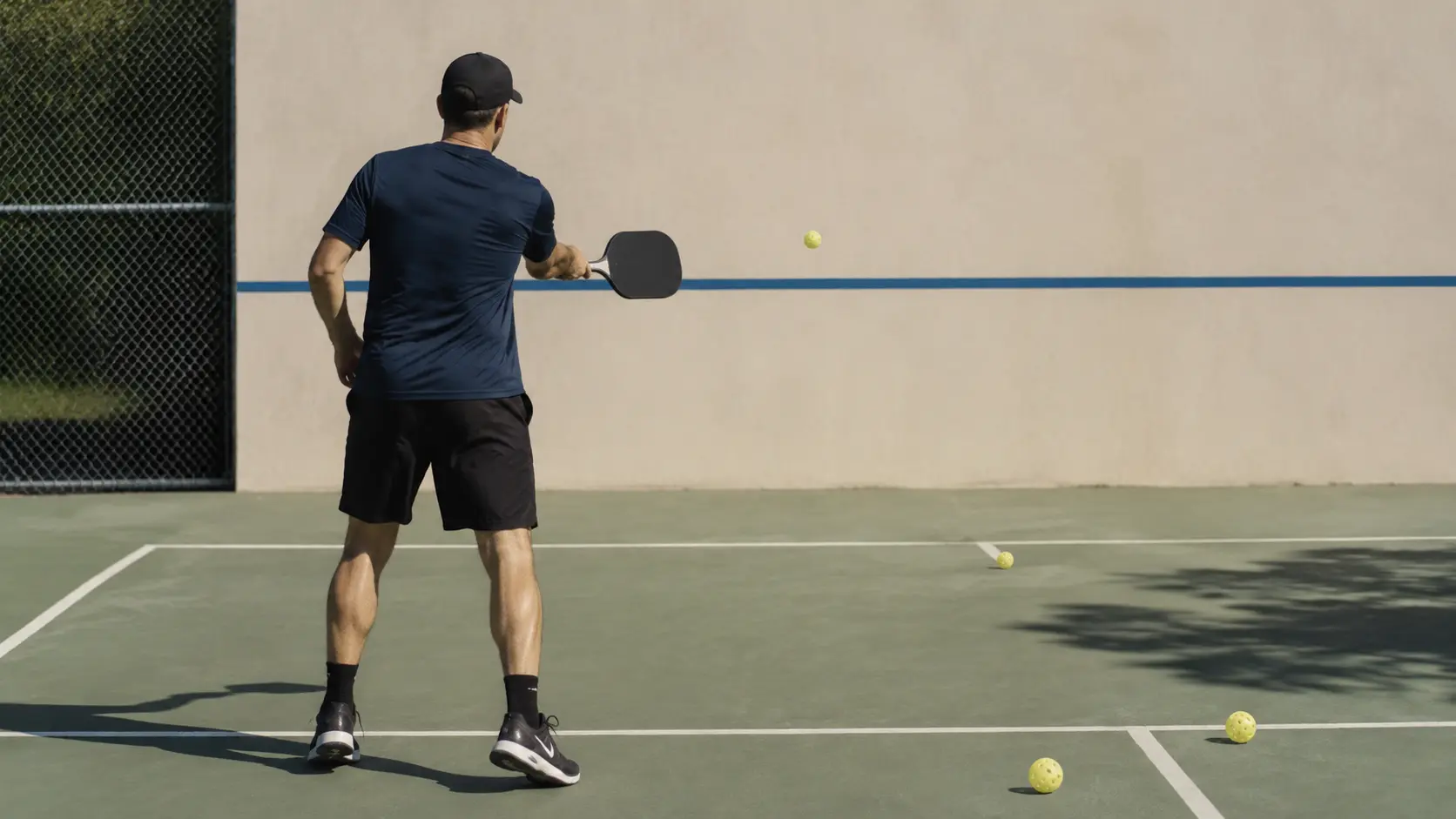
Solo Drills Against a Wall
A wall returns everything. Tape the line at 34 inches and, if you have room, a floor line about seven feet (2.13 m) from the wall to stand in for the kitchen line.
1. Wall dink taps.
Objective: a compact dink swing with contact in front of the body.
Setup: at your floor line, paddle face slightly open, feed a gentle underhand ball so it comes back and bounces once before you dink it again.
Suggestion: three sets of 20 continuous dinks.
Variation: alternate forehand and backhand.
Watch for: USA Pickleball's dink guidance is "less is more," a swing that is "small and compact," the paddle face "angled up to lift the ball over the net," and the paddle "in front of your body at all times."
2. Wall volley blocks.
Objective: a volley that blocks rather than swings.
Setup: a step behind your floor line, paddle at chest height, feed a firmer ball so it comes straight back without bouncing.
Suggestion: three sets of 15 in a row; a miss restarts the count.
Variation: one soft block, one firmer push, alternating.
Watch for: USA Pickleball describes the volley as hit "in a blocking motion with the paddle face square (vertical)." If the paddle drops below your waist between hits, you are winding up.
3. Wall drop ladder.
Objective: the drop arc from progressively deeper positions.
Setup: from the floor line, hit a soft, lifted ball that touches the wall just above the tape and drops near its base. After five good ones in a row, take a big step back. Where it falls apart is your current range.
Suggestion: one ladder out and back, twice.
Variation: drop from the deepest rung, walk forward two steps during the flight, and dink the rebound.
Watch for: USA Pickleball's third shot drop guidance is to hold the paddle "loosely, around a three on a scale of one to ten for grip pressure," because "the tighter you squeeze, the farther the ball will fly." A drop that hits the wall high is usually a tight grip.
Serve and Return Drills
Rule 7.C.1: "The server's paddle must be moving in a clear upward arc when the paddle contacts the ball." Rule 7.C.3: "The ball must clearly be no higher than the server's waist when the paddle contacts the ball." The drop serve, Rule 7.D, is "dropping the ball and hitting the ball with the paddle after the ball bounces on the playing surface."
4. Bucket serves to a deep target.
Objective: a legal serve that lands deep, every time.
Setup: a bucket of balls behind the baseline. Lay a towel a couple of feet inside the far baseline, in the centre of the diagonal service court. Serve the whole bucket at it, collect, and serve from the other side.
Suggestion: two buckets per side, counting only balls beyond the towel.
Variation: the same bucket with the drop serve.
Watch for: USA Pickleball's serving basics say placement "should be deep and to the center of the diagonally opposite service court to keep the receiver back." Rule 8.C makes a serve that "lands on the non-volley zone line" out.
5. Deep return and move up.
Objective: a return that lands deep and a receiver already moving forward.
Setup: partner serves from the bucket. You return toward the far baseline, take three quick steps toward the kitchen line, and stop in a ready position. Partner does not play the return; they serve the next ball.
Suggestion: 15 returns each, then swap.
Variation: partner calls "forehand" or "backhand" as they serve.
Watch for: USA Pickleball says the goal is "to return the serve deep to keep the serving team at the baseline; power is not as important as control." If you cannot reach the line before the next ball, "stop and assume the ready position," then keep going after you hit.
Keep the Rallies Worth Keeping
Film a drill, keep the clip, and share it with your partner from one short address.
Dink Drills
USA Pickleball calls the dink "arguably the most fundamental shot in pickleball," and the reason is the kitchen: a dink that bounces in the opposing non-volley zone cannot be volleyed from inside that zone, so it has to be played off the bounce.
6. Cross-court dink count.
Objective: a long, patient dink rally.
Setup: two players at the kitchen line, diagonally across. Dink cross-court only and count out loud.
Suggestion: rallies of 20, then 30, switching diagonals halfway.
Variation: every fifth ball must land in the front half of the kitchen.
Watch for: USA Pickleball notes that "crosscourt dinks are easier because the net is lower in the center," which is why this comes before the straight version. If the rally keeps dying, loosen the grip: their dink page puts pressure "at about a 2" on a scale of one to ten.
7. Dink and move.
Objective: moving the feet instead of reaching.
Setup: straight across at the kitchen line. Partner dinks alternately to your left and right, a couple of steps each way. You get behind each ball and dink it straight back so they can keep feeding.
Suggestion: 2 minutes each, three rounds.
Variation: start with no paddle, catching each ball in front of the matching knee and tossing it back, which is how USA Pickleball's own kitchen line footwork drill begins.
Watch for: USA Pickleball's footwork guidance is to "get behind the ball before making contact," and warns that "reaching for the ball often leads to inconsistent shots."
Third Shot Drop Drills
USA Pickleball describes the third shot drop as "the strategic bridge between the baseline and the Kitchen line," a soft shot from deep that "lands softly in your opponent's Kitchen, forcing them to let it bounce."
8. Drop ladder, mid-court to baseline.
Objective: the drop arc at increasing distance, without moving forward yet.
Setup: partner at the kitchen line feeds a bounced ball to you at mid-court. You drop it into their kitchen. After five good drops in a row, step back two paces, until you are behind the baseline. Partner blocks each ball and feeds the next.
Suggestion: one ladder, twice, then swap.
Variation: every feed to your backhand.
Watch for: USA Pickleball's advice is a semi-open stance and a paddle that stays in front, with the image of "a brick wall right behind your legs" that the paddle "should never swing past."
9. Drop and advance to the line.
Objective: the drop followed by the walk-up, with a stop each time the opponent hits.
Setup: you at the baseline, partner at the kitchen line. Partner feeds deep, you drop, then move forward. Partner dinks your drop back. Wherever you are when they hit, stop, split step, play the ball softly, then keep moving. The point ends when you reach the line and dink three in a row.
Suggestion: 10 points each, then swap.
Variation: if your drop is high, partner may volley it at your feet, which shows what the drop is protecting you from.
Watch for: USA Pickleball's positioning guidance names the area between the baseline and the kitchen line "the transition zone" and says "it's not a place you want to linger," because "it's easy for opponents to hit hard, downward shots at your feet."
Volley Drills
The definition is the technique: "a strike of the ball before the ball bounces." USA Pickleball's basic terms page says to hit it with "the paddle face square (vertical) to 'push' the ball over the net."
10. Kitchen line block volleys.
Objective: a controlled volley rally with no backswing, then a chosen target.
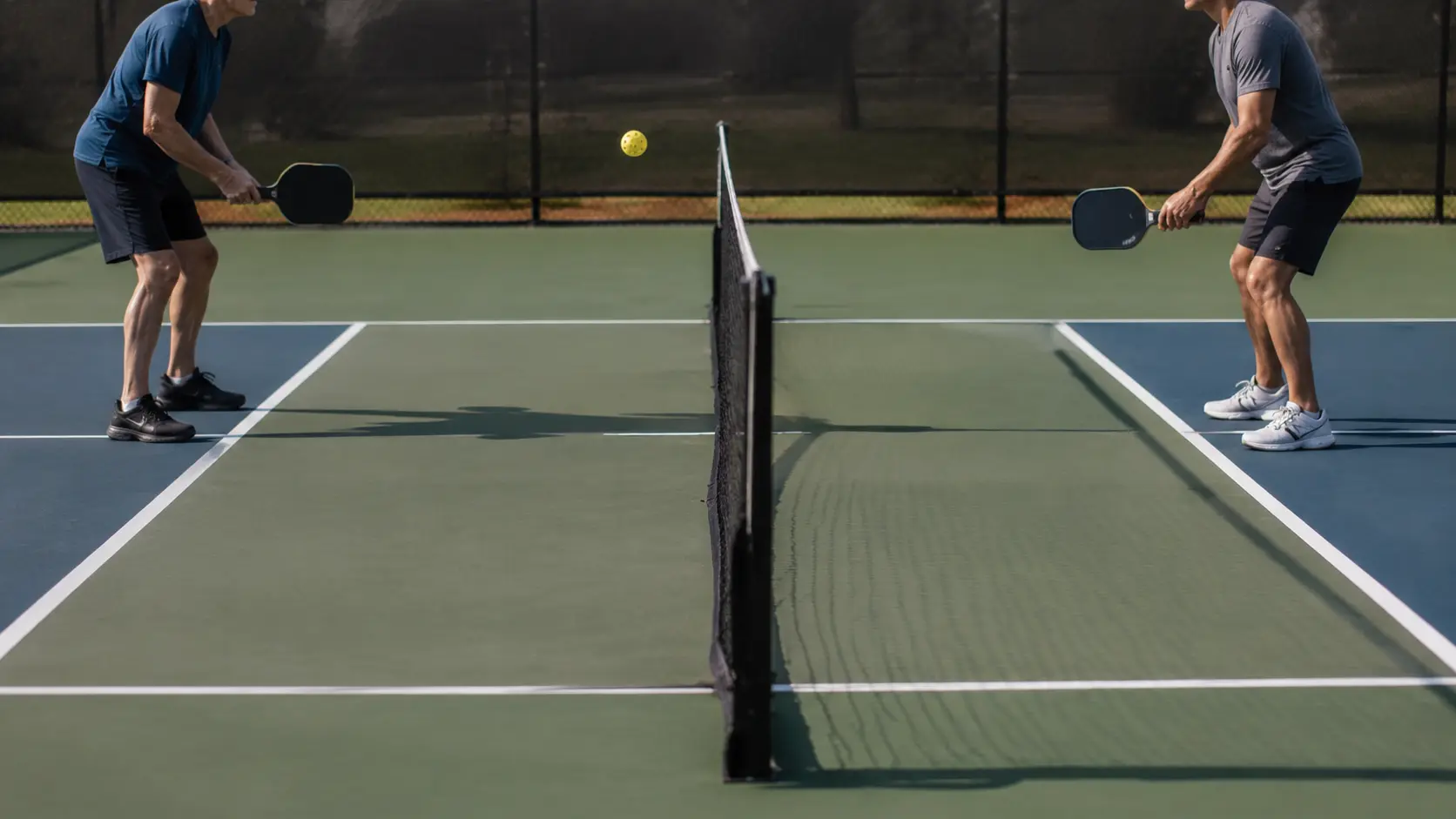
Setup: two players at their kitchen lines, straight across, volleying at each other's paddle so the rally continues.
Suggestion: rallies of 20, then a faster set of 10.
Variation: partner calls "feet" or "deep" before each ball. "Feet" means you angle the ball down toward their shoes; "deep" means you open the face slightly and push toward the baseline, which is the mechanic the basic terms page gives: "to hit the ball deeper, open the paddle face slightly."
Watch for: Rule 11.A.2 makes it a fault when "a volleying player's momentum causes the player to contact anything" in the non-volley zone, "even after the ball becomes dead." Stand a hand's width behind the line.
Footwork, Transition and Positioning
Positioning follows from the two-bounce rule. USA Pickleball's positioning page: the serving team should "stay back at the baseline after serving, since you're not allowed to volley the return," while on the returning team "the non-receiving partner should already be at the Kitchen line."
11. Split step walk-up.
Objective: the timing of the split step, then the walk through the transition zone without stopping in it.
Setup: first without a ball. Partner at the far kitchen line mimes a swing and says "hit" at pretend contact. You hop so you are in the air on "hit," land ready, take two steps forward, and wait for the next one, baseline to kitchen line. Then with the bucket: partner feeds at your feet as you advance, you play each ball softly into their kitchen, split step, and keep coming until you arrive.
Suggestion: three shadow walk-ups, then eight with feeds, then swap.
Variation: in doubles, both partners walk up together at the spacing USA Pickleball suggests, about six to eight feet, so neither leaves a gap.
Watch for: USA Pickleball describes the split step as "a small hop you take just as your opponent makes contact with the ball," timed so you are "in the air as their paddle makes contact and land the moment the ball leaves their paddle."
Drills for Four Players
12. Serve, return, drop, then play.
Objective: the first four shots of a doubles point, in order, every time.
Setup: full court, two pairs. Serving pair serves and stays back. Receiving pair returns deep and the receiver moves up to join their partner at the line. Serving pair hits a third shot drop and both advance. From there the point is live. If the drop is missed, restart instead of playing it out.
Suggestion: 10 points, then rotate the serve.
Variation: half-court dink games, each pair on one half of the court, every ball a dink that bounces in the kitchen, first to five.
Watch for: Rule 10.A.2 faults the serving side when "the server or server's partner does not allow the return of serve to bounce." The pattern exists to make that mistake impossible.
Common Beginner Mistakes and How to Fix Them
Rushing to the net after serving. USA Pickleball's serving basics: "Don't continue into the court; remain behind the baseline until after the 3rd shot is hit." Fix: drill 12, and say "stay" out loud after you serve.
Big backswing on soft shots. Dinks and drops sail because the swing is a groundstroke. Fix: the brick wall image from drill 8, and drill 1, where a long swing is obvious immediately.
Tight grip. USA Pickleball puts dink grip pressure at "about a 2" and third shot drop grip "around a three" on a scale of one to ten. Fix: before drills 6 and 8, loosen until the paddle almost moves in your hand, then tighten one notch.
Stepping into the kitchen on a volley. The fault includes momentum, per Rule 11.A.2. Fix: the hand's width in drill 10.
A 30 to 45 Minute Session, as a Suggestion
One arrangement for two players, to be reshaped around whatever felt weakest last time.
- Warm-up, about 5 minutes. Easy movement, shadow swings, then 20 gentle dinks straight across.
- Serve and return, about 8 minutes. Drill 4 for the server, drill 5 for the receiver, then swap.
- Dinks, about 10 minutes. Drill 6 on both diagonals, then drill 7.
- Third shot drop, about 10 minutes. Drill 8 as a ladder, then drill 9.
- Volleys, about 5 minutes. Drill 10 with the feet-or-deep variation.
- Play, whatever is left. Half-court dink games, or with four people, drill 12.
With only 30 minutes, cut the volley block and shorten the play. Alone, drills 1 to 3 cover dink, volley and drop in about 20 minutes. Write down the count you reached; the next session starts from there.
Share the Session in One Link
Your court, your drill partners and the clips from practice, behind one short address.
FAQ
What should a beginner practise first in pickleball?
The dink, because the kitchen rule is built around it, and the serve, because a game cannot start without a legal one. Drills 1 and 6 cover the dink, drill 4 the serve. Then add the third shot drop.
Can you practise pickleball alone?
Yes. A wall with a line taped at 34 inches, the centre net height under Rule 3.B.7, lets you drill dinks, volleys and drops on your own. Drills 1 to 3 are built for it, and bucket serving in drill 4 needs no partner either.
What is the third shot drop?
USA Pickleball defines the drop as a soft shot hit off a bounce from deep in the court, intended to land in the opponents' non-volley zone. It is called the third shot because the serving team uses it after the serve and the return, when they must still be back for the return's bounce and need a safe way to move up.
Can you stand in the kitchen during a drill?
Yes, as in a game. Rule 11.A says a player may contact the non-volley zone "at any time except during the act of volleying a ball." The fault is volleying while touching the zone, or being carried into it by momentum after a volley.
References
- 2026 USA Pickleball Official Rulebook (PDF)
- USA Pickleball, Pickleball Basic Terms
- USA Pickleball, How to Dink
- USA Pickleball, Basics of the Third Shot Drop
- USA Pickleball, Positioning, Patience and Kitchen Line Strategy
- USA Pickleball, How to Master the Split Step
- USA Pickleball, Pickleball Footwork Drill