

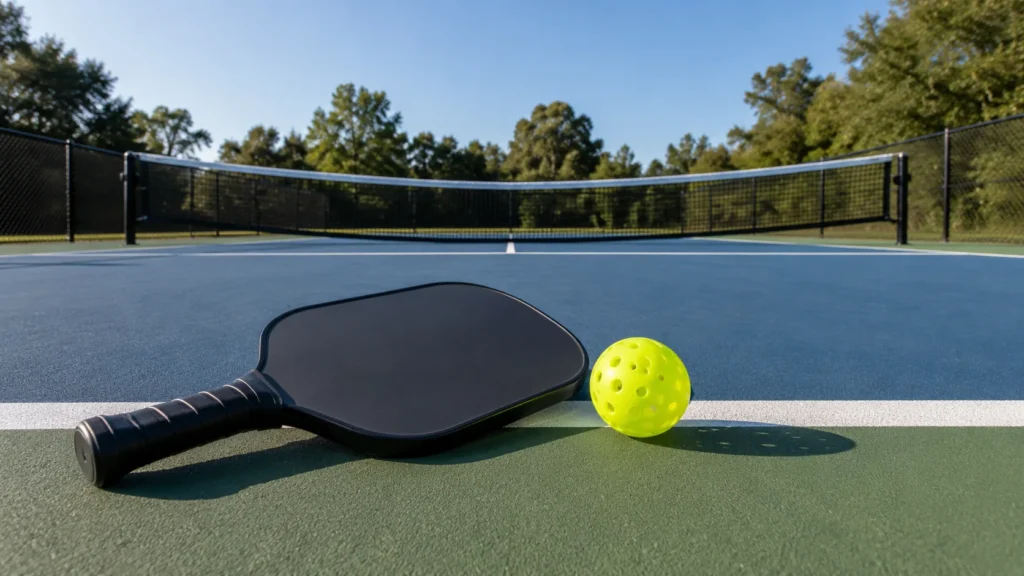
Pickleball has four rules that decide almost every point, and three of them differ from tennis. The serve goes underhand and diagonally, the first two shots of every rally must bounce, you cannot volley inside the seven foot zone at the net, and only the serving side scores. Learn those and you can play. Everything here is quoted from the 2026 USA Pickleball Official Rulebook.
This guide covers the rules and the court. It is written for a first game, so it says what you need to start and skips tournament procedure. If you end up filming your games, our guide to filming amateur sports covers the camera side.
One Link for Your Whole Game
A short address you control, pointing to your court, your group and everything else you share.
What Pickleball Is
The rulebook opens with a description worth quoting because it explains the odd equipment: "Pickleball is a paddle sport that combines elements of badminton, table tennis, and tennis. It is played using a special perforated ball on a 20-foot by 44-foot court with a tennis type net. The court is divided into right and left service courts and a non-volley zone on each end of the net. Pickleball can be played as singles or doubles."
The scoring method is the other structural fact: "Standard pickleball uses a scoring method where points are scored only when the serving team wins the rally. The server alternates service courts and continues to serve until they lose a rally (commit a fault)."
The Court and the Net
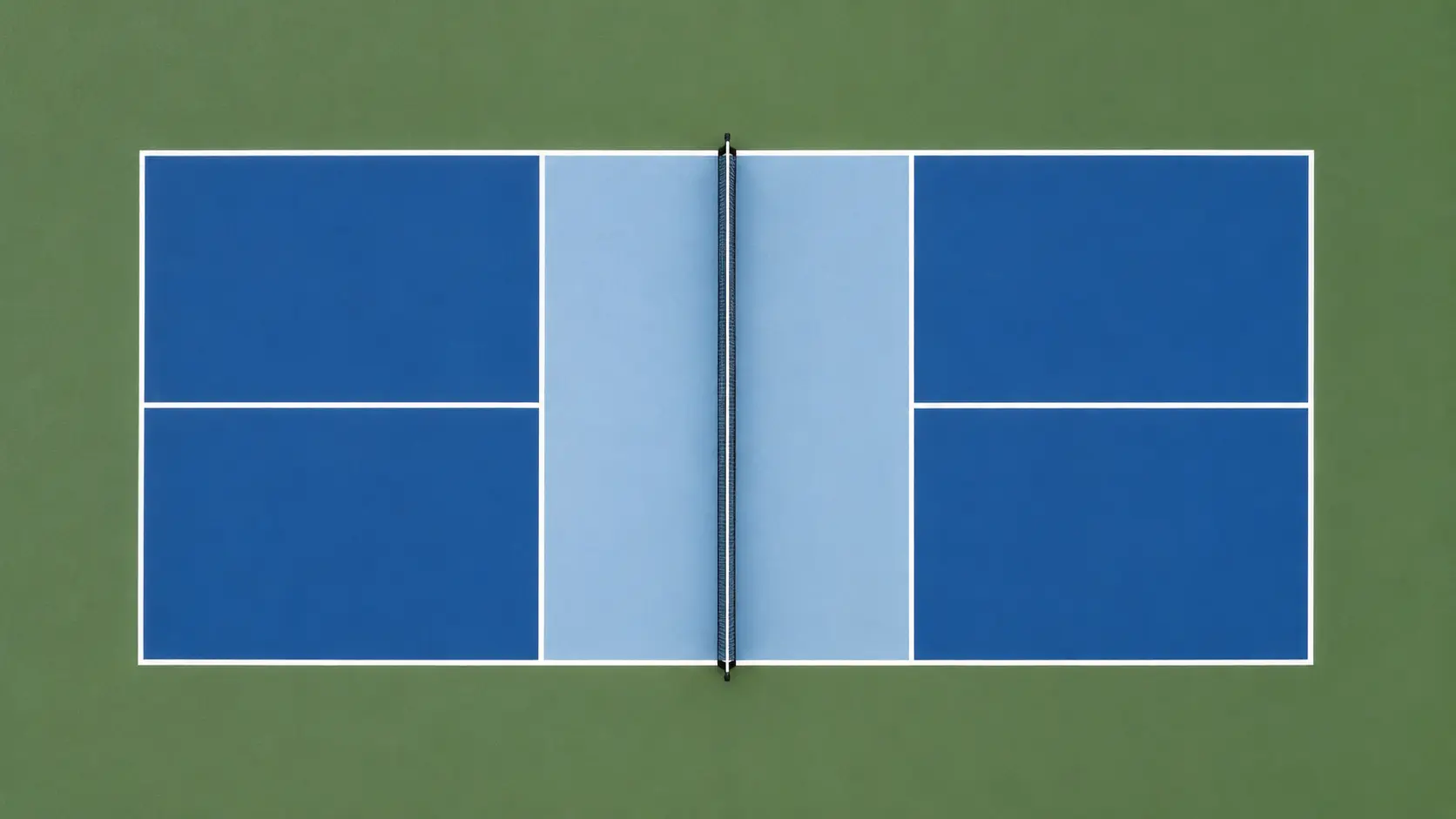
The playing court is small. Rule 3.A.1: "The court must be a rectangle measuring 20 feet (6.10 m) wide and 44 feet (13.41 m) long for both singles and doubles matches." Singles and doubles use the same court, so nothing moves when a player joins.
You need room around it too. Rule 3.A.3: "The minimum playing surface area is 30 feet (9.14 m) wide and 60 feet (18.29 m) long."
The net is 36 inches high at the sidelines and 34 inches at the centre. Rule 3.B.6 sets the height "36 inches +/- 0.25 inch (91.44 cm +/- 0.635 cm) above the playing surface where the net crosses the outer edge of the sidelines," while Rule 3.B.7 sets it at "34 inches +/- 0.25 inch (86.36 cm +/- 0.635 cm) above the playing surface at the center point of the court."
| Measurement | Size | Rule |
|---|---|---|
| Court | 20 ft × 44 ft (6.10 m × 13.41 m) | 3.A.1 |
| Minimum playing area | 30 ft × 60 ft (9.14 m × 18.29 m) | 3.A.3 |
| Net at the sidelines | 36 in (91.44 cm) | 3.B.6 |
| Net at the centre | 34 in (86.36 cm) | 3.B.7 |
| Non volley zone, each side | 7 ft × 20 ft (2.13 m × 6.08 m) | 3.A.4.c |
Paddle and Ball
Paddle rules are permissive about size and silent about weight. Rule 3.D.2: "The combined length and width of the paddle, including any edge guard and butt cap, must not exceed 24 inches (60.96 cm). The paddle length must not exceed 17 inches (43.18 cm). There is no restriction on paddle thickness." Rule 3.D.3 adds: "There is no restriction on paddle weight."
What is forbidden is anything that grips or springs. Rule 3.D.5 prohibits several paddle-surface features, including holes or delamination, rough texturing, sandpaper-like characteristics, rubber and certain moving parts (Rules 3.D.5.a to 3.D.5.e).
On balls, the rulebook is direct. Rule 3.C.1: "All approved balls are acceptable for indoor or outdoor play." The indoor and outdoor distinction is a custom rather than a rule; the rulebook's own figure caption notes that the ball with larger holes "is customarily used for indoor play" and the one with smaller holes "is customarily used for outdoor play." Any approved ball is acceptable for indoor or outdoor play.
The Serve
This rule differs from tennis, so check it carefully if tennis is your reference point. There is no overhead serve in pickleball.
Where you stand. Rule 7.A.1: "At least one of the server's feet must be in contact with the correct serving area when the serve is hit." Rule 7.A.2: "Neither of the server's feet is allowed to be in contact with the court when the serve is hit." In plain terms, behind the baseline, and within the width of the service court you are serving from.
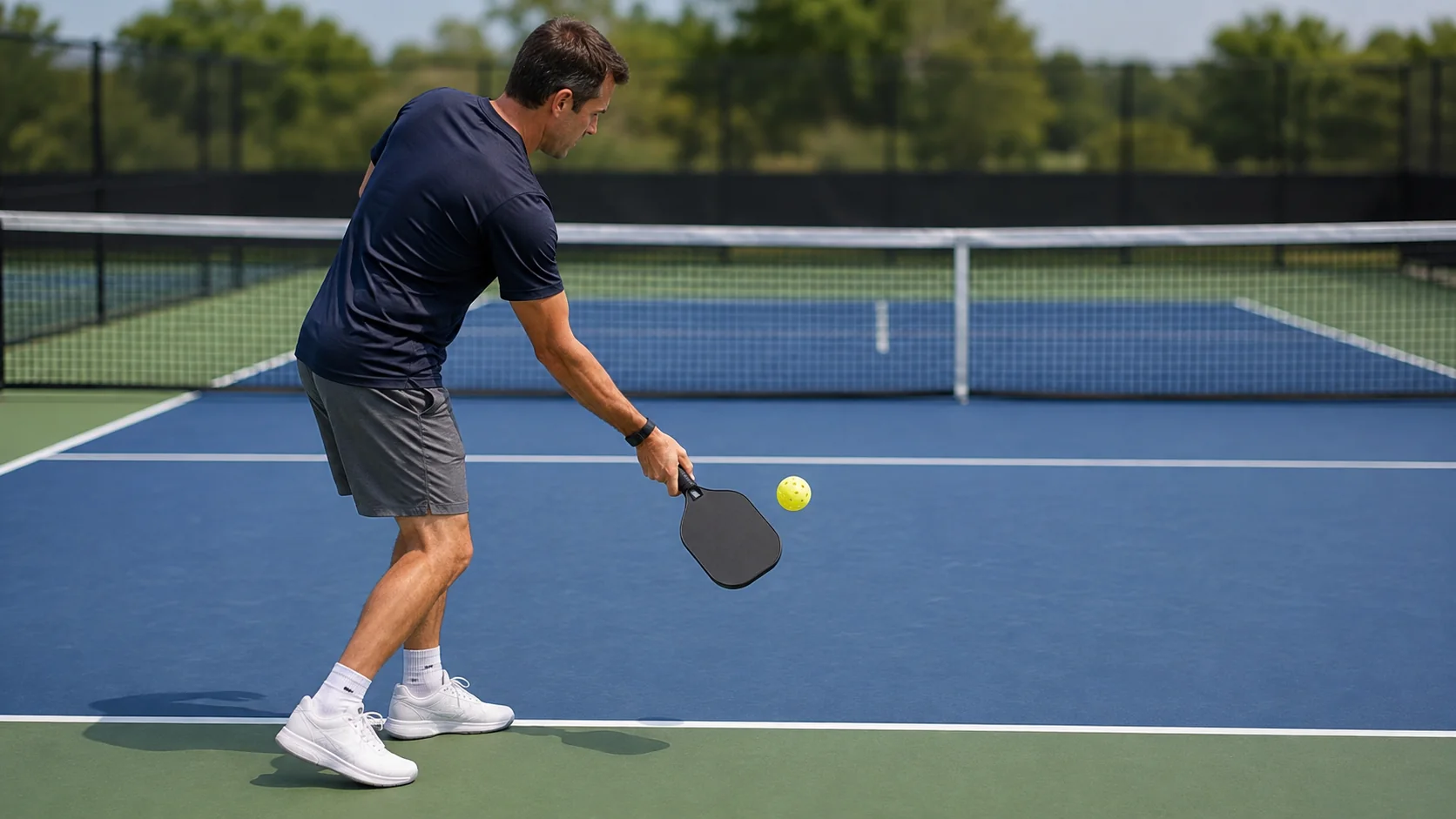
How you hit it. The traditional volley serve has three conditions. Rule 7.C.1: "The server's paddle must be moving in a clear upward arc when the paddle contacts the ball." Rule 7.C.2: "The highest point of the paddle head must clearly not be above the highest part of the server's wrist joint when the paddle contacts the ball." Rule 7.C.3: "The ball must clearly be no higher than the server's waist when the paddle contacts the ball." Forehand or backhand are both fine, per Rule 7.C.4.
The easier alternative. Rule 7.D describes the drop serve: "A drop serve is made by dropping the ball and hitting the ball with the paddle after the ball bounces on the playing surface." You must release it "from a natural (unaided) height" and must not propel it downward. Usefully for beginners, Rule 7.D.3 says "there is no restriction on how many times the ball can bounce" before you hit it. The drop serve removes the upward arc and wrist rules, so it is the simpler place to start.
Where it has to land. Rule 7.E: "The server must serve to the service court diagonally opposite their correct position. The served ball must clear the opponent's non-volley zone, with or without touching the net, and land in the correct service court."
Two details inside that sentence matter. First, a serve that clips the net and lands correctly is live, not a replay. The old let serve rule is gone. Second, the kitchen line is out: Rule 8.C states that a served ball "that lands on the non-volley zone line, is out."
The Two Bounce Rule
The rule that most defines how pickleball feels. Rule 10.A: "The serve and the return of serve must each bounce before being returned."
In sequence: the serve bounces once in the receiver's court before the receiver hits it. The return then bounces once in the serving side's court before they hit it. From the third shot onward, anyone may volley.
Both sides can break it. Rule 10.A.1 faults the receiver who "does not allow the serve to bounce before hitting the ball," and Rule 10.A.2 faults the serving side when "the server or server's partner does not allow the return of serve to bounce."
A vocabulary note, because it trips people up: this is the two bounce rule, not the "double bounce rule." The rulebook uses "double bounce" for something else entirely, defining it as "when the ball bounces twice on one end of the net before it is returned," which is a fault under Rule 10.B.1. Two different things, opposite meanings.
Keep the Group in One Link
Your court, your schedule and everything else you share, behind one short address.
The Non Volley Zone, or Kitchen
Rule 3.A.4.c defines it: "The 7-foot by 20-foot (2.13 m by 6.08 m) area of the court adjacent to each end of the net. The non-volley zone lines run parallel to the net, 7 feet (2.13 m) from the net on each end between the two sidelines. All lines that bound the non-volley zone are part of the zone. The non-volley zone is two-dimensional and does not extend above the playing surface."
Now the correction, because this is the rule to get right first. Standing in the kitchen is legal. Rule 11.A: "All volleys must be initiated outside of the non-volley zone. A player, or anything in contact with the player, may contact the non-volley zone at any time except during the act of volleying a ball."
The zone restricts one action, volleying, which the rulebook defines as "a strike of the ball before the ball bounces." If the ball bounces first, you may stand in the kitchen and play it.
Three ways to fault, and the second and third catch newcomers:
- Rule 11.A.1, touching the zone while volleying, including via your partner or anything you are carrying.
- Rule 11.A.2, momentum: it is a fault when "a volleying player's momentum causes the player to contact anything (including the player's partner) that is in contact with the non-volley zone, even after the ball becomes dead." Landing in the kitchen after a winning volley is still a fault.
- Rule 11.A.3, re-entry: after being in the zone, you must get "both feet contact the playing surface completely outside the non-volley zone" before volleying again.
The rulebook defines the act of volleying as ending only "when the player's movement from the follow-through action (i.e., momentum) stops."
Scoring, and Why the Score Has Three Numbers
Only the serving side scores. Rule 4.A: "A point is scored by serving the ball and winning the rally." Lose a rally on serve and you do not lose a point, you lose the serve.
Games are normally to 11, win by 2. Be aware the rulebook states this as a convention rather than an absolute: Section 1 says "typically, the first player or team scoring 11 points and leading by at least a 2-point margin wins the game," and tournament play also sanctions "two of three games to 11 points, one game to 15 points, or one game to 21 points, all win by two points."
The three number call is the part that confuses spectators. Rule 6.B.2: "For doubles play, the score must be called as three numbers: serving team's score, then receiving team's score, then the server number. To start each game, the score will be called as zero zero two."
Singles is simpler. Rule 6.B.1: two numbers, server's score then receiver's score.
Call it before you serve, every time. Rule 6.C: "The entire score must be called before the server hits the serve," and Rule 6.D gives you "10 seconds after the score call is completed" to actually serve.
Which side you serve from is decided by your own score, not by whose turn it is. In singles, Rule 5.A.1: "When the server's score is zero or even, the serve must be made from the right serving area... When the server's score is odd, the serve must be made from the left serving area." The same even-right, odd-left logic positions players in doubles.
Doubles Serving Order
Both partners serve before the serve passes over. Rule 5.B: "Both players on a team will serve before a side out is declared, except at the start of each game when only the starting server will serve as a second server before a side out is declared."
At the start of each game, only the starting server serves before the first side out; after that, both players on a doubles team can serve before a side out.
After that it is a loop. The first server serves, "alternating between right and left serving areas after each point is won, until the serving team loses a rally" (Rule 5.B.5). Then the second server does the same, "until the serving team loses a rally, which results in a side out" (Rule 5.B.6).
Note what alternates: you swap sides with your partner only when you win a point. Lose the rally and everyone stays where they are.
Faults and Line Calls
A fault is defined as "a rules violation that results in a dead ball and the loss of a rally." The common ones for a new player:
- Serving into the net, out of the service court, or into the kitchen including its line
- Volleying either of the first two shots, breaking the two bounce rule
- Touching the kitchen while volleying, or being carried into it by momentum
- Letting the ball bounce twice on your side, Rule 10.B: "A player must return the ball before a second bounce"
- Hitting the ball out of bounds
- Catching or carrying the ball on the paddle
In non-officiated play, players are expected to call faults on themselves and their partners. Rule 9.B.2: "Players are expected to call faults on themselves or on their partner as soon as the fault is committed or detected." Rule 9.B.3 limits what you may call on an opponent: only "non-volley zone faults and service foot faults."
On close calls, the standard favours your opponent. Rule 8.D: "all questionable calls must be resolved in favor of the opponent," and "any ball that cannot be promptly called out must be considered in." Rule 8.E sets the visual test: "Players must not call a ball out unless they can clearly see a space between the line and the ball when it lands." And if the two sides disagree, Rule 9.B.3.b says "the rally must be replayed."
Your First Game, in Order
- Pick partners and sides. The starting server stands on the right.
- Call "zero zero two" out loud.
- Serve underhand, diagonally, into the opposite service court, clearing the kitchen line. Use the drop serve if the volley serve rules feel fiddly.
- Let the serve bounce before returning it.
- Let the return bounce before hitting it.
- From shot three, volley freely, but never with a foot touching the kitchen.
- Win the rally on serve and you score a point, then swap sides with your partner and serve from the other side.
- Lose the rally and the serve passes to your partner, then to the other team.
- First to 11, win by 2.
The two habits worth building deliberately from day one: call the full score before every serve, and let those first two balls bounce.
Share Your Court in One Link
One VisuLink holds your games, your pages and everything else you share.
FAQ
What are the basic rules of pickleball?
Four decide most points. The serve is underhand and goes diagonally into the opposite service court, clearing the non volley zone. The serve and the return must both bounce before being hit, which is the two bounce rule. You cannot volley while touching the seven foot non volley zone at the net. Only the serving side scores, and games are normally to 11, win by 2.
Can you step in the kitchen in pickleball?
Yes. Standing in the non volley zone is legal at any time except while volleying. The rulebook says a player may contact the zone "at any time except during the act of volleying a ball." If the ball has bounced, you can stand in the kitchen and play it normally.
What is the two bounce rule?
The serve must bounce before the receiver returns it, and that return must bounce before the serving side hits it. From the third shot on, either side may volley. Note the official term is two bounce rule; the rulebook uses "double bounce" to mean a ball bouncing twice on one side, which is a fault.
How does pickleball scoring work?
Only the serving side can score, so winning a rally while receiving earns you the serve rather than a point. Games are normally played to 11 and must be won by 2. In doubles the score is called as three numbers before every serve: your score, their score, and whether you are the first or second server.
Why do they say "zero zero two" at the start?
Because the team serving first only gets one server instead of two. The starting server is designated the second server for that first turn, so the call reflects it.
Do you have to serve underhand in pickleball?
Yes, in effect. The volley serve requires the paddle to move in an upward arc, the paddle head to stay below the wrist and contact to happen no higher than the waist. The alternative is the drop serve, where you drop the ball and hit it after it bounces, which has fewer restrictions and is easier for beginners.
What is the difference between indoor and outdoor pickleballs?
By custom, indoor balls have larger holes and outdoor balls have smaller ones. It is not a rule: the rulebook states that all approved balls are acceptable for indoor or outdoor play, and describes the hole difference as customary rather than required.