

A resolution survives when it is small enough to do on a bad day and specific enough that you can tell whether you did it. The 50 ideas below are grouped by area of life, each written as a 30 day version with a way to count it.
Most resolution lists give a direction and stop there. Read more. Save more. Move more. A direction is not a plan, and by the second week of January it has no shape. What follows turns each idea into something you can put on a calendar: one action, one window, one number. Pick one, not five: a single small commitment finished in full is worth more in February than five ambitious ones abandoned in different states of guilt.
If Your Goal Is Getting Out More
VISU connects rewards to verified presence at partner locations. When leaving the house is the resolution, the visit itself can carry a small extra.
Why Small Resolutions Survive January
A resolution has to compete with an ordinary week: work, travel, meals, errands, other people, and tiredness that arrives without warning. A goal that needs an unusually good day will only happen on those, and there are not many in a row.
So the first rule is scale. Write the version you could still do on your worst Tuesday. An hour of reading becomes one page. A long walk becomes the block. The small version is not a compromise, it is the actual commitment, and good days simply exceed it.
The second rule is that the goal has to be countable. "Cook more" cannot be checked. "Cook dinner at home three nights a week" can, and at the end of the month you have a number rather than a feeling. Feelings about consistency are unreliable in both directions.
The third rule is one at a time. Several new habits in parallel compete for the same evening, and the first collision usually takes all of them down together. One habit, finished for 30 days, leaves you with a habit and with proof that you finish things.
Two smaller points help. Start on the day you decide, not on the next Monday: waiting for a clean starting line is how a January idea becomes a February idea. And write the plan somewhere you see without opening an app, such as a card on the fridge. Each idea below has the same shape: the action, the 30 day version, and how you count it.
Home and Routine
1. Clear one surface every night. Pick the kitchen counter or the desk and reset it before bed. Count: one mark per night it ends empty.
2. Make the bed before leaving the room. Every morning, weekends included if that is easier to remember. Count: tick each morning it is done.
3. Run one load of laundry on a fixed day. Washed, dried and put away within 24 hours. Count: four completed cycles by day 30.
4. Remove one item a day. One thing leaves the house daily: donated, recycled or binned. Count: the objects, aiming for 30.
5. Empty the sink before sleeping. No dish left overnight, even if that means one mug. Count: mornings you wake to an empty sink.
6. Deal with the post on the day it arrives. Open, act, file or bin, nothing left in a pile. Count: days the pile is at zero.
7. Keep a written weekly menu. Four dinners written every Sunday, the rest of the week free. Count: menus written and planned dinners actually cooked.
8. Water the plants on a fixed day. Same weekday, all of them at once. If you are unsure what yours need, start with how to keep plants alive. Count: watering days marked.
9. Fix one small broken thing a week. The loose handle, the dead bulb, the drawer that sticks. Count: four repairs by day 30.
Money Habits
10. Write down every expense for 30 days. Every purchase noted the same day, on paper or in a plain note. Count: days with a complete entry, aiming for 30.
11. Hold one no-spend day a week. One day with no discretionary purchase, essentials excluded. Count: four no-spend days marked.
12. Cancel one subscription you do not use. List every recurring charge in week one, cancel one by week two. Count: the list exists, plus the number cancelled.
13. Check the balance on a fixed day. Same day each week, two minutes, just looking. Count: four check-ins recorded.
14. Use a waiting period before non-essential buys. Anything above a limit you set goes on a list and waits a fixed number of days. Count: items listed, and how many you still wanted.
15. Cook one meal a week you would normally order. Pick the dish you order most and make it at home. Count: four home versions cooked.
16. Bring lunch on fixed days. Choose two weekdays and prepare them the night before. Count: eight packed lunches by day 30.
17. Read one bill in full. One bill a week, line by line, questions written down. Count: bills read and questions found.
18. Write one page listing what you owe and what you own. By hand in week one, updated once at the end. Count: the page carries two dates.
Time and Screens
19. Keep the phone out of the bedroom. It charges in another room overnight, with a separate alarm if needed. Count: nights it stayed out.
20. Delay the first look at the phone. Nothing on screen until you are up, dressed and have had water. Count: mornings the order held.
21. Set one screen-free hour. The same hour each evening, phone in a drawer, television off. Count: one mark per completed hour.
22. Eat one meal a day without a screen. Pick the meal you most often eat while scrolling. Count: days that meal was screen-free.
23. Do a single-task block. Twenty-five minutes on one task, everything else closed, once per working day. Count: completed blocks, aiming for 20.
24. Write tomorrow's three tasks tonight. Exactly three, written before you stop for the day. Count: lists written, and how many of the three were done.
25. Empty the inbox once a week. One fixed hour, archive freely, reply only to what takes two minutes. Count: four sessions marked.
26. Keep one evening a week unplanned. Block it in the calendar so nothing else lands there. Count: four protected evenings.
27. Leave the phone at home for one walk a week. One short walk, no device, same day each week. Count: four walks marked.
Make the Outing Count Twice
If one of your goals is less screen and more street, VISU ties a small reward to a verified visit at a partner location. Showing up is the whole action.
Learning and Skills
Learning goals fail most often because the unit is too big. "Learn Spanish" has no end. "Fifteen minutes a day" has a shape.
28. Read ten pages a day. Any book, at the same point in the day. Count: pages logged, 300 by day 30.
29. Study a language for fifteen minutes daily. One method, no switching resources mid-month. Count: sessions completed out of 30.
30. Learn one recipe properly. The same dish once a week, with a note on what changed. Count: four attempts and four notes.
31. Practise an instrument for ten minutes. Daily, one piece or one exercise at a time. Count: one mark per session.
32. Write 200 words a day. A journal entry, a description of the day, notes towards something longer. Count: words, aiming for 6,000.
33. Learn a keyboard shortcut a week. One in the program you use most, used until it is automatic. Count: four written on a card.
34. Take one photo a day with one idea. Pick one principle, framing or light or symmetry, and apply it daily. These photography basics for beginners are enough to choose one and stay with it. Count: 30 photos in one folder.
35. Finish one online course. Short enough to finish in a month, one module per fixed slot. Count: modules completed.
36. Learn to identify ten things. Ten trees, ten birds or ten constellations, one new every three days. Count: the list written from memory at the end.
Hobbies and Creativity
37. Draw for ten minutes a day. One sketchbook, no judging what comes out. A set of easy drawing ideas removes the daily decision about what to draw. Count: filled pages, aiming for 30.
38. Finish one unfinished project. Choose one, put it somewhere visible, give it a fixed weekly slot. Count: sessions worked, and whether it is done by day 30.
39. Cook or bake one new thing a week. Four recipes you have never made, chosen before the month starts. Count: four dishes.
40. Keep a one-line-a-day notebook. One sentence about the day, written before bed, no minimum quality. Count: lines out of 30.

Movement and Outdoors
These are habits, not health outcomes, and they follow the same shape as everything above. What suits your body is a question for you and, when relevant, for a professional who knows your situation.
41. Walk 15 minutes after one meal. The same meal daily, same route, shoes left by the door so the decision is already made. Count: one mark per walk.
42. Take the stairs on a fixed trip. One predictable staircase, taken every time you pass it. Count: days you took it.
43. Stretch for five minutes at a fixed time. One short sequence, same moment daily. Count: sessions out of 30.
44. Get outside once a day. Ten minutes outdoors, whatever the weather, coat by the door. Count: days outside out of 30.
45. Choose one weekend outing. A park, a market or a route you have not walked, chosen before the weekend. Count: four outings.
Relationships and Community
46. Send one message a week to someone you have lost touch with. Write the four names in advance so you do not spend the month deciding. Count: four messages.
47. Call instead of texting once a week. One call, short is fine, same day each week. Count: four calls.
48. Host one simple thing. Coffee, a walk or one uncomplicated dinner, invited in week one so it actually happens. Count: whether it took place.
49. Write one thank-you note by hand. One per week, on paper, delivered or posted. Count: four notes.
50. Volunteer for one fixed slot. One commitment that repeats, small enough to keep after January. Count: shifts attended.
Turning an Idea Into a 30-Day Goal
The action. Write the verb and the object with no adverbs. Not "read more", but "read ten pages". Not "be tidier", but "clear the kitchen counter". If a stranger could not perform the sentence without asking a question, it is not specific enough.
The window. Attach the action to a moment that already exists in your day: after coffee, before the commute, while the kettle boils. A habit attached to a fixed point is remembered by the day itself. One attached to "whenever I get a chance" competes with everything else in the evening and usually loses.
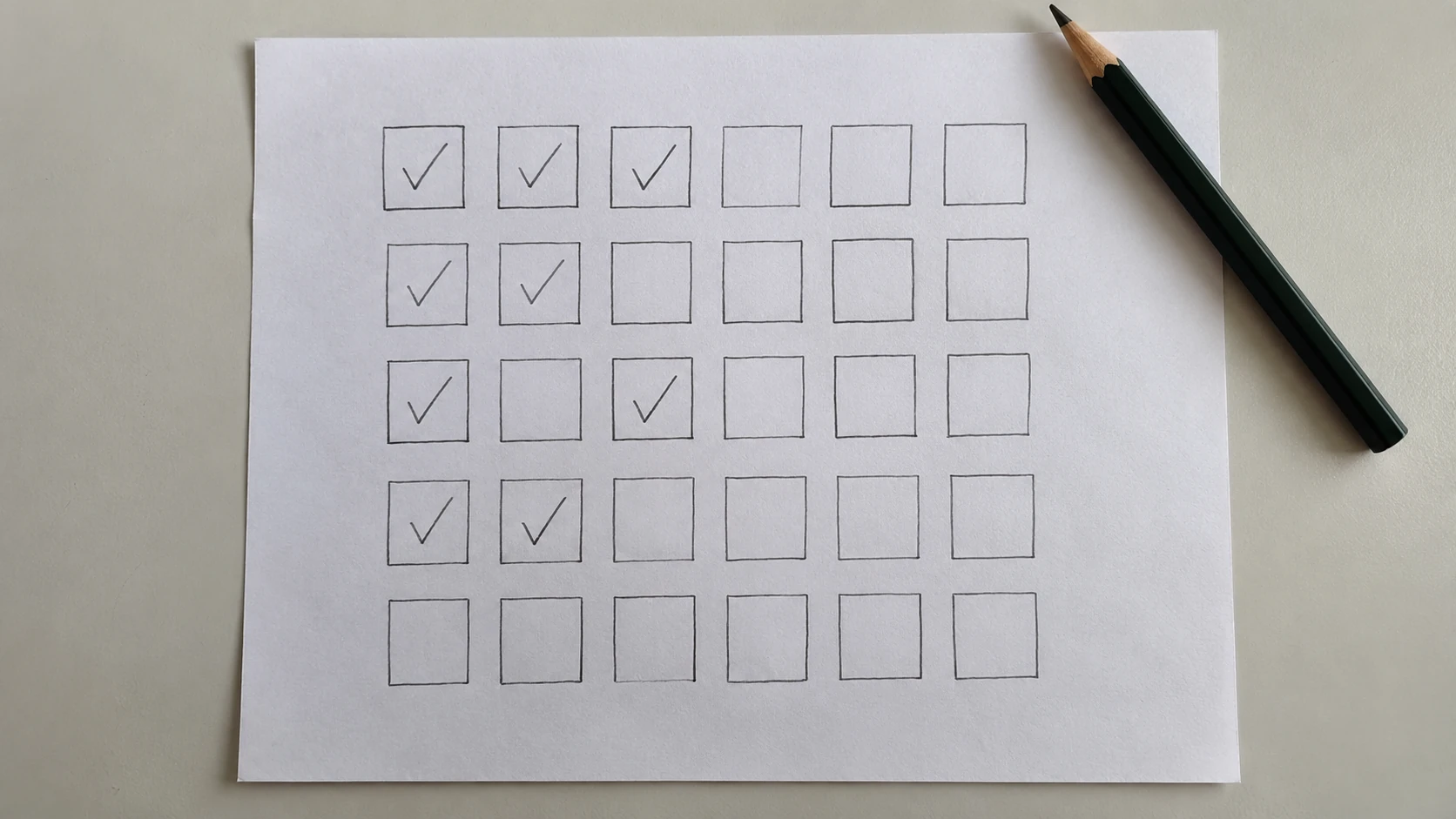
The count. Decide what you will write down and where. A grid of 30 squares on paper is enough, and it has one advantage over an app: it is visible without unlocking anything. The count is the whole feedback mechanism, so it has to be easier to do than to skip.
The bad-day version. Write the smallest acceptable version in advance and treat it as a real success, not a failure with an excuse. Ten pages becomes one page. Fifteen minutes becomes three. It exists so a hard week produces a smaller mark instead of a broken chain, and the broken chain is what usually ends the whole attempt.
Then set a review date. On day 30, answer three questions: how many days did it happen, what got in the way, and do you want to continue, adjust or stop. Stopping something you completed and decided against is not the same as abandoning it in week two.
Start a second habit after the first review, not alongside it. And choose your start date as the day you decide: if that is the 3rd or the 11th, the cycle still ends 30 days later. Waiting for the 1st, or for Monday, adds nothing to the plan and subtracts days from it.
Let Showing Up Be the Reward
VISU ties a reward to a verified visit at a partner location: you scan the code that is there and the reward comes from being present. If leaving the house more often is on your list this year, that is a nudge in the same direction.
FAQ
What are good New Year's resolution ideas?
The ones you can describe as a single action in a fixed window: writing down every expense for 30 days, clearing one surface each night, reading ten pages a day, or walking 15 minutes after one meal.
How many resolutions should I make?
One at a time works better than a list, because several new habits compete for the same evening. Finish one 30 day cycle, review it, then decide whether to add a second.
How do I make a resolution measurable?
Replace the adjective with a number and a place to record it. "Cook more" becomes "cook dinner at home three nights a week, marked on the calendar". If you cannot say at day's end whether you did it, rewrite it.
What if I miss a day?
Mark the miss and continue the next day. This is what the bad-day version is for: an interrupted week then produces a smaller mark rather than an abandoned plan.
Should I start on January 1st?
Start on the day you decide. A date chosen for symbolism postpones the plan without improving it, and a cycle beginning on the 9th still ends 30 days later.
What is a good resolution for someone with very little free time?
Something that attaches to an event already in the day rather than requiring a new slot: stretching for five minutes after brushing your teeth, one screen-free meal, or clearing a single surface before bed.
How do I keep a resolution going past 30 days?
Review it on day 30 and decide explicitly. Continuing, adjusting the size or replacing it are all valid outcomes, and choosing on purpose is what stops it from quietly ending in the second month.