


A first bullet journal does not need a theme, a tracker wall or perfect handwriting. It needs four working parts: an index, a future log, a monthly log and a daily log. This guide builds those parts for one example month, October 2026, with page numbers and entries you can use as a structure while replacing every example with your own life. The Bullet Journal method was created by Ryder Carroll. The layouts below are original illustrations of the method, not copies of an official notebook page.
Keep Public Resources Separate
Your notebook can stay private. If you need one public page for class links, project references or resources you share, VISU Link can hold those links without turning the journal into an app.
Before the First Line: Notebook, Pen and Four Symbols
Use any notebook that opens comfortably and any pen you will actually carry. Number the pages if the notebook is not already numbered. Leave the first two pages for the index, then use the next blank pages in order. You do not need to decide today how many pages the whole month will take.
Start with four marks. A dot is a task: • send the form. A circle is an event: ○ dentist at 15:00. A dash is a note: - ask Sam about the train. Mark a completed task with an X. Use > when you migrate an open task into a new Monthly Log. Use < when you schedule it in the Future Log. If you move a task to tomorrow, rewrite it under the new date and mark the old entry >. Keep the key inside the front cover until the marks feel natural.
Do not add habit trackers, mood charts or decorative collections yet. Those can be useful later, but they make a poor test of whether the basic notebook helps you capture and find information.
Pages 1 to 4: Build the Index and Future Log
Write Index on pages 1 and 2. An index is a list of topics and page numbers, not a list of every daily entry. Add a line when you create a monthly log or a collection you will want to find again. The worked example starts with Future Log 3-4 and October 5-6.
Use pages 3 and 4 for the Future Log. Divide the spread into six simple areas for November through April. This area holds dates and tasks that belong after the current month. Example entries are ○ renew library card November 8, 2026, • buy train tickets December 20, 2026 and ○ course enrollment January 14, 2027.
At the start of each month, read only that month area. Move relevant items into the new monthly or daily pages. Leave later months where they are. The purpose is to give future commitments one home before their month exists.
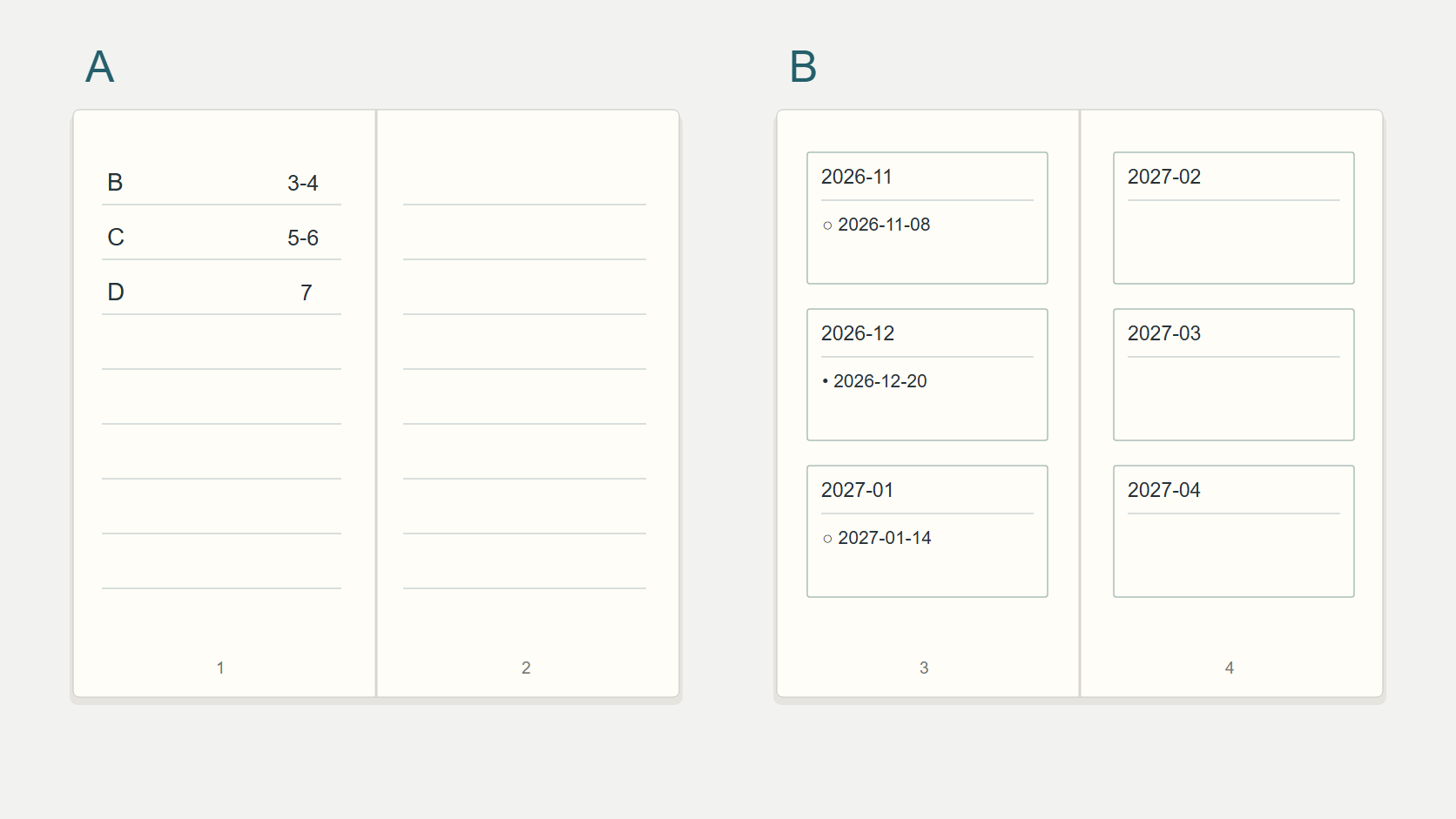
| Panel | Page | Localized label | Example entries |
|---|---|---|---|
| A | 1-2 | Index | Future Log 3-4; October 5-6; Books to borrow 15 |
| B | 3-4 | Future Log | November 8, 2026 renew library card; December 20, 2026 buy train tickets; January 14, 2027 course enrollment |
Pages 5 and 6: Make the First Monthly Log
Open the next spread and write October 2026. On page 5, list 1 through 31 down the left side and add a weekday abbreviation. October 1, 2026 is Thursday, so the first line is 1 Th. Add only fixed events and deadlines: 01 Th dentist 15:00, 03 Sa market, 07 W rent due.
Use page 6 as the monthly task list. Write tasks that matter this month but do not yet need a date: • renew library card, • choose train, • outline project. This is not a promise to finish everything. It is a place to see the month's open work without assigning fake deadlines.
If you start on October 12, begin on October 12. Leave the earlier dates visible and blank. A bullet journal follows the pages you use instead of charging you for pages you missed.
Share the Sources, Not the Planner
A study group or project team may need the same reference links. Put those public resources on one VISU Link page while your tasks and notes stay in the notebook.
Page 7 Onward: Start the Daily Log Where You Are
On the next blank page, write today's date. Add tasks, events and notes as they appear. Do not reserve one page per day. Tomorrow begins directly below today's last line or on the next page if you need it.
A short day might read: • email project draft, • return library book, ○ dentist 15:00, - Sam recommended the 18:20 train. When the email is sent, turn its task dot into X. If returning the library book still matters tomorrow, rewrite it under tomorrow's date and mark the old entry >. If the December train must wait for a future month, mark that task < and place it in the Future Log.
The Daily Log is capture first and sorting later. A phone calendar can still hold alarms. The notebook holds the context around the day: what must be done, what happened and what deserves another look.
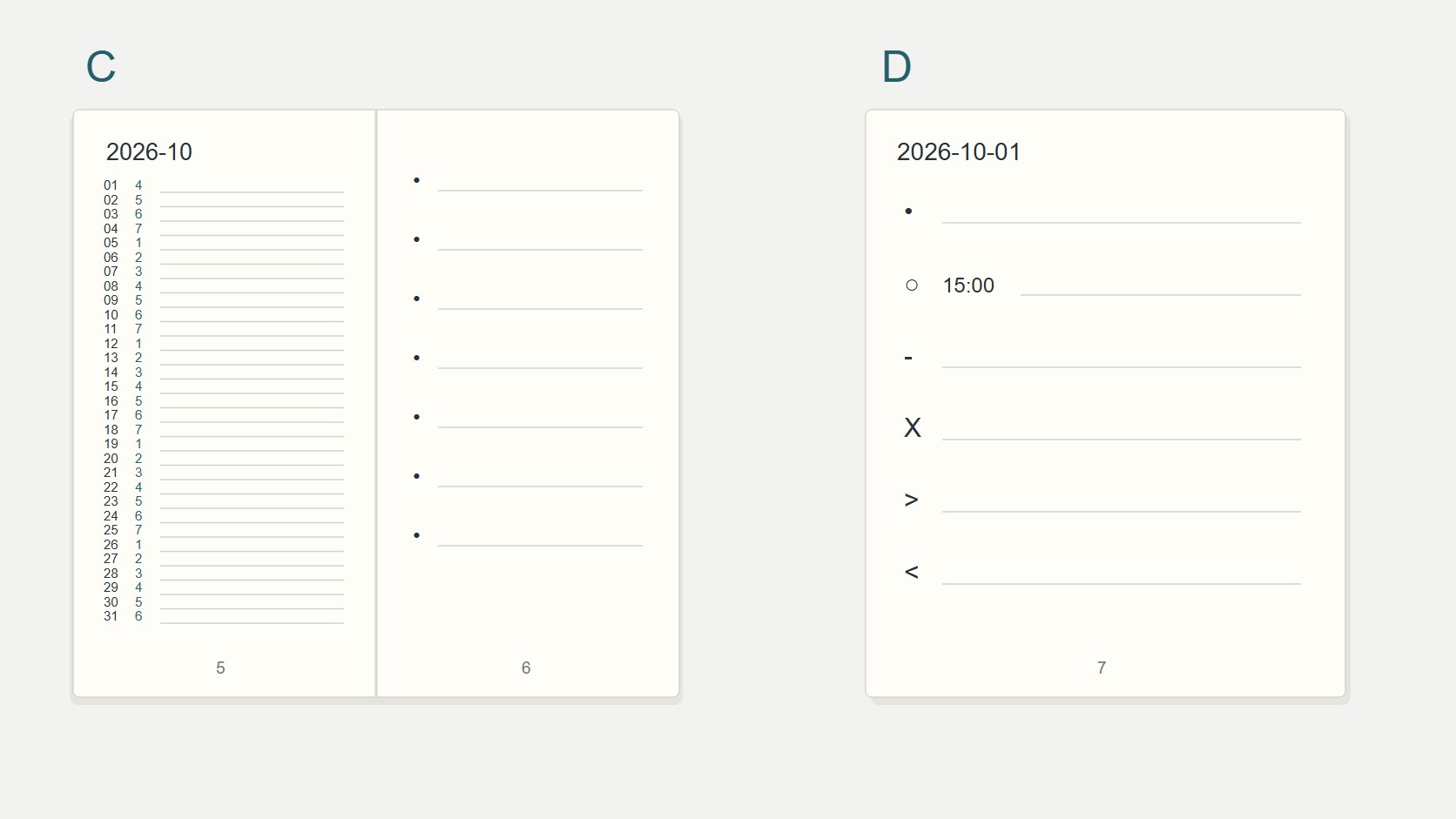
| Panel | Page | Localized label | Example entries |
|---|---|---|---|
| C | 5-6 | October 2026 Monthly Log | 01 Th dentist 15:00; 03 Sa market; 07 W rent due; monthly task list |
| D | 7 | October 1, 2026 Daily Log | • email project draft; • return library book; ○ dentist 15:00; - train note; X completed; > migrated; < scheduled in Future Log |
Close the Loop: Daily Checks and the End-of-Month Review
At the end of a day, scan the open task dots. Complete the mark, migrate the task or leave it open if you will see it again on the same page. This check can be brief. Its value is the decision, not the amount of time spent decorating it.
At the end of October, read the monthly task list and the open tasks in the Daily Logs. Cross out anything that no longer matters. Move a future commitment to the Future Log. Move a still-relevant near-term task to November. Rewriting is a filter: if an item is not worth writing again, it may not be worth carrying.
Update the Index after creating any collection you want to revisit. Daily pages can remain unindexed because their dates already tell you where they belong.
A First-Month Plan That Stays Small
For week one, use only the four core parts. In week two, notice one repeated need. If books keep appearing in your Daily Log, create Books to borrow on page 15 and add it to the Index. If you want a low-pressure drawing collection, start with these easy drawing ideas and record only the ones you want to try.
In week three, remove friction. Drop a symbol you never remember. Stop drawing boxes that stay empty. In week four, complete the monthly review and decide what earns a place in November. A useful page survives because you return to it, not because it looks finished.
Collections are optional and should answer a real recurring need. A short list of rainy-day ideas sorted by energy can become a practical collection. Gratitude prompts, children's prompts and long-form diary pages are different reader tasks. They can live elsewhere without changing this basic planning system.
Keep Private Notes on Paper
Use the notebook for private planning. Use your public profile only for links you intentionally want other people to open.
Frequently Asked Questions
Do I need a dotted notebook?
No. Dots can make spacing easier, but lined, grid and blank notebooks all work. Page numbers and a notebook you will carry matter more than the paper pattern.
Can I start in the middle of a month?
Yes. Make the current monthly log and begin the Daily Log on today's date. Leave earlier dates blank instead of rebuilding days that already passed.
What are the four pages I need first?
Use an Index, a Future Log, a Monthly Log and a Daily Log. The Future and Monthly Logs usually use spreads, while Daily Logs continue for as much space as each day needs.
How is this different from a printed planner?
A printed planner assigns space before you use it. A bullet journal adds pages as needs appear and uses the Index to find them later. You can still keep alarms and fixed appointments in a digital calendar.
How much time should I spend each day?
Spend only enough time to capture new entries and decide what happens to open tasks. There is no required session length, decoration step or daily page size.
What if I make a mistake or the page looks messy?
Correct the entry, turn the page and keep using the system. A readable notebook that you consult is doing its job. You can simplify the next page without rebuilding the old one.