
Free crochet patterns are everywhere; readable ones are not. The gap between "I found a pattern" and "I made a thing" is knowing the abbreviations, matching the yarn to the hook, and choosing a first project that forgives mistakes. This hub closes that gap and includes a complete first pattern to start on today.
This is a beginner's map, not a link dump: what pattern difficulty ratings actually mean, how to decode the shorthand, which project types are genuinely beginner-friendly and which only claim to be, and a full washcloth pattern written in plain rows. Everything uses US crochet terms, the convention in most free patterns online.
One Link for Everything You Make
A short address you control, pointing to your project photos and favorite patterns wherever they live.
How to Read a Crochet Pattern
A crochet pattern is a recipe written in shorthand. The abbreviations that carry most free patterns are a small set: ch (chain), sc (single crochet), dc (double crochet), hdc (half double crochet), sl st (slip stitch), st/sts (stitch/stitches), rep (repeat), and yo (yarn over). Asterisks and brackets mark repeats: "*sc, ch 1; rep from * across" means do that pair over and over until the row ends. The Craft Yarn Council publishes the standard abbreviation list that most designers follow, linked in the references.
Two conventions trip up newcomers. First, US and UK terms use the same words for different stitches: a UK "double crochet" is a US "single crochet". A free pattern should say which system it uses; if it does not, the presence of "sc" means US terms, since UK notation has no single crochet. Second, the turning chain: most flat patterns start each row with one or more chains to lift the yarn to the new row's height, and whether that chain counts as a stitch is the pattern's single most common source of mysteriously growing or shrinking rows. Good patterns state it; this guide's washcloth below does.
What "Beginner" Actually Means
Most published patterns carry one of four standard skill levels, defined by the Craft Yarn Council: Basic, using basic stitches with minimal shaping; Easy, introducing stitch combinations and simple shaping; Intermediate, with a wider stitch vocabulary such as clusters and lace and mid-level shaping; and Complex, with intricate stitchwork, detailed shaping and refined finishing.
The honest reading for a first project: stay at Basic for the first piece or two, move to Easy as soon as a full project has gone start to finish without the urge to throw it. The level tag measures the pattern's demands, not your worth; a Basic project finished beats an Intermediate project abandoned in a drawer, every single time.
Yarn and Hook: The Boring Decision That Decides Everything
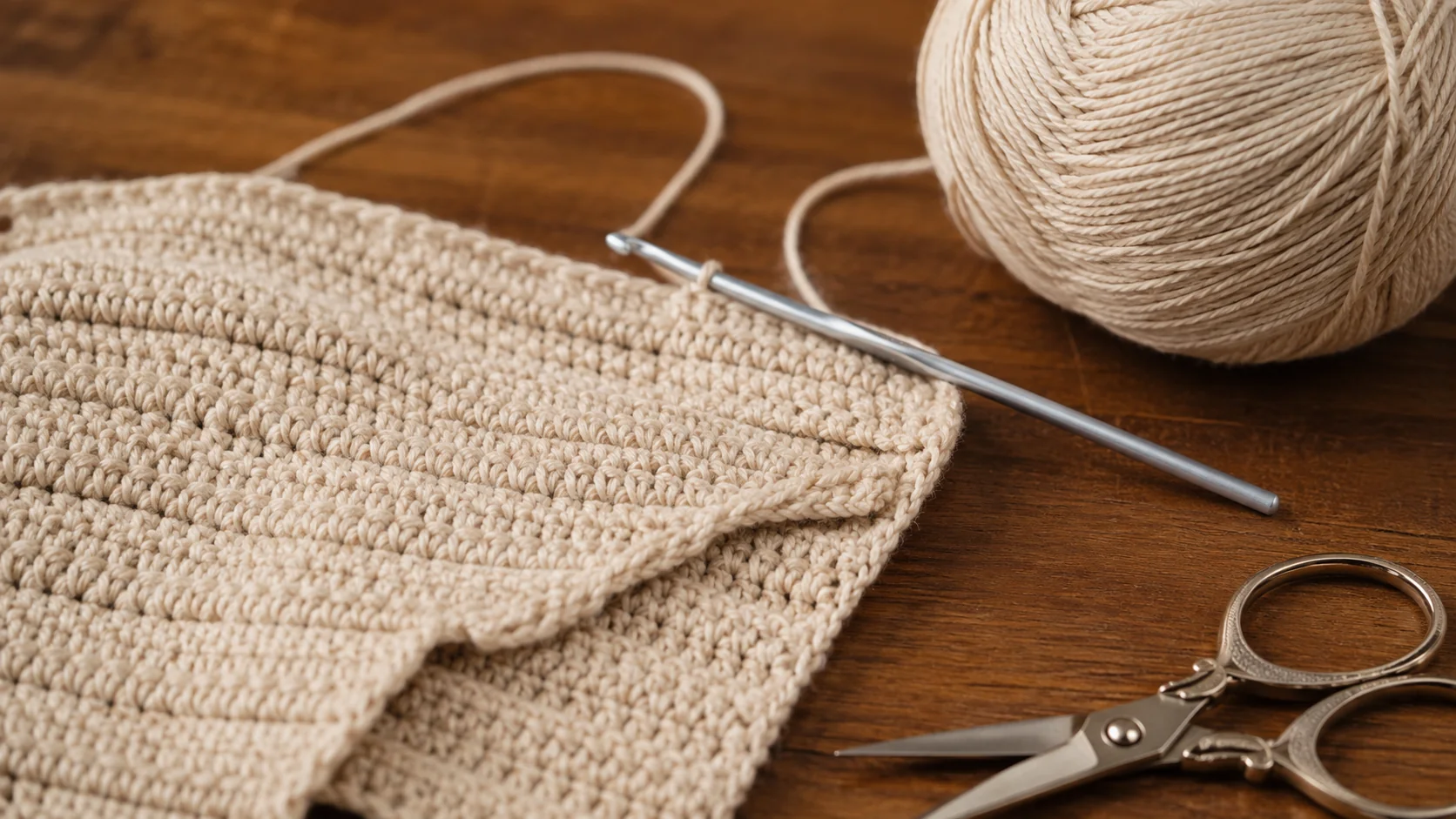
Yarn comes in standard weight categories, numbered 0 (lace) through 7 (jumbo) under the Craft Yarn Council's weight system. For learning, the sweet spot is category 4, medium or "worsted" weight: thick enough to see individual stitches clearly, thin enough that fabric grows at a satisfying pace. Every yarn label shows the weight symbol plus a recommended hook size, which removes the guesswork; for worsted yarn that recommendation typically lands around a 5 to 6 mm hook.
Two properties matter more than color. Smooth and light-colored yarn shows your stitches, and seeing stitches is the whole learning curve; fuzzy, dark or highly textured yarn hides them exactly when you need to count. And for the washcloth below, cotton is the classic choice: it holds shape, survives hot wash and shows stitch definition beautifully.
Keep Your Craft Life in One Place
Link your project gallery, pattern bookmarks and progress photos from one short address.
The Best First Projects, Ranked by Forgiveness
Beginner-friendliness is really about how loudly a project punishes small errors. Ranked from most forgiving to least:
1. Washcloth or dishcloth. Flat, small, square, done in an evening or two. A wobbly edge still washes dishes. This is the canonical first project, and the full pattern is below.
2. Scarf. The same flat rows, just more of them. The risk is not difficulty but boredom and drifting stitch counts over length; count stitches every few rows and it stays a rectangle.
3. Granny square. Worked in rounds from the center out, teaches clusters and corners, and each square is finished in under an hour. Squares stack into blankets, bags and pillows, so practice accumulates into something.
4. Simple beanie. Introduces working in the round and basic decreasing. Real shaping, still forgiving: heads do not demand precision the way garments do.
5. Amigurumi and garments, later. Stuffed toys need tight tension, invisible decreases and assembly; sweaters need gauge, fit and seams. Both reward a foundation of finished flat projects first. When a free pattern labeled "easy amigurumi" tempts you in week one, bookmark it for month two.
Your First Pattern: A Simple Washcloth
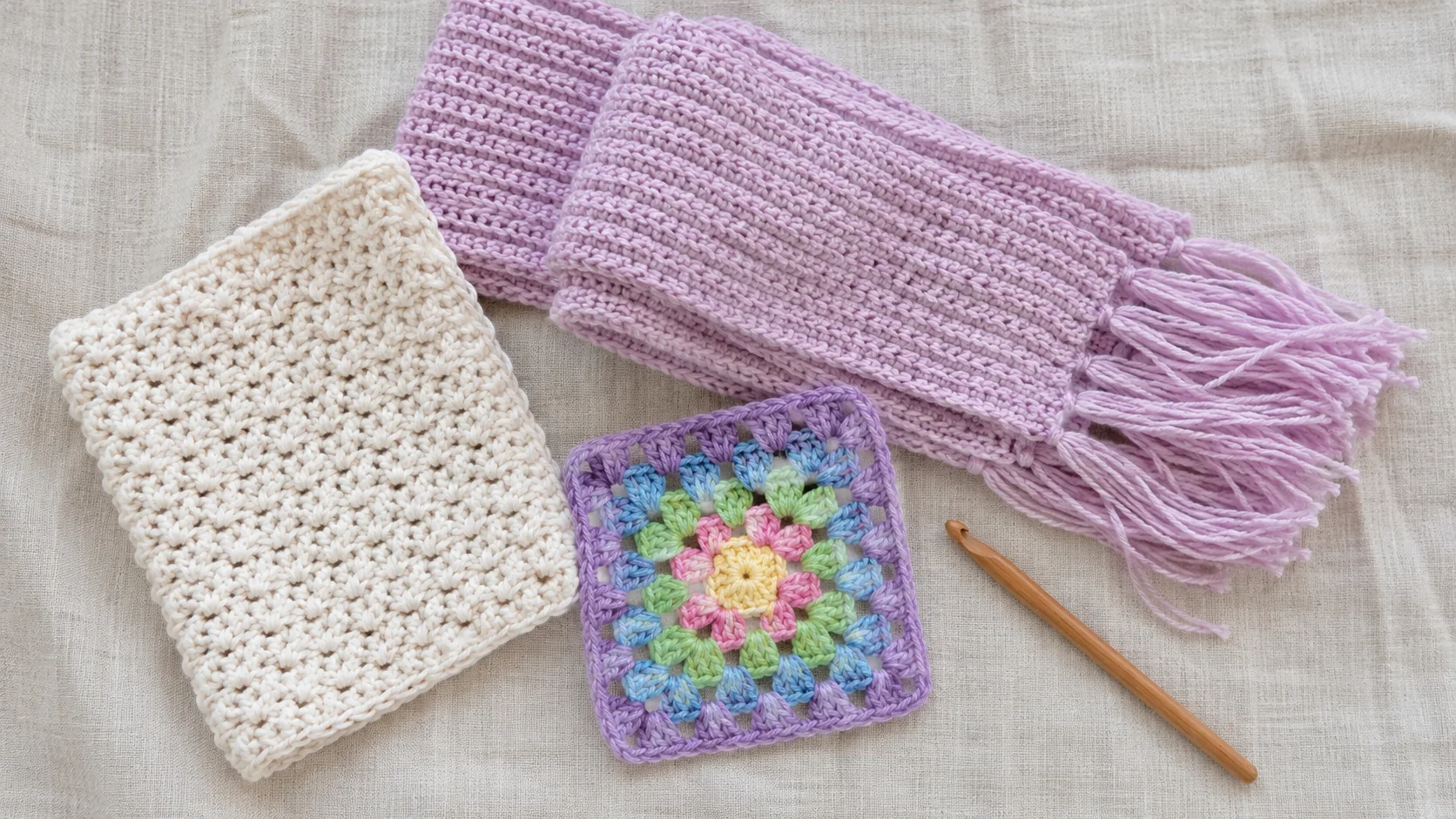
An original basic-level pattern in US terms, written the way patterns are really written, so finishing it also teaches the notation. Finished size roughly 20 cm square, depending on tension.
Materials: worsted weight cotton yarn (category 4), a 5 mm hook, scissors, and a yarn needle for weaving in ends.
Pattern:
Foundation: ch 25.
Row 1: sc in 2nd ch from hook and in each ch across. 24 sc. Ch 1, turn.
Row 2: sc in each sc across. 24 sc. Ch 1, turn. The ch 1 does not count as a stitch.
Rows 3 to 26: repeat Row 2.
Finishing: after the last row, cut the yarn leaving a 15 cm tail, pull the tail through the final loop to fasten off, and weave both ends into the fabric with the yarn needle.
The built-in lesson: count every row. Twenty-four stitches, every row, no exceptions. If a row comes up 23 or 25, the culprit is almost always a missed first stitch after turning or an accidental extra in the last stitch. Undo the row, redo it, and the habit that makes every future pattern work is installed. Wobbly early rows are normal; cotton blocks out surprisingly flat after a wash.
The Mistakes Every Beginner Makes
Death-grip tension. Beginners choke the yarn, producing tight stitches the hook can barely enter. If working the next row feels like archaeology, loosen up; fabric should bend like cloth, not armor.
Losing the edge stitches. The first stitch after turning and the last stitch of each row are where rows silently shrink or grow. Counting stitches at the end of each row catches the drift while it is one row deep instead of fifteen.
Ignoring gauge on sized projects. For a washcloth, gauge is irrelevant. The moment a project must fit something, a head, a foot, a person, the tension swatch stops being optional. Building the counting habit now is what makes gauge easy later.
Switching yarns mid-learning. Every yarn handles differently. Keeping one smooth worsted cotton or acrylic through the first projects means your hands learn one material's behavior instead of relearning three.
Share the Finished Projects, Not Ten Links
One VisuLink holds your maker gallery, your pattern list and everything else you share.
FAQ
What is the easiest thing to crochet for a complete beginner?
A washcloth in worsted cotton: flat, small, one stitch throughout, finished in an evening or two, and useful even when imperfect. The complete pattern is in this guide.
Are free crochet patterns actually good?
Many are excellent; quality varies more in writing than in design. A good free pattern states its skill level, yarn weight, hook size, whether it uses US or UK terms, and whether turning chains count as stitches. Missing all of those is the warning sign.
What do the skill levels on patterns mean?
The standard scale runs Basic, Easy, Intermediate and Complex, describing stitch vocabulary and shaping demands. Start at Basic, move up when a full project has gone start to finish comfortably.
What yarn should a beginner learn with?
Category 4 worsted weight, smooth texture, light color, with the hook size the label recommends, typically around 5 to 6 mm. Visible stitches are the entire point at this stage.
US and UK crochet terms: how do I know which a pattern uses?
The pattern should say. If it does not, the presence of "sc" (single crochet) indicates US terms, because the UK system has no stitch by that name. The same words name different stitches across systems, so this check matters before starting.