

Eighty true or false questions with answers and one-line explanations, balanced at exactly 40 true and 40 false. Every fact was checked against Encyclopaedia Britannica's articles, so you can read the answers out loud with confidence, and no statement depends on wordplay to work.
True or false is the fastest quiz format there is: everyone answers everything, even the people who swear they know nothing. If your table wants open questions instead, the full set of fun trivia questions for adults covers every category, and there are themed banks for sports, food and music. Nothing below repeats what is already in them.
One Link for Your Whole Quiz Night
A short address you control, pointing to your quiz sets, party pages and everything else you share.
How to Use This Quiz
One rule before the formats: in true or false, a guess is right half the time. To stop the scoreboard becoming a lottery, pick an antidote: each wrong answer costs a point, or play in rounds of 10 with a cutoff per round. Party mode: one reader, everyone answers by standing or sitting (standing = true), one point per hit. Quiz night: 10 statements per round, written answers, penalty per miss. Family mode: alternate an easy and a medium one, and save the hard list for tiebreaks. Statements are numbered 1 to 80; the answer follows each one, so the reader keeps the screen to themselves.
Animals: Mammals, Birds and Arachnids
1. Bats are the only mammals capable of flight. TRUE. It is the definition of the order Chiroptera in Britannica.
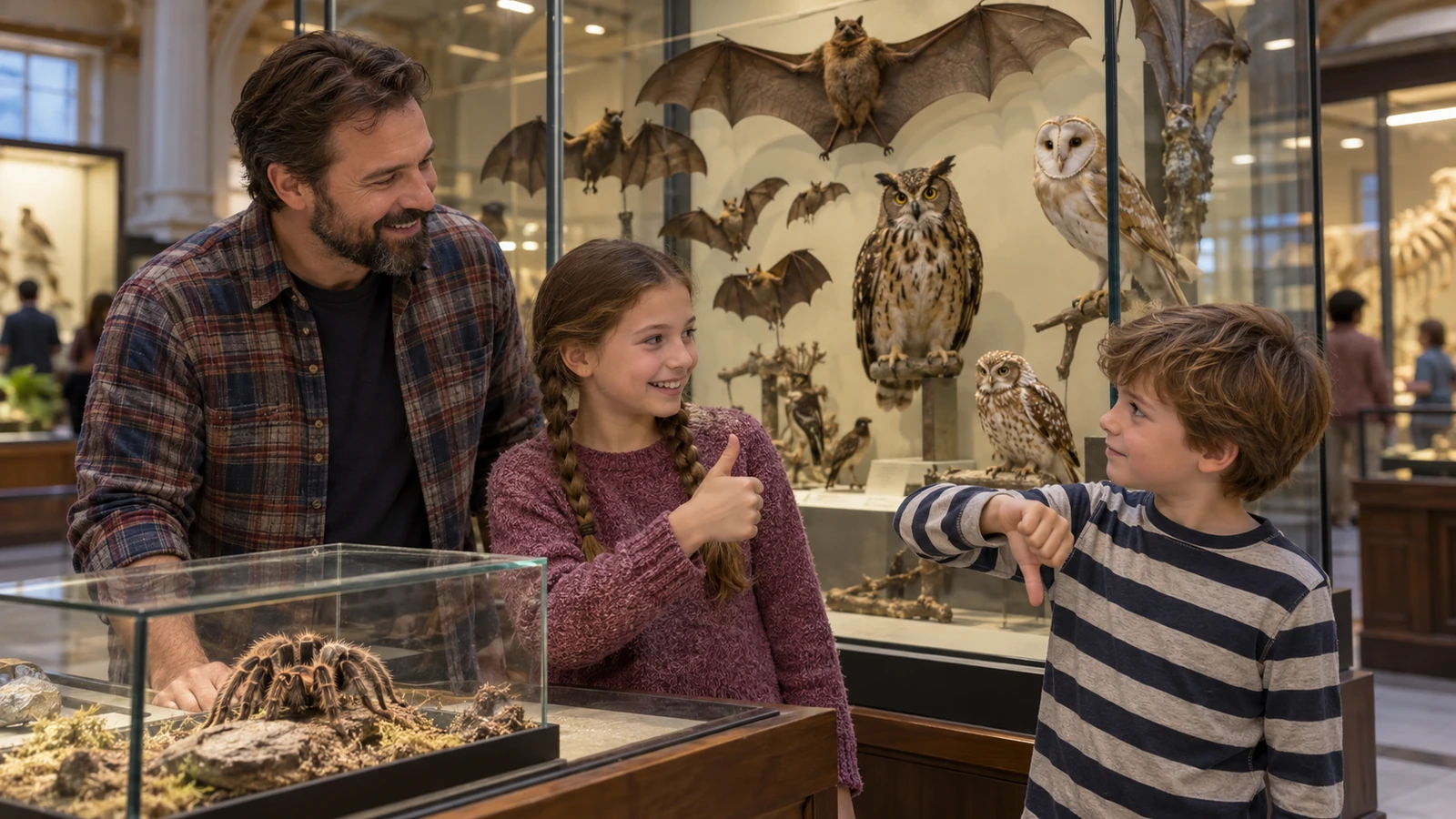
2. Bats are blind. FALSE. "Blind as a bat" is a myth: the smaller ones rely on echolocation, the larger ones see well.
3. Bats navigate at night by night vision, not by sound. FALSE. They navigate by echolocation, a system of acoustic orientation.
4. Spiders have eight legs, and insects have six. TRUE. That is exactly the difference that separates the two groups, per Britannica.
5. A spider is an insect. FALSE. A spider is an arachnid, with a body in two parts; an insect has three.
6. All known spiders are predators. FALSE. Britannica names one exception, the nearly herbivorous Bagheera kiplingi.
7. Each octopus arm carries two rows of suckers. TRUE. Eight arms, each with two rows of fleshy suckers with great holding power.
8. Octopus ink is a poison that kills the predator. FALSE. It is melanin-based ink, used as a smoke screen for escape.
9. Penguins live at the North Pole. FALSE. They live only in the Southern Hemisphere.
10. There is a penguin species that lives at the Equator. TRUE. The Galapagos penguin lives at the Equator.
11. Most penguin species breed between latitudes 45° and 60° S, not in Antarctica. TRUE. Antarctica hosts few species; most live on subantarctic islands.
12. The ostrich is the largest living bird. TRUE. The superlative is literal in Britannica.
13. Ostriches can fly short distances. FALSE. It is a flightless bird; it escapes by running, not flying.
14. The ostrich has two toes on each foot. TRUE. It is the only two-toed bird.
Animals: Giants and Marsupials
15. Ostriches bury their heads in the sand when frightened. FALSE. The source describes flight at up to 72.5 km/h and dangerous kicks when cornered, never that behavior.
16. The ostrich egg is the largest egg laid by any living bird. TRUE. About 150 mm by 125 mm and 1.35 kg.
17. The elephant is the largest living land animal. TRUE. The superlative is literal in Britannica.
18. The elephant's trunk is just an elongated nose, with no lip involved. FALSE. The trunk is an elongated upper lip and nose at once.
19. Elephants are found only in Africa. FALSE. They occur in tropical and subtropical regions of Africa and Asia.
20. The blue whale catches its food with its teeth. FALSE. It has baleen plates instead of teeth, which it uses to feed on krill.
21. A blue whale's mouth can hold up to 800 baleen plates. TRUE. The number is literal in Britannica's prose.
22. In blue whales, females are smaller than males. FALSE. It is the reverse: females are generally larger than males.
23. A shark's skeleton is made of cartilage, not bone. TRUE. Sharks are cartilaginous fishes.
24. The kangaroo carries its young in a pouch. TRUE. The marsupium is well developed, opens forward and contains four teats.
25. A newborn kangaroo is about 2 cm long. TRUE. It is born very immature, weighing less than a gram.
26. The young kangaroo leaves the pouch for good before it is a month old. FALSE. It leaves completely at 7 to 10 months of age.

The Human Body
27. The human heart has four chambers. TRUE. Right atrium, right ventricle, left atrium and left ventricle, per Britannica.
28. The heart sits at the far left edge of the chest. FALSE. It sits between the two lungs, slightly to the left of center, behind the breastbone.
29. The human heart has four valves. TRUE. Four valves ensure that blood flows in one direction.
30. In healthy adults, a normal resting heart rate is above 120 beats per minute. FALSE. Normal at rest is 60 to 100 beats per minute.
31. The heart pumps about 7,000 liters of blood per day. TRUE. Between 7,000 and 8,000 liters each day.
32. The human skeleton divides into a cranial skeleton and a spinal skeleton. FALSE. The two subdivisions are the axial and the appendicular skeleton, per Britannica.
33. The skull is part of the appendicular skeleton. FALSE. Much of the skull belongs to the axial skeleton; the appendicular is the girdles and limbs.
34. The human heart sits on the left side of the chest, away from the midline. FALSE. It sits between the two lungs, slightly to the left of center, behind the breastbone.
35. The appendicular skeleton includes the girdles and the limbs. TRUE. It is the second of the two subdivisions, opposite the axial skeleton.
36. The vertebral column is part of the axial skeleton. TRUE. The axial skeleton includes the vertebral column and much of the skull.
37. The human heart beats about 100,000 times a day. TRUE. About 100,000 heartbeats a day, pumping 7,000 to 8,000 liters.
38. The human skeleton has just one main subdivision. FALSE. The source declares two main subdivisions: axial and appendicular.
Host the Night, Share One Link
Your quiz sets, your scoreboards and your party page behind a single short address.
Space
39. A day on Venus lasts longer than a year on Venus. TRUE. Rotation takes 243 Earth days; the trip around the Sun, 224.7, per Britannica.

40. Venus rotates in a retrograde direction. TRUE. Stated literally in the planetary table.
41. Venus has no moons. TRUE. Known moons: none.
42. Venus's atmosphere is about 96% nitrogen. FALSE. It is 96% carbon dioxide; molecular nitrogen is 3.5%.
43. Venus is the planet closest to the Sun. FALSE. Venus is second; Mercury is first. The source puts Venus at 108,209,475 km (0.72 AU) from the Sun.
44. Venus is about half the size of Earth. FALSE. Venus's mean radius is 6,051.8 km against Earth's roughly 6,371 km: close to 95%, not half. That similarity is why Venus is called Earth's twin.
45. Galileo discovered the phases of Venus in 1710. FALSE. It was 1610.
46. Observing the phases of Venus supported the Copernican model. TRUE. It was the first direct observational evidence for Copernican theory.
47. Mars is the fourth planet from the Sun. TRUE. Fourth in order of distance from the Sun, per Britannica.
48. Mars is named after a Greek god. FALSE. It is named for the Roman god of war.
49. Mars is the largest planet in the solar system. FALSE. It is seventh in the solar system in size and mass.
50. Mars has less mass than Earth. TRUE. The source ranks it seventh in the solar system in size and mass.
Geography
51. The Amazon basin is the largest drainage system in the world by water volume and area. TRUE. The superlative is literal in Britannica's prose, about the drainage system.
52. The Amazon River is longer than the Nile. FALSE. At a length of at least 6,400 km, it is slightly shorter than the Nile.
53. The westernmost source of the Amazon lies in the lowlands of Brazil. FALSE. It lies high in the Andes Mountains.
54. Most of the Amazon basin lies in Peru. FALSE. By far the largest portion of the basin is within Brazil, along with roughly two thirds of the main stream.
55. The Amazon basin is nearly twice the area of the Congo basin. TRUE. About 7 million square km, nearly twice the Congo's basin.
56. The Andes run along the western edge of South America. TRUE. Along the continent's western edge.
57. The Sahara desert is in northern Africa. TRUE. It is the great North African desert.
58. Penguins are native to the Sahara. FALSE. Penguins live only in the Southern Hemisphere; the Sahara is North African.
59. Australia is the smallest continent. TRUE. Literal in Britannica.
60. Australia has eight states. FALSE. There are six states (New South Wales, Victoria, Queensland, South Australia, Western Australia and Tasmania) plus territories.
61. Tasmania is an Australian territory, not a state. FALSE. Tasmania is on the list of the six states.
62. The Northern Territory became self-governing in 1901. FALSE. It was 1978.
History
63. The Great Wall of China was built to fortify the country's southern border. FALSE. It was built to fortify China's northern border, per Britannica.
64. The Great Wall was the site of battles against the Mongols during the Ming dynasty. TRUE. The source records multiple battles and skirmishes across history, including against the Mongols in the Ming dynasty.
65. Machu Picchu is in Peru. TRUE. An Inca site in the Peruvian Andes, a World Heritage Site, per Britannica.
66. Hiram Bingham reached Machu Picchu in 1911. TRUE. Led to the site by Melchor Arteaga, a local Quechua resident.
67. It is confirmed that Machu Picchu is Vilcabamba, the "lost city of the Incas". FALSE. That interpretation of Bingham's is no longer widely accepted.
68. The Incas recorded information in an alphabet of painted glyphs. FALSE. They used the quipu, knotted cords, per Britannica.
69. The Inca messenger service covered about 240 km per day. TRUE. About 150 miles (241 km) a day, in relays.
70. At its peak, the Inca empire reached the Maule River in central Chile. TRUE. From the northern border of modern Ecuador to the Maule River.
71. The Maya used a hieroglyphic writing system. TRUE. A script that has now largely been deciphered, per Britannica.
72. Mayan languages have no speakers left today. FALSE. More than five million people speak Mayan languages.
Everyday Science
73. Ice floats because it is less dense than liquid water. TRUE. That is why ice forms at the surface and freezes downward, per Britannica.
74. Water reaches its greatest density at about 4 °C. TRUE. In the liquid phase.
75. Lakes usually freeze solid, from the bottom up. FALSE. They rarely freeze completely; the liquid water below becomes a winter refuge for aquatic life.
76. Water has no color of its own; it only looks blue by reflecting the sky. FALSE. Water has an intrinsic blue color, caused by slight absorption of light at red wavelengths.
77. A lightning channel reaches temperatures on the order of 30,000 °C. TRUE. Peak temperatures in the return-stroke channel, per Britannica.
78. Sound travels through a vacuum. FALSE. Sound is a mechanical disturbance that needs an elastic material medium.
79. Sound travels as a transverse wave. FALSE. It travels as a longitudinal wave, with alternating compressions and rarefactions.
80. Human hearing covers roughly 20 Hz to 20 kHz. TRUE. Between 20 hertz and 20 kilohertz lies the human frequency range of hearing.

The Hard Ones (Tiebreakers)
When two teams tie, pull from these eight, already listed above and chosen for their miss rate: 16 (the ostrich egg), 22 (larger female whales), 25 (the 2 cm newborn), 45 (Galileo's year), 52 (Amazon vs Nile), 62 (the Northern Territory), 69 (the Inca messengers), 77 (the lightning temperature). Read the statement, not the number, and give ten seconds flat: true or false deserves no more than that.
Share the Scoreboard, Not Ten Links
One VisuLink holds your quiz sets, your scoreboards and everything else you share.
FAQ
How do you score true or false so guessing does not dominate?
A guess is right 50% of the time, so the score needs an antidote: subtract a point per miss, or play rounds of 10 with a cutoff per round. Without it, someone guessing everything ties with someone who knows half.
How many statements per round?
Ten is the number that works: fast enough to keep the pace, long enough to separate luck from knowledge. Eight rounds of ten cover this whole bank in one evening.
How do I adapt these statements for kids?
Use the easy ones: the animal statements and the basic geography work well from about age 8. The human body and space sections carry the most entertaining medium ones for preteens.
What is the difference between true or false and multiple choice for quiz night?
Speed and inclusion. In true or false everyone answers everything, which keeps shy players in the game; the tradeoff is that guessing is worth more, so use a penalty per miss. Multiple choice filters knowledge better but is slower to read aloud.