

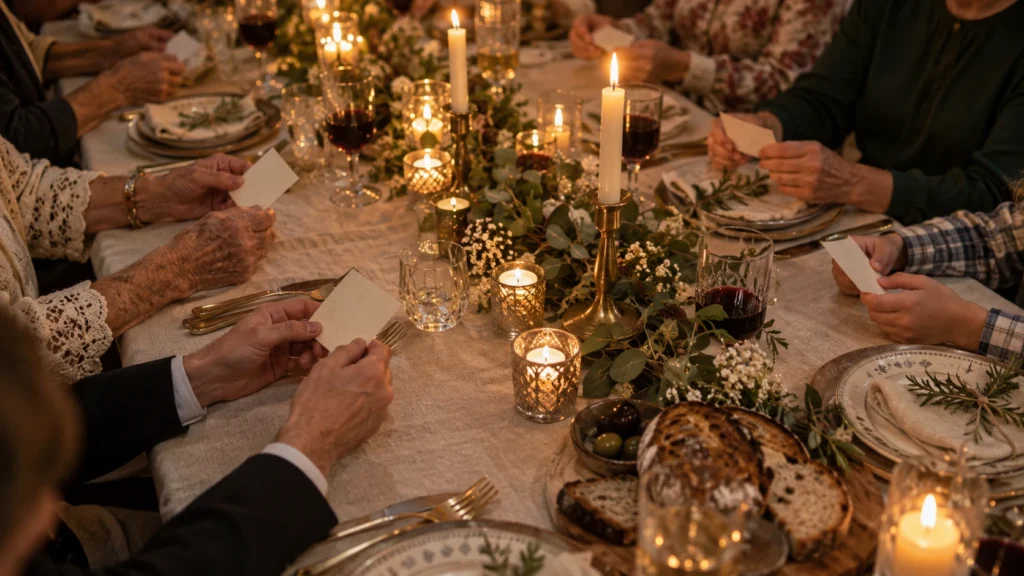
A family Christmas game is not one that everyone tolerates, it is one where a grandparent and a six year old are doing different jobs in the same round. That difference is the whole design problem, and it is solvable.
Below are eighteen games for a room holding three generations at once. Each gives the minimum age, group size, time, materials, rules, a role for the oldest and the smallest, and a variant for anyone who cannot stand or read.
The Night Happens Somewhere
If the gathering is at a VISU partner location, a code scan can tie your verified presence to a reward. Nothing to buy, no profile to complete.
What Makes a Game Work Across Three Generations
Most lists sort games by theme. For a mixed-age room that is the least useful sort. What matters is whether the game asks everyone for the same thing at the same moment, which is where the youngest and oldest drop out.
Split roles, not split teams. A game survives an age gap when it holds more than one job: someone reads, someone guesses, someone counts, someone judges. A four year old turning the card holds a real position.
No private reading. Reading is fine when one person does it aloud. The moment a player must read silently to take a turn, every pre-reader is out.
A seated version of every movement game. After a large meal some people will not leave a chair and some cannot. A standing-only game excludes by furniture.
Short rounds, and name the finish line. A three minute round lets someone join late without a briefing, and a game that ends when the room gets bored ends badly. Everything below runs on what is in the house.
Games Before Dinner
This window is the hardest. Guests arrive in waves, the kitchen needs the host, and the children are at peak energy.
1. The Arrival Board. Age four. Six to twenty. The arrival window. A sheet on a door, a pen on a string. Write six prompts answerable in three words: a first you had this year, a place you want to go, a word you overuse. Guests answer and sign with a mark, and at dinner someone reads a line aloud for the table to guess. Oldest: chooses the prompts. Youngest: mark inspector. Seated or pre-reading: pass a clipboard round, with an adult reading each prompt aloud.
2. Three Chairs, One Story. Age five. Six to fourteen. Twelve minutes. Nothing. Three people face the rest and the group gives an opening line about a fictional event, say the box left on the porch. Each adds a sentence in turn, none may contradict an earlier one, and whoever does swaps with a spectator. Oldest: contradiction judge, needing attention and nothing else. Youngest: picks the opening line. Seated or pre-reading: swaps are verbal and nothing is written.
3. Kitchen Drawer Auction. Age five. Five to twelve. Fifteen minutes. Eight drawer objects, ten paper tokens each. Announce a fictional scenario, say alone in a cabin while it snows for a week, then auction the objects one at a time. Each player then explains why their set wins and everyone votes for a set other than their own. Oldest: auctioneer. Youngest: picks the scenario, delivers each sold object. Seated or pre-reading: pass objects down the table, tokens counted by hand.
Games at the Table
Table games cost nothing in logistics. Nobody moves, nobody sets up, and play pauses for a dish without losing state.
4. Two Spoons. Age four. Five to sixteen. Eight minutes a round. Two spoons that look different. The spoons start at opposite ends. Whoever holds one names an item in the round category and passes it one seat onward: things that are cold, things with wheels, things you can hear. Anyone holding both says two items, and a repeat turns that player into a listener. Oldest: owns the categories. Youngest: sets directions, calls repeats. Seated or pre-reading: already seated, entirely spoken.
5. What Was on the Table. Age five. Four to fourteen. Six minutes. The table and a cloth. One player shuts their eyes while another removes an item and hides it under the cloth. The guesser gets three tries but must describe the missing item rather than name it. Oldest: holds the cloth and arbitrates. Youngest: the remover, needing no reading or counting. Seated or pre-reading: only reachable items count, and nothing is written.
6. The Same Word. Age six. Four to twelve. Twelve minutes. Nothing, played aloud. Pair each player with whoever sits diagonally opposite. The caller gives a broad category, say something you find in a cold place, and both halves try to say the same word on a count of three. First pair to three matches ends the round. Oldest: caller and scorekeeper. Youngest: paired with an adult who whispers three options, so the child chooses. Seated or pre-reading: already seated, no paper needed.
7. The Table Map. Age six. Five to fourteen. Fifteen minutes. Paper and a pen. One player draws a hidden map of an imaginary place, five rooms joined by four doors, then describes a route aloud without naming a room. Everyone draws what they hear, and the closest drawing to the majority wins. Oldest: mapmaker, an unhurried seated job. Youngest: holds the original face down, reveals it. Seated or pre-reading: already seated, spoken in and drawn out.

A Reward Tied to the Visit
VISU rewards a verified visit at a partner location. The scan confirms you are there, without asking you to buy anything or fill in a profile.
Games After Dinner
After the meal the room splits: some want to move, some want a chair. These four hold both groups in the same round.
8. Cushion Delivery. Age four. Six to eighteen. Ten minutes. Four cushions. Seated players form a ring holding cushions, and standing players are couriers. The caller names a delivery, say the patterned cushion goes to whoever is not holding one, and a seated player may refuse one per round. Eight deliveries wins for the room. Oldest: a seated hub with two cushions. Youngest: courier, picking their own route. Seated or pre-reading: ring only, passing hand to hand, all calls spoken.
9. Sound Order. Age four. Five to sixteen. Eight minutes. Noisy objects: a spoon on a glass, crumpled paper, a zip, a knock on wood. Everyone shuts their eyes while one player makes four sounds in sequence. Eyes open, and the group reconstructs the order by consensus. The right set scores one, the right order two, and the sequence grows each round. Oldest: sound maker, objects brought to them. Youngest: eye marshal, checking eyes are shut. Seated or pre-reading: nobody stands and the game is pure audio.
10. The Slow Relay. Age five. Eight to twenty in two teams. Fifteen minutes. Two cups and paper balls. Nobody races for speed. Every ball must reach the cup by a different method than the one before: on a flat palm, on a shoulder, down a chain of hands. A repeat costs a ball, and seven methods wins. Oldest: method registrar, rejecting repeats. Youngest: invents the next method, taking charge of strategy. Seated or pre-reading: pass along a row of chairs, the registrar draws symbols.
11. The Chair Interview. Age six. Five to fifteen. Twelve minutes. One chair. One person answers the room questions as an invented character the group introduces in a sentence: a lighthouse keeper afraid of water. Six questions maximum, then the room votes and whoever asked the best takes the chair. Oldest: character inventor, requiring no memory. Youngest: asks first and calls time at six. Seated or pre-reading: the chair is figurative and nothing is written.
Games for the Grandparents to Lead
Handing the oldest person a game to lead is different from including them in one. These four make leading the fun part, with no standing or quick reactions.
12. The Object Provenance. Age five. Four to sixteen. Fifteen minutes. Three small objects the leader picks privately. The leader presents one object with three short origin stories, one true and two invented. The room asks up to four questions, the leader answers in character, then everyone votes. A correct room scores one, a leader who fools it two. Oldest: the leader, since they hold more objects with histories than anyone. Youngest: vote counter. Seated or pre-reading: objects passed, votes counted in place, all spoken.
13. Then and Now. Age six. Five to fourteen. Twelve minutes. Paper and a pen for the leader. The leader names an ordinary task: getting a message to a friend, hearing one specific song. Each player describes how it is done now, and the leader how it was done at a chosen point in their own life. The room decides which took more steps. Oldest: leader. Youngest: picks the next task, counts steps on fingers. Seated or pre-reading: nobody moves and the tally is marks.
14. The Recipe With a Missing Step. Age six. Four to twelve. Ten minutes. Nothing. The leader describes making something simple in six spoken steps, deliberately dropping one or swapping two. The room listens through, then anyone may call a step number and the leader confirms or denies. Two wrong calls ends it. Oldest: leader, knowing a process well enough to break it on purpose. Youngest: step counter, one finger per spoken step. Seated or pre-reading: seated throughout, entirely spoken.
15. The Word That Left. Age seven. Five to fourteen. Ten minutes. Nothing. The leader says a word that was common in their day and is rare now. Nobody guesses it: each player invents a plausible definition aloud, the leader gives the real one last, and the room votes for the one it liked most. Oldest: leader and final authority, a position nobody can contest. Youngest: sets the order, and may draw a definition. Seated or pre-reading: seated throughout, and a drawing counts as an answer.

Games the Youngest Can Win
These are not simplified adult games. The deciding skill is one a small child has as much of as anyone: noticing, choosing, saying the obvious out loud.
16. Who Is Copying. Age four. Six to eighteen. Eight minutes. Nothing. Everyone sits in a circle and one player turns to face away. The circle silently picks a leader who starts a small repeating motion, tapping a knee or turning a hand, and everyone copies. The player turns back and gets three guesses. Small children are often best, because they watch faces not hands. Oldest: frequently the leader, since a seated hand motion is the job. Youngest: guesser on request. Seated or pre-reading: nobody stands and the game is entirely visual.
17. The Colour Call. Age three. Five to twenty. Six minutes. Nothing. The caller names a colour and everyone touches something of that colour within a count of five, not on their own clothes and not the same object as anyone else. Two players on one object score nothing, a colour nobody else found scores two. Oldest: plays from their chair, no rule distinction. Youngest: caller, choosing the colours, real control over the round. Seated or pre-reading: arm reach binds everyone, colours spoken aloud.
18. The Quiet Search. Age four. Five to sixteen. Twelve minutes. One small object. One player hides a small object in an agreed room, in plain sight rather than inside anything. Everyone else searches in silence, and whoever spots it sits down without pointing. The last one searching hides it next. Oldest: told the general area, so they dispense hints. Youngest: hider on the first round. Seated or pre-reading: fold your arms instead of sitting down.
Closing the Night
A gathering that dissolves leaves people unsure whether it went well. Two short rituals fix that, and neither carries religious content.
The Round of One Thing. Everyone says one thing they will remember from today, in one sentence, going around once. Three rules make it work: one sentence only, no responses in between, and the youngest starts. Nobody may repeat what was said, which makes the last speakers the most interesting.
The Sealed Page. Pass a sheet of paper around. Each person writes one line about the year ahead, a prediction, a plan or a joke, then folds it so the next cannot see. The last writes the date outside and it goes in a drawer, to be opened at the same gathering next year. Children who cannot write dictate their line, and opening that page becomes the first activity of the next night.
Keeping It Fair and Short
Replace elimination with a job change. When a player is out, give them a role rather than a sideline chair: judge, counter, timer, caller. A child sidelined for ten minutes will not rejoin.
Cap the round, not the game. Say how many rounds before you start. Three rounds of a good game beats one round of everything you planned, and you stop while people want more.
Let anyone pass without explaining. One word, and the turn moves on. It applies to the ninety year old and the five year old equally, and saying so up front removes the awkwardness.
Never put the youngest first at something hard. Going first is a good job when the task is choosing a category, and a bad one when it means producing a clever answer with no example. Put a child first on choosing, third on producing.
For extra material, a round built from movie trivia questions suits a room spanning several generations of viewing, and a list of would you rather questions for kids is an instant fallback.
Let the Place Count
When a gathering happens at a VISU partner location, scanning a code can connect the visit to a reward. It comes from verified presence, not from a purchase.
FAQ
What Christmas Games Work With Grandparents and Small Children Together? The ones with more than one job per round, so a five year old and an eighty year old are not competing at the same skill. Two Spoons and Who Is Copying hold the widest range.
What Do I Need to Buy? Nothing. Every game uses paper, pens, cups, spoons, cushions, string or objects already in the house.
How Do I Include Someone Who Does Not Want to Play? Give them the judge or scorekeeper role and stop asking. Most games here have a position that needs attention and no performance, which is usually the part people decline.
Which Games Work at the Table Without Clearing Anything? Two Spoons, What Was on the Table, The Same Word and The Table Map, all with plates still down and nothing but paper and a pen.
What If the Age Gap Runs From Three Years Old to Ninety? Use the games where the deciding skill is noticing rather than knowing. The Colour Call starts at three and puts everyone within arm reach, removing both the mobility and knowledge advantage.