


Christmas games for kids work best when the rules fit the age of the smallest player in the room. These twenty-two games are sorted by age band and by moment: the table, the living room, before bed, the cousin crowd and the yard. Each uses paper, cups, socks, ribbon or nothing at all, and none leaves a child sitting out.
The Party Happens Somewhere
If that place is a VISU partner location, your verified presence can earn a reward. You scan the code there, with no purchase required.
Picking Games by Age
The age band is the first filter, not the theme. A game a nine year old finds obvious can be impossible for a four year old, and the reverse feels babyish within a round. With both in the room, pick the younger rule and give the older child a job.
Three to five. One instruction at a time, no reading or writing, and no waiting longer than half a minute for a turn. Matching, carrying, pointing, copying a movement and finding a hidden object all work.
Six to nine. Two-step rules and simple teams work. They read short cards, count their own points and notice unfairness at once, so say the finish out loud first.
Ten to twelve. They want a rule to argue about and a way to win by thinking: hidden information, deduction, a strategy choice, or a role running a round for the younger ones. Keep an opt-out from anything that isolates one child.
Two more filters cut fast. Space: table, living room and running games are not interchangeable. Noise: keep two quiet games ready after the meal. For the same age bands, see the list of indoor activities for kids.
Games at the Table
These run seated and pause when a plate lands.
1. Pass the Paper Star. Ages: 3 to 8. Players: 3 to 10. Time: 8 minutes. Materials: one paper star. Rules: pass the star while an adult hums. When the humming stops, the child holding it names one thing on the table, no repeats, then passes it on. Fair play: pointing counts, a neighbour may help, and the round ends after two laps.
2. Napkin Guess. Ages: 4 to 9. Players: 3 to 8. Time: 10 minutes. Materials: a napkin and small table objects. Rules: an adult hides an object under the napkin and children ask yes-or-no questions in turn: is it round, is it cold, do we eat with it. The winner hides the next one. Fair play: an adult whispers questions to the smallest, and everyone hides in fixed order.
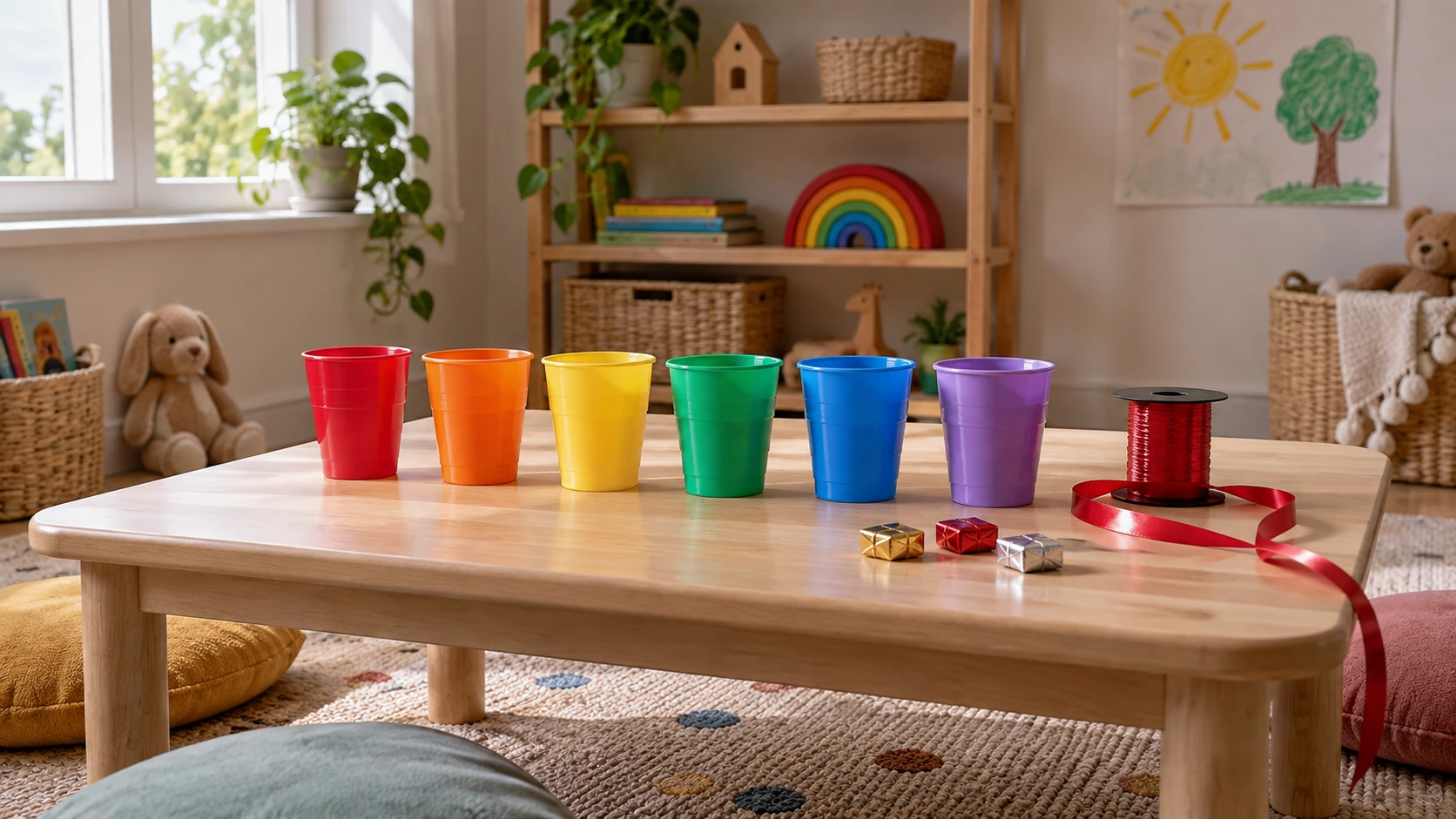
3. Cup Match. Ages: 3 to 7. Players: 2 to 6. Time: 10 minutes. Materials: six cups and three pairs of small objects. Rules: hide an object under each cup while the children watch, mix slowly, then players lift two cups per turn and keep matching pairs. Fair play: three cups and one pair for the smallest, ending when all pairs are found.
4. Christmas Word Chain. Ages: 6 to 12. Players: 3 to 10. Time: 12 minutes. Materials: none. Rules: the first player says a December word such as ribbon, and the next says a word starting with its final letter, so ribbon leads to napkin. A repeat closes the chain, and the group restarts to beat the last length. Fair play: younger children skip the letter rule, and the score belongs to the table.
5. Draw What I Say. Ages: 5 to 12. Players: 2 to 12. Time: 12 minutes. Materials: paper and pencils. Rules: one child describes a drawing without naming it: a circle at the top, two lines down, a square on the left. Everyone draws from the words alone, then compare placements. Fair play: pair a small child with an older one, and judge drawings against the description only.
Games in the Living Room
Room to stand and take a few steps, but no running. Clear a square of floor and move anything breakable off the low tables.
6. Freeze Like a Statue. Ages: 3 to 9. Players: 3 to 15. Time: 8 minutes. Materials: music or an adult clapping. Rules: children move while the sound runs and freeze when it stops. Instead of sending anyone out, the adult calls a new way to move: slowly, on tiptoes, backwards. Fair play: a three year old can hold an adult hand, and nobody is ever eliminated.
7. Sock Toss Lines. Ages: 4 to 12. Players: 2 to 10. Time: 12 minutes. Materials: rolled socks and a laundry basket. Rules: mark three throwing lines with tape. Each child picks a line before every underhand throw: near one point, middle two, far three. Six throws each. Fair play: the near line suits a four year old, and each child picks their own difficulty.
8. Follow the Leader Ribbon. Ages: 3 to 8. Players: 4 to 12. Time: 10 minutes. Materials: one long ribbon. Rules: everyone holds along the ribbon. The leader walks a route and makes one movement, a big step or a slow spin, that the line copies in order. Change leader every minute. Fair play: a very small child leads holding an adult hand, and turn order replaces scoring.
9. Find the Hidden Star. Ages: 3 to 9. Players: 2 to 12. Time: 12 minutes. Materials: one paper star per child, each a different colour. Rules: an adult hides all the stars while the children wait outside. Each child hunts only their own colour, then sits and gives hot-or-cold hints to the rest. Fair play: hide the smallest star in plain sight at eye level, so everyone finds one.
10. Two Truths About the Room. Ages: 7 to 12. Players: 3 to 10. Time: 15 minutes. Materials: paper and pencils. Rules: each child writes three statements about the room, two true and one invented. Vote on the invented one, then check by looking. One point per correct vote, one to the writer per vote fooled. Fair play: a younger sibling dictates to an adult, and statements cover objects, never people.
Quiet Games Before Bed
Swap-ins for the end of the evening: seated, low voices, no running.
11. The Whisper Story. Ages: 5 to 12. Players: 3 to 10. Time: 10 minutes. Materials: none. Rules: the first player whispers one sentence of a made-up December story to a neighbour, who passes it on and adds one. The last child says the whole story out loud, and the group compares it with the opening line. Fair play: a small child adds one word instead of a sentence, and the drift belongs to everyone.
12. Guess the Sound. Ages: 3 to 9. Players: 2 to 12. Time: 10 minutes. Materials: household objects and a cloth. Rules: children close their eyes while an adult makes a sound behind the cloth: crumpling paper, pouring water, tapping a spoon. Everyone whispers a guess in turn, then the object is shown. Fair play: three obvious sounds for the smallest, and whispered guesses so nobody is wrong out loud.
13. Sleepy Alphabet. Ages: 6 to 12. Players: 2 to 8. Time: 12 minutes. Materials: none. Rules: the group builds one sentence through the alphabet, each word starting with the next letter. The first attempt usually collapses early, so start again and get further. Fair play: younger children take the easy letters with help, and the record belongs to the group.
14. Colour Hunt in Your Head. Ages: 4 to 9. Players: 2 to 10. Time: 8 minutes. Materials: none. Rules: an adult names a colour and each child, without moving, names one thing of that colour visible from their seat. No repeats, so the round gets harder and quieter. Fair play: pointing counts, and a child who runs out picks the next colour.
A Reward Tied to the Visit
VISU rewards a verified visit at a partner location. The scan confirms that you are there, without asking you to buy something or fill in a profile.
Games for a Big Group of Cousins
Eight children or more, usually with a wide age spread. Teams solve most of it: mix ages inside each team, and give every team the same materials.
15. Mixed-Age Relay. Ages: 4 to 12 in mixed teams. Players: 8 to 24. Time: 15 minutes. Materials: crumpled paper balls and two bowls per team. Rules: each child carries a paper ball on the back of an open hand to the far bowl, walks back and tags the next. A dropped ball restarts that run only. Fair play: the smallest run a shorter route, and both teams finish to the same applause.
16. The Silent Line-Up. Ages: 6 to 12. Players: 6 to 20. Time: 8 minutes. Materials: none. Rules: the group lines up without speaking, ordered by something visible: height, sleeve length, letters in a name. Gestures are allowed, and an adult checks the finished line. Fair play: a small child is placed with an older one, and the line succeeds or retries together.
17. Team Charades With a Choice. Ages: 5 to 12 in teams. Players: 8 to 20. Time: 20 minutes. Materials: slips with simple actions such as wrapping a box, untangling lights, setting a table. Rules: a child draws a slip and may act, draw or describe it without the key word. Their team has forty-five seconds to guess, one point per correct answer. Fair play: the three clue methods score equally, and points belong to teams.
18. Cushion Islands. Ages: 4 to 10. Players: 6 to 16. Time: 12 minutes. Materials: cushions. Rules: place cushions across a cleared floor. Children walk between them while the music runs, and on the stop everyone needs a foot on a cushion, sharing. Each round removes a cushion, so the group crowds closer. Fair play: the smallest get the biggest cushion and nobody is sent out.

Games for Outside or a Big Room
Yard, garage, terrace or school hall. These need space and noise, so run them before the meal.
19. Ribbon Trail. Ages: 3 to 8. Players: 2 to 12. Time: 15 minutes. Materials: a long roll of ribbon or string. Rules: an adult lays a ribbon route with turns, a loop and a low obstacle. Children follow in single file without letting go, then run it again with one change: very slowly, or a hand on the shoulder in front. Fair play: ground level only, with no climbing, no timing and no order of arrival.
20. Sock Snowball Battle. Ages: 5 to 12. Players: 6 to 20. Time: 12 minutes. Materials: many rolled socks and a line of tape or chalk. Rules: two teams, one each side of the line, equal piles. On the signal everyone throws socks across, underhand and below the waist. After ninety seconds each side counts the socks on its own floor, and the lower count wins. Fair play: a small child can refill the pile, sides swap, and nobody is a target by name.
21. The Star Race Against the Clock. Ages: 6 to 12. Players: 4 to 16. Time: 10 minutes. Materials: paper stars and a timer. Rules: scatter paper stars and give the group sixty seconds to collect them into one bowl. If they finish, add ten stars and run the minute again. One of only two timed games here. Fair play: the smallest collect the nearest stars, and the clock is the only opponent.
22. Balloon Keep-Up. Ages: 4 to 12. Players: 3 to 15. Time: 10 minutes. Materials: one balloon per group of five. Rules: the group keeps the balloon up with taps, counting every touch. Nobody may touch it twice in a row, so they spread out and watch each other. Note the record, beat it once, then stop. A timed variation swaps the count for a sixty-second window. Fair play: a small child may use both hands, and the record is the group's. Adults should supervise balloons around children under eight and pick up burst pieces at once.
Keeping It Fair for the Youngest
Most crying at a family party comes from elimination, waiting and a prize only one child gets. All three are fixable before the first round. For the turn order, a random name picker on the TV settles who goes next without anyone choosing.
Replace elimination with a change. When a rule would send a child out, change something instead: a new way to move, a new colour, a new role. The child stays in and names the next constraint.
Cut the waiting. A four year old will not wait three minutes for a turn. Split a big group into two circles with two adults, or give the waiting children a job: holding the bowl, counting, starting the round.
Give everyone something at the end. Keep prizes symbolic and identical: a paper star, a sticker, a ribbon on the wrist. If you want a winner, make it a team and change teams every game.
Announce the finish before the first turn. Five rounds, one pass around the table, until the bowl is full. Children accept an ending they heard in advance and argue about one that appears from nowhere.
Let a child pass. One pass per round, no explanation asked and no comment made. A child allowed to sit out one turn usually comes back for the next. Keep a quiet corner ready too, with cushions and paper.
For question games between rounds, see the sorted set of would you rather questions for kids in the same age bands, and how VISU Network works for the reward named above.
Let the Place Count
When a family gathering is held at a VISU partner location, scanning a code can connect the visit to a reward. It comes from verified presence, not from a purchase.
FAQ
What Christmas Games Can Three Year Olds Play?
Pass the Paper Star, Cup Match, Freeze Like a Statue, Find the Hidden Star, Guess the Sound and Ribbon Trail: one instruction at a time, no reading.
How Do I Run a Game With Children of Very Different Ages?
Choose the rule that fits the youngest, then give the older ones a role: caller, scorekeeper, partner or judge. Mix ages inside each team.
What Do I Need to Buy?
Nothing. Paper, pencils, cups, rolled socks, ribbon, cushions, a basket, a napkin and a balloon. Several games use nothing at all.
How Do I Stop a Game Ending in Tears?
Remove elimination, shorten the wait, and give an identical symbolic prize to everyone. Announce the ending before the first turn and allow one pass per round.
Which Games Work at the Dinner Table?
Pass the Paper Star, Napkin Guess, Cup Match, Christmas Word Chain and Draw What I Say all stay seated.
What Can We Play Right Before Bedtime?
The Whisper Story, Guess the Sound, Sleepy Alphabet and Colour Hunt in Your Head are seated games that wind a room down.
How Many Games Should I Prepare?
Three or four, with one quiet game held back as a swap-in. Prepare the materials before the children arrive.
References
- CPSC: Suffocation Danger Associated with Children's Balloons. US safety regulator guidance on supervising balloon play and collecting broken balloon pieces right away.
- INSPQ: Preventing Suffocation and Choking. Quebec public health guide on why latex balloons and popped pieces must stay out of young children's reach.