

A Halloween carnival is not one game everyone plays together. It is a row of stations, and each one has to take a line of strangers, give every child a turn of about a minute, and hand back something small without the queue backing up. That constraint decides which ideas survive the afternoon and which jam the room.
Wikipedia describes trick-or-treating as a traditional Halloween custom in which people in costumes travel from house to house asking for treats. It also records that some organizations in the United States and Canada sponsor a trunk-or-treat, done from parked car to parked car in a local parking lot, often at a school or church, with open trunks displaying candy and often games and decorations. A school or church carnival sits in that same slot: the same night, the same crowd, a fixed place instead of a walking route. This guide turns that into stations, each with the details usually improvised on the day.
When the Night Happens at One Address
A carnival is a crowd arriving at one place for a few hours. VISU works on exactly that: at a partner location, scanning a code turns the visit into a small reward. The event stays yours.
The Station Test Every Halloween Game Has to Pass
Hold every idea against one test. A child walks up, waits behind a few others, plays, collects something small, leaves. Nobody waits for a team to form or a round to end. A game needing six players together belongs at a birthday party, not at a station. If a booth falls through on the day, games that need no materials fill the gap with nothing to set up.
Wikipedia describes party games as games played at social gatherings to facilitate interaction and provide entertainment and recreation, listing categories including icebreaker, parlour, picnic and large group games. A carnival station is the narrowest of those, repeated for hours at strangers arriving one at a time.
Every station below is written the same way, because these six details get improvised badly halfway through the evening:
- Station. What it is built from, using what the venue owns or a volunteer can carry.
- Turn. How long one child occupies the spot, decided in advance.
- At once. How many can play simultaneously, the real throughput number.
- Operator. Who is needed and what that person does.
- Prize. What is handed over, kept small and not automatically candy.
- Age reach. How one station serves a four year old and a ten year old in the same line, without announcing a younger version out loud.
That last point is where most carnivals slip. A queue holds a three year old on a parent's hand, an eight year old alone, and a twelve year old pretending not to care. The fix is never a kiddie version called out by the operator, because the children who need it refuse it. It is built in: a mark chalked closer, a wider target, a quiet extra attempt.
Pumpkin Stations for the Widest Age Spread
Pumpkins carry the visual grammar of the night and are forgiving props: heavy, round, hard to break, readable across a room.
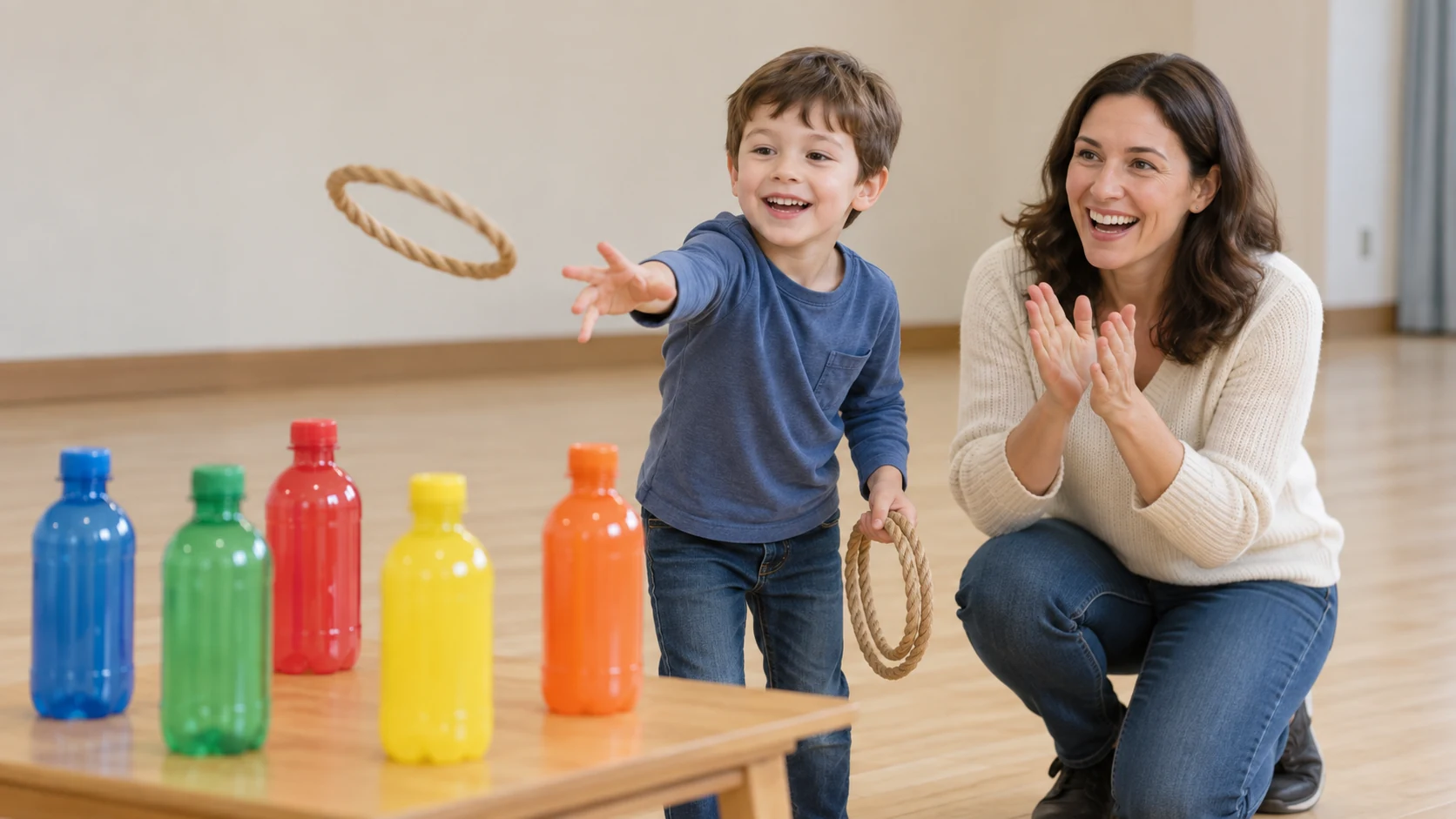
Pumpkin Ring Toss. Station: three or four small pumpkins with stems left on, at increasing distances on a low table, plus five rings cut from stiff rope. Turn: five rings, sixty seconds. At once: one thrower, one on deck. Operator: one adult who resets rings and keeps the collection box behind the pumpkins rather than crossing the throwing line. Prize: a stamp, a second for landing all five. Age reach: two chalk marks on the floor, chosen silently by whoever steps up.
Pumpkin Bowling. Station: ten plastic bottles half filled with sand and wrapped in white paper with faces drawn on, set as a triangle at the end of a taped lane, plus a small round pumpkin as the ball. Turn: two rolls, forty five seconds. At once: one roller, one resetter. Operator: one, ideally a teenager who resets pins fast. Prize: a stamp, two for a clean sweep. Age reach: a shorter lane mark and a lighter pumpkin in reserve.
Ghost and Spider Stations Built From Paper and String
The cheapest stations in the room, and they hold a queue as well as anything expensive. Paper, string, tape, an hour of preparation the night before.
Ghost Bottle Knockdown. Station: eight plastic bottles covered in white tissue with faces drawn in marker, stacked as a pyramid on a crate, plus three soft balls. Turn: three throws, forty seconds. At once: one. Operator: one, restacking between turns, standing to the side and never behind the pyramid. Prize: a stamp, two for clearing the stack. Age reach: the closer mark plus a quietly offered fourth ball.
Spider Web Toss. Station: a doorway or frame strung with white wool in a rough web, made sticky in places with loops of tape, plus five lightweight plastic spiders. Turn: five throws, sixty seconds. At once: one. Operator: one, who pulls the spiders off and hands them back. Prize: a stamp, plus a spider to keep for the youngest. Age reach: the web is wide, so the child sets the distance.
The failure mode of every throwing station is the retrieval walk. If the operator crosses the throwing line to collect props, the station loses half its capacity. Keep two full sets, so the next child throws while the last is gathered.
Skeleton and Monster Stations That Reset Instantly
These trade on shapes rather than throwing, the right neighbours for a tossing row: a child who queued for three throwing games walks past a fourth.
Monster Mouth Beanbag. Station: three cardboard boxes painted as monster faces with mouths cut at different widths, at one, two and three metres, plus four beanbags. Turn: four throws, forty seconds. At once: one. Operator: one. Prize: a stamp, the far box worth an extra. Age reach: the widest mouth is also the nearest, which handles the age spread without a word.
Build the Skeleton. Station: paper bones cut from card, laid face down, plus a body outline taped on a board. Turn: forty five seconds to assemble as much as possible. At once: two, with two boards. Operator: one, scattering the bones between turns. Prize: a stamp. Age reach: fewer, larger bones on the second board, so choosing the board is choosing the difficulty.
Let the Place Count for Something
Everyone in the room came to one address on one evening. VISU is built on that: at a partner location, being there earns the reward, with no purchase and no form to fill in.
Candy Stations Without a Sugar Free For All
Candy is the vocabulary of the night, so it belongs in the games. Treating it as a prop rather than a payout keeps the budget under control.
Candy Corn Count. Station: a sealed clear jar, a slip pad and a pen. Turn: fifteen seconds. At once: unlimited. Operator: none until the announcement. Prize: the jar to the closest guess at closing. Age reach: universal, and an adult can write for a child.
Sweet or Trick. Station: ten identical closed paper cups, some with a wrapped sweet underneath, some with a small written dare. Turn: one lift, ten seconds. At once: three, the fastest station in the room. Operator: one, resetting the cups from a tray. Prize: whatever was under the cup. Age reach: the dares use short words and the operator reads them aloud.
Keep every dare harmless. Nothing requiring a child to be alone, nothing involving being frightened, nothing that singles anyone out in front of a queue. "Hop to the door and back" is a good dare. Anything with a jump scare does not belong in a room where a three year old is in the same line.
Stations for the Dark Corner and the Nervous Child
Every carnival has a corner with no traffic and children who will not go anywhere loud. Both have one answer: quiet stations needing almost no supervision.
Mystery Boxes. Station: four shoeboxes with a hand hole cut in the lid, each holding an item to identify by touch, such as cooked spaghetti, a sponge or dried beans. Turn: forty five seconds, one guess per box. At once: one, or four if spread out. Operator: one, who says plainly what a box contains before a hesitant child reaches in. Prize: a stamp. Age reach: saying what is inside keeps the station open to the child who would otherwise walk away. A quiet corner also holds a making table, and Halloween art projects run from the same supplies.
Shadow Guessing. Station: a white sheet, one lamp behind it, cardboard shapes on sticks. Turn: thirty seconds, three shapes, three guesses. At once: three or four together. Operator: two, one holding shapes, one taking answers. Prize: a stamp for the group. Age reach: naturally mixed, since the youngest of four still gets one right.
Both also work as the wet weather plan and the tired child plan. Put them in the corner nobody walks past and it fills on its own.
Costume Stations for Anyone in Regular Clothes
Costumes are the assumption of the night, so a carnival that requires one turns away the family that could not manage it. Build the costume into a station and the requirement disappears.
Instant Disguise. Station: a box of card masks on sticks, paper hats, capes cut from black bin bags, and a mirror. Turn: sixty seconds to assemble a look. At once: three or four. Operator: one, tying and returning items to the box. Prize: a stamp, plus the paper mask to keep. Age reach: universal, and it lets a child in school uniform join at the door.
Costume Parade Lap. Station: a taped lane down the middle of the room and one volunteer with a loud voice. Turn: one lap, thirty seconds, announced by first name only. At once: one walker, several queued. Operator: one announcer. Prize: a stamp for walking, no judging and no winner, which is what keeps it running. Age reach: anyone, including a child in a paper hat from the disguise box.
Prizes, Cards and Stamps That Keep the Line Moving
The prize system decides throughput more than any individual game. Handing a prize at every station bolts a second transaction onto every turn, and every transaction is a pause with a queue behind it.
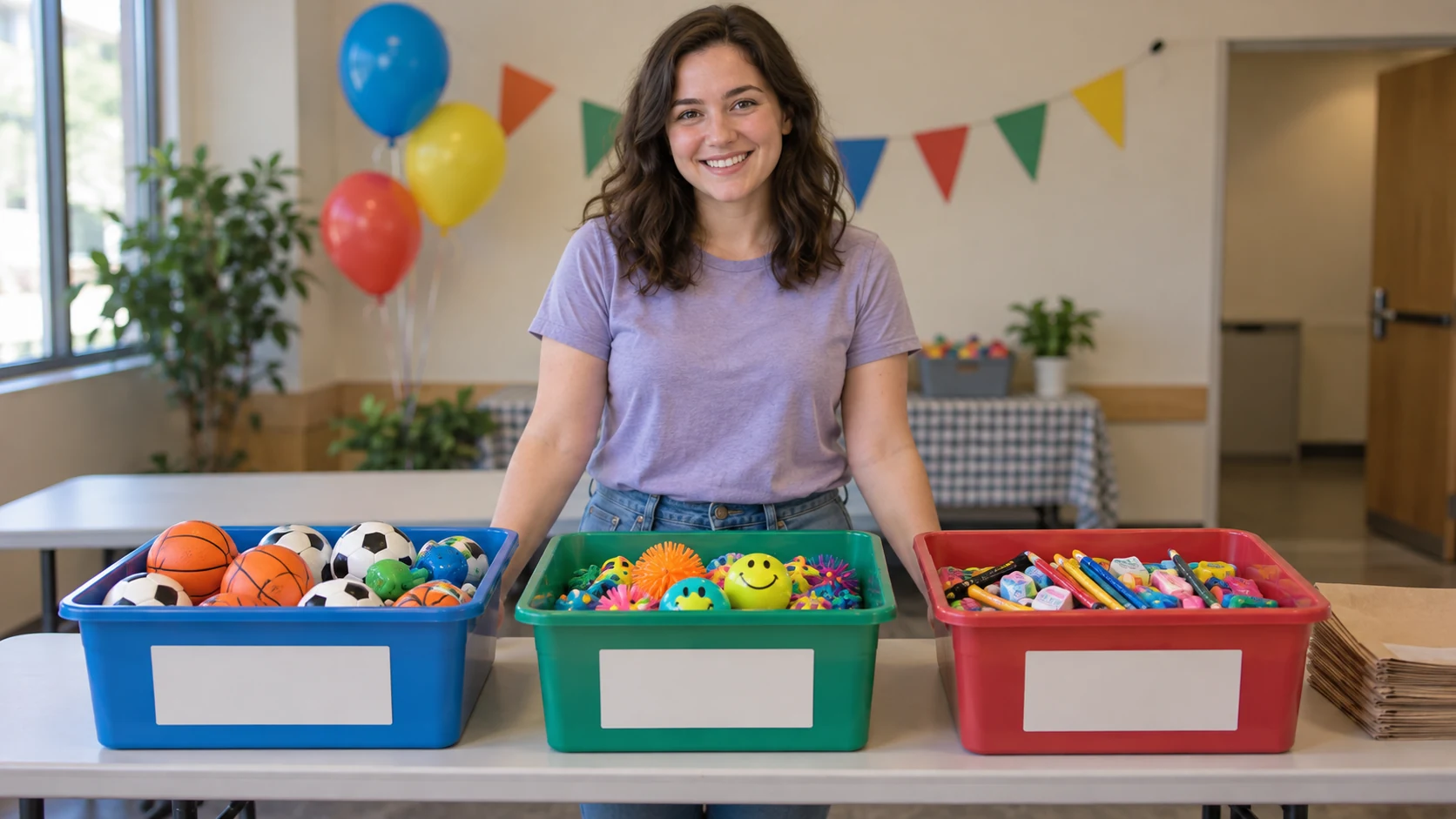
What holds up is one card per child, collected at the door, with a box per station for a stamp, sticker or hole punch. The station gives the mark and the child walks. The choosing happens at one table at the exit, where a slow decision costs nothing because nobody behind is waiting to play.
Sort that table into three bins by number of stamps, labelled in large writing. A child who played four stations reaches into the first, one who played ten into the third. Keep the top bin reachable within the event, and hold a reserve bin out of sight for the child whose card was lost and the sibling too young to play.
Working the Floor: Volunteers, Signage and the Last Hour
Count one volunteer per station plus two floaters plus two on the prize table, then assume a quarter will not arrive. Design so a station can be run by someone who has never seen it: every table needs a card stating the rule, the turn length, and what to hand over. A volunteer who invents the rule invents a different one for each child.
Lay the room out so lines grow away from each other. Two throwing stations facing the same aisle collide, and that is where the arguments happen. Put the fastest stations near the entrance, the slow ones at the far end, the quiet corner as far from the announcer as the building allows.
Rotate volunteers every forty five minutes. Someone running one station for two hours becomes a slow operator, and one slow station backs up its aisle. Rotation also gives each volunteer twenty minutes to walk their own child around.
Plan the last thirty minutes. Close the stations fifteen minutes before the prize table, so nobody is left holding a full card. Draw the candy corn jar at a stated time and hand that prize over in front of everyone.
If rain is possible, decide the wet plan before doors open. Every station here works indoors with shortened distances, apart from the parade lap. For more that runs in a small space, our guide to indoor activities for kids covers the same problem from the other direction, and our would you rather questions for kids list gives a volunteer something to run from a chair when props run out.
A Reward Tied to Showing Up
VISU rewards the visit itself, not a purchase and not a profile. If your venue is a partner, the code on the wall is all a guest has to scan.
FAQ
How many stations does a Halloween carnival need?
Plan roughly one station per twenty five to thirty expected children, plus one low equipment station such as the candy corn jar to absorb overflow.
What makes a game unsuitable for a carnival station?
Fixed teams, a round longer than a minute, or a rule taking more than ten seconds to explain.
Do children have to wear a costume?
No. A disguise station near the entrance removes the question: anyone arriving in ordinary clothes leaves that table with a mask, a hat or a cape.
How do you handle very different ages in the same queue?
Give each station two distances or two target sizes and let the child choose. A younger version announced out loud gets refused by the children it was meant for.
How long should a Halloween carnival run?
Two to three hours is usually enough to complete a card without the volunteers wearing out.
What is a trunk-or-treat?
Wikipedia describes it as an activity sponsored by some organizations in the United States and Canada, done from parked car to parked car in a local parking lot, often at a school or church, with open trunks displaying candy and often games and decorations. The stations here fit that format.