

A Halloween party at home needs three things: a theme everyone can see, a few games with real rules, and material you already own. Everything below runs on paper, tape, string, a bucket and whatever is in the kitchen drawer.
The games are sorted by who is playing, because a game built for a four-year-old is not the game that holds a room of teenagers. Each one says what it needs, how many people, roughly how long it runs, and exactly how it ends. Motifs are the generic ones (pumpkin, ghost, bat, spider, mummy, witch, skeleton, cauldron), so nothing here depends on a costume from a film.
One Link for the Whole Party
A short address you control, holding the game list, the plan and the photos, ready to share with everyone who is coming.
Pick by Who Is Playing
The constraint is never the theme. It is whether the youngest player can follow the rule, whether the game has a clear end, and whether it can run in the space you have.
| Who is playing | What the game needs | Start with |
|---|---|---|
| Little kids only | One rule, no elimination, adult as referee | Feed the Ghost |
| Kids and adults together | Distance or handicap by age, teams | Cauldron Toss |
| Teens and adults | Hidden roles, writing, judging by vote | The Haunting |
| Small flat, no running | Seated or table games | Fold-a-Monster |
| Garden or big room | Lanes and lines on the floor | Pumpkin Roll |
Every game below uses material you can make or find at home: paper, cardboard boxes, masking tape, string, markers, a bucket or pot, rolled socks, toilet paper, paper cups, plastic bottles. Nothing needs buying beyond a roll of tape.
Decorating With What Is Already Home
The theme has to be visible the moment people walk in, and it does not need to be bought. What works, in order of effort:
- Paper bats. Fold black paper in half, draw half a bat, cut along the line, open. Tape a flock of them climbing a wall or a door frame. An adult does the cutting when small children are around.
- Tissue ghosts. A ball of scrunched paper inside a white tissue or napkin, tied at the neck with string, two dots for eyes. Hang from string across the room at different heights.
- Painted pumpkins. Pumpkins, oranges or even round stones with faces drawn in marker. No carving needed, which matters for the safety section below.
- Cauldron. A black pot or a bucket lined with a dark bag, filled with scrunched green or purple tissue. It doubles as the target for two of the games.
- Spider webs. White string or wool stretched between chair legs, over a doorway, or across a corner, with paper spiders taped on.
- Lighting. Lamps turned low, plus battery lights or a torch inside a paper bag with a face cut out. No flame, anywhere, at a party with children moving around.
Simple figures are enough: a pumpkin with a triangle face, a ghost that is a sheet with two eyes, a spider that is a circle with eight legs. If you want more drawing ideas for the decorations, the easy drawing ideas list covers plenty of simple shapes that work at this size.
Safety by Age, in Practice
None of this is a general warning. These are the specific choices that change what goes on the table, and they come from named sources.
No candles. The American Academy of Pediatrics' HealthyChildren.org advises: "Consider using a battery-operated flameless candle, flashlight or glow stick instead of a candle to light your jack-o'-lantern." At a home party with children running games, we go one step further and keep flame out of the house entirely. Battery lights do the same job.
Adults cut, children decorate. The same source is direct about pumpkins: "Allow small children to decorate (not carve) pumpkins. Children can draw a face with markers. Leave the carving and cutting to the adults." The same rule applies to scissors and craft knives for the decorations above: an adult cuts the bats, the children tape them up.
Small parts stay away from the youngest. HealthyChildren.org lists "small toys or temporary tattoos" among choking hazards, and the FDA's Halloween safety tips say that "parents of very young children should remove any choking hazards such as gum, peanuts, hard candies, or small toys." For the games below, that means the youngest group throws rolled socks and large pompoms, never marbles, beads, small sweets or anything that fits in a mouth.
Face paint gets tested first. The FDA advises: "Test the makeup you plan to use at least 24-48 hours in advance. Put a small amount on the arm of the person who will be wearing it. If a rash, redness, swelling, or other signs of irritation develop where the makeup was applied, that's a sign of a possible allergy." HealthyChildren.org gives the same instruction for children: test "on a small patch of your child's skin." The FDA also notes, on fluorescent colours in novelty makeup, that "none of them are allowed for use near the eyes."
Costumes and props. HealthyChildren.org recommends looking for "flame resistant" on costume labels and advises avoiding "sharp or long swords, canes or sticks as a costume accessory." For the games, that means no props with points, and long capes off before any running game.
Latex. If anyone coming avoids latex, skip latex balloons in the decorations and the games. Paper ghosts and rolled socks do the same job and nobody misses the balloons.
Little Kids, Roughly Three to Six
One rule per game, nobody sits out, and an adult is the referee. Time estimates are for the game itself; setup is extra.
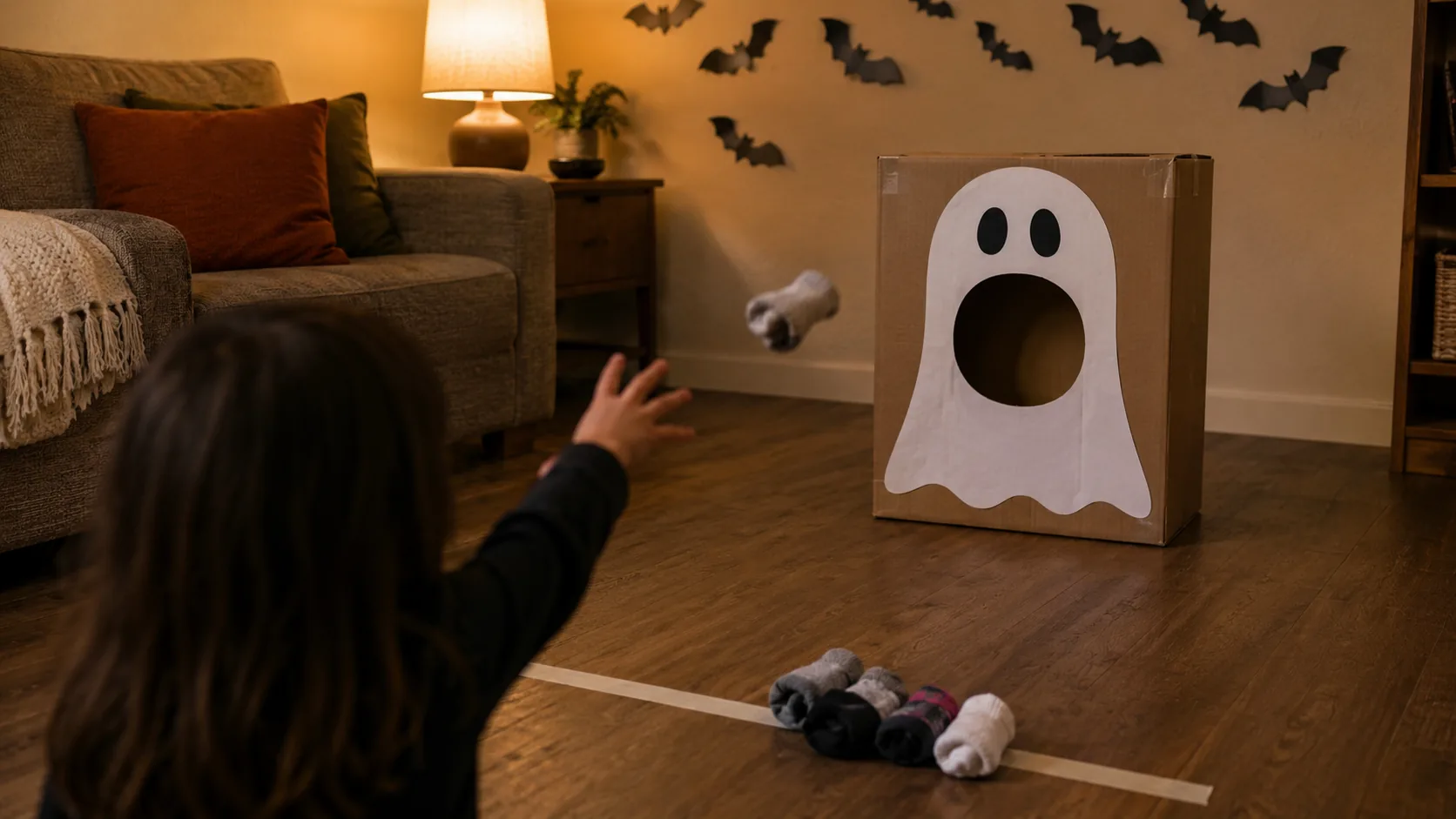
1. Feed the Ghost. Tape a large paper ghost to a cardboard box with a wide mouth cut out by an adult. Children stand behind a tape line and throw rolled socks into the mouth, three throws each. Every sock that goes in scores one. Move the line closer for the smallest players. Needs: box, paper, tape, rolled socks. Players: two to eight. Runs: about ten minutes. Ends: after three rounds, highest total wins, or everyone who scored at least once gets a paper bat to keep.
2. Pumpkin Roll. Mark a start and finish line with tape. Each child pushes a small pumpkin, an orange or a ball along the floor with a wooden spoon, never with hands, to the finish and back. Hands touching the pumpkin means going back to the last line crossed. Needs: tape, one round thing and one spoon per lane. Players: two to six, in lanes or in heats. Runs: about ten minutes. Ends: first back across the start line wins the heat.
3. Spider Web Walk. Stretch string between chair legs in a zigzag at knee height, with paper spiders taped on. Each child crosses the web stepping over and under without touching the string. Every touch is a "bite", counted out loud by the adult. Needs: string, chairs, paper. Players: one at a time, any number waiting. Runs: about a minute per crossing. Ends: fewest bites after two crossings wins.
4. Bat Hunt. Cut paper bats in three or four colours and hide them around the room at child height. Each child is given one colour and must find only that colour. Finding another child's colour means leaving it where it is. Needs: paper, scissors used by an adult. Players: two to six. Runs: about ten minutes. Ends: when every bat is found. The hunt is the game, so everyone finishes.
5. Ghost Bowling. Drape a tissue over six plastic bottles or paper cups, draw two eyes on each, and set them in a triangle. Roll a soft ball from a tape line. Two rolls per turn. Needs: bottles or cups, tissues, a ball, tape. Players: two to eight. Runs: about ten minutes. Ends: after two turns each, most ghosts knocked down wins.
6. Monster Freeze. Music plays, everyone dances. When the music stops, the adult calls a creature: bat, ghost, witch, spider, skeleton, mummy. Everyone freezes in that shape. Anyone still moving on the count of three sits out one round, then rejoins. Needs: music. Players: three or more. Runs: about ten minutes. Ends: when the adult says it ends, because there is no winner and that is the point at this age.
Keep the Game List Where Guests Can See It
Put the games, the timing and the photos behind one address and share it with every family coming.
Mixed Groups, Kids and Adults Together
The trick with mixed ages is a handicap that is visible and agreed before the first throw: a closer line for children, a further one for adults, or teams built so every team has a mix.
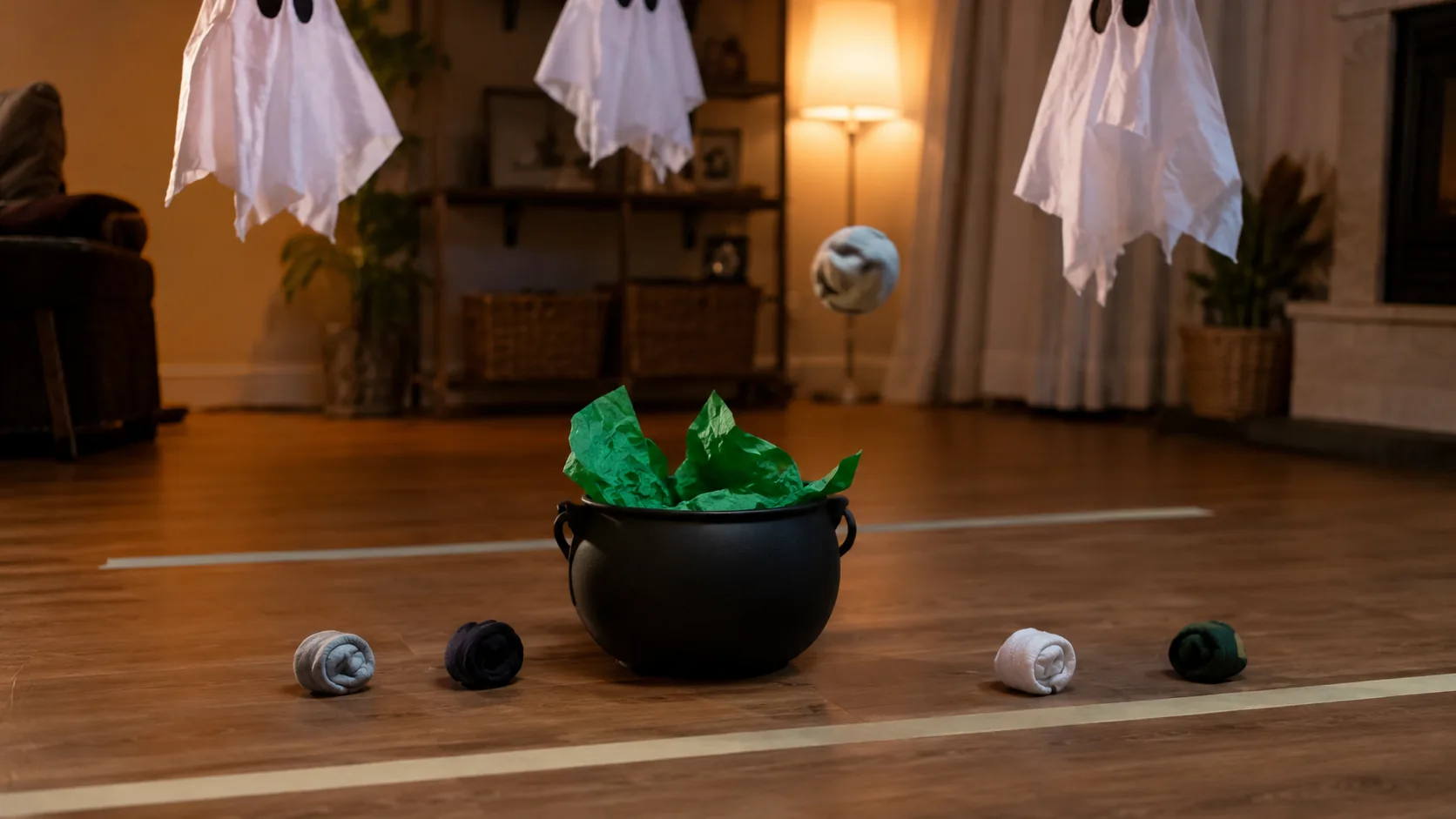
7. Cauldron Toss. The cauldron from the decorations sits in the middle of the room. Two tape lines: children throw from the near one, adults from the far one. Each player has five rolled socks or beanbags. One point per sock in the cauldron. Needs: pot or bucket, socks, tape. Players: four to twelve. Runs: about fifteen minutes. Ends: after everyone has thrown, highest score wins. Ties throw again from one step further back.
8. Mummy Wrap. Teams of three: one mummy, two wrappers. Each team gets one roll of toilet paper. On go, the wrappers wrap the mummy from shoulders to ankles, never the face. The referee checks: any gap where skin or clothing shows loses a point. First team to finish with no gaps wins. Needs: one roll of toilet paper per team. Players: six to twelve. Runs: about five minutes. Ends: when a team calls "done" and passes the gap check. A failed check sends the team back to wrapping.
9. Skeleton Scramble. Before the party, draw a simple skeleton on a large sheet of card and cut it into ten pieces: skull, ribcage, pelvis, two arms, two legs, two hands, two feet. One skeleton per team, in a different colour of card. Hide all pieces around the house. Teams find only their colour and assemble their skeleton on the floor. Needs: card, marker, scissors used by an adult. Players: two teams of three to five. Runs: about fifteen minutes. Ends: first complete skeleton, checked by the referee, wins.
10. Pass the Pumpkin. Everyone sits in a circle. A small pumpkin or ball goes around while music plays. When it stops, whoever holds it draws a challenge from a cup: howl like a wolf, walk like a spider, do a skeleton dance, say a spooky word backwards. The group writes the challenges before the game, one per slip of paper. Needs: a round thing, cup, paper, music. Players: six or more. Runs: about fifteen minutes. Ends: when the cup is empty.
11. Straw Spider Race. Crumple black paper into a spider the size of a walnut, tape on paper legs. Mark lanes on a table with tape. Each player blows their spider along the lane through a straw, never touching it with hands. Needs: paper, tape, one straw per player. Players: two to four per heat. Runs: about a minute per heat. Ends: first spider over the far edge of the table wins the heat. Run heats until a final.
12. Statues in the Lantern Light. Dim the room, keeping enough light to move safely. One player is the lantern keeper and holds a torch or battery light. All other players are statues and try to move across the room without being caught moving. Whenever the keeper turns the light on, everyone freezes. Anyone caught moving goes back to the start. Needs: a torch or battery light. Players: four to ten. Runs: about ten minutes. Ends: the first statue to touch the far wall becomes the next keeper. No full darkness at any point.
13. Monster Charades. Before the game, each player writes two monster actions on slips of paper: a mummy brushing its teeth, a ghost trying to open a door, a witch parking a broom. Slips go in the cauldron. Players draw and act without sound. Team-mates guess. One point per correct guess within a minute. Needs: paper, pen, cauldron. Players: six to twelve, in two teams. Runs: about twenty minutes. Ends: when the cauldron is empty, most points wins.
Teens and Adults, No Alcohol Needed
Games here run on hidden roles, writing and voting. None of them needs a drink to work, and none of them puts anyone on the spot who did not choose to be.
14. The Haunting. A variation on the classic wink game. Everyone draws a folded slip from the cauldron; one slip says "ghost", one says "medium", the rest are blank. Players mingle and talk. The ghost "haunts" by winking at someone; a haunted player counts silently to five, then dramatically falls silent and sits down. The medium may accuse once at any moment. A correct accusation ends the round with the medium winning; a wrong one ends it with the ghost winning. Needs: paper slips. Players: six to fifteen. Runs: about ten minutes per round. Ends: when the medium accuses, or when only the ghost, the medium and one other player are left standing, in which case the ghost wins.
15. Fold-a-Monster. Each player takes a sheet of paper and draws a monster head at the top, folds the paper so only two small neck lines show, and passes it left. The next player draws the body from those lines, folds, passes. The third draws the legs. Unfold all at once. Each player then writes a name for the monster they are holding. Needs: paper and pens. Players: three to twelve. Runs: about fifteen minutes. Ends: the group votes for the best monster and, separately, the best name. Nobody may vote for a sheet they drew on.
16. Cauldron Scents. The host prepares six paper cups covered with foil, each with a smell inside: coffee grounds, orange peel, vinegar on a cotton ball, cinnamon, cut onion, mint. Cups are numbered. Players sniff through a small hole in the foil and write their guess for each. No tasting, no touching the contents. Ask about food allergies before choosing the contents and keep the list of what is in each cup with the host. Needs: paper cups, foil, kitchen items, paper. Players: two to twelve. Runs: about ten minutes. Ends: the host reveals the cups; most correct wins.
17. Epitaphs. Each player invents a monster and writes a two-line epitaph for it, without showing anyone. A reader collects and reads them all aloud. The group then votes, per epitaph, on who wrote it. One point for every correct guess, and one point for the writer each time someone guesses wrong. Needs: paper and pens. Players: four to twelve. Runs: about twenty minutes. Ends: after all epitaphs are read and scored.
18. Cobweb Bells. Stretch string across a doorway or between two chairs in a loose web, and hang spoons or keys from it with thread so they clink when touched. Each player crosses through the web. Every clink is a point against. Needs: string, thread, spoons or keys. Players: one at a time, any number. Runs: about a minute per crossing. Ends: fewest clinks after two crossings wins. Ties do a third crossing with the lights lowered a little, never off.
19. Blind Jack-o'-Lantern. Each player gets a paper plate and a marker. With eyes closed, in thirty seconds, they draw a pumpkin face on the plate: two eyes, a nose, a mouth with teeth. Eyes open, plates go on the wall. Needs: paper plates, markers. Players: any number. Runs: about five minutes. Ends: the group votes for the scariest and the funniest. Two winners, no plate may win both.
20. Sound of the Night. One player goes to the next room with a bag of household objects: keys, a comb, a sheet of paper, a spoon and a cup, a zip. They make a sound with one object at a time. The group writes a guess for each sound. Needs: a bag of objects, paper. Players: three to ten. Runs: about ten minutes. Ends: after ten sounds, most correct wins, and the winner is the next sound-maker.
How to Run the Party
Set up the games before guests arrive. Tape lines, the cauldron, the web and the hidden bats all go in first. A game that needs setting up in front of a room of children does not get played.
Order by energy. Start with a hunt or a toss, put the running games in the middle, and finish with a seated game like Fold-a-Monster or Epitaphs. Ending on something calm is how children leave without a scene.
Say the ending out loud. Rounds, points or minutes, before the game starts. Games without a stated end fade rather than finish.
One adult referees, another resets. While one game is being played, someone re-hides the bats or resets the ghost pins for the next one.
Keep the youngest in view of the youngest group's material. If small children and teenagers are at the same party, the small parts from the teen games (keys, spoons on thread) go up out of reach when the little ones' games are running.
Photograph the setup, not just the faces. A picture of the cauldron and the tape lines is what lets you rebuild the same game next year. If you want the party photos to look better than snapshots, the basics in photography for beginners apply just as well to a dim living room.
Save the Party Plan for Next Year
The game list, the setup photos and the rules you changed, all behind one address you can share.
FAQ
What are good Halloween party games for kids?
Feed the Ghost, Pumpkin Roll, Spider Web Walk, Bat Hunt, Ghost Bowling and Monster Freeze. All six use one rule, nobody is eliminated for long, and an adult referees.
What Halloween games work for adults without alcohol?
The Haunting, Fold-a-Monster, Cauldron Scents, Epitaphs, Cobweb Bells, Blind Jack-o'-Lantern and Sound of the Night. They run on hidden roles, drawing, writing and voting, and none needs a drink.
What Halloween games can kids and adults play together?
Cauldron Toss, Mummy Wrap, Skeleton Scramble, Pass the Pumpkin, Straw Spider Race, Statues in the Lantern Light and Monster Charades. Each uses a distance handicap or mixed teams so age does not decide the winner.
How do I make Halloween games with no budget?
Every game above uses paper, tape, string, cardboard boxes, rolled socks, paper cups, plastic bottles, a pot and kitchen items. The only thing you may need to buy is a roll of masking tape.
Are candles safe at a Halloween party with children?
HealthyChildren.org advises a battery-operated flameless candle, flashlight or glow stick instead of a candle for pumpkins. At a home party with children moving between games, we keep flame out entirely and use battery lights.
Is face paint safe for kids?
The FDA advises testing makeup 24 to 48 hours ahead by putting a small amount on the wearer's arm and watching for rash, redness or swelling, and notes that fluorescent colours in novelty makeup are not allowed for use near the eyes.
How many games should a party have?
Fewer than you think. Four or five games, each with a stated end, fill two hours once you count setup, snacks and the moment between games.
References
- American Academy of Pediatrics, HealthyChildren.org: Halloween Safety Tips. Flameless lights instead of candles, adults carve and children decorate, makeup patch test, choking hazards including small toys, flame resistant labels, and avoiding sharp or long props.
- U.S. Food and Drug Administration: Halloween Safety Tips: Costumes, Candy, and Colored Contact Lenses. Testing makeup 24 to 48 hours in advance on the arm, and removing choking hazards such as small toys for very young children.
- U.S. Food and Drug Administration: Novelty Makeup. Fluorescent colours in novelty makeup are not allowed for use near the eyes.