

The difference between a Halloween craft and a Halloween STEM activity is one question: what is the child measuring? If the answer is nothing, it is a decoration with a science-sounding name.
Everything below has the same four parts: a starting question the child can answer wrong, something the child does, something observable that can be counted or ranked, and an explanation in plain words that is correct. Materials come from the kitchen drawer and the stationery shelf. Nothing from a supplier, nothing that burns, nothing corrosive. A mixed age group that finishes early can close on Halloween trivia questions instead of a sixth station.
When the Session Happens Outside the House
A lot of these sessions end up on a long table at a library, a community room or a cafe with space. If the place is a VISU partner, scanning the code there turns the visit into a small reward. The afternoon stays yours, the bonus is an extra.
The Test That Sorts Science From Decoration
Search for Halloween science and most of what comes back is a craft in a costume: a jar painted to look like a ghost, a bat cut from black card. Fine activities, just not this one. If the child decides how it looks and nothing gets recorded, it belongs on the art table, and our guide to preschool art projects is where that side lives. Three filters sort them.
Is there a question with a wrong answer? "Make a bubbling potion" has no wrong answer, so nothing can be learned from it. "Which of these three amounts of powder makes the foam climb highest?" has one answer the table will discover, and the child can guess it in advance and be mistaken. That possibility of being wrong is the engine.
Is there something to count, time, mark or rank? A line drawn on a cup with a felt tip is a measurement, and so is counting out loud until the fizzing stops. What you are avoiding is the session where nothing is comparable afterwards.
Can you explain the result correctly to a curious eight-year-old? This filter removes more activities than the other two combined. If the only available explanation is "the chemicals react," skip it.
One rule underpins all of them: change one thing at a time. Change the powder and the cup size at once, and you have no idea which moved the foam. Children grasp that instantly if you let them get it wrong once.
The Two-Column Sheet That Does the Heavy Lifting
Fold a plain sheet of paper down the middle, write What I think will happen on the left and What happened on the right. That is the entire apparatus. The left column is filled in before anything is poured, because a prediction written down cannot be quietly revised, and the gap between the columns is the part children remember. For children not yet writing, it takes drawings or a spoken guess an adult writes down.
Keep the right column factual. "It went over the cup onto the tray" is a result. "It was amazing" is a review.
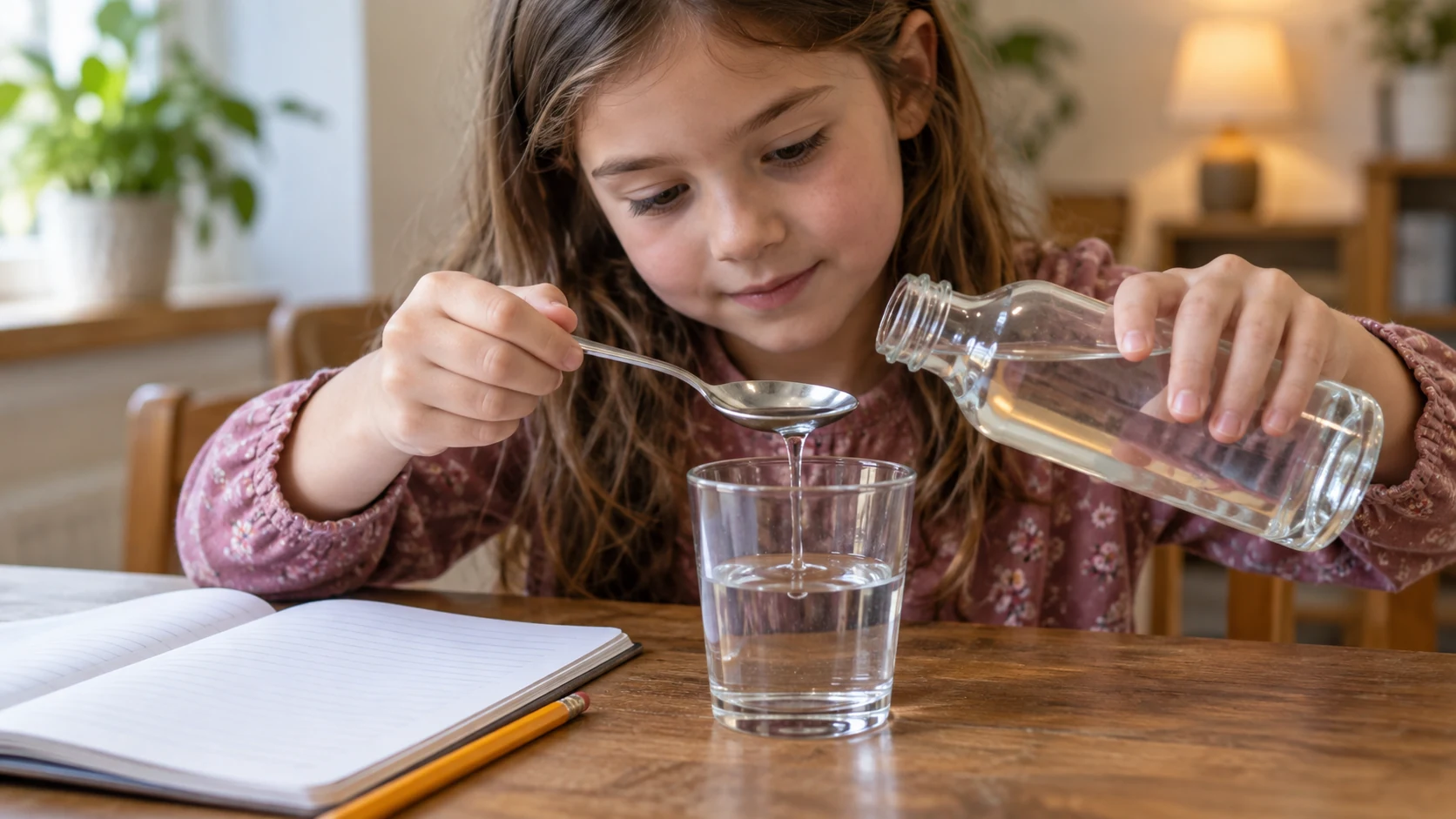
Fizzing Reactions You Can Actually Measure
What is happening. Baking soda is sodium bicarbonate and vinegar is a dilute acid, acetic acid in water. When they mix, an acid-base reaction occurs and one of the products is carbon dioxide gas. The gas leaves the liquid as bubbles, and where there is soap the bubbles hold together as foam instead of popping. The fizzing stops when one of the two ingredients has been entirely used up, which is the key to every version below.
Find the amount where it stops getting bigger. Four identical clear cups on a tray, the same shallow depth of vinegar in each, measured against a mark drawn on all four. One spoon of baking soda in the first, two in the second, three, four. Question first: does four spoons make four times the foam?
It does not. Around the second or third cup the foam stops growing and the extra powder sits at the bottom as a gritty layer. The vinegar has been used up, so additional baking soda has nothing left to react with, and that leftover powder is the abstract idea in visible form.
Mark the height. Run the reaction and mark the cup at the moment the foam is highest. Then change one thing in an identical cup: a squeeze of washing-up liquid, or a narrow cup against a wide one. Compare the marks. The soap version climbs higher because soap makes bubble walls stretchy enough to survive instead of bursting, so the same gas builds a taller pile. The narrow cup climbs higher because the same gas in a narrower space has to go up rather than out.
Time it. Same total baking soda, loose powder in one cup, packed inside a twist of tissue in the other. Count out loud until the fizzing stops in each. The loose powder finishes sooner, because the reaction only happens where acid touches powder.
Floating, Sinking and Stacking Liquids
The sink or float line-up. A deep clear container of water and eight to ten kitchen items: a grape, a cork, a metal spoon, a bottle cap, a small potato, a coin, an orange with the peel on. Before anything goes in, lay every item in a line ordered from "I think this sinks" to "I think this floats." That ranking is the prediction, and more interesting to get wrong than a yes or no.
Test them one at a time and rebuild the line to match reality. An object floats when it is lighter than the water it pushes out of the way, so this is about the object compared with an equal volume of water, not about being heavy or light on its own.
The orange is the item worth having on the table. A whole orange floats and the same orange peeled sinks, even though peeling made it lighter: the peel is full of tiny air pockets, so the whole fruit takes up more room for its weight. Put that in the left column as its own prediction, because almost everyone gets it wrong.
Stacking liquids. Pour honey or syrup into a tall clear glass, then washing-up liquid, then coloured water, then cooking oil, each slowly down the back of a spoon. They settle into layers, heaviest for its size at the bottom. Drop in small objects and record which layer each stops in, which gives a scale rather than a yes or no.
A Short Trip That Gives Something Back
Some of these sessions start with a walk to collect leaves and stones, or a stop somewhere on the way home. At a VISU partner location, scan the code available there and the reward is tied to being present, not to buying anything.
Soaking, Spreading and Climbing Colour
The colour that climbs. Cut strips of kitchen roll or coffee filter paper and draw a thick dot of washable felt tip about two centimetres from one end. Stand the strips in shallow water, below the dot and never touching it. Over ten to twenty minutes the water climbs the paper carrying the ink with it, and the ink separates into the colours it was mixed from. Black usually splits into blue, purple and a dull orange.
Measure it: mark where the water reached at five minutes, then ten, then fifteen. The gaps get smaller. Paper is a mesh of fibres with tiny channels between them, water creeps along those channels because it sticks to the fibres, and drags the ink along. Colours that cling to the paper get left behind lower down, and the ones that travel easily with the water end up higher.
The soaking race. Identical squares of kitchen roll, newspaper, a paper napkin and cotton cloth. Put a counted number of drops on each and record how many it takes before water appears underneath. That produces a ranked list, and an argument about what counts as soaked. Agreeing how you will decide before you start is part of the experiment.
The Hunt Format, Rebuilt as Data Collection
The hunt suits a group of mixed ages. Wikipedia describes the standard version: "A scavenger hunt is a game in which the organizers prepare a list defining specific items that need to be found, which the participants seek to gather or complete all items on the list, usually without purchasing them." It adds that "Participants typically work in small teams," and that in variations, "players take photographs of listed items."
Keep the list and the teams, and change what goes on it: name properties rather than objects, so finding an item requires a test rather than recognition.
A property list for a garden or park in autumn: something rougher than the palm of your hand, something that floats, something heavier than it looks, something colder than the ground, the roundest thing you can find. Indoors: the darkest surface and the shiniest, three objects that fit inside a cup, two things that sound different tapped with the same spoon. Every one requires the child to do something to the object to find out.
Bring the results together at the end and this becomes measurement rather than collection. Line up every team's "heavier than it looks" item and rank them by hand, and test all the "floats" claims in one bowl. Settling the disagreements requires a shared test. The photo variation the source describes also spares a garden: nothing gets picked.
The Pumpkin as a Measuring Instrument
The carved pumpkin is the fixed image of the season. Wikipedia records that "It is believed that the custom of making jack-o'-lanterns at Halloween time began in Ireland and Britain," that in the nineteenth century "turnips or mangel wurzels, hollowed out to act as lanterns and often carved with grotesque faces," were used in parts of England, Ireland, Wales and Scotland, and that "Jack-o'-lanterns carved from pumpkins are a yearly Halloween tradition that developed in the United States when Celtic influenced immigrants brought their root vegetable carving traditions with them." The pumpkin is a substitute for the turnip, adopted because it was easier to hollow out.
Treat the pumpkin as an object with properties rather than something to decorate. No carving is needed.
Guess the circumference. Cut a length of string you think will go around the widest part, then check. Everyone guesses before anyone measures. People overestimate consistently, and seeing everyone else make the same mistake is more interesting than being right.
Guess the seeds, then count. Written guesses first, then open it and count in groups of ten. With two pumpkins of different sizes, ask whether the bigger one has proportionally more seeds. It varies, and letting a child find that a reasonable-sounding rule does not hold is a real result.
Float the whole thing. A whole pumpkin in a bucket floats, which surprises people given the weight. Same explanation as the orange: it is mostly hollow, so for its size it is lighter than the water it pushes out of the way.
Watch it collapse. Leave an opened pumpkin outdoors and photograph it in the same spot each day for a week or two, measuring the height with a ruler each time. The soft interior is broken down by moulds and bacteria, and the structure holding it up gives way. The only activity here that runs longer than an afternoon.
Safety, Said Once
An adult sets up and stays at the table. That is the rule, stated plainly once. Nothing here involves flame, so use a battery light inside anything that needs to glow. Nothing here involves a bought reagent or a corrosive: kitchen vinegar, baking soda, cooking oil, food colouring and washing-up liquid are the entire chemical inventory. Never mix cleaning products from under the sink together or with vinegar.
Under threes should not be near small objects such as coins, bottle caps or dried pasta, which are choking hazards. Give younger children the pouring, floating and soaking activities. Cutting the pumpkin is an adult job; children can scoop, count seeds and measure. A tray under every liquid activity, sleeves rolled up, hands washed at the end.
Running a Session for a Group
The failure mode is always the same: one demonstration at the front, most children unable to see, two doing all the pouring, the rest gone in four minutes. For a wider set of table activities with no theme attached, our list of indoor activities for kids covers the same room from the other direction. Run stations instead. Three or four tables, one activity each, small groups rotating on a timer, materials portioned into cups before anyone arrives. Give every station a written question on a card, phrased so it can be answered wrong. Two identical sets of cups per station means one group starts while the other is rinsed. Assign roles rather than splitting by age: someone pours, someone counts out loud, someone writes, someone marks the cup.
Finish with the comparison, not the last station. Bring everyone back to one table with the marked cups, the ranked strips and the sheets, and spend five minutes on what disagreed. Two groups getting different results from the same procedure is the most valuable thing that can happen, because the next question, why did ours do that, is the one scientists spend careers on.
Let the Place You Are In Count for Something
VISU connects rewards to verified presence at partner locations. If the group is already meeting somewhere on the map, a library, a club, a community space, the bonus comes from showing up, not from spending more.
FAQ
What Is the Youngest Age This Works For?
Around three, restricted to floating, pouring, soaking and climbing colour, with an adult writing the spoken prediction and no small objects on the table. From about six, most children handle the fizzing series and write their own two columns.
How Do I Keep It From Turning Into a Craft Session?
Insist on the prediction being written before anything is poured, and on one number, mark or ranking recorded at the end. If decorating is all that happened, ask what they are going to measure.
What If the Experiment Does Not Work?
Then you have a better session than if it had. Ask what was different, change one thing, try again. Never pretend a failed run succeeded, because children notice.
How Long Should a Session Be?
Forty minutes across three stations suits primary-age children, thirty with two for younger ones. Start the climbing colour strips early and read them at the end.