
This is a catalogue, not a list of ideas to scroll past. Activities are grouped by age band and by what a child is up for at that moment, so you can pick by what the situation actually calls for: someone who wants to move, someone who wants something calmer, or a stretch of afternoon that has to be filled without another screen. Everything here uses what is already in an ordinary home.
If what you actually need is what to do when the weather traps everyone indoors unexpectedly, that is a different question with a different answer, and it lives in what to do on a rainy day. This page is the structured catalogue you come back to.
One Link for the Whole Family
A short address holding your activity list, photos and everything you want to share with grandparents.
How to Use This Catalogue
Two axes, and the second one is easy to skip.
The age bands are only a practical starting point for complexity and supervision, not a developmental claim. Choose by how complicated the activity is, what materials it involves, and what supervision suits your child. The bands overlap on purpose, and you know yours better than any bracket does.
What they are up for right now tells you what the moment needs. The same child at four in the afternoon after a day inside is simply in a different mood from the same child at seven after dinner. Choose based on whether they want to move, make something, or sit quietly. This is about the mood of the hour, not about what kind of child they are.
So: read down to your age band for options, then cross-check against the two mood sections. If they want to move right now, start there rather than with scissors and glue. Half an hour later the answer may well be the other one.
If the group wants to move and you have a suitable outdoor space, use our outdoor games for kids, organised by space to choose a yard or park game with setup, turn-taking and a clear finish. Keep this indoor catalogue as the alternative when the space or conditions do not fit.
Toddlers, Roughly 1 to 3
These need almost no setup and no rules to explain. Most of them are just a material and a container, which is why they suit the youngest end of the catalogue. If you want more of the same shape, a set of preschool art projects covers the same low-setup ground.
- Posting games. Cut a slot in a box lid; supply large lids, cardboard discs or clothes pegs to post through.
- Pots and pans band. Wooden spoon, upturned saucepans, a plastic tub. Loud and brief.
- Water play in the sink. A stool, a few cups, a whisk and warm water. Put a towel down first and accept that the floor gets wet.
- Sticker pages. Stickers and a sheet of paper. Peeling them is most of the activity.
- Cushion path. Cushions on the floor to step between. Simple and physical.
- Emptying and filling. A basket and a set of safe objects. The emptying is the activity.
Having the next option loosely in mind is more useful than trying to make any one of them last.
Preschool, Roughly 3 to 5
These lean on pretend scenarios rather than on finishing a task, and most of them can be set up from things already in the room.
- Blanket fort. Chairs, blankets, clothes pegs to hold it together. Building it is half the activity; then it becomes a shop, a cave or a spaceship.
- Shop or café. Tins from the cupboard, paper money, a bag.
- Obstacle course. Cushions to jump, a chair to crawl under, tape on the floor to balance along.
- Painting with unusual tools. Sponges, forks, cotton buds, a toy car's wheels. The tool is the novelty.
- Simple baking. Anything they can stir, pour or cut with a blunt knife. Mixing is the appeal.
- Treasure hunt. Hide five objects; give picture clues for pre-readers.
- Dress-up box. Old clothes, hats, scarves. Use a costume or household object as the starting point for the story.
Keep the Family Activity List in One Link
What worked, what did not and the photos from the good afternoons, all at one address.
Early School Age, Roughly 5 to 8
These involve rules to follow or something that gets built, so they suit readers and children happy to sit with a set of instructions.
- Card games. Go Fish, Snap, Memory. A single deck covers weeks.
- Board games. Simple rules, turns, and a chance to practise losing gracefully.
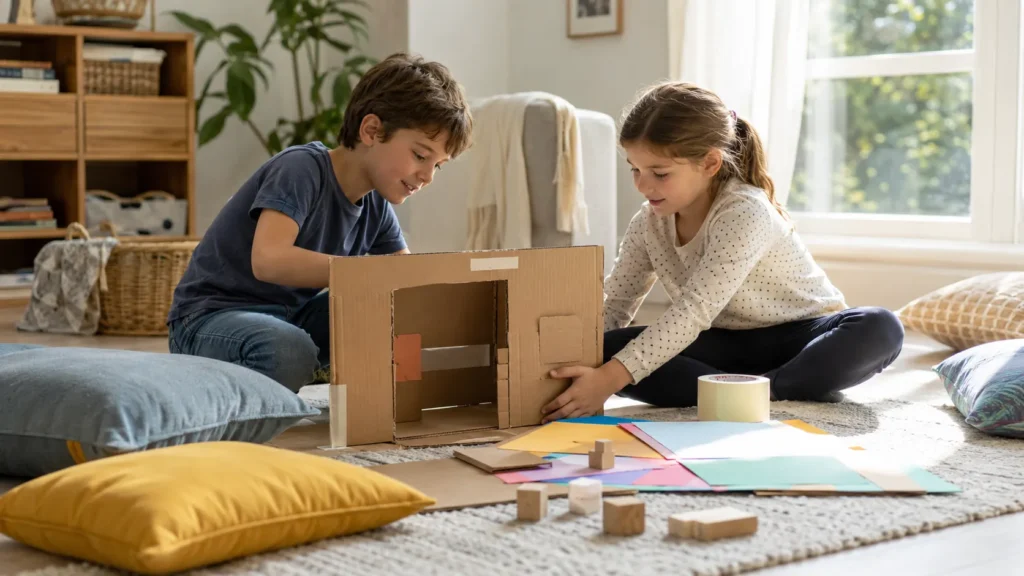
- Cardboard construction. A big box becomes a car, a robot suit or a puppet theatre. Keep a delivery box back for exactly this.
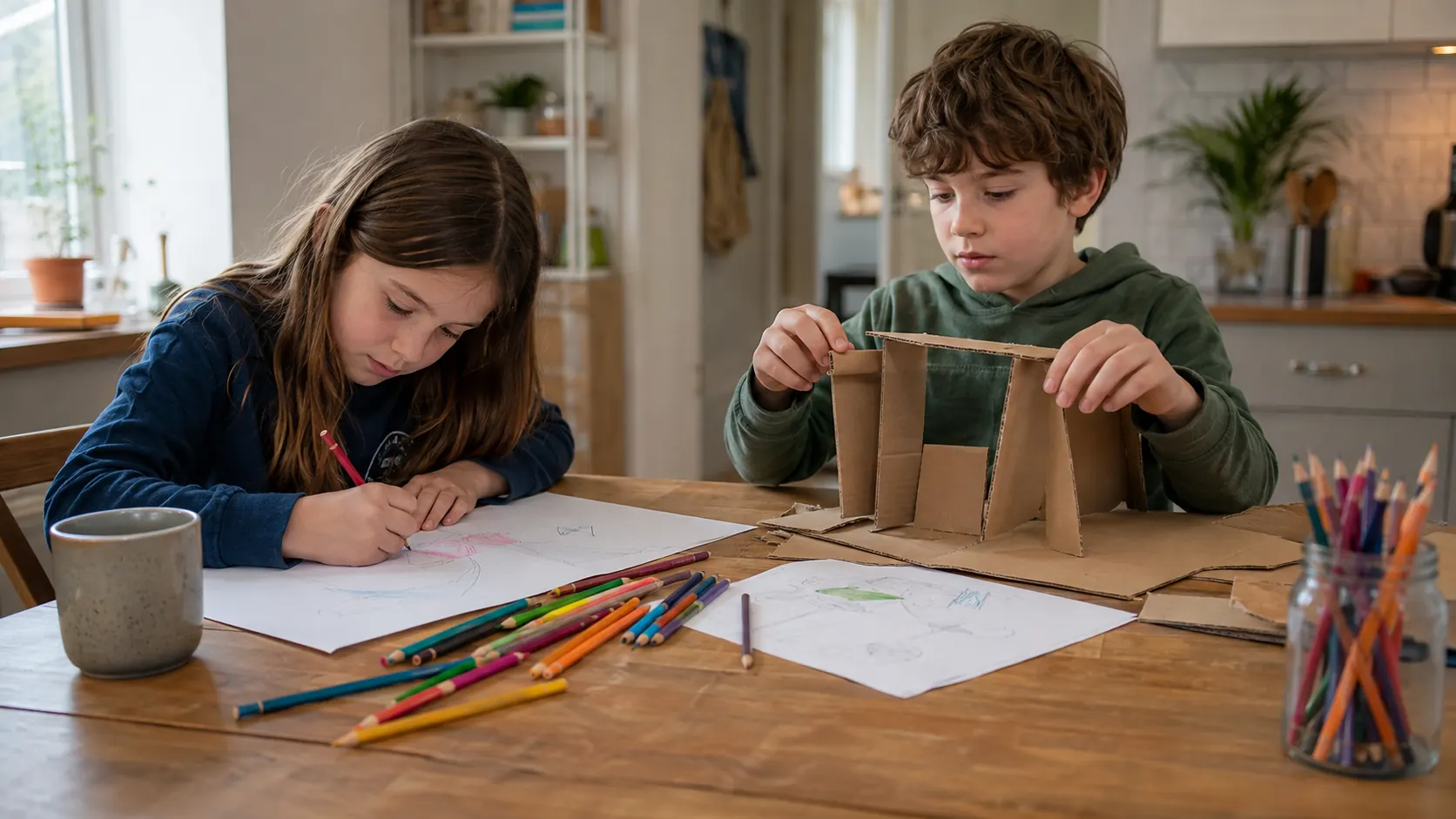
- Comic strip. Fold paper into six panels and tell a story. Drawing carries the story, so writing is optional.
- Indoor bowling. Plastic bottles and a soft ball down a hallway.
- Science you can do in the kitchen. Bicarbonate and vinegar in a tray, floating and sinking in a bowl, cabbage water as a colour indicator.
- Origami and paper planes. Fold, test, adjust, repeat. The testing is the fun part.
- Beading and friendship bracelets. Repetitive, satisfying, and the result gets worn.
Older Children, Roughly 8 to 12
These are projects with a real result and a bit of genuine difficulty, usually involving tools or steps that need more independence.
- Cooking a real dish. Not helping: owning it, start to finish, with supervision matched to the tools involved.
- Stop-motion animation. A phone, some figures, a free app.
- Card and dice strategy games. Rummy, cribbage, Yahtzee. Real competition, without letting them win.
- Model building and kits. Many small steps, and the result ends up on a shelf.
- Escape room at home. Write four or five puzzles on paper leading to a "locked" box. Making one for a sibling is as good as solving it.
- Learning a real skill. Juggling, card tricks, a knot set, first chords on an instrument.
- Redesigning their room on paper. Measure, draw to scale, argue about the budget.
- Writing and recording something. A podcast episode, a news report, a review of a game.
When They Want to Move
Reach for these when they want to move.
- Animal moves. Bear crawl the hallway, frog jump back, crab walk the return leg.
- Balloon keepy-uppy. One balloon, floor is lava. Cheap.
- Dance freeze. Music on, pause it, everyone freezes. No rules to explain and no equipment.
- Tape lines on the floor. Masking tape becomes a balance beam, a long jump, a hopscotch grid.
- Sock basketball. Rolled socks, a laundry basket, a line to throw from. Move the line back each round.
- Timed challenges. How many star jumps in thirty seconds. Repeat, try to beat it.
Clear the space first. Ten seconds of moving a lamp prevents the interruption that ends the game.
When They Want Something Calmer
For the stretch before bed, after a difficult moment, or when someone is unwell. The common thread is a repetitive task with a slow, visible result. When even that is too much, a list of questions that need no materials works from the same spot on the sofa.
For a school-age child who already has a numbered collection, organizing a sticker album turns a quiet table session into sorting spares and writing down the missing numbers. Start with what is already in the album rather than buying supplies for a new activity.
- Audiobook plus hands. Something to listen to while colouring, threading beads or building quietly.
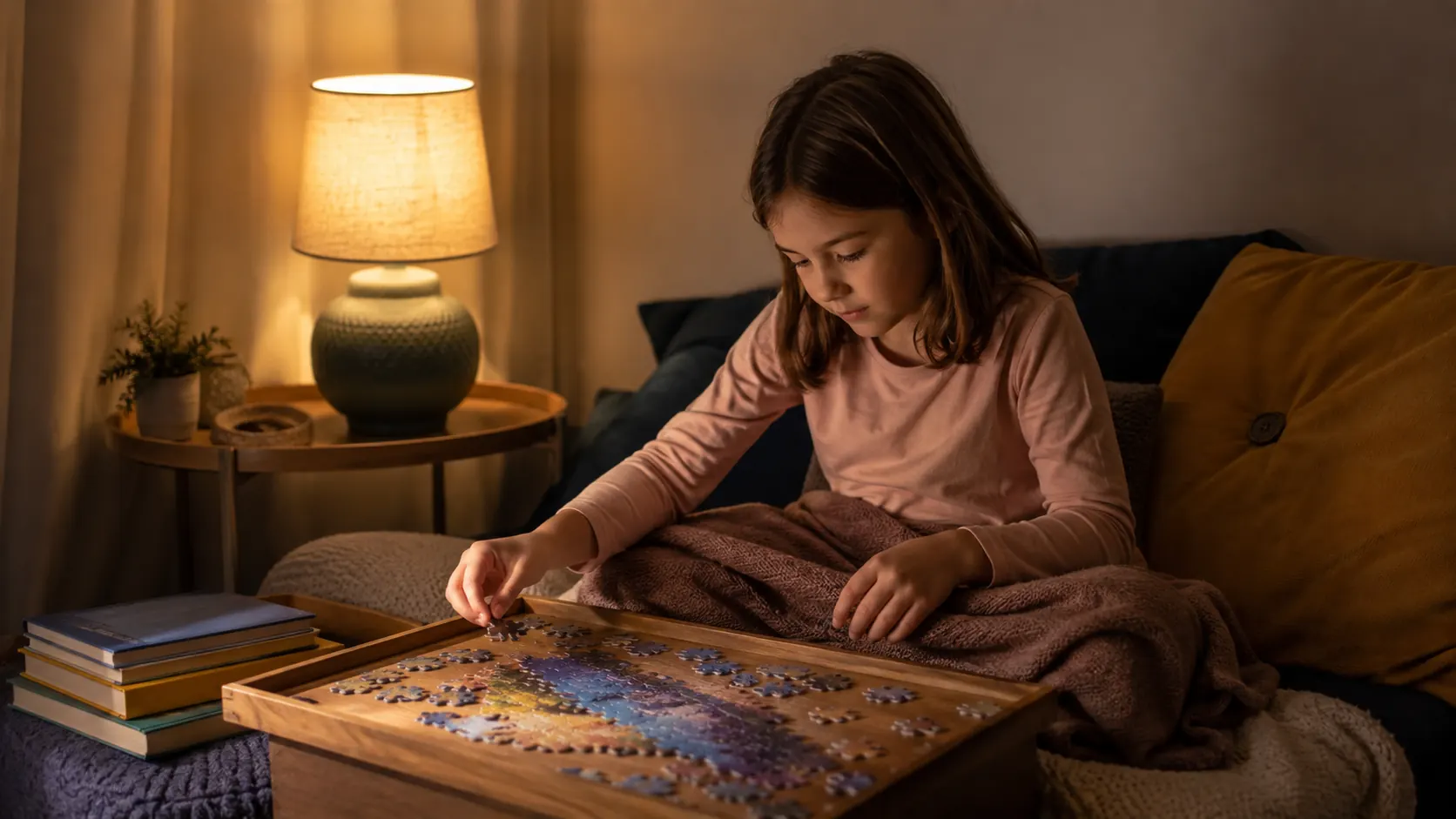
- Jigsaw puzzles. On a tray so it can be moved without losing progress.
- Colouring and dot-to-dot. Undemanding on purpose.
- Reading nest. Cushions, a blanket, a lamp, a pile of books. The nest matters as much as the books.
- Sorting things. Buttons by colour, coins by size, a shelf put in order.
- Drawing to music. Slow instrumental, paper, no instructions.
Things Worth Doing Together
These need an adult in the game rather than nearby.
- Cooking something you both want to eat. Not a craft version of cooking. An actual meal.
- Reading aloud above their reading level. A chapter a night of something they could not yet read alone.
- Looking at old photos. Tell the stories behind them.
- Fixing or taking apart something broken. An old radio, a torch, a clock. Unpowered and unplugged.
- Teaching them a game from your own childhood. The transmission is the point.
- Making something for someone else. A card, a batch of biscuits, a decorated box for a grandparent.
A Short Word on Safety
Nothing on this page is a substitute for your own judgement about your own child, and supervision levels are yours to set.
A few practical notes. Small parts, coins, beads and marbles are a choking risk for the youngest children, so keep those activities for ages where that is not a concern. Anything involving water needs an adult present. Scissors, knives, hot ovens and hobs need supervision matched to the child and the tool. When taking something apart, make sure it is unplugged and has no batteries in it. Clear the floor before anything involving running or jumping indoors.
If a child has an allergy, a medical condition or a specific need, check any activity involving food, materials or physical exertion against advice from your own healthcare provider. This page is a catalogue of things to do, not health guidance.
Share the Afternoon
One link for the photos, the drawings and the things worth keeping.
FAQ
What can kids do indoors when they are bored?
If they seem restless and want to move right now, start with one of the movement options. If they are in the mood for something quieter, use the calmer section.
What indoor activities work for mixed ages?
Blanket forts, obstacle courses, baking, treasure hunts, dance freeze and cardboard construction all scale, because the same game can be given harder roles and easier ones.
How do I keep a toddler busy indoors?
Short activities in sequence rather than one long one. Posting games, water play at the sink, stickers, and emptying and filling a basket all need minimal setup, so moving between them is easy.
What can we do indoors without buying anything?
Most of this catalogue uses paper, tape, cardboard, cushions, socks, tins and a deck of cards. The cardboard box from your last delivery is the single most useful item in it.
How is this different from rainy day activities?
This page is a structured catalogue by age and by what a child is up for, for planning. Rainy day activities answer a circumstantial question, when the weather has changed the plan and you need something now.
How long should an indoor activity last?
As long as it holds. There is no target to hit, and having the next option loosely in mind matters more than making any one thing last.