

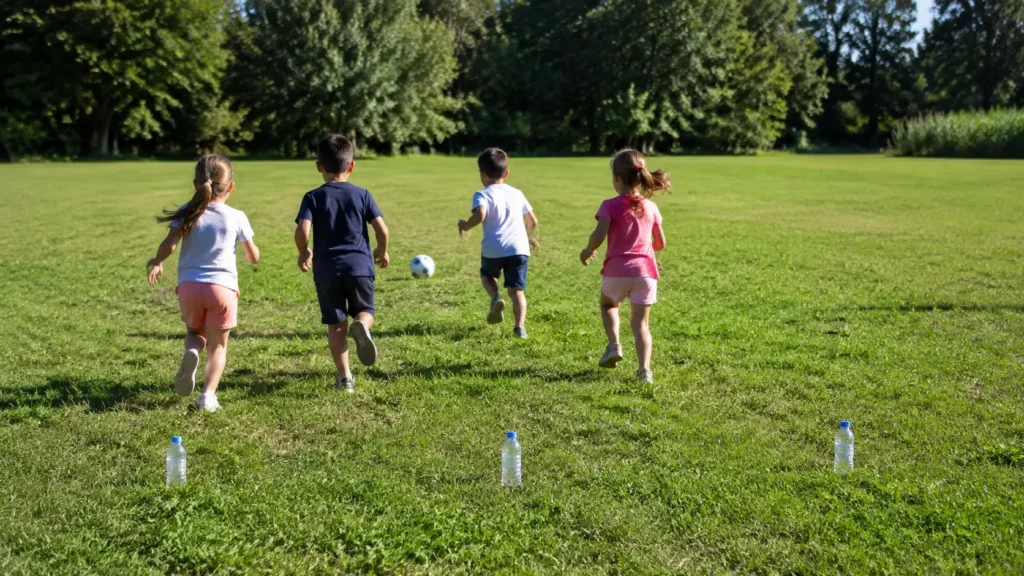
An outdoor game for kids needs three things: space to run, a rule everyone can repeat, and a way to win that arrives before anyone gets bored. The material list is short on purpose. A ball, a stick of chalk, a rope, a bucket and a few empty bottles cover everything below.
The games are organised by the space you actually have (a small yard or driveway, a big lawn or park, a beach or anywhere with water) and each one states the setup, the full rule, how turns work, the win condition, a suggested age range and a rough duration. Times and group sizes are estimates from how the game is built, not measurements. Every game assumes an adult is present and watching.
One Link for the Afternoon
A short address you control, holding the photos, the score sheet and the rules you want to keep for next time.
Pick by Space and Group Size
Then count heads. Games 1 to 4 work from two players. Games 5 to 9 want at least six, and most of them get better at ten or more. Games 10 to 13 sit in between and can be run as single rounds for three children or as team relays for a dozen.
This guide stays outdoors and stays physical. If you need games for a waiting room, a car or a table, with nothing in your hands, those are in the no-material list. Here, everybody runs.
Before You Start: Cars, Sun, Water, Shoes
Four checks, done once, before the first game.
Cars. Choose a park, enclosed yard or another permitted play area separated from vehicle access. Do not use a street or driveway that vehicles can enter; a cul-de-sac or an adult acting as lookout does not remove that access. If a ball can roll into an open road, choose a different place for ball games.
Sun. The NHS advises spending time in the shade when the sun is strongest (in the UK, between 11am and 3pm from March to October), covering up with suitable clothing, taking extra care with children, and keeping babies under 6 months out of direct sunlight. The American Academy of Pediatrics gives a similar window for the US, 10:00 a.m. to 4:00 p.m., and recommends a hat with an all-around brim and reapplying sunscreen every 2 hours and after swimming, sweating or towelling off. In practice: hats on, water bottles in the shade, and the longest running games scheduled early or late rather than at midday. Wherever you are, check the local hours rather than assuming.
Water. For any game with a bucket, a paddling pool or the sea, the American Academy of Pediatrics describes "touch supervision" for infants and toddlers, meaning an adult in the water and within arm's reach, and for older children an adult paying constant attention and free from distractions like the phone. They also list emptying small inflatable pools after each use. Treat the water games below as needing one adult whose only job is the water.
Shoes and ground. Walk the space before the children do. Pick up glass, sticks and anything that turns an ankle. Closed shoes on tarmac and gravel; barefoot is fine on sand and on grass you have checked. Chalk games belong on dry, flat pavement, never on a slope or near a kerb.
Small Yard or Driveway
Two to six players. Chalk, one ball, one bucket.
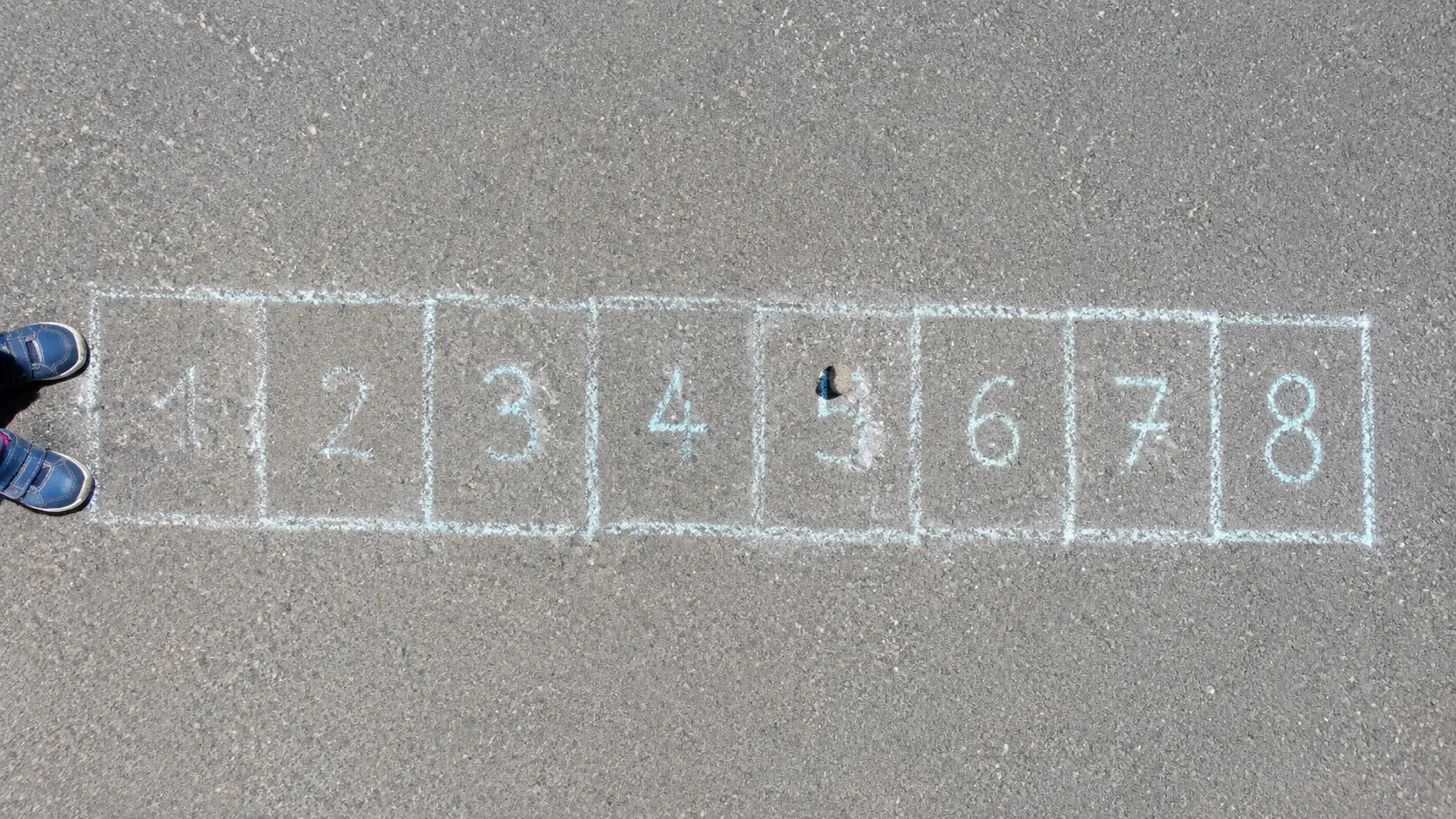
1. Hopscotch, Ladder Version. A declared variation on the classic hopscotch grid. Setup: draw a ladder of eight rungs in chalk, each box wide enough for two feet, and number them 1 to 8. Rule: on your turn, toss a pebble so it lands in the next box you need, starting at 1. Hop up the ladder on one foot, skipping the box with the pebble, turn at the top, hop back, pick up the pebble on the way down without putting the other foot in the box. Land on a line, miss the box with the pebble, or put your second foot down, and your turn ends and the pebble stays where it is for the next player to avoid. Turns: clockwise. Win: first player to complete all eight boxes. Age: five to nine. Lasts: about fifteen minutes.
2. Wall Ladder. Needs a blank wall with no windows and a bouncy ball. Setup: chalk a throwing line two big steps from the wall. Rule: each player, in turn, throws the ball at the wall and must catch it after one bounce. Every clean catch moves them up a rung, and each rung adds a task: rung two, clap once before catching; rung three, clap twice; rung four, turn around; rung five, catch with one hand; rung six, catch without letting it bounce. A drop sends you back to rung one. Turns: one throw per player, then pass the ball. Win: first to complete rung six. Age: six to ten. Lasts: ten to twenty minutes.
3. Bucket Drop. Setup: a bucket in the middle of the yard, three chalk lines at increasing distances, a soft ball. Rule: everyone starts at the nearest line. Land the ball in the bucket and you move back to the next line. Miss and you stay. The ball is fetched by the thrower. Turns: one throw each, in order. Win: first player to score from the farthest line. With children of very different ages, give the youngest the nearest line as their "farthest" and let the oldest add a fourth line. Age: four to eight. Lasts: ten minutes.
4. Colour Map. Setup: chalk four large patches in four different colours in the corners of the yard, with a circle in the middle. Rule: all players start in the middle. The caller (an adult, or a child who is sitting out this round) turns their back and calls a colour. Everyone runs to that patch. Last one to arrive with both feet inside is out and becomes the next caller. If the caller says "middle", everybody returns to the circle. Turns: one call per round. Win: last player still in. Age: four to eight. Lasts: five minutes per game, so run it three times.
Keep the Score Sheet
Write down who won what and keep it behind a single link the whole family can open at the next gathering.
Big Lawn or Park
Six or more players. Bottles as cones, a rope, one soft ball, pillowcases.
5. Shadow Tag. A declared variation of tag that only works on a sunny day, which is also why it needs the hats from the section above. Setup: mark the boundary with four bottles. Rule: the tagger tags by stepping on another player's shadow, not by touching. The tagged player calls "shadow" and becomes the tagger. Standing in the shade of a tree makes you safe, but you may stay there for a count of ten and then must come out. Turns: continuous. Win: there is no single winner; play until an adult calls time, then whoever has been tagged the fewest times (players count their own) takes the first turn in the next game. Age: five to ten. Lasts: ten minutes.
6. Cone Raid. Setup: two teams, two bases at opposite ends of the lawn, five bottles standing at the back of each base, a centre line marked with a rope. Rule: players cross the line to steal one bottle at a time from the other base and carry it home. On the other side of the line you can be tagged; if tagged, you freeze on the spot, put the bottle down where you stand, and wait for a teammate to touch you free. Bottles dropped in the field can be picked up by either side. Inside your own base nobody can tag you. Turns: continuous. Win: first team to have eight bottles standing in its own base, or the team with more bottles when the adult calls time. Age: seven to twelve. Lasts: fifteen to twenty minutes.
7. Sack Race, Relay Version. A declared variation on the traditional sack race, run with pillowcases. Setup: two or three teams in lines, a turnaround bottle twenty steps away for each team, one pillowcase per team. Rule: the first player steps into the pillowcase, holds it at the waist, jumps to the bottle, rounds it and jumps back, then hands the pillowcase to the next player. Stepping out of the sack means returning to where you stepped out and getting back in. Turns: in team order. Win: first team whose last player crosses the start line. Age: five to ten. Lasts: five minutes per race.
8. Dodgeball, Two-Court Version. A declared variation on the playground game known in Brazil as queimada and in Spanish-speaking countries as quemados or balón prisionero, written here with a soft ball and a below-the-shoulders rule. Setup: a rope divides the lawn in two; behind each half, a strip marked with bottles is the "prison". Two teams, one soft ball. Rule: throw the ball to hit an opponent below the shoulders. A hit player walks to the prison behind the opposing team. A prisoner who catches a ball thrown to them by a teammate returns to their own court. Catching a throw cleanly sends the thrower to prison instead. Head shots do not count and the thrower sits out one round. Turns: whoever holds the ball throws. Win: first team to send every opponent to prison. Age: eight to twelve. Lasts: fifteen minutes.
9. Hide and Seek, Home Base Version. A declared variation on hide and seek that adds a race. Setup: a bottle is the home base. Agree the boundary out loud before the first count and walk it with the youngest players. Rule: the seeker counts to thirty at the base with eyes closed. Hiders who reach the base and touch the bottle before the seeker tags them are safe. The seeker must say the hider's name and where they are (for example, "Ana, behind the bench") before running back to the bottle; if the hider gets there first, they are safe. Turns: the first player tagged is the next seeker. Win: the round ends when everyone is either safe or tagged; a hider who was never found in three rounds wins the game. Age: five to ten. Lasts: five minutes per round.
Beach and Water
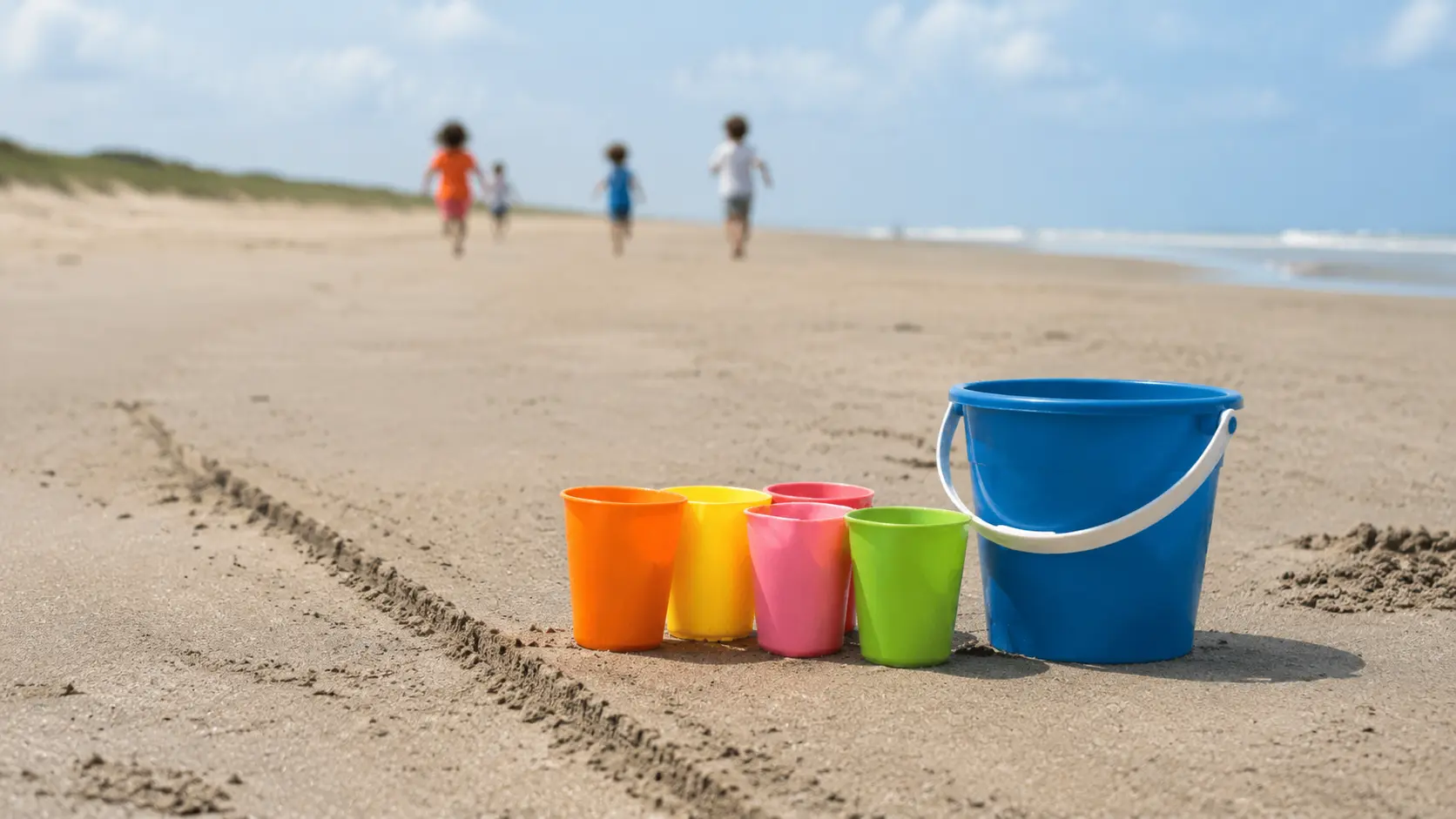
Three to twelve players. A bucket, plastic cups, a soft ball, a sponge. One adult whose only job is the water, as described above.
10. Bucket Brigade. Setup: a full bucket at one end, an empty bucket for each team at the other, one cup per player, a chalk or sand line to mark the far bucket. Rule: each player fills their cup at the full bucket, carries it to their team's empty bucket, pours it in, and runs back to tag the next player. Only one player per team runs at a time. Spilled water is lost. Turns: team order. Win: first team whose bucket reaches a line drawn inside it in advance, or the fullest bucket when the adult calls time. Age: four to ten. Lasts: ten minutes.
11. Sand Target. Setup: draw three rings in the sand with a stick, one inside the other, and a throwing line three steps away. Write 1, 2 and 3 in the rings, with 3 in the centre. Rule: each player throws the ball underarm to land in a ring. The ball scores the ring it stops in, not the ring it first touched. Balls that roll out score zero. Turns: three throws each, then the next player. Win: highest total after two full rounds. With sand that slopes, redraw the rings on the flattest patch you can find. Age: four to eight. Lasts: ten minutes.
12. Sponge Tag. Setup: a bucket of water, one large sponge, a boundary marked with bottles well away from the water's edge. Rule: the tagger holds the wet sponge and tags by throwing it below the shoulders. A hit player becomes the tagger, dunks the sponge and throws from where they were hit. Missed throws are fetched by the tagger, and while fetching they cannot tag. Turns: continuous. Win: no single winner; when the adult calls time, whoever has been hit the fewest times chooses the next game. Age: six to twelve. Lasts: ten minutes.
13. Sea and Sand. A declared variation on the "ship and shore" calling game, written for a beach. Setup: a line drawn in the sand, parallel to the water and well above where the waves reach. Everyone stands with their toes on the line. Rule: the caller shouts "sea" or "sand". On "sea", everyone jumps forward over the line; on "sand", everyone jumps back. If the caller repeats the same word twice, players who jump are out. Last to move on a correct call is also out. Turns: the adult calls, or the first player out becomes the caller. Win: last player standing. Age: four to eight. Lasts: five minutes per game.
Scaling Up or Down
Too few players. Tag games (5 and 12) do not work with fewer than four, so swap them for the ladder games (1, 2) or the target games (3, 11), which work with two. Cone Raid (6) with four players becomes a two-on-two with three bottles per side.
Too many players. Split relays (7, 10) into more teams rather than longer lines; four lines of four beat two lines of eight. Colour Map (4) and Sea and Sand (13) handle twenty at once. Dodgeball (8) with more than twelve gets a second ball.
Running the Afternoon
Say the whole rule before the first go, then play one practice round that does not count. Explain everything up front rather than announcing a rule after someone has lost.
Rotate the caller. In games 4, 5, 12 and 13 the caller or the tagger is the best job, so cap it: one round each, then pass it on.
Shade breaks between games, with water bottles, are part of the plan and not an interruption. Slot them after every second game on a hot day.
The Rules, Saved Once
Put the rules you tweaked and the photos from the day behind one link, so the next birthday or park meetup starts from what worked.
FAQ
What outdoor games can kids play with no equipment at all?
From this list, Shadow Tag (5) and Hide and Seek, Home Base Version (9) need nothing but a marker for the base, and Sea and Sand (13) needs only a line scratched in the sand. Everything else uses a ball, chalk, a rope, a bucket or a few bottles.
What are good outdoor games for a large group of kids?
Colour Map (4), Cone Raid (6), Dodgeball, Two-Court Version (8) and Sea and Sand (13) all run with twenty players. Relays (7, 10) scale by adding teams.
How do I make tag games fair for younger kids?
Use the safe-zone rule from Shadow Tag (a count of ten in the shade), let children under six be tagged only by another child under six, and change the tagger often so nobody is "it" for long.
What can I use instead of cones?
Empty plastic bottles with a little water or sand in the bottom so they do not blow over. Shoes and backpacks work for corners but are harder to see from a distance.
How many games should I plan for one afternoon?
Four: one chalk game while everyone arrives, one relay, one tag game, and a calmer target game (3 or 11) to finish. Keep the rest for another day.
What about sun and water safety during outdoor play?
See the section above: shade when the sun is strongest and reapplying sunscreen after water (NHS and the American Academy of Pediatrics), and around water an adult within arm's reach of the youngest children (American Academy of Pediatrics). All three sources are linked below.