
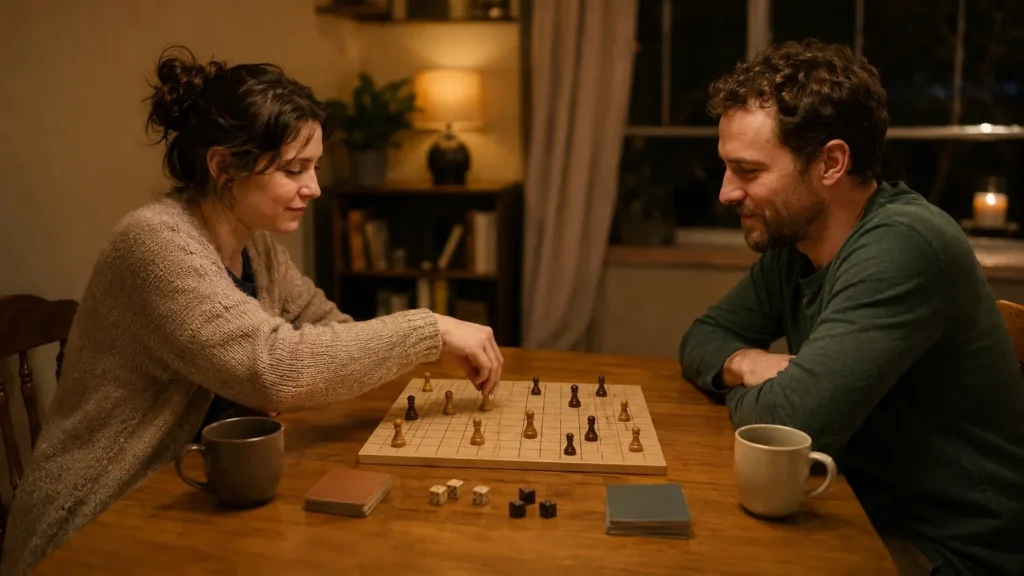
A game built for four does not automatically work at two. With two players the negotiation disappears, nobody can gang up, and every decision points directly at one opponent. That changes which games actually work.
This guide sorts two player games by mechanism rather than by title, because the mechanism is what decides whether a game holds up at two. Once you know which mechanisms suit a pair, you can judge any game on the shelf, including ones not named here.
How to read this guide: what follows is a framework for choosing, not a set of measured findings. The mechanism criteria below are editorial rules of thumb drawn from how these mechanisms behave by design, and your own experience with a specific game may differ. No titles are ranked, no prices are quoted, and nothing here is a claim about the board game market.
One Link for Your Game Nights
A short address you control, holding your collection, your house rules and everything you want to share.
Why Two Players Is a Different Game
Four structural things change the moment a third player leaves the table.
No alliances. With three or more, players can align against a leader. At two there is nobody to appeal to, so a lead tends to compound instead of being corrected by the table.
Full information about intent. With one opponent, every card taken and every space filled is aimed at you. You can model what they are doing far more accurately than in a four player game, which makes bluffing and hidden goals more valuable.
No downtime, and no break either. Turns come back immediately. That is good for pace and bad for long games: there is never a moment to disengage. For this guide, a three hour two player game is a substantial time commitment.
Runaway leaders are harder to stop. Without a table to police the leader, a game with no catch-up mechanism can be decided early and then take another hour to finish. In our framework this is the first thing to check when a game disappoints at two.
Mechanisms That Work at Two
Tight, contested spaces. When both players want the same small set of options, every choice is also a denial. This guide favors limited shared resources at two because every claim directly affects the only opponent.
Simultaneous selection. Both players choose at once and reveal together. Removes waiting entirely and turns each round into a read of the other person.
Drafting from a shared pool. Taking what you need also takes it away from them. At two, every draft pick is a double decision, which is more interesting than it is with five players where the pool refreshes before your turn comes round.
Asymmetric sides. Each player has different powers, goals or victory conditions. Asymmetry gives two players something to explore beyond outplaying each other, and makes the second play different from the first.
Hidden information with a tell. Bluffing works best when there is exactly one person to read. This guide particularly likes commit-to-a-guess systems at two, where each commitment is read against one opponent rather than several.
Built-in catch-up. Any mechanism that gives the trailing player an advantage, even a small one, protects the second half of the game from being decided in the first.
Mechanisms That Fall Apart
Worth knowing before you buy something because the box says two to six. These are structural expectations rather than verdicts on any particular game: a good design can work around any of them, and the point is to know what it has to work around.
Negotiation and trading. With one trading partner there is no market, no competing offer and no leverage. Trades collapse into take it or leave it, which is not a negotiation.
Voting and social deduction. Both need a group to function. With two players a vote is either unanimous or deadlocked, and deduction has a suspect pool of one.
Auctions. With two bidders, every bid has only one opponent responding to it. That removes the multi-player pressure this guide looks for in an auction.
Elimination. Knocking out a player at two ends the game rather than continuing it, so the mechanism has nothing left to do.
Long turns with heavy planning. Acceptable when three others are also thinking. At two it is just waiting, alternating, for the whole session.
Games that add a dummy player at two. Some designs built for more players add a simulated opponent so the mechanisms keep working. This can be elegant, and it can also mean both of you are maintaining bookkeeping for a system rather than playing each other. Either way it is worth reading how the two player mode works before assuming it works.

Abstract Strategy
No theme, no luck, all information visible. The purest two player category.
What it feels like. Every loss is yours. There is no die roll to blame, which is either the appeal or the problem depending on the person.
Who it suits. Pairs who play often and want to improve against each other, because the skill gap becomes visible and closable.
What to check before buying. Whether the first player has an advantage, and whether the game has an accepted way to balance it, such as swapping sides between games or letting the second player claim the first player's opening move.
The trap. A large skill gap is brutal here. With no luck at all, if the same skill gap decides the result repeatedly in your pair, the matchup may feel less interesting over time. If that is your pair, look at the parallel race category instead.
Keep the House Rules Somewhere
Every pair invents variants. Keep yours behind a single address you can share.
Direct Conflict
Both players build or manoeuvre, and the interaction is attacking, blocking or taking what the other one wanted.
What it feels like. Sharp and personal. Every gain of yours is visibly their loss, which is exactly what some pairs want and exactly what others cannot stand across a kitchen table.
Who it suits. Pairs who enjoy competing openly and do not carry a lost game into the evening.
What to check. Whether the game has a comeback path. Direct conflict without catch-up produces the situation this guide most warns against: a decided game that still has a long stretch left to play out.
The trap. Games where a bad early roll or a single mistake compounds all game. At four players the table absorbs that; at two it just ends the contest early.
Parallel Race
Both players build their own engine or track, interacting mainly by competing for a shared pool rather than by attacking each other.
What it feels like. Friendly. You are mostly solving your own puzzle while watching them solve theirs, with occasional collisions when you both want the same piece.
Who it suits. Mixed skill pairs, and anyone who wants a game that does not create conflict. This is the category to pick when one player is much more experienced, because the weaker player can enjoy their own construction even while losing.
What to check. How contested the shared pool actually is. If the pool is generous, the two of you are effectively playing solitaire side by side, which some pairs love and others find pointless.
The trap. Very low interaction can make the win feel arbitrary, because you never really played against each other.
Playing on the Same Side
Both players against the game itself. Structurally excellent at two, because coordination is easy and no one is left out.
What it feels like. Collaborative and often tense, since the pressure comes from the system rather than from each other.
Who it suits. Pairs who do not want to compete at all, and pairs with a large skill gap, since you win or lose together.
What to check. Whether the game has hidden information between players. Without it, cooperative games at two are vulnerable to one player effectively directing both sides, which turns the second player into an assistant.
The trap. The quarterback problem above is the main failure mode. If one of you is much more experienced, choose a cooperative game that restricts what you may tell each other; that restriction is the whole design and it is what keeps both people playing.
A related option worth knowing: some games are one against one but asymmetric, where one player controls a single powerful side and the other controls many weaker pieces. These give a duel structure with cooperative pacing, and they tend to work very well at exactly two.
Matching the Game to the Evening
Length is worth deciding before the title. A game that suits your pair perfectly is still the wrong choice on an evening that cannot hold it.
| Time you have | Pick | Because |
|---|---|---|
| Under 20 minutes | Abstract or simultaneous selection | Setup is short and a full game fits |
| 30 to 45 minutes | Drafting or parallel race | Long enough for an engine to matter |
| An hour or more | Asymmetric duel or cooperative | The variety sustains attention without a table |
| Repeated evenings | Asymmetric, campaign or legacy | Something changes between sessions |
Treat the time printed on the box as a rough planning estimate rather than a promise. Budget extra for a first play, and note that at two players there is nobody at the table who already knows the game, so both of you are learning while you play.

How to Judge a Box Yourself
Five checks that work in a shop, without knowing the game.
1. Read the player count carefully. Two to six and two to four are very different claims. A range that starts at two is a stronger signal than a wide range where two is the floor.
2. Look for a two player variant in the rules. If there is one, read it. A short elegant variant is a good sign. Treat a simulated third player as a compatibility caveat, not as proof that the base mechanisms fail at two.
3. Check which mechanisms are listed. Negotiation, voting, auction and social deduction are warning signs at two. Drafting, simultaneous selection, asymmetry and area control are good signs.
4. Ask whether a leader can be stopped. If the only way to slow a runaway leader is for other players to gang up, that mechanism does not exist at two.
5. Match the length to how you actually play. A ninety minute game you play twice is worse value than a twenty minute game you play thirty times.
One thing this guide deliberately does not do is rank specific titles by price or tell you where to buy. Availability and cost vary enormously by country, and a recommendation that is accurate in one market is misleading in another. Take the mechanism criteria to whatever is actually on the shelf where you live.
FAQ
What makes a board game good for two players?
Contested shared resources, simultaneous decisions, asymmetric sides and a working catch-up mechanism. At two players, this guide gives extra scrutiny to negotiation, voting, auctions and elimination because they depend heavily on how interaction is structured.
Are two player only games better than variants?
They start from an advantage. A game designed for exactly two does not need to simulate absent players, so the mechanisms are doing what they were built to do. A well made variant can still be excellent.
We have very different skill levels. What should we play?
Cooperative games, or parallel race games with low direct conflict. Avoid pure abstract strategy, where a skill gap decides every game with no luck to soften it.
What is the dummy player problem?
Some games keep four player mechanisms alive at two by adding a simulated third player that both people maintain. It can be elegant, but it is worth reading how it works before buying, since sometimes it is mostly bookkeeping.
How long should a two player game be?
Shorter than the equivalent group game. Turns come back constantly with no downtime, so the same length feels more demanding at two.
What is the quarterback problem?
In cooperative games, one experienced player directing both sides. Choose cooperative games that limit what players may tell each other, which is the design feature that prevents it.
Why does our game feel over before it ends?
No catch-up mechanism. With no other players to slow a leader, an early advantage compounds. Look for games where the trailing player gets some structural help.
Keep Your Collection in One Link
What you own, what you liked and the house rules you invented, all behind a single address.