

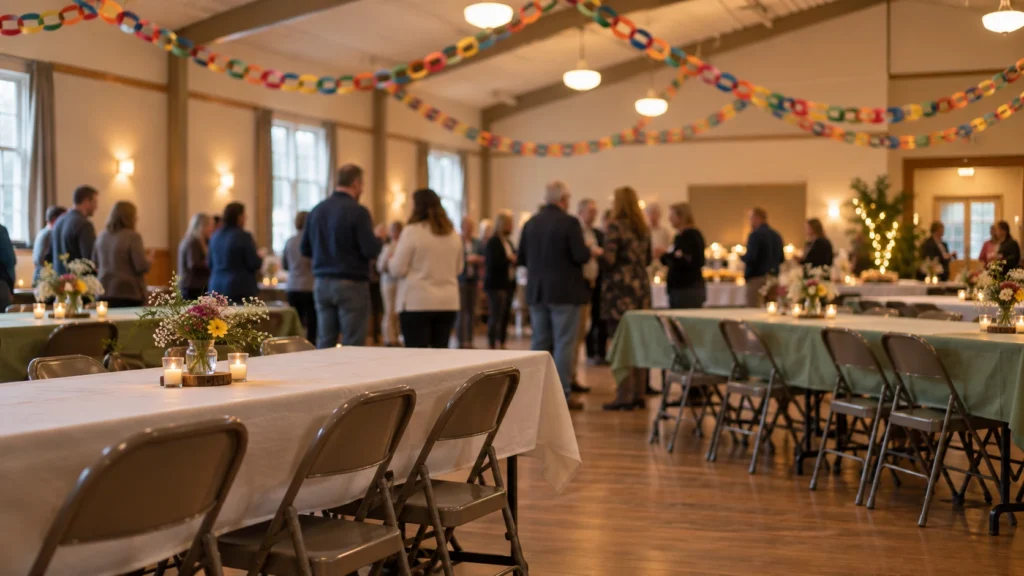
Christmas party games for large groups fail for one reason: the queue. With twenty, forty or sixty people in a hall, a game that gives one person a turn while everyone else watches loses the room by the fourth turn. Every game below states its smallest group, materials from an ordinary cupboard, the full rule, and whether everyone plays at once or in rounds.
A Big Gathering Happens Somewhere
If the hall, club or restaurant is a VISU partner location, your verified presence can earn a reward. Scan the code there, no purchase required.
What Changes When the Group Is Big
A game for eight and a game for forty are not the same game with a bigger number attached. Three things break at scale.
The queue. One turn at a time, thirty seconds a turn, forty people: twenty minutes of standing still for whoever went first, and the main reason a big room drifts back to its phones. Either everybody acts at once, or the room splits into parallel groups playing their own round. Every game below is labelled Everyone at once or In rounds.
The voice. Hard floors and high ceilings swallow a speaking voice, and thirty people make enough noise to bury an explanation. Assume each rule is said once, to a room half listening.
The split. Any method that lets people choose teams leaves someone standing unchosen. Never ask two captains to pick. Use a mechanical split: numbered slips, counting off, or birth month, announced before you announce that there will be teams.
Player counts and durations here are planning estimates, not measurements from real parties.
Games Where Everyone Plays at the Same Time
These have no queue at all, which makes them right for the first fifteen minutes.
1. The Standing Poll. People: fifteen or more. Format: Everyone at once. Time: eight minutes. Materials: none. How to play: name one side of the room yes and the other no, then read a light seasonal preference: tinsel or no tinsel, ham or turkey, tree up in November or December. Everyone walks to a side, and one person on the smaller side gets a single sentence. Run eight to ten questions. No scoring; the room simply mixes and moves.
2. Everyone Writes One. People: twenty or more. Format: Everyone at once. Time: twelve minutes. Materials: a slip and a pen per person, one bowl. How to play: each guest writes one seasonal object on a slip and drops it in the bowl, which feeds later games. To play it alone, draw slips two at a time and ask the room to shout the connection.
3. The Silent Sort. People: fifteen to sixty. Format: Everyone at once. Time: six minutes. Materials: none. How to play: the room forms one line without speaking, ordered by something invisible: distance travelled, letters in a first name, birthday within the year. Gestures allowed, words not. Walk the line and check; errors count as one score for the room, then beat it with a second criterion.
4. Thirty Seconds of Paper. People: twenty or more. Format: Everyone at once. Time: five minutes. Materials: one sheet of scrap paper per person. How to play: thirty seconds to fold or tear the sheet into something seasonal. When time is called everyone holds it overhead and you read out what you see. No winner.
Games in Teams
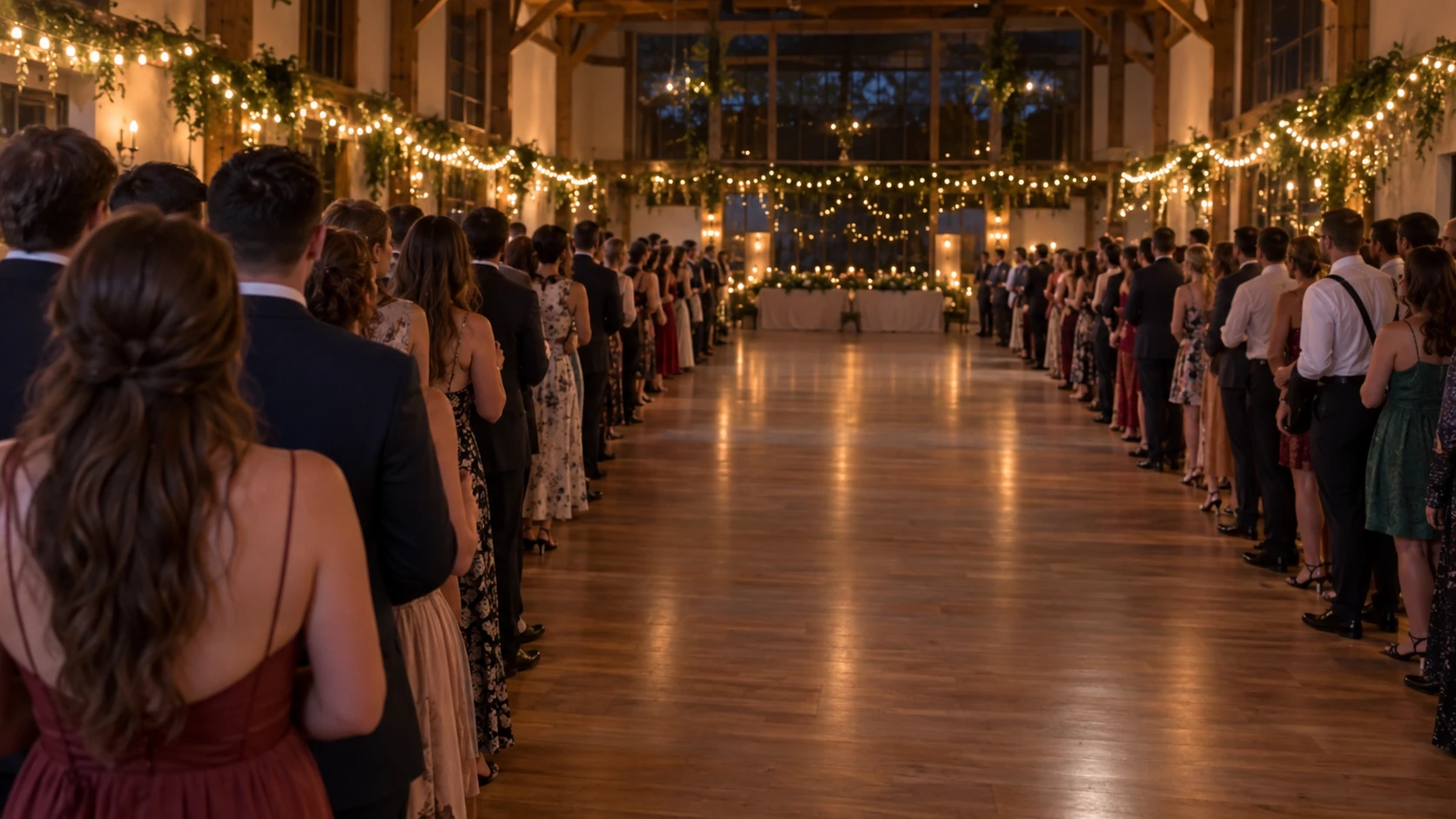
Teams convert a queue into parallel play: six teams of six means six things happen at once. Split mechanically and give every team the rule in writing.
5. The Category Wall. People: twenty or more, in teams of four to eight. Format: Everyone at once. Time: fifteen minutes. Materials: a large sheet and a pen per team. How to play: call one broad category, such as things on a table in December, and give teams ninety seconds to write as many items as possible. Read the lists aloud; anything on two lists is crossed off both, so only items nobody else thought of score.
6. Six Objects, One Story. People: twenty-four or more, in teams of six. Format: Everyone at once. Time: eighteen minutes. Materials: six random household objects per team, in a bag. How to play: each team gets a bag sight unseen and eight minutes to build one story using all six objects in order. A member the team chooses tells it in under sixty seconds, holding up each object as it appears. The room votes by applause.
7. Relay of Written Answers. People: twenty-four or more, in teams of six to ten. Format: In rounds, all teams at once. Time: twenty minutes. Materials: question cards face down at one end, paper and pens at the other. How to play: one player runs to the card pile, reads the top card, returns without it and reports the question. The team writes one agreed answer, then the next runs. One question per team at a time, one point per correct answer.
8. The Assembly Line. People: twenty or more, in teams of five or more. Format: Everyone at once. Time: twelve minutes. Materials: paper, tape and scissors per team. How to play: produce twelve identical paper decorations in eight minutes, nobody doing more than one step. Teams get two minutes first to design the line. One point per decoration a neutral judge cannot pick out as the odd one.
9. Two Rooms, One Drawing. People: twenty-four or more, in teams of six. Format: In rounds within each team. Time: fifteen minutes. Materials: shape cards, paper, pens. How to play: each team sends a describer to see a card made of basic shapes, then describes it to the team without naming the object. Everyone on the team draws at once, scoring a point per shape in the correct relative position on every drawing.
A Reward Tied to the Visit
VISU rewards a verified visit at a partner location. The scan confirms that you are there, without asking you to buy something or complete a profile.
Games for a Circle of 20 to 40
A circle is the one shape where a large group can still see and hear each other, and it needs nothing but chairs. These keep the wait short by making the turn tiny or running two things around the ring.
10. The Passing Word. People: twenty to forty. Format: In rounds, two seconds a turn. Time: ten minutes. Materials: none. How to play: name a category. Each person adds one item, and the circle tries to reach the far side without a repeat or a pause over three seconds. A break starts a new lap with a new category, so the room counts together instead of watching one player.
11. Two Objects Chasing. People: twenty to forty. Format: Everyone at once. Time: eight minutes. Materials: two clearly different small objects, such as a rolled sock and a wooden spoon. How to play: start them at opposite points of the circle, travelling the same way, passed hand to hand, never thrown. When one catches the other in the same pair of hands, the lap ends. Play three laps, reversing on the third.
12. Change Seats If. People: twenty to forty. Format: Everyone at once. Time: ten minutes. Materials: one chair fewer than players. How to play: the person in the middle names a neutral true statement about themselves, such as anyone who wrapped a gift this week. Everyone for whom it is true moves to a different chair, never the one beside them, and whoever is left standing goes to the middle. Rule out appearance, body, income and family.
13. The Growing Rhythm. People: twenty to forty. Format: Everyone at once. Time: six minutes. Materials: none. How to play: one person starts a repeating clap. Each next person adds their own sound, a stamp, a click, a hum, until the circle produces a layered rhythm. Then remove the sounds one at a time in the order added, which takes a room from noisy to quiet before an announcement.
14. Blind Ranking. People: twenty to forty. Format: Everyone at once. Time: twelve minutes. Materials: the bowl of slips from game two. How to play: draw five slips and read the words aloud. Everyone writes them in the order they think the room would rank them, most to least seasonal. Reveal by a show of hands and build the real ranking on a wall sheet. One point per position matched, and no expertise is involved.
Games That Work in a Hall or a Church Basement
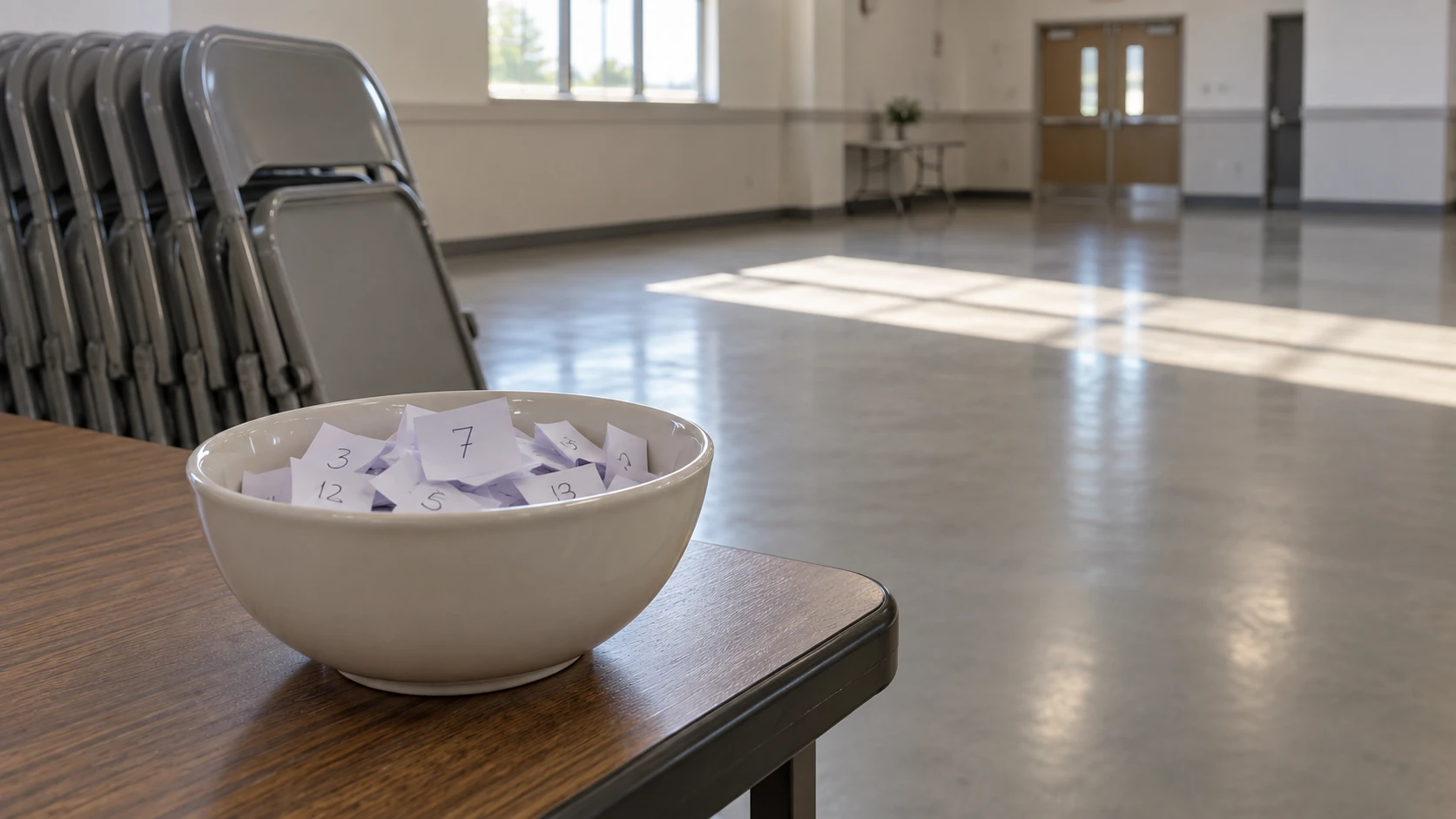
A hall gives floor space and takes away furniture and carpet. These use the space itself and survive bad acoustics.
15. The Four Corners Quiz. People: twenty or more. Format: Everyone at once. Time: eighteen minutes. Materials: four large letters taped to the corners. How to play: read a four-option question, give the room fifteen seconds to walk to a corner, then reveal the answer. A wrong corner collects a mark on a card, never an exit. After fifteen questions the lowest marks win, so the room stays full and everyone answers with their feet.
16. The Long Line Pass. People: twenty-four or more, in two long lines. Format: Everyone at once. Time: ten minutes. Materials: a bag of soft crumpled paper balls per line. How to play: the lines face each other across the hall, an arm's length apart. The first person takes a ball and passes it down using open palms only. Balls follow without pause, so the whole line always has something in hand. Count how many reach the far bucket in four minutes.
17. The Room Census. People: twenty-five or more. Format: Everyone at once. Time: fifteen minutes. Materials: a printed grid of squares per person. How to play: each square holds a neutral checkable statement: has sung in a choir, drove over an hour to be here, owns a red jumper. Everyone circulates for signatures from people for whom the square is true, one per person per sheet. Full row wins, then keep going.
18. Zone Charades. People: thirty or more, in four groups. Format: Everyone at once, one clue-giver per zone. Time: twenty minutes. Materials: four bowls of neutral action slips. How to play: four corners run their own charades round at once, each with its own bowl and clue-giver, rotating every clue. A clue-giver may mime, draw or describe without the key word, all scoring equally. Every five minutes rotate a quarter of each corner clockwise. Score by corner.
Games You Can Explain in Two Minutes
A rule survives a hall if it has one action, one visible finish and no exceptions. Say the goal, the action, then the finish, and demonstrate rather than describe.
19. Count the Room. People: twenty or more. Format: Everyone at once. Time: five minutes. Materials: none. How to play: the room counts aloud from one to thirty. Anyone may say the next number, one person at a time, nobody twice in a row. If two speak together, the count restarts.
20. The Held Note. People: twenty or more. Format: Everyone at once. Time: four minutes. Materials: none. How to play: the room hums one comfortable note together and each person stops when they run out of breath. Guess in advance how long the last hum lasts. Take three guesses, time the round, closest wins.
For a round that needs no rules at all, read questions aloud from a prepared set: 104 fun trivia questions for adults, 60 movie trivia questions and 80 music trivia questions. In a hall, have teams write answers rather than shout them.
Games for Mixed Ages in a Big Room
A large gathering spans generations, and the principle is not to find games that suit everyone equally. It is to give each game more than one way to take part that scores the same, with reading, drawing, walking and describing interchangeable. Never set the youngest against the oldest in anything measured by speed.
Two moves solve most of it. Mixed teams by mechanical split, never by age band, so no team is the children's team. And a seated equivalent for any movement game, worth the same points.
Use jobs rather than elimination. Someone goes out early, and with forty people that person waits a long time. Give them a role instead: timekeeper, scorekeeper, judge, clue reader, rotated so it never reads as a consolation. Announce the finish before the first turn: uncertainty about length is what makes people wander off.
Running the Night Without Dead Time
Dead time is the gap between one game ending and the next being understood, and in a large room those gaps run long.
Prepare in bags, not piles. One bag per team per game, packed before anyone arrives and handed out while you explain.
Set the teams once. Draw numbered slips at the start and keep those teams all evening.
Alternate the format. Follow every round-based game with an everyone-at-once game. A room that spent twenty minutes waiting needs all forty moving at once.
Recruit two helpers. One for materials, one for a visible score sheet.
Plan more than you will use, and cut silently. Six planned for a two-hour evening, expecting four. If something works, run a second round; if not, move on.
Finish early. End while the room is still full. A clear last game, announced as such, gives the evening a shape.
Let the Place Count
When a gathering is held at a VISU partner location, a code scan can connect the visit to a reward. The reward is for verified presence, not a purchase.
FAQ
What Are the Best Christmas Party Games for Large Groups?
The ones where nobody queues: whole-room games such as The Standing Poll or The Four Corners Quiz, or parallel teams running several rounds at once.
How Many Games Do I Need for a Group of Forty?
Plan six for a two-hour evening and expect to run four. The spares give you somewhere to go if one falls flat.
How Do I Split a Big Group Into Teams Without Anyone Feeling Left Out?
Use a mechanical split: numbered slips, counting off, or birth month, announced before the teams. Never let two captains pick.
What Do I Need to Buy?
Nothing. Everything runs on paper, pens, bowls, tape, chairs, socks and ordinary kitchen objects.
Which Games Work in a Hall With Bad Acoustics?
Games using position instead of speech: The Four Corners Quiz, The Silent Sort, The Long Line Pass and Zone Charades.
How Do I Include Someone Who Does Not Want to Play?
Give them a job rather than a turn. Timekeeper, scorekeeper and judge are real roles, rotated so the job never reads as a consolation.
How Long Should Each Game Last With a Big Group?
Use the listed time as a ceiling and stop at the announced finish. A large room tires sooner than a small one.