

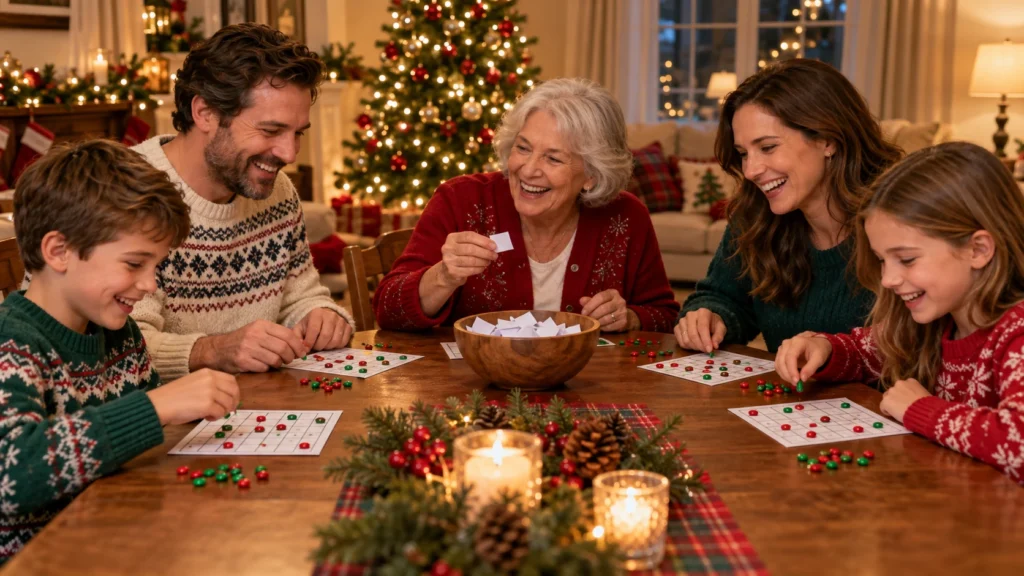
Christmas bingo works at almost any holiday gathering because the rules fit in one sentence and nobody has to perform. What makes the evening run well happens before the first call: choosing between numbers and Christmas words, making cards that are really different from each other, deciding which patterns win and settling the prize rules out loud. This guide covers each step, with a ready Christmas call list and versions for family nights, office parties, classrooms, church halls and video calls. When you are ready to print, our free bingo card generator makes every card different and includes a caller for the big screen.
Give Your Holiday Party One Link
A free VISU Link page keeps the date, the address, the dress code and the group chat link together, so every guest finds the details in one place.
Numbers or Christmas Words: Pick the Format First
Every bingo game is the same loop: someone calls an item, players mark it if it is on their card, and the first person to complete the agreed pattern shouts "Bingo". What changes from party to party is what sits on the card.
| Format | Card | Best for | Watch out for |
|---|---|---|---|
| Classic numbers, 1 to 75 | 5 x 5 grid under the letters B, I, N, G, O, free space in the center | Large groups, church halls, anyone who grew up with bingo | Feels less festive unless the calling adds the Christmas mood |
| Numbers, 1 to 90 | 3 rows of 9 columns, 15 numbers per ticket | Guests who grew up with British-style bingo | Americans may not recognize the ticket at first |
| Christmas words, 5 x 5 | 24 words plus a free center | Office parties, adult family nights, readers of all ages | Needs a word list longer than the card, or everyone finishes together |
| Christmas words, 3 x 3 or 4 x 4 | 9 or 16 short words | Young children, short rounds, classrooms | Games end fast, so plan several rounds |
Word bingo is the most festive version. It turns every call into a small moment ("Mistletoe!") and lets you write inside jokes into the list. Number bingo is quicker to set up and easier to call in a noisy room, which suits church and community halls.
A good rule for mixed groups: play numbers when more than about thirty people are in the room and the caller needs a microphone, and play words everywhere else.
How to Make Christmas Bingo Cards That Are All Different
The one thing a homemade card set must get right is that no two cards are alike. If two guests hold the same card, they win on the same call and the round ends in an argument.
Number Cards
A standard 75-ball card is not random numbers in a grid. Each column has its own range: B holds only numbers from 1 to 15, I from 16 to 30, N from 31 to 45, G from 46 to 60 and O from 61 to 75. The center square is free and counts as already marked. Keeping the ranges is what makes calls like "G 52" work, because players know which column to check.
The good news is that duplicates are very unlikely when you follow those ranges and fill each column at random: there are about 552 septillion possible standard cards (552,446,474,061,128,648,601,600,000, to be exact). The risk comes from shortcuts, such as photocopying one card or printing the same template twice.
Word Cards
Word cards need more care, because the list is short. Three rules keep them working:
- More words than squares. A 5 x 5 card with a free center holds 24 words. If your list has exactly 24, every card has the same words in a different order and the whole room completes the card on the same call. Aim for 35 to 45 words, so each card holds a different selection.
- Short words read best. "Elf" and "Wreath" can be read from across a table. "Ugly sweater contest" in a small square cannot.
- One idea per word. If the list has both "Snow" and "Snowman", someone will argue that one covers the other.
Number Every Card
Print a small card number on each one. When someone shouts "Bingo", the number lets you check the card against the calls quickly, and it lets you spot two cards that came out the same before the game starts.
Making 30 different cards by hand takes an evening. Our Christmas bingo card maker builds up to 200 cards in classic 1 to 75, 1 to 90 or your own words, checks each new card against the others so none repeat, numbers them and shows a seed. Copy the link to your set before the party: it holds the settings and the seed, so opening it again rebuilds the same cards and a card spilled with cocoa can be printed again. Everything is made in your browser; your word list is not uploaded.
A Christmas Call List You Can Use Tonight
Here are 40 Christmas words that fit on a card and read well out loud. Use them as they are, or swap ten of them for words that belong to your own group: the name of the family dog in a Santa hat, the office printer that jammed all year, the town's light show.
- Characters: Santa, Elf, Reindeer, Rudolph, Snowman, Angel, Nutcracker, Gingerbread man
- Around the house: Christmas tree, Ornament, Tinsel, Lights, Wreath, Stocking, Chimney, Fireplace, Advent calendar, Pine cone
- Gifts: Present, Ribbon, Wrapping paper, Gift tag, Bow, Ugly sweater
- Food and drink: Candy cane, Cookies, Hot cocoa, Eggnog, Fruitcake, Marshmallow
- Outside: Snowflake, Sleigh, Sledding, Ice skates, Mittens, Scarf
- The season: Carol, Bells, Star, Manger
Two ways to call the words. For a low-tech table, write each word on a slip of paper, fold the slips into a bowl and draw one at a time, setting called slips aside so you can check a win later. For a bigger room, paste the list into the generator and use its on-screen caller: it never calls the same word twice and keeps everything called so far on the board, which is exactly what you need when someone claims a bingo.
The Rules: Patterns, Calling and Checking a Win
Say the rules once, before the first call, and write the pattern for each round somewhere everyone can see it. Many disputes start when people are playing for different patterns.

Patterns to Choose From
- Single line. Any complete row, column or diagonal. The quickest round and the best opener.
- Four corners. Only the four corner squares. Quick, and a change of pace after lines.
- Postage stamp. A 2 x 2 block in one corner.
- Blackout. Every square on the card, also called coverall. Save it for the last round and the biggest prize.
One quirk worth knowing: with many players and standard number cards, the first winning line is about three times more likely to be horizontal than vertical, because of how the column ranges work. If you want a round won on a column, say "columns only" for that round.
Calling
Call at a steady pace, repeat each call once and pause a couple of seconds before the next. With number bingo, read the letter with the number ("N 38"), because it tells players which column to look in. If the room is loud, show the called item on a screen or a whiteboard as well.
Checking a Bingo
When someone shouts "Bingo", stop calling. The player reads the winning items aloud and the caller checks each one against the called list. If everything matches, the win stands. If not, call it a false alarm, laugh it off and carry on; the rest of the game is unchanged.
Agree beforehand what happens on a tie, when two players complete the pattern on the same call (see the FAQ below).
Put the Party Details on One Page
A VISU Link page can hold the start time, the location, the menu and the round schedule, so nobody scrolls back through the chat on the day.
Family, Office, Classroom and Church Hall
The game stays the same in every setting. What changes is the card size, the word list and how long you let each round run.
Family Night
Mixed ages are where bingo shines, because luck evens out the gap between a child and an uncle. Give small children a 3 x 3 or 4 x 4 card with easy words while adults play 5 x 5, and run every format from the same call list. Let a child be the caller for a round; it keeps them invested even when they are not winning.
Office Party
Keep the list work-safe and include a few shared references from the year: the move to the new floor, the coffee machine, the project everyone survived. Two or three short rounds work better than one long one. If the party also has a gift exchange, our Secret Santa generator handles the draw before the day.
Classroom
Christmas words make a natural vocabulary game. Instead of calling the word, read a definition or show a picture and let students find the matching word. In a language class, call in the new language and print the cards in the same one. A 4 x 4 grid keeps rounds within a few minutes, and printing four cards per sheet saves paper.
Church or Community Hall
Number bingo with a microphone works best for a big hall. A volunteer per table helps older players keep up. Keep the cards free: once people pay for a card to compete for prizes, bingo becomes gambling, and in the United States its legality and stakes vary by state regulation. If the goal is to raise money, our guide to church fundraiser ideas covers methods that do not depend on games of chance.
Christmas Bingo Over a Video Call
Bingo is one of the few party games that works almost as well on a call as in a room, because each person only needs their own card and the caller's voice.
- Send each player one card in private. Save the cards as images and send one per person by message, noting the card number. Players can print it, mark it in a photo editor or copy it onto paper.
- Share the caller's screen. The host shares the caller so everyone sees each item and the full list of calls so far. That screen also settles any "did you already call Reindeer?" question.
- Shout it or type it. Typing "BINGO" in the chat avoids people talking over each other.
- Check by card number. The winner says their card number and the host compares that card with the calls. If the host runs the generator's caller, opening that card shows how many of its squares have been called and whether it has a full line.
Prizes and the Line You Should Not Cross
Small prizes make the shout worth it. A candy cane per line, a chocolate bar for four corners and one nicer item for the blackout keeps the evening light. At home, prizes do not need to be bought at all: first choice of dessert, a pass on dish duty, or picking the next movie.
Three habits keep prize rounds friendly:
- Announce the prize before the round, not after, so nobody feels a better prize was saved for someone else.
- One win per person per evening in groups with many children, or the luckiest player collects everything. Later winners pass their turn to the next player who completes the pattern.
- No cash, and no paid cards. Charging for cards so people can compete for a prize turns the party game into gambling, which US states regulate and many allow only with a licence. Our guide to school fundraising ideas explains why for school events.
Printing, Markers and Reusing the Cards
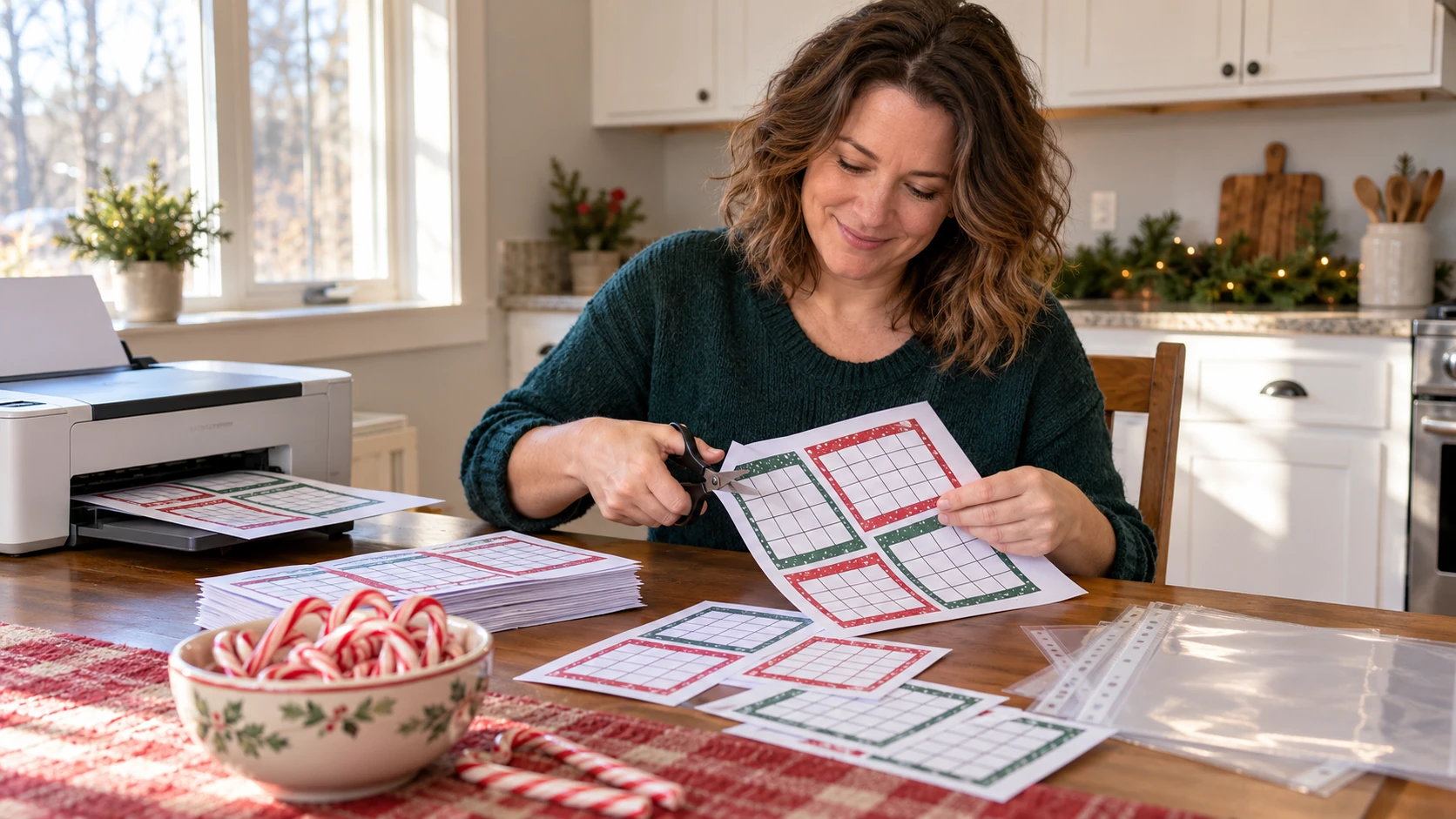
Print problems usually start in the print dialog. Choose the paper you actually have (US Letter or A4), set the scale to 100% instead of "fit to page" and turn off extra margins, so every card comes out the same size. Printing several cards per sheet with cut marks saves paper and time; four per sheet is a comfortable size for adults, and children manage well with larger single cards.
- Paper. Card stock survives a whole evening of markers and spilled drinks. Plain paper is fine for a single round.
- Markers. Small candies, buttons, coins from a board game or dried beans all work. Dried beans are a nod to history: in 1929, toy merchandiser Edwin S. Lowe, who went on to popularize bingo, watched a carnival crowd near Atlanta play it as "Beano", marking their cards with dried beans.
- Reusable cards. Slide each card into a clear sheet protector and use dry-erase markers. Wipe between rounds and the same set lasts the whole season.
If you would rather not print at all, the bingo card generator also saves each card as an image, or all of them in a single ZIP file, to send by message.
Share the Party by Link or QR Code
Create a free VISU Link page for your holiday gathering and print its QR code on the invitation or by the door.
Frequently Asked Questions
How do you play Christmas bingo?
Give each player a different card with Christmas words or numbers. A caller draws items one at a time without repeats, players mark the items on their card, and the first to complete the pattern announced for that round shouts "Bingo" and has the card checked against the calls.
What can you use to mark Christmas bingo cards?
Small candies, buttons, dried beans or board game tokens work at the table. For cards you want to reuse, put them in clear sheet protectors and mark them with dry-erase markers.
What patterns can you play besides a straight line?
Four corners, a 2 x 2 postage stamp in one corner, and blackout, where every square must be marked. A good evening starts with a single line and ends with a blackout for the biggest prize.
What happens if two people get bingo on the same call?
The simplest rule is that both win and each gets a prize. If there is only one prize, draw one more item and give it to the first of the two who has it on their card. Agree on the rule before the first round.
How many cards should you print for a Christmas party?
One per player plus about five spares for late arrivals and accidents. Number every card so you can check winners quickly and reprint a damaged card from the saved link to the set.