

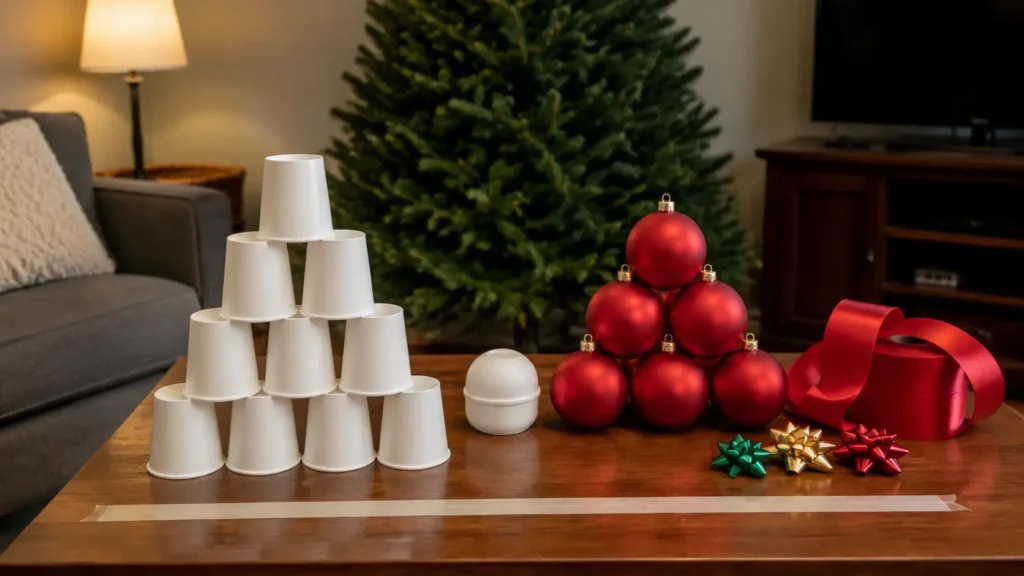
Sixty seconds, one kitchen timer, and a pile of things that are already in the house in December. That is the whole format. Every challenge below is built from plastic baubles, wrapping paper, ribbon, straws, paper cups, socks and large pompoms, and every one of them ends when the timer does.
Each challenge is written so you can run it without looking anything else up: the setup, what you need, the rule, how it is scored, and a version for small children and a harder version for adults. There are sixteen, sorted by where they happen, plus a simple way to string them into a tournament.
One Link for the Whole Evening
Keep the challenge list, the scoreboard and the photos behind one short address you can share with everyone who played.
How the Sixty-Second Format Works
The clock is the rule. A challenge lasts exactly one minute, not "about a minute", and that is what makes the format work with a mixed room: nobody waits long, nobody can stall, and a player who fails is out of the spotlight in sixty seconds.
There are three ways to score a challenge, and every challenge below names which one it uses:
- Count. The player does the task as many times as possible before the timer. Highest count wins.
- Beat the clock. The task has a finish line. Done before the timer means a point; not done means nothing.
- Head to head. Two players run the same challenge side by side on the same timer. Whoever is ahead when it rings wins the round.
One referee per station, who starts the timer, calls "stop", and counts. The referee's count is final. Agree that before the first round, because sixty seconds produces arguments if nobody has the last word.
Setting Up a Station
The timer. A kitchen timer that rings is better than a phone, because everyone can hear it and nobody has to watch a screen. Set it to one minute once and reset it between rounds.
The lines. Masking tape on the floor and on the table marks start lines, target zones and lanes. Every challenge that says "line" means a strip of tape.
The materials, all from the house:
- Plastic tree baubles, the unbreakable kind, in two sizes if you have them. Glass ones stay on the tree.
- Wrapping paper, ribbon, stick-on gift bows and tape.
- Drinking straws, paper cups and paper plates.
- Rolled socks, ideally the festive ones, and a couple of long stockings.
- Large pompoms, the size of a walnut or bigger.
- Small cardboard boxes, a cardboard tube, clothes pegs, spoons, a bowl.
Put everything for one challenge in one box before guests arrive, with a card on top saying the rule in two lines. Resetting a station takes as long as the round itself, so the box is what keeps the evening moving.
Safety as Part of the Setup
Nothing here needs a warning label, but three things belong in the setup rather than in a speech.
The floor. Any challenge that involves walking or turning happens on a clear floor with nothing to trip on, and in shoes or grippy socks rather than smooth socks on a smooth floor. Push the coffee table to the wall before the first floor challenge, not after the first stumble.
Small objects and small children. Pompoms, bows and small baubles are exactly the size that goes in a toddler's mouth. Penn State Extension's Better Kid Care programme gives concrete limits: "Young children can choke on small objects and toy parts. All items used for children under three years of age and any children who put toys in their mouths should be at least 1¼ inch in diameter and between 1 inch and 2¼ inches in length." If a child under three is in the room, use only the large baubles and keep pompoms and bows on a table they cannot reach.
Space. One player per station, one station per clear patch of floor or table. Spectators stay behind the tape line. That is the whole rule, and it also makes the referee's job easier.
One more thing that is a rule rather than a safety note: nothing goes in anyone's mouth except the end of their own straw. No eating races, no catching food, nothing swallowed against a clock.
Table Challenges
1. Bauble Column. Setup: six paper cups and five large plastic baubles on the table. Rule: build a single column alternating cup, bauble, cup, bauble, with the baubles resting on the upturned cup bottoms. Hands off at the timer. Scoring: beat the clock. A column of at least three cups and two baubles still standing five seconds after the ring scores a point; the tallest standing column in the room scores two. Kids: cups only need to alternate with one bauble at the top. Adults: one hand only.
2. Straw Lift. Setup: a plate of ten large pompoms on the left, an empty plate on the right, a straw. Rule: move pompoms from plate to plate by suction through the straw. No hands touch a pompom. A pompom that drops between plates stays where it fell. Scoring: count. Kids: replace the straw with a spoon held in one hand. Adults: the empty plate goes on the far side of the table, so every lift is a walk.
3. Bow Pinch. Setup: a heap of stick-on gift bows, an empty gift box with the lid off, two straws. Rule: pick up bows using the two straws as chopsticks and drop them in the box. Fingers never touch a bow. Scoring: count of bows in the box. Kids: use two spoons instead of straws. Adults: straws held in the non-dominant hand.
4. Ribbon Reel. Setup: a cardboard tube and a length of ribbon as long as the table, taped at one end to the tube. Rule: wind the ribbon onto the tube using one hand only; the other hand stays behind the back. Scoring: head to head. When the timer rings, the player with the shorter loose tail wins. Kids: both hands allowed. Adults: the ribbon is laid out in a zigzag under three paper cups that must not be knocked over; each cup knocked adds a hand-length of ribbon back.
5. Bauble Roll. Setup: a tape zone the width of a hand along the far edge of the table, a start line at the near edge, eight plastic baubles. Rule: roll baubles one at a time from the start line so they stop inside the zone. Plastic baubles roll unevenly, which is the entire challenge. Scoring: count of baubles resting in the zone at the timer; every bauble that went over the edge takes one away. Kids: the zone is two hands wide and nothing is deducted. Adults: rolled with the back of the hand.
6. Sock Pairs. Setup: twenty socks from ten pairs, mixed in a heap. Rule: match them into pairs and fold each pair once. Only folded pairs count. Scoring: count of correct pairs. A wrong pair counts against. Kids: five pairs with clearly different patterns. Adults: one hand, and the socks are all white with small differences in the cuff.
Save the Scoreboard
A photo of the tally sheet and the winning column, kept at one address you can send to the family group after the party.
Floor and Room Challenges
All five need a clear stretch of floor with a tape line at each end. Set both lines before guests arrive and leave them down all evening.
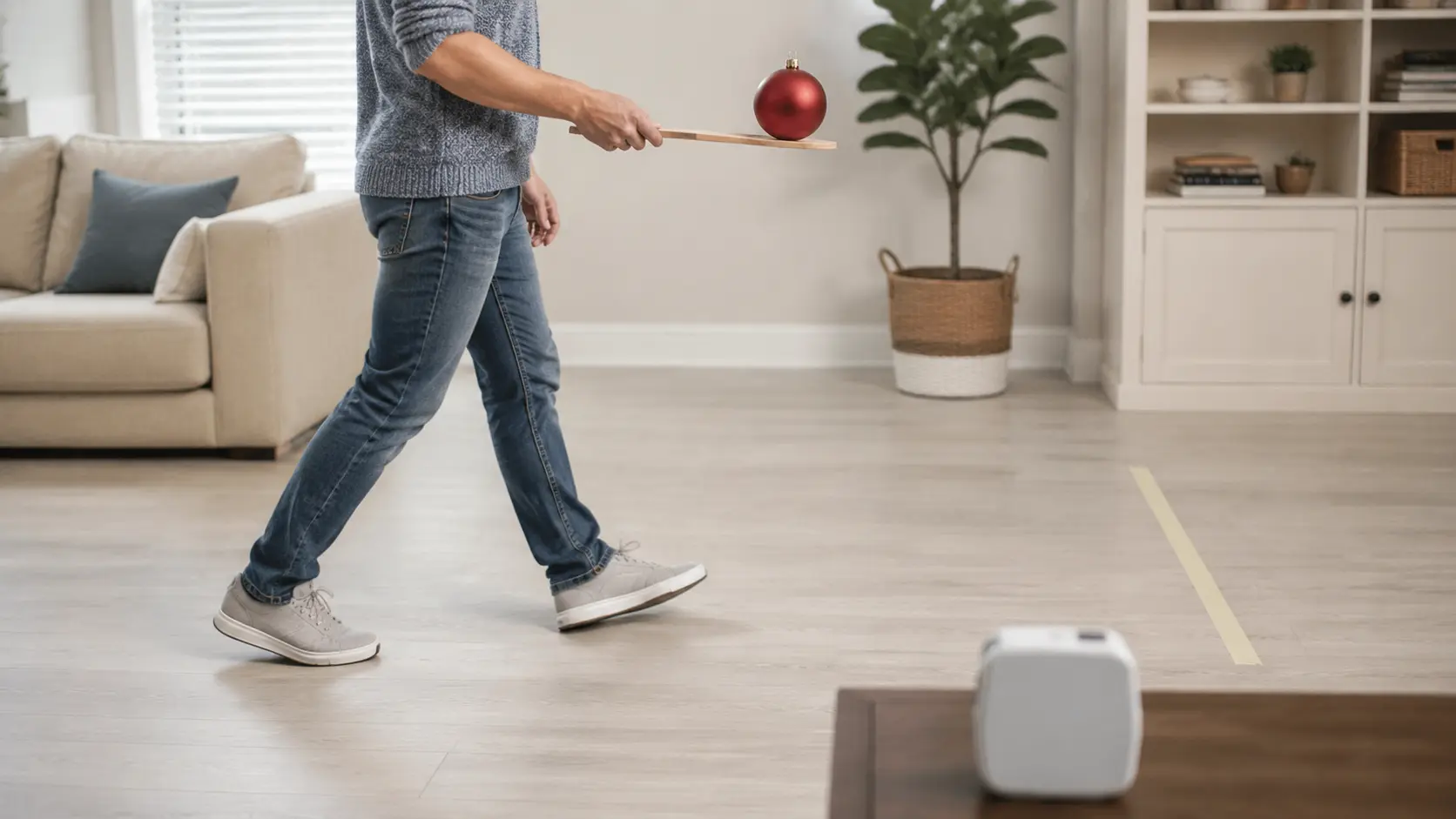
7. Spoon Sleigh. Setup: a spoon and a plastic bauble at the start line, a turn line at the far end. Rule: carry the bauble on the spoon to the far line and back. A drop means walking back to the start line with the bauble in hand and starting that lap again. Scoring: count of completed laps. Kids: a tablespoon and a shorter course. Adults: a teaspoon, and the spoon handle is held between two fingers only.
8. Bauble Pendulum. Setup: a plastic bauble dropped into a long sock, the sock tied to a belt or ribbon around the player's waist so it hangs at the back, just above the floor. Six paper cups standing upright on the floor in a wide spread. Rule: knock the cups over with the swinging sock only. No hands, no feet, no turning to look. Scoring: count of cups on their side at the timer. Kids: the cups are in a straight line, close together. Adults: cups are spread across the whole room and each cup must be knocked in a called order.
9. Chimney Drop. Setup: a cardboard tube or small open box standing on the floor between the player's feet, ten rolled socks in a bowl on a chair beside them. Rule: stand straight, hold a sock at chin height, and drop it into the chimney. No bending, no throwing, no bending the knees. Scoring: count of socks in the chimney. Kids: a wide box instead of the tube. Adults: the sock is released from arm's length above the head.
10. Elbow Delivery. Setup: five small wrapped boxes at the start line, an empty laundry basket at the far line. Rule: carry one box at a time held between the elbows, forearms pointing up, hands never touching the box. A dropped box goes back to the start. Scoring: count of boxes in the basket. Kids: boxes held between the forearms. Adults: two boxes at a time, stacked.
11. Hang the Line. Setup: a length of ribbon tied taut between two chair backs at chest height, a bowl of plastic baubles with their loops on. Rule: hang baubles on the ribbon by their loops, one hand only, the other behind the back. A bauble that falls is out. Scoring: count of baubles hanging at the timer. Kids: the ribbon is at their eye level and both hands are allowed. Adults: the ribbon is slack, so every new bauble swings the ones already on it.
Take one photo of every station before it is reset. The column that survived, the cups on the floor after the pendulum, the chimney full of socks. If you want those pictures to look like the room and not like a snapshot of a cup, the basics are in our guide to photography for beginners.
Pairs and Team Challenges
12. Gift Wrap Sprint. Setup: two players, one box, one sheet of wrapping paper, tape, a bow. Rule: each player uses one hand only, and it must be the same hand for both, so two right hands or two left hands. Wrap the box completely and stick the bow on top. Scoring: beat the clock. Done before the timer with no cardboard showing scores a point; if several pairs finish, the room votes the neatest for a second point. Kids: both hands, one child wraps while the other tears tape. Adults: the box is an awkward shape, such as a tube or a triangle.
13. Human Tree. Setup: one team member stands with arms out, wearing a jumper. The others have a bowl of plastic baubles and a bag of clothes pegs. Rule: clip baubles to the tree's clothing by their loops using the pegs, one bauble per peg. Nothing goes on the face or hair. Scoring: count of baubles still hanging at the timer. Kids: pegs are pre-opened by an adult and the tree sits down. Adults: the tree walks slowly in a circle the whole time.
14. Cup Catch. Setup: two players on either side of a tape line, two paces apart. One has a bowl of large pompoms, the other a paper cup. Rule: the thrower tosses underarm, the catcher catches only with the cup, one hand behind the back. A pompom that touches the catcher's body is out. Scoring: count of pompoms in the cup. Swap roles for the next round. Kids: one pace apart and a bowl instead of a cup. Adults: three paces, and the catcher holds the cup by the rim with two fingers.
15. Bow Line. Setup: a ribbon tied between two chairs, a pile of short ribbon lengths at each end, two players. Rule: starting from opposite ends, each player ties bows onto the line, working toward the middle. A knot that is not a bow, with two loops, does not count. Scoring: head to head, most bows when the timer rings. Kids: a single overhand knot counts. Adults: bows must be tied with the ribbon behind the line, so the player cannot see their hands.
16. Blind Bauble Sort. Setup: a bowl of plastic baubles in two clearly different sizes, mixed, and two empty boxes. Rule: eyes closed, sort the baubles by size into the two boxes. A teammate may say only "yes" or "no" after each bauble is placed. Scoring: count of correctly sorted baubles minus wrongly sorted ones. Kids: eyes open, sorting by colour, with no helper. Adults: the helper says nothing, and the boxes are swapped by the referee at the thirty-second mark.
Running It as a Tournament
Sixteen challenges is more than one evening needs. Six to eight is a full session, and the choice of which six depends on who is in the room.
Ladder. Everyone attempts every challenge in turn. Points as written above, on a sheet on the wall. Highest total after the last challenge wins. Best for a small group where nobody minds waiting a minute.
Knockout. Pair players up for a head-to-head challenge. The loser is out, the winner moves on. With eight players that is three rounds and seven minutes of play, which is why the knockout suits a big, loud room.
Stations. Set up four stations, split the room into four teams, and rotate every two minutes: one minute to play, one to reset. Each team's referee records the count. After four rotations everyone has done everything, and the team totals decide it.
Mixed ages. Run the kids' version and the adults' version of the same challenge at the same time on the same timer and count them on separate sheets. A child who beats the count on the easier version has won their round exactly as much as the adult who beat the harder one.
Ties. Rerun the last challenge with the adult variation for whoever is tied. If they are tied again, they both win.
Keep the Rules for Next Year
The six you chose, the scores and the pictures, at one link you can open next December instead of starting over.
FAQ
How many minute-to-win-it challenges do I need for a party?
Six to eight fills an evening once you count the setup and reset between rounds, which takes about as long as the round itself. Choose from the sixteen above by who is playing and how much floor you have.
What materials do I need for Christmas minute-to-win-it games?
Plastic baubles, wrapping paper, ribbon, gift bows, straws, paper cups, socks, large pompoms, tape, a few small boxes and a kitchen timer. Everything in the list above uses only these.
Can kids and adults play the same challenges?
Yes. Every challenge above has a kids' version and an adults' version. Run both on the same timer and count them on separate sheets.
How do I keep score with a large group?
Use the stations format: four stations, four teams, rotate every two minutes, one referee per station recording counts. Team totals decide it.
What if a challenge turns out too easy or too hard?
Switch to the other version written under it, or move the tape line. Change it between rounds, never during one, so every player faced the same rule.
Is it safe with small children in the room?
The small items, pompoms, bows and small baubles, stay out of reach of any child under three or any child who still puts things in their mouth, following the size guidance quoted in the safety section. Floor challenges happen on a clear floor in shoes or grippy socks.
Do I need a timer that shows seconds?
No. A kitchen timer that rings is better, because the ring is the rule and nobody has to watch a screen. Set it to one minute and reset between rounds.