


Most lists of church fundraiser ideas open with a raffle, which is a problem if your denomination prohibits games of chance or your state regulates them. This guide takes a different route: it starts from what the IRS already treats as safe for a congregation, adds the giving methods with data behind them, and covers the receipt rules that decide whether a gift is deductible. For methods beyond the church context, the broader guide to fundraising ideas that actually raise money covers the same ground.
Short version: the fundraisers with the cleanest tax treatment are the ones your volunteers already run, and the biggest available gain for most congregations is not a new event but recurring giving.
Show Your Congregation Where Their Giving Goes
VISU turns a scan into a tracked, transparent action, so generosity comes with a record instead of a guess.
The Fundraisers the IRS Already Blesses
There is a shortcut to knowing which fundraisers will not create a tax headache, and almost nobody uses it. Read the IRS exceptions to unrelated business income tax as a list rather than as tax code, and they describe three fundraisers your congregation already knows how to run.
Anything run substantially by volunteers. Where almost all the work is unpaid, the income is excepted. The IRS names the example directly: volunteer operated bake sales. Your Saturday bake sale is not a gray area, it is the textbook case.
Selling donated goods. Where almost all the merchandise arrived as donations, the sale is excepted. That covers the rummage sale, the thrift table and the donated-goods auction.
Activities for the convenience of members. Where the activity runs primarily for members, it is excepted. Church dinners sit here.
Three exceptions, three of the oldest fundraisers in church life. Worth noticing before you pay a platform for something more complicated: volunteer labour plus donated goods plus a congregation that shows up is the structure with the best treatment available.

Recurring Giving: The Largest Missed Gain
If a congregation changes one thing, this is the one with the most evidence behind it.
The numbers: recurring gifts account for 42 percent of digital giving dollars and 57 percent of digital transactions, and recurring givers contribute roughly 120 percent more than one-time givers.
The mechanism is unremarkable. A recurring gift survives the weeks someone is travelling, unwell or simply not in the building.
Capacity is uneven. About 62 percent of churches accept donations through their website and 54 percent support recurring payments, which leaves a real minority with no recurring option at all.
Matching gifts are the other quiet gap. Many members work for employers who will match a gift, and most never file the paperwork. Only about 31 percent of eligible donations get submitted after one email, while a second reminder raises matches by 45 percent.
Let givers cover the processing fee. Around half choose to when offered. It is a checkbox, not a campaign.
Note that most of these figures come from companies selling church giving software, though the direction is consistent across sources.
Events, Meals and Silent Auctions
Silent auctions are permitted and are not games of chance. The highest bidder wins, deterministically, so no gaming licence is involved and the denominational objection does not apply.
One rule catches people out. When someone pays more than 75 dollars and receives goods in return, the church must state in writing that only the amount above fair market value is deductible, with a good-faith estimate of that value. Printing the fair market value beside each catalogue item handles most of it.
Church meals and community dinners fall under the convenience-of-members exception. They also do something a giving page cannot: put people in a room together, which is usually the actual point.
Work-a-thons and service drives convert volunteer time into pledges with nothing bought to resell. Yard cleanups and sponsored walks keep nearly everything they raise.
Rummage sales are the highest-margin sale a church can run. The inventory costs nothing and the tax treatment is settled.
Digital Giving, Honestly Assessed
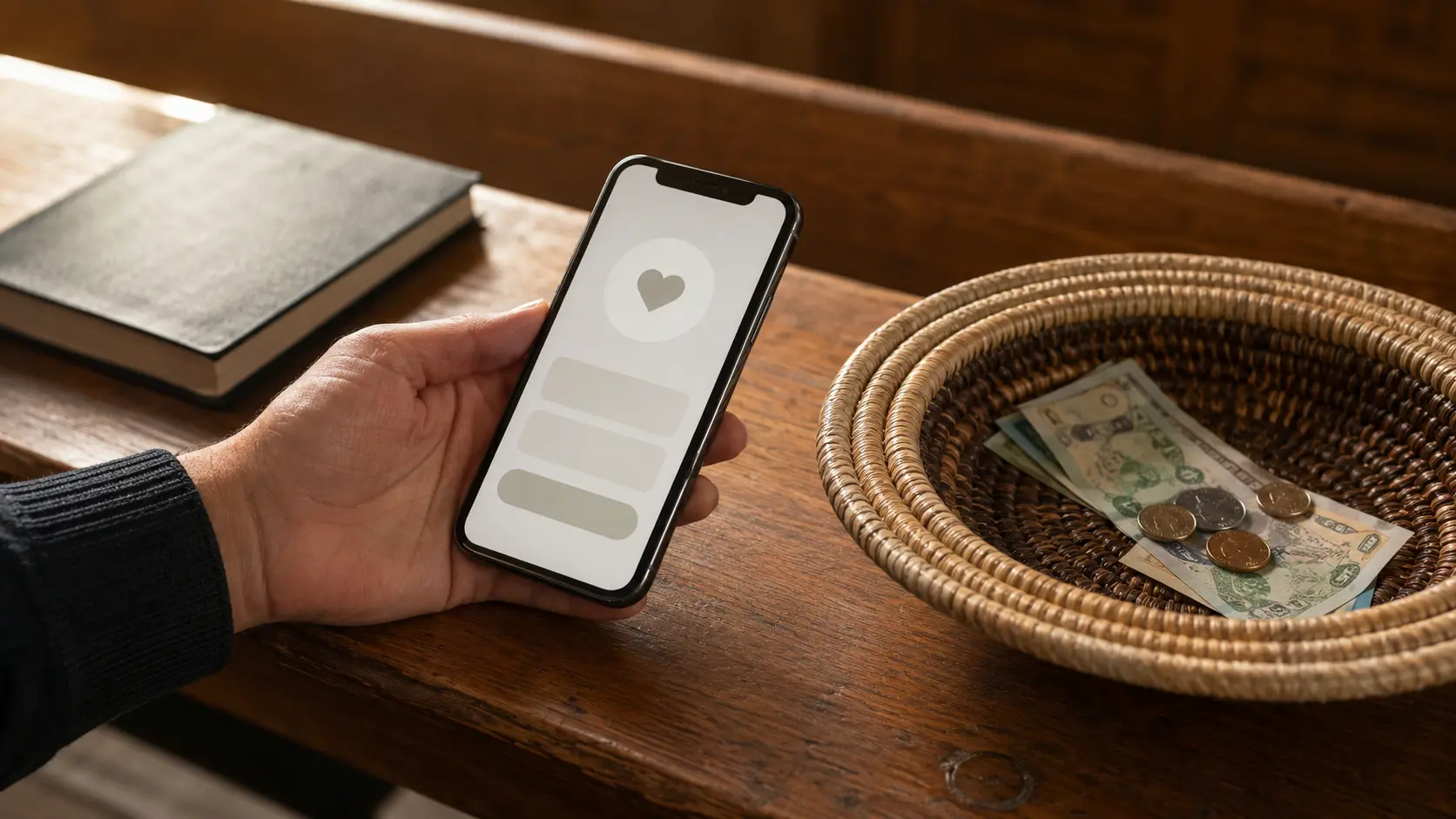
Congregations now split about evenly between electronic and traditional givers. Mobile grew fast: around 40 percent of donors used a phone to give in 2024, up from 34 percent two years earlier, ranging from about 30 percent of Boomers to roughly 68 percent of Gen Z.
Add digital, do not replace physical. Cash is about 14 percent of US consumer payments, but its volume has held steady at roughly seven payments a month since 2020, and older adults and lower-income households rely on it more. A church that removes the plate in favour of an app loses gifts from the people most likely to give every week.
On QR codes, a caveat worth stating. Only about 16 percent of internet users scan a QR code in a given month, and after years of restaurant menus there is real fatigue.
A code printed in a bulletin with nothing behind it will not raise money. A code that leads somewhere specific, records the gift and offers to make it recurring is a different proposition. The value is in the path, not the square.
Transparency is the strongest argument for tracking. Roughly 67 percent of donors say trust must come first, only about 22 percent report high trust in the organizations they support, and 34 percent say uncertainty about where money goes discourages them entirely.
Showing a member exactly what their gift funded addresses the real obstacle. Congregations already using QR-based giving may find the guide to QR codes for nonprofits useful on the mechanics.
Worth keeping in view: religion's share of American charitable giving fell from 34 percent in 2011 to 23 percent in 2024. Congregations are not competing for a growing pool.
Youth Group Fundraising
Youth fundraising differs in one way that shapes every decision: it has a defined number attached. A mission trip costs what it costs, generally 1,200 to 2,500 dollars per participant, and the fundraising closes a specific gap.
A useful default comes from the Presbyterian Church (U.S.A.): set participant fees at around 50 to 60 percent of true per-person cost and raise the rest. Naming that split at the start prevents fundraising from drifting into something open-ended.
Youth groups have time and people rather than capital, which maps onto the volunteer-labour exception above. Work-a-thons, yard cleanups and service auctions all fit. Peer-to-peer suits the structure too, with each participant raising toward their own trip within their own network.
Two cautions. Keep your youth protection policy in force during fundraising, which means no minors going door to door unaccompanied. And avoid framing that treats a destination community as a backdrop.
Receipts, Thresholds and the 2026 Change
Churches are automatically exempt. A church meeting the requirements of section 501(c)(3) is tax exempt without applying to the IRS, contributions remain deductible, and churches are excepted from filing the annual Form 990.
The 250 dollar receipt threshold. Any single contribution of 250 dollars or more needs a written acknowledgment with the church's name, the amount, a description of any non-cash gift, and a statement about goods or services provided in return.
Weekly offerings are treated separately rather than aggregated, so a member giving 40 dollars each week never crosses the threshold even though the annual total is well above it.
What changes in 2026. Legislation signed in July 2025 brings back a deduction for people who do not itemise: up to 1,000 dollars single, 2,000 dollars filing jointly, on cash donations from tax year 2026. Since roughly nine in ten households do not itemise, that restores a tax reason to give for most of a congregation.
Working the other way, itemisers face a new floor and can only count giving above 0.5 percent of adjusted gross income. Worth a mention from the front in the new year, because most members will not hear it anywhere else.
Why Raffles Are Not on This List
Three separate reasons, any one of which would be enough.
Your denomination may already prohibit it. The United Methodist Church states it without ambiguity: "It is expected that United Methodist churches abstain from the use of raffles, lotteries, bingo, door prizes, other drawing schemes, and games of chance for the purpose of gambling or fund-raising."
Note that door prizes are named, and they appear on a great many church fundraising lists. Other bodies hold their own positions, so check your denomination's standard before planning anything built on chance.
State law regulates it. Games of chance are regulated activities and outright illegal in several states. Where permitted they generally require a licence obtained in advance, sometimes with a segregated bank account and background checks on staff.
The tax treatment is worse than expected. Gaming income may count as unrelated business income, and prizes above certain thresholds carry reporting and withholding obligations.
Every method in this guide works without a gaming licence, without a denominational conflict, and without withholding tax on a prize.
Make Generosity Traceable
When members can see the result of a gift, the gift is easier to repeat. VISU records the action and the outcome together.
FAQ: Church Fundraiser Ideas
What is the easiest fundraiser for a small church to run?
A donated-goods sale. The inventory costs nothing because the congregation supplies it, the work is volunteer, and the IRS excepts both from unrelated business income tax. A bake sale run by volunteers sits in the same category and is the example the IRS itself uses.
Can a church hold a raffle to raise money?
Legally it depends on the state, and several prohibit it entirely while most others require a licence in advance. Separately, some denominations prohibit it regardless of state law. The United Methodist Church expects its churches to abstain from raffles, lotteries, bingo and door prizes. Check your denomination first, then your state.
Are silent auctions allowed for churches?
Yes. An auction is a sale to the highest bidder rather than a game of chance, so gaming rules do not apply. Remember the disclosure requirement: for any payment above 75 dollars where the bidder receives goods, the church must state in writing that only the amount above fair market value is deductible.
When does a church have to give a donation receipt?
For any single contribution of 250 dollars or more. The acknowledgment needs the church's name, the amount, a description of any non-cash gift, and a statement about goods or services provided. Weekly offerings are not added together for this threshold.
Does a church need to apply to the IRS to be tax exempt?
No. A church meeting the requirements of section 501(c)(3) is automatically tax exempt without applying for recognition, and donations remain deductible. Churches are also excepted from filing an annual Form 990.
Should we add QR codes for giving?
They can work, but only as an entry point to something. Roughly 16 percent of internet users scan a QR code in a given month, so a code with no clear destination will underperform. A code that opens a specific giving page and offers to make the gift recurring is worth adding. Keep the offering plate as well.
What changes for church giving in 2026?
Two things. People who do not itemise can again deduct cash donations, up to 1,000 dollars single or 2,000 dollars filing jointly, which covers most households. Those who do itemise face a new floor and can only count giving above 0.5 percent of adjusted gross income.