
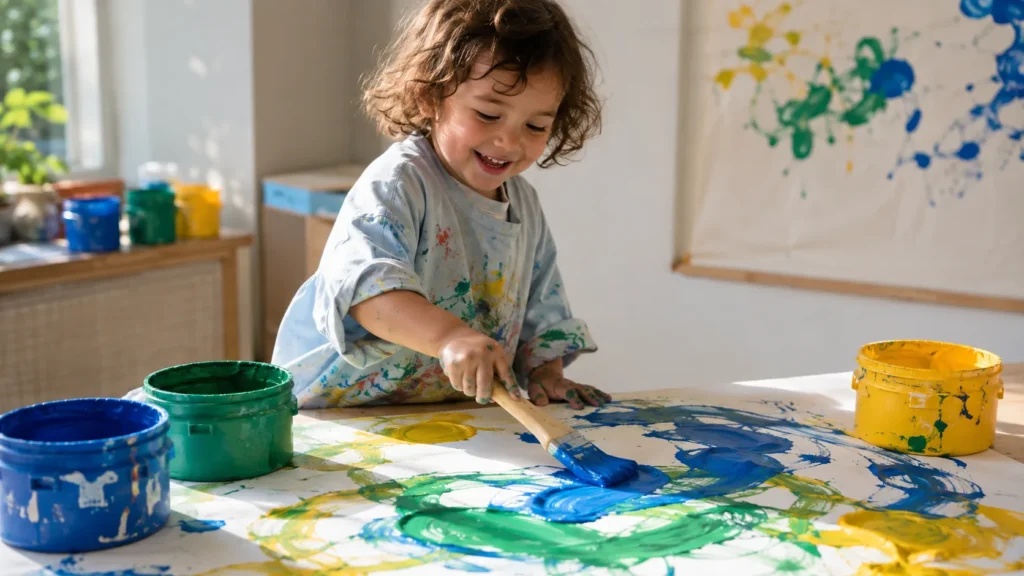
The best art activity for a three-year-old usually produces something you would not recognise, and that is the point. Preschool art works differently from craft. There is no model to copy and no finished object to match.
Below are activities organised by what the child is actually doing with their hands, plus the safety limits that matter at this age and the one habit that changes how children respond to their own work.
One Link for Everything They Make
A short address you control, holding the photos and the projects you want to keep and share.
Process, Not Product
This is the distinction that makes everything else make sense, and Penn State Extension's Better Kid Care programme states it plainly: "Children don't need to make a finished product to learn from art. This is sometimes hard for adults to understand. For young children, what they are doing is most important, not what they make."
They also describe what that means for the adult's role: "Art should be a time to allow the children to express their ideas and experiment with materials. Focus on helping children develop their creativity and enjoy the process of expressing thoughts and feelings through art. Guide, model, and show skills and techniques that can be used to create without teaching."
And the practical setup that follows: "Give children time and places to be creative, explore, express themselves, and experiment. Provide safe and interesting materials for children to use on their own."
Better Kid Care is also honest about how the results look: "To an adult, great children's artwork often looks a lot like scribbles, lines, and even a mess on paper!"
Set expectations accordingly. A session that produces a page of overlapping colours and a happy child went well.
What to Leave Out
This section is unusual for an activity list, but it comes straight from the source and it changes what you buy.
Better Kid Care notes that "crafts tend to limit a child's creative ideas," and lists activities to avoid because they do not allow a child to be creative:
- "Coloring books or printed pages to color."
- "Creating a craft project for the children to see and make the same thing."
- "Patterns to follow or lines to cut on."
- "Telling a child what to draw, paint, or make."
- "Finishing a child's work or telling a child to finish it to make it better."
- "Drawing things for children."
The last two are the hardest for adults, because both come from wanting to help. Drawing a house for a child who asked, or tidying up the edges of their painting, removes the part that was theirs.
Safety First, Because It Is Specific
At this age safety is not a general warning, and Better Kid Care gives concrete limits.
On choking: "Young children can choke on small objects and toy parts. All items used for children under three years of age and any children who put toys in their mouths should be at least 1¼ inch in diameter and between 1 inch and 2¼ inches in length. Oval balls and toys should be at least 1¾ inch in diameter. Toys should meet federal small parts standards. Any toys or games labeled as unsuitable for children under three should not be used."
Note the second condition: it applies to children under three and to any child who still puts materials in their mouth.
There is also a named list of things to keep out of reach: "Other items that pose a safety risk and should not be accessible to children under three include, but are not limited to: button batteries, magnets, plastic bags, styrofoam objects, coins, balloons, latex gloves, and glitter."
Glitter appearing on a safety list surprises people. Pompoms, googly eyes, beads and sequins belong in the same category for the same reason.
On materials generally, Better Kid Care advises considering "any safety factors, such as non-toxic materials and the ability to experience the process without injury."
The simple rule that follows: at this age, choose materials that would be harmless if a handful went in a mouth, and keep everything small and swallowable out of the activity entirely.
Painting Activities
Better Kid Care lists what painting offers a young child: "convey ideas, express emotion, use their senses, explore color, explore process and outcomes, and create aesthetically pleasing works and experiences."
1. Easel painting with big paper. The guidance is specific about scale: "Young children need large pieces of paper (to have full range of motion) as well as a variety of brush sizes to experiment with (find what works best for control)." Small paper forces small movements, which is the opposite of what a three-year-old's arm wants to do.
2. Painting with things that are not brushes. Sponges, cotton balls, corks, feathers, cotton swabs, combs, rolling pins and toy cars all leave different marks. Swapping the tool changes the whole activity without changing the materials.
3. Colour mixing on purpose. Offer two colours and let the third appear. Better Kid Care describes children discovering exactly this, quoting the kind of thinking you can almost watch happen: "I mixed red with more red and orange, and got fire color red!"
4. Ice cube painting. Frozen coloured water melts as it moves across paper, so the mark keeps changing. Slow, absorbing, and much less mess than it sounds.
5. Two brushes at once. Better Kid Care notes that "the pleasant feeling of painting over and over, possibly using two brushes or their fingers, is what is important." Not a technique to correct.
One practical tip from the same source, which saves both paint and frustration: "Consider offering smaller quantities of paint so children can manage fewer spills and can mix colors without ruining large containers of paint."

Keep the Ones Worth Keeping
Photograph what they make and keep it behind a single address you can share with family.
Hands and Fingers
6. Finger painting on a tray. Better Kid Care points out that this works even for the youngest: "Even very young children can dip their fingers in a paint mix and spread it on a table or tray." A tray contains it and can be wiped clean, so there is no paper to ruin and nothing to keep.
7. Playdough with no cutters. Rolling, squashing and pulling is the activity. Shape cutters turn it into producing a correct outcome, which is the thing to avoid.
8. Tearing paper for collage. Tearing needs no scissors and no cutting lines, and produces soft, irregular edges. It is also a good first step for a child not yet ready to use scissors safely.
9. Stamping. Better Kid Care lists a stamp set and ink pad among useful materials for older preschoolers, who begin to notice pattern and repetition. Halved potatoes, corks and sponge shapes work the same way.
Collage and Assembly
10. Glue and paper scraps. Better Kid Care describes children learning "about their world (colors, shapes, and sizes of objects)" as they "draw, paint, and make collages." A tray of assorted paper and a glue stick needs no further instruction.
11. Nature collage. Leaves, petals and grass collected on a walk, glued down afterward. The walk is half the activity. Check size against the choking guidance above before anything small goes on the table.
12. Fabric and texture boards. Scraps of different fabrics glued to card, chosen by feel rather than colour.
13. Box sculpture. Clean packaging, tape and glue. Better Kid Care notes that preschoolers "become more interested in what they can make with materials" and become "more intentional about creating art that looks like something."
14. Drawing from a real object. Put a real thing on the table and let them look at it. Better Kid Care recommends providing "real examples of objects. Let children examine them closely," adding that "this type of observing and drawing is a key element of scientific investigation."
Outdoors and Large Scale
15. Painting with water on paving. A bucket of water and a decorator's brush. The marks dry and vanish, which removes any question of keeping the result. No mess at all.
16. Chalk on the ground. Big movements, and the scale suits the whole arm.
17. Mud and sand marks. Sticks dragged through wet sand or mud, which is drawing with no materials to buy.
Better Kid Care suggests extending creative work into other parts of the day, such as inviting children to "help design and decorate a puppet theater or traffic signs for use with the trikes outdoors," and adds the reason to keep going: "The more opportunities and encouragement children are given to be artistically creative, the more confident, inventive, and skilled they become."
What to Say About Their Work
This is the habit that costs nothing and changes the interaction, and the source is specific about it.
Better Kid Care advises using "insightful open-ended comments that will encourage each child to explore," and explicitly warns against praise that evaluates: "Avoid general comments that sound as if you are evaluating the children's artwork, such as 'That's pretty!' or 'I like your bright picture!'"
What to say instead, in their examples:
- Invite them to explain: "Tell me about your artwork."
- Describe what you saw them do: "I see you mixed many colors."
- Notice something specific: "Look at the bright orange circle you drew."
All three keep the work belonging to the child. "That's pretty" ends the conversation. "Tell me about your artwork" starts one.
One more thing worth doing, from the same source: "Allow children to save their artwork and continue working on it over time." Not everything has to be finished in one sitting.

Setting Up so It Is Not a Disaster
Keep materials where they can reach them. Better Kid Care recommends "well-stocked collections of art materials available and accessible daily."
Teach the routine, not just the activity. The same source suggests teaching "children how to prepare to paint independently," including "where materials are kept, how to clip paper to an easel or tape to a table, where to place it for drying, and proper clean-up steps."
Decide the boundary before you start. A tray, a covered table or an outdoor slab. A child who has to be interrupted for going over the edge is being corrected for the adult's failure to set the edge.
Small amounts of everything. Less paint means fewer spills and colours that survive being mixed.
Dress for it. Old clothes remove the reason to say be careful.
FAQ
What art activities are best for preschoolers?
Open-ended ones: painting on large paper, finger painting, collage from torn paper, playdough without cutters, and drawing from a real object. Better Kid Care emphasises presenting materials and letting children explore them in their own ways.
Why avoid coloring books?
Better Kid Care lists coloring books and printed pages among activities that do not allow a child to be creative, along with patterns to follow and craft projects where everyone makes the same thing.
Is glitter safe for preschool art?
Better Kid Care lists glitter among items that pose a safety risk and should not be accessible to children under three, alongside button batteries, magnets, plastic bags, styrofoam, coins, balloons and latex gloves.
How small is too small for art materials?
For children under three and any child who still mouths objects, items should be at least 1¼ inch in diameter and between 1 and 2¼ inches in length, with oval items at least 1¾ inch in diameter.
What should I say when my child shows me their painting?
Ask about it rather than rate it. Better Kid Care suggests "Tell me about your artwork," describing what you saw them do, or noticing a specific feature, and advises avoiding evaluative praise like "That's pretty."
My child just scribbles. Is that normal?
Better Kid Care notes that great children's artwork often looks to adults like scribbles, lines and a mess on paper, and that what children are doing matters more than what they make.
How do I keep the mess manageable?
Set a physical boundary before starting, offer small quantities of paint, and teach the clean-up routine as part of the activity rather than as something that happens to the child afterward.
How long should an art session last?
As long as the child stays interested. The source frames painting as something to encourage "where it interests the child, not the adult," which cuts both ways: stopping early is fine, and so is going much longer than planned.
References
- Penn State Extension, Better Kid Care: Children's art. Process over product, activities to avoid, and how to comment on children's work.
- Penn State Extension, Better Kid Care: Painting with young children. Value of painting, safety considerations, paper and brush sizes, and teaching independent setup.
- Penn State Extension, Better Kid Care: Arts and creativity in three- and four-year-olds. What preschoolers do with materials, drawing from real objects, and the choking and small-parts cautions.
Keep What They Made
One link for the photos, the projects and the notes you want to keep.