

A Christmas craft for a one-year-old or a two-year-old is a project the adult makes, with one part left open for the child. The child presses a painted foot, pats a sponge, crumples a square of tissue or sticks one big piece where the glue already is. Everything else, cutting, drawing, taping, peeling, cleaning, belongs to the adult.
The eleven projects below are built on that split. Each one names the single thing the child does, what the adult does before and after, the materials, a rough time and how much mess to expect. The motifs are the plain ones: tree, star, reindeer, snowman, bell, wreath. No characters, no kits, nothing small enough to swallow, and no glitter anywhere.
One Link for Their First Christmas Crafts
A short address you control, holding the photos of the painted foot and the paper it landed on, ready to send to the family in one message.
One Action per Project
Between one and three the honest description of a Christmas craft is this: the adult makes it, and the child does one thing to it. That is not a compromise. Penn State Extension's Better Kid Care programme, whose guidance runs through this article, says of one-year-olds that "it's all about exploring the materials, not about a final piece of art!" The tree or the star at the end is for the adult and the grandparents. The child is there for the paint on the foot and the paper that crumples.
So every project here is written in two columns. The adult's column is long: cut the shape, tape the paper down, put a spoonful of paint on a plate, hold the sheet still, lift the foot off, wipe, dry, trim, glue. The child's column is one line: press, pat, smear, scribble, crumple or stick. If the child does that one thing twice and walks away, the project is done. If the child only watches, that is also allowed. Better Kid Care's advice for this age is direct: "Let children decide if and when they will participate; they may just want to watch."
Safety at One to Three: Stricter Than Preschool
The limits here are tighter than for a four-year-old, and the reason is simple: at this age things go in the mouth. Better Kid Care's page on one-year-olds states the rule for materials without hedging: "All materials that are used with ones need to be completely non-toxic and safe in case a child swallows some."
On size, the same programme gives a measurement rather than a warning: "Young children can choke on small objects and toy parts. All items used for children under three years of age and any children who put toys in their mouths should be at least 1¼ inch in diameter and between 1 inch and 2¼ inches in length. Oval balls and toys should be at least 1¾ inch in diameter."
And it names the items that fail: things that "pose a safety risk and should not be accessible to children under three include, but are not limited to: button batteries, magnets, plastic bags, styrofoam objects, coins, balloons, latex gloves, and glitter."
What that means for this list, applied harder than a preschool list would:
- No glitter, no sequins, no beads, no buttons, no pompoms, no googly eyes, no small bells. None appear in any project below, and nothing is offered as a substitute that is small.
- Every piece the child touches is bigger than the child's palm. Tissue squares, paper circles, sponge chunks and cardboard tubes are all cut oversized on purpose. Anything that a crumple or a tear could reduce below the size above is either held by the adult or not used.
- Paint is labelled non-toxic and washable, and goes on the plate a spoonful at a time. Better Kid Care recommends "smaller quantities of paint so children can manage fewer spills."
- Masking tape is an adult tool. It holds paper to the table and comes off before the child leaves the table. No loose strip is left where it could be picked up and chewed.
- The adult is at the table for the whole project, at arm's length, from the first spoon of paint to the last wipe. That is a practice we are stating, not a rule we are citing.
Hands and Feet: Pressing
The child's action in this group is to have a hand or a foot pressed onto paper. The adult paints the hand or foot with a sponge, holds the paper, presses, lifts and wipes. Most children at this age want to look at the coloured foot more than at the paper, so plan for the wipe to be the slow part.
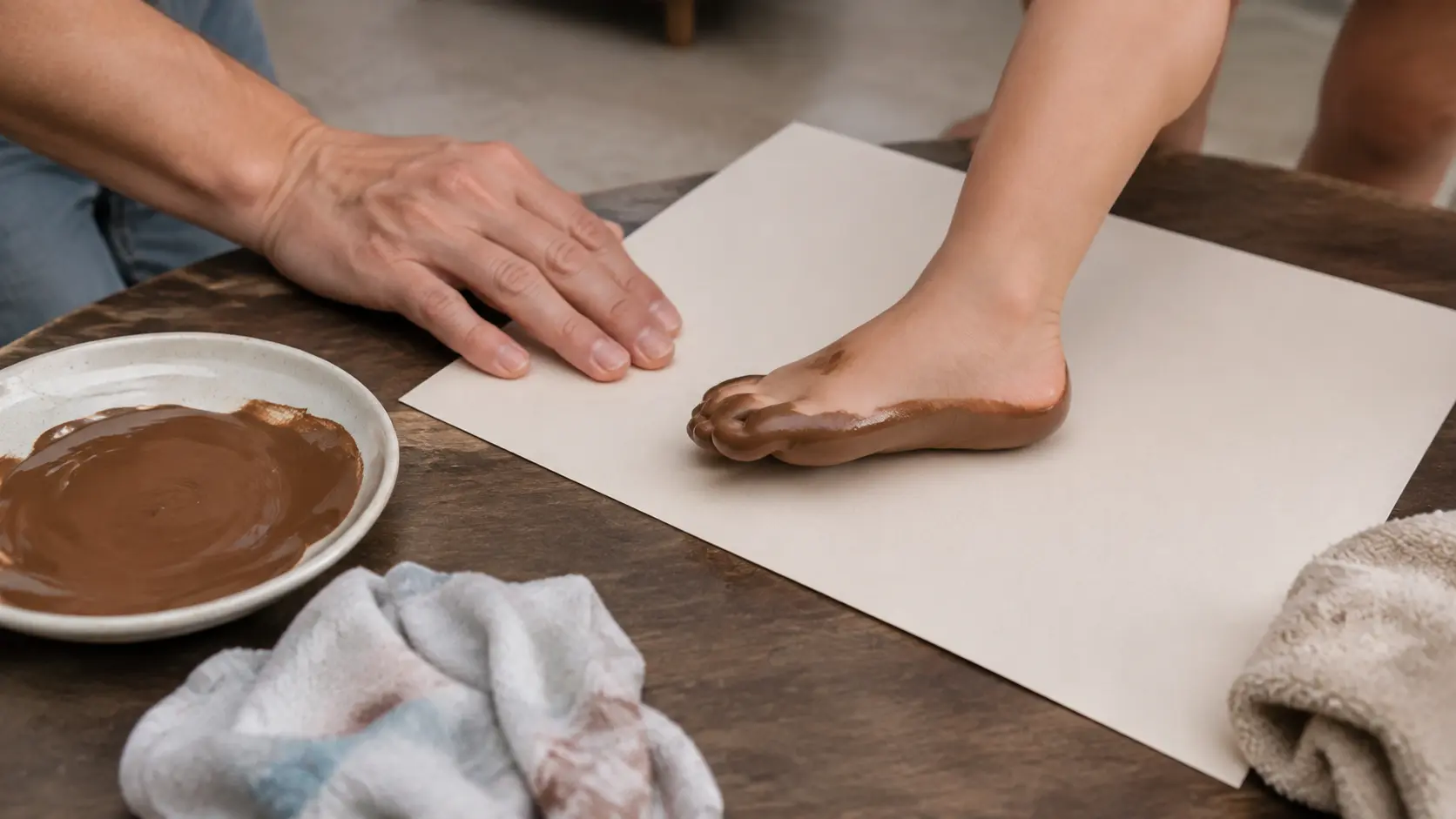
1. Footprint reindeer. Materials: a sheet of card, brown washable paint on a flat plate, a sponge, a marker, a wet cloth, a towel. Adult before: tape the card to the table or the floor, put a spoonful of brown on the plate, lay the towel where the foot will land afterwards. Child: one foot pressed on the card, heel at the top. Adult after: lift the foot straight up, wipe it, and when the print is dry draw two antlers coming out of the heel with the marker and a nose and eyes on the toes. Time: five minutes, plus the wipe. Mess: contained if the towel is there first.
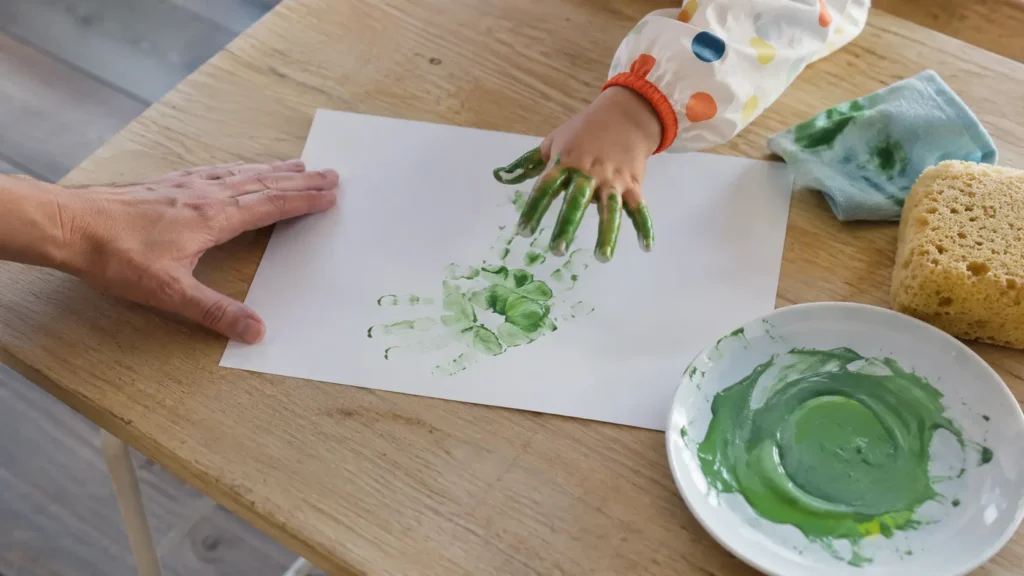
2. Handprint wreath. Materials: a large sheet of paper, green washable paint on a plate, a sponge, a wet cloth, a red marker. Adult before: tape the paper to the table, draw a faint circle in pencil the size of a dinner plate. Child: a green hand pressed onto the circle, again and again, fingers pointing out, until the ring is roughly covered. Adult after: wipe, dry flat, draw a few red circles with the marker where berries would go. Time: ten minutes. Mess: high on the hand, low on the room. This wreath is a picture for the wall or the fridge, not something to hang from a branch.
Sponges and Tubes: Patting
The child's action here is to pat something into paint and then onto paper. Better Kid Care lists "sponges, cotton balls, wooden or foam blocks, bubble wrap, crumpled foil" among the textured objects one-year-olds can paint with. The three below use a sponge chunk, a sheet of bubble wrap and a cardboard tube, each large enough to fit the size rule above.
3. Sponge-print wrapping paper. Materials: a roll of plain brown or white paper, a kitchen sponge cut by the adult into chunks the size of a fist, red and green washable paint on two plates. Adult before: unroll a length of paper across the table or the floor and tape every corner down. Child: pat the sponge in the paint, then on the paper, anywhere, as many times as they like. Adult after: let it dry flat, then wrap the presents. Time: fifteen minutes. Mess: medium, and the paper catches most of it.
4. Bubble-wrap snow card. Materials: a piece of bubble wrap bigger than a sheet of paper, white washable paint, a sponge, dark blue card. Adult before: tape the bubble wrap to the table bubbles up, taping all four edges, and sponge white paint over the bubbles. Child: pat the blue card down onto the painted bubbles with flat hands. Adult after: lift the card, dry it, fold it. The dots can be snow or lights; in a hot December they are lights. Time: ten minutes. Mess: low. The bubble wrap comes off the table the moment the card is lifted.
5. Tube-stamp baubles on a drawn tree. Materials: a large sheet of paper, a marker, a cardboard tube from a kitchen roll, red and yellow washable paint on plates. Adult before: draw a big plain triangle tree with a trunk on the paper and tape it down. Child: press the end of the tube into the paint and stamp circles, on the tree, beside the tree, over the trunk. Adult after: dry and hang on the wall. Time: ten minutes. Mess: low.
Keep the Sponge Prints Together
Photograph the wrapping paper before it wraps anything, and keep the photo behind one address the family can open.
Fingers and Fat Crayons: Smearing and Scribbling
The child's action here is to smear paint with fingers or to scribble with a thick crayon. The adult turns the result into a shape afterwards, by cutting or by lifting a print. Better Kid Care notes that "even very young children can dip their fingers in a paint mix and spread it on a table or tray," and recommends "fat, thick crayons, markers, chalk, and paint brushes that ones are able to grasp with their whole hand."
6. Tray-print star. Materials: a flat baking tray or a plastic tray, white washable paint, dark card, a wet cloth. Adult before: put a spoonful of white paint on the tray. Child: spread it around with fingers or a whole hand until the tray is streaky. Adult after: lay a sheet of dark card face down on the tray, press, lift, and when it is dry cut a large star out of the printed side. Time: ten minutes. Mess: hands only, and the tray wipes clean.
7. Scribble tree. Materials: a large sheet of paper taped to the floor, two or three fat green crayons, a sheet of card. Adult before: tape the paper down at every corner. Child: scribble. Adult after: cut a big triangle out of the most scribbled area, glue it to the card, add a trunk with a brown crayon. Time: as long as the scribbling lasts. Mess: none. Better Kid Care suggests "a large piece of paper taped to the wall or laid on the floor" for this age, and if the marks head off the paper, its script for the adult is: "Here is where you can paint/draw. Look! You can make it big!"
8. Big-brush cardboard bell. Materials: the side of a cereal box, yellow washable paint, the fattest brush in the house, tape. Adult before: cut a bell shape from the cardboard, as big as the box allows, and tape it to the table. Child: paint it, with the brush held in a fist, any direction. Adult after: dry and tape it to the front door at the child's height. It is a door sign, not an ornament, and nothing hangs from it. Time: ten minutes plus drying. Mess: medium.
Tissue and Big Pieces: Crumpling and Sticking
The child's action here is to crumple a square of tissue paper, or to press a big pre-cut piece onto a surface that is already sticky. Nothing in this group asks the child to use glue. The adult puts the glue or the sticky paper down first; the child only presses.
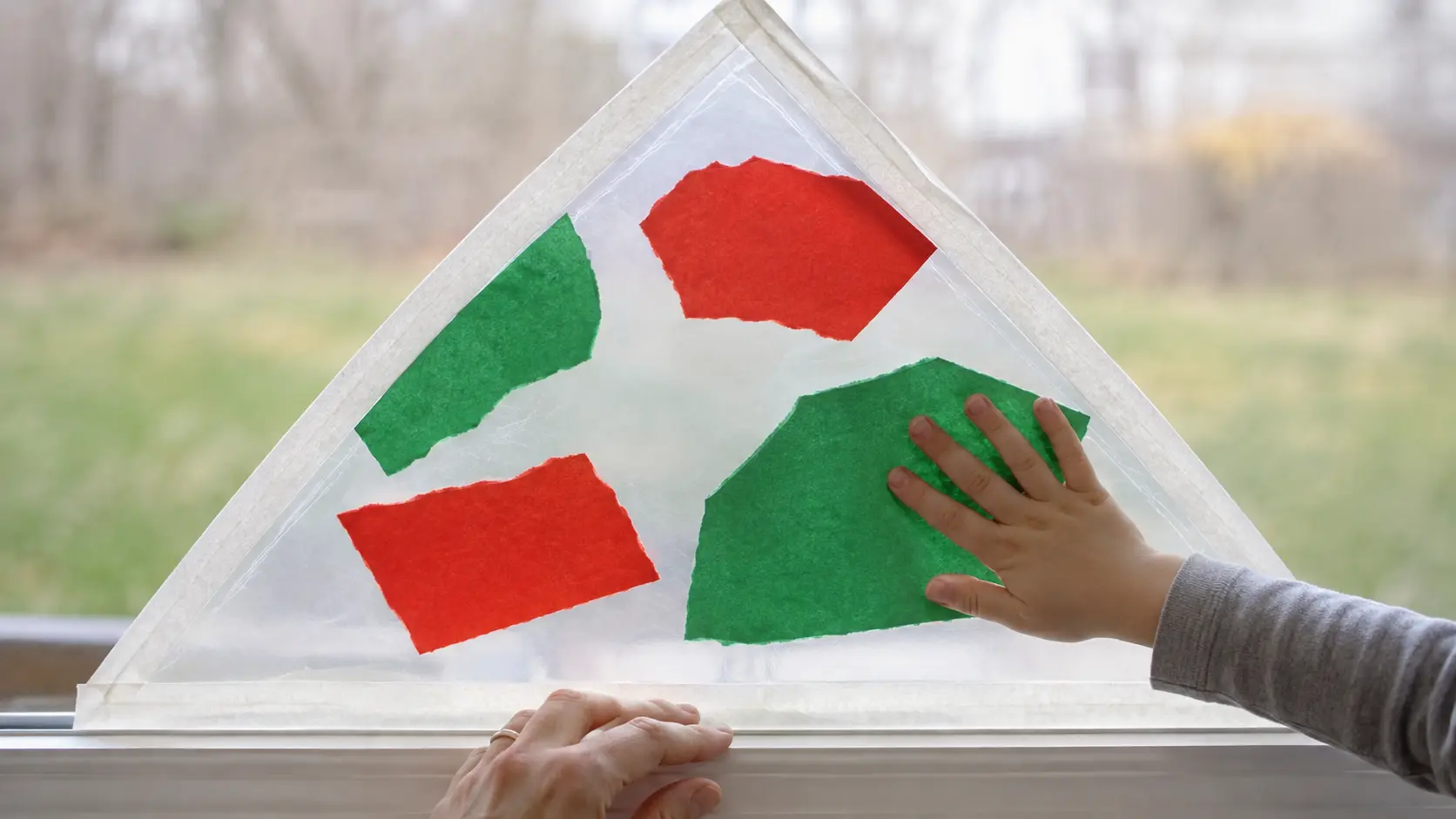
9. Sticky-paper window tree. Materials: clear self-adhesive contact paper, masking tape, green and red paper torn by the adult into pieces the size of a child's hand. Adult before: cut a triangle of contact paper, peel the backing, tape it to a low window or wall sticky side out, taping every edge so no corner lifts. Child: press the paper pieces onto the sticky triangle. Adult after: take the whole thing down when the child is done, and either leave it on the window inside a taped frame or stick it to card. Time: fifteen minutes. Mess: none. Better Kid Care suggests exactly this setup, "a large sheet of sticky paper" that is "attached to the wall sticky side out."
10. Crumpled-tissue wreath. Materials: a ring cut by the adult from the side of a cardboard box, green and red tissue paper cut into squares bigger than the child's palm, a glue stick. Adult before: rub glue over a section of the ring. Child: crumple a tissue square in a fist and press it onto the glued part. Adult: glue the next section, hand over the next square. Adult after: fill any gaps, dry, and lean it against a wall or tape it to the door. The squares are cut large so that a crumpled one is still bigger than the size rule, and any that tears small goes in the bin, not on the ring. Time: twenty minutes. Mess: low. The wreath is a flat picture leaning on a shelf, not a hanging one.
11. Three-circle snowman. Materials: blue card, white paper, a glue stick, a marker. Adult before: cut three white circles of different sizes, each bigger than the child's hand, and put a stripe of glue on the card where each one should land, or across the whole card if placement does not matter today. Child: press the circles down. Adult after: draw the face, buttons and a scarf with the marker. In a warm December the snowman is simply the shape; nobody at the table needs to have seen snow. Time: ten minutes. Mess: none.
Setting Up, Stopping and Cleaning
The adult's list before any of the projects: an old shirt over the child, the paper taped down at every corner, the paint on a plate rather than in a pot, the wet cloth and the towel within reach, and the drying spot decided before the first print. Better Kid Care advises showing children "where materials are kept, how to clip paper to an easel or tape to a table, where to place it for drying, and proper clean-up steps." At one and two, the adult does those steps and the child watches them happen.
Stopping is part of the plan. A one-year-old may press one foot and be finished. That is the project completed, not abandoned. Better Kid Care is also frank that some children "are very reluctant to get messy," and that the adult's message, in words and face, should be "that it's okay to touch, smear, and generally get messy."
What to Keep
The footprint will be kept for years. The sponge paper will wrap a present and be torn open on the day. Both deserve a photograph in daylight, flat on the table, with the small hand or foot beside the paper for scale. Our guide to photography for beginners starts with exactly that kind of plain, well-lit shot.
Keep the Footprint and the Foot
One link for the reindeer, the wreath and the photos of the small hands and feet that made them.
FAQ
What Christmas crafts can a one-year-old actually do?
One action per project: a foot or hand pressed on paper, a sponge patted, paint smeared on a tray, a crayon scribbled, a tissue square crumpled, a big piece pressed onto sticky paper. The adult does the cutting, taping, drawing and cleaning. Better Kid Care's description of this age is that "it's all about exploring the materials, not about a final piece of art!"
Is glitter safe for toddlers?
Better Kid Care lists glitter among items that "pose a safety risk and should not be accessible to children under three," alongside button batteries, magnets, plastic bags, styrofoam, coins, balloons and latex gloves. No project here uses it, and none uses sequins, beads, pompoms or googly eyes either.
How big do craft pieces need to be for a toddler?
Better Kid Care advises that for children under three, and for any child who puts things in their mouth, items should be at least 1¼ inch in diameter and between 1 and 2¼ inches long, with oval items at least 1¾ inch in diameter. Every piece in this list is cut larger than the child's palm, and anything that tears smaller is removed.
What paint is safe for a toddler's hands and feet?
Paint labelled non-toxic and washable, used a spoonful at a time on a plate. Better Kid Care says materials for one-year-olds "need to be completely non-toxic and safe in case a child swallows some." Wipe hands and feet at the table, before the child moves.
What if my toddler just wants to watch?
Then they watch. Better Kid Care's advice for this age is to "let children decide if and when they will participate; they may just want to watch."