

These Thanksgiving activities for kindergarteners are organized by subject, not by craft supply: counting and graphing, early writing, an honest version of the 1621 story, simple food science and movement. Each one lists what the children do, what the adult prepares and a rough time estimate, so a teacher or parent can build a full week before the break.
Kindergarten sits between preschool and first grade, and the activities that work at this age look different from both. The activities below give children room to practice counting past ten, putting events in order, drawing and dictating a sentence, and waiting a few minutes for a result. Many of the ideas below connect to the Common Core State Standards for kindergarten, which we quote where relevant. Your state or school may use its own version, so check your local standards before labeling any lesson.
One Link for the Whole Thanksgiving Week
A VISU Link page can hold the plan, the song list and the family resources you choose to share, reachable from one short address or a QR code on the classroom door.
Before You Start: Date, Age and Goals
In the United States, Thanksgiving falls on the fourth Thursday of November. The National Archives explains that Congress fixed that rule in 1941, after two years in which different states celebrated on different Thursdays. The federal holiday calendar published by the Office of Personnel Management lists Thanksgiving Day 2026 as Thursday, November 26. Most classrooms will run these activities in the week or two before that date.
The goal at this age is doing, not a finished object. A kindergartener who counts twelve paper feathers, argues about whether the pumpkin will float and dictates one sentence about a favorite food has had a better Thanksgiving lesson than one who glued a pre-cut turkey together. If you do want a take-home project for younger siblings or a mixed-age group, our list of preschool Thanksgiving crafts covers the make-and-take side; this guide stays with activities that practice a skill.
Three planning rules apply to every activity below:
- One skill per activity. The feather count practices counting; it is not also a cutting lesson.
- Short blocks. Times are estimates for a class of about twenty with one adult, and a single child at home will finish faster.
- Every family is included. Some children do not celebrate Thanksgiving, some have complicated family situations and some have food restrictions. Gratitude, harvest and autumn work for everyone; “draw your family dinner” does not.
Math Activities: Counting, Sorting and Graphing
Harvest themes are good math material because they come with real objects to count: leaves, paper feathers, gourds and ears of corn. The kindergarten standards ask children to “count to 100 by ones and by tens,” to “solve addition and subtraction word problems, and add and subtract within 10” and to “classify objects into given categories; count the numbers of objects in each category and sort the categories by count.” Each activity below practices one of those.
1. Make-ten turkey. Draw a turkey body on a sheet of paper with a ten-frame (two rows of five boxes) as its tail. The adult rolls a die or draws a number card from 1 to 9; the child places that many paper feathers in the frame and then works out how many more are needed to reach ten. This mirrors the standard that asks children to find “the number that makes 10 when added to the given number.” Time: about ten minutes per round, as an estimate. Adult: prepares the frame and feathers. Child: counts, adds, says the missing number aloud.
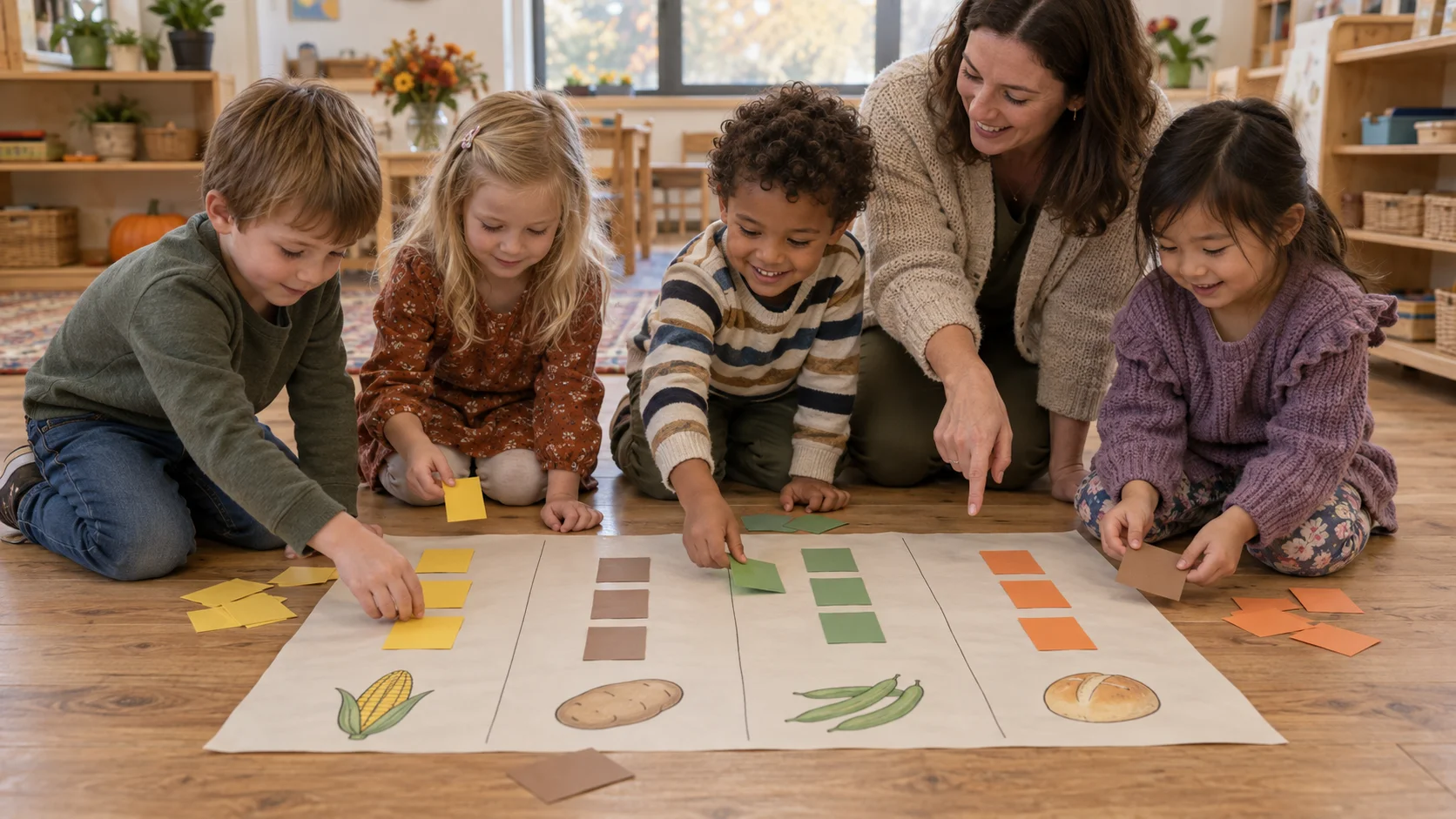
2. Class graph of favorite side dishes. Give each child one sticky note or paper square and four picture choices along the bottom of a chart: for example corn, potatoes, green beans and bread. Children place their square above their choice. Then the class counts each column, says which has the most and the fewest, and puts the columns in order. Keep the choices general so no family menu is singled out, and add a “something else” column. Time: about fifteen minutes, as an estimate.
3. Taller or shorter harvest line. Put out five or six harvest objects of clearly different sizes: a small gourd, an ear of corn, a large leaf, a pinecone too big to swallow, a squash. Children compare two objects at a time and say which is longer, taller or heavier, then line all of them up from smallest to largest. The standards describe exactly this kind of direct comparison, where children decide which object has “more of” or “less of” an attribute. Time: about ten minutes, as an estimate.
4. Countdown chain. On the first school day of November, children make a paper chain with one link for each school day left before the break and count the links each morning before removing one. A class that is working toward 100 can instead count harvest stickers on a hundreds chart, ten at a time. Time: two or three minutes a day.
Reading, Writing and Talking
Kindergarten writing standards expect children to use “a combination of drawing, dictating, and writing.” That matters for planning: a child who cannot yet write a full sentence can still produce a complete piece by drawing it and telling an adult the words. Do not turn these into copying exercises.
5. “My favorite fall food is...” page. The standard for opinion writing asks children to name a topic and “state an opinion or preference about the topic.” Each child draws one food and completes the sentence by writing, sounding out or dictating. Five-year-olds often add “because it is yummy,” which is a real reason and counts. Time: about fifteen minutes, as an estimate.
6. First, next, last. Tell or read a simple sequence about getting ready for a meal: washing hands, setting the table, eating, clearing plates. Children draw three boxes and show the steps in order, then tell a partner what happened. This matches the narrative standard, which asks children to tell events “in the order in which they occurred, and provide a reaction to what happened.” Time: about fifteen minutes, as an estimate.
7. Thankful sentence strips. Each child finishes “I am thankful for...” on a paper strip. Answers like “my dog,” “recess” or “my blue shoes” are all correct. Link the strips into a class chain or hang them on a paper tree. Time: about ten minutes, as an estimate.
8. Harvest sound sort. Lay out picture cards of harvest words (turkey, pumpkin, corn, leaf, pie, apple) and two or three letter cards. Children say each word aloud and place the picture under the letter it starts with. Time: about ten minutes, as an estimate.
Share the Plan, Keep the Children Private
Put the week's schedule, song links and the books you read on one VISU Link page for families. Keep photos of children off any public page unless every family has agreed.
Telling the 1621 Story Honestly
The popular classroom image of the “first Thanksgiving” contains more guesswork than most adults realize, and kindergarteners can handle a simpler, more accurate version. Plimoth Patuxet Museums notes that the English colonist Edward Winslow wrote the only eyewitness account that survives, a short letter from 1621. In it he describes how “their greatest king Massasoit, with some 90 men” joined the colonists, “whom for three days we entertained and feasted, and they went out and killed five deer.”
The museum also points out that this account “mentions just two foods”: venison and wildfowl. It does not say what else was eaten, so the full modern menu of pie, potatoes and sauces should not be presented as the 1621 meal. It adds that Wampanoag women “planted, weeded, hilled, tended and later harvested several types of beans, summer and winter squashes, pumpkins, melons and sunflowers.”
For kindergarteners, that becomes three plain sentences: two groups of people, the English colonists and the Wampanoag, shared a harvest meal in 1621; they ate deer and birds; the Wampanoag people knew how to grow many of the foods of that season. Add a fourth sentence that surprises many adults: the Wampanoag are not only history. The Mashpee Wampanoag Tribe describes itself as a living community with families rooted in or near the same land. Avoid paper headdresses, “Pilgrims and Indians” costumes and dress-up role play. They reduce a living people to a costume, and the eyewitness source does not describe the scene they show.
9. What do we know, how do we know? Draw two columns on chart paper. In the first, children say what they think happened at the harvest meal. The adult then reads the short list from the eyewitness letter (deer, birds, three days, many visitors), and the class moves each guess to “the letter says so” or “we are not sure.” This is an early lesson in using a source. Time: about fifteen minutes, as an estimate.
10. Harvest seed look. Show a real squash or small pumpkin, a bean pod and an ear of corn, the crops the museum names. Children look, touch and describe the outside, then the adult opens the squash so they can see the seeds. The seeds stay in the bowl and are not eaten.
Harvest Science and Simple Cooking
Food is the easiest science material in November, but it brings two rules. First, wash hands. The CDC lists “before, during, and after preparing food” and “before and after eating food” among the key times to wash hands, so build a handwashing line into every food activity. Second, check food safety for small children. The American Academy of Pediatrics lists popcorn, nuts and seeds, whole grapes, marshmallows, hard candy and raw fruit chunks such as apple pieces among foods to avoid or modify for young children, and says high-risk foods should wait until “4 years of age or older, depending on each child's development and maturity level.” Kindergarteners are usually past that line, but not all of them, so the adult decides, not the recipe. Ask families and the school about allergies before any child tastes anything.
11. Will it float? Fill a clear tub with water. Hold up a small pumpkin, an apple, an ear of corn and a gourd, one at a time. Children predict sink or float by moving a picture card to one side of a chart, then the adult places the object in the water. Record what really happens next to the prediction. Do not tell them the answer first; the gap between guess and result is the lesson. Time: about fifteen minutes, as an estimate.
12. Leaf and gourd sorting by senses. Put out leaves and gourds and ask children to sort them twice: once by color, once by how they feel (bumpy or smooth, crunchy or soft). The second sort surprises them because the groups change. Time: about ten minutes, as an estimate.
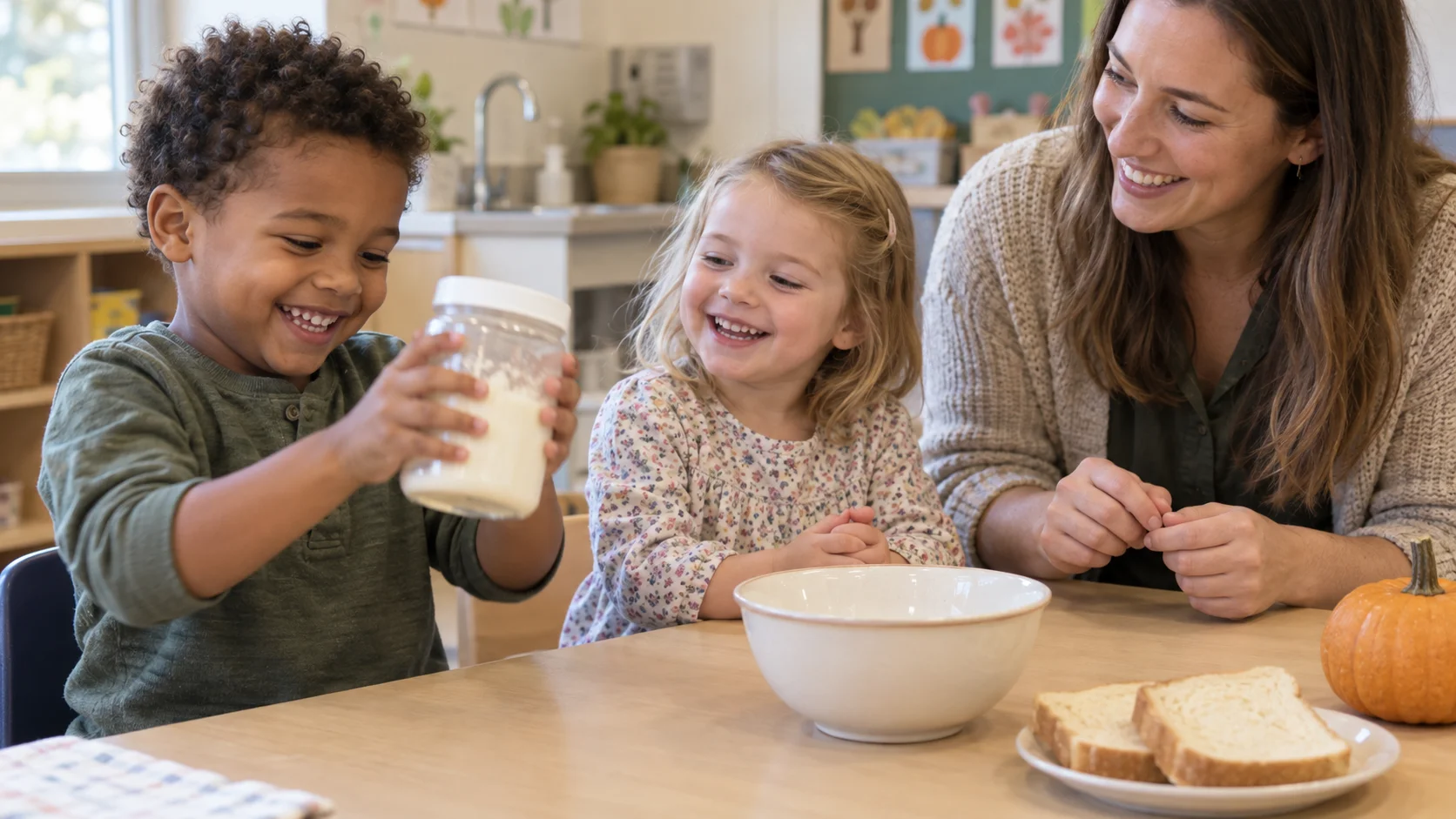
13. Shake-a-jar butter. Pour a few spoonfuls of heavy cream into small, tightly closed plastic jars, one per pair of children. Children take turns shaking and passing the jar, singing or counting to keep time, until they notice the cream thicken and then separate into a lump and liquid. Adults handle opening the jar and spreading the result. Skip this activity if any child in the group has a milk allergy, and check the school's food policy first. Time: about fifteen to twenty minutes of shaking, as an estimate, and it varies with the cream and the temperature.
Movement and a Gratitude Circle
By the last days before a holiday, kindergarteners have energy to spend. Two activities give that energy a shape without turning into a race.
14. Harvest freeze dance. Play music and call out a harvest movement: waddle like a turkey, fall slowly like a leaf, roll like a pumpkin, stand tall like corn. When the music stops, everyone freezes in that shape. No one is out; the fun is in the freezing. Time: about ten minutes.
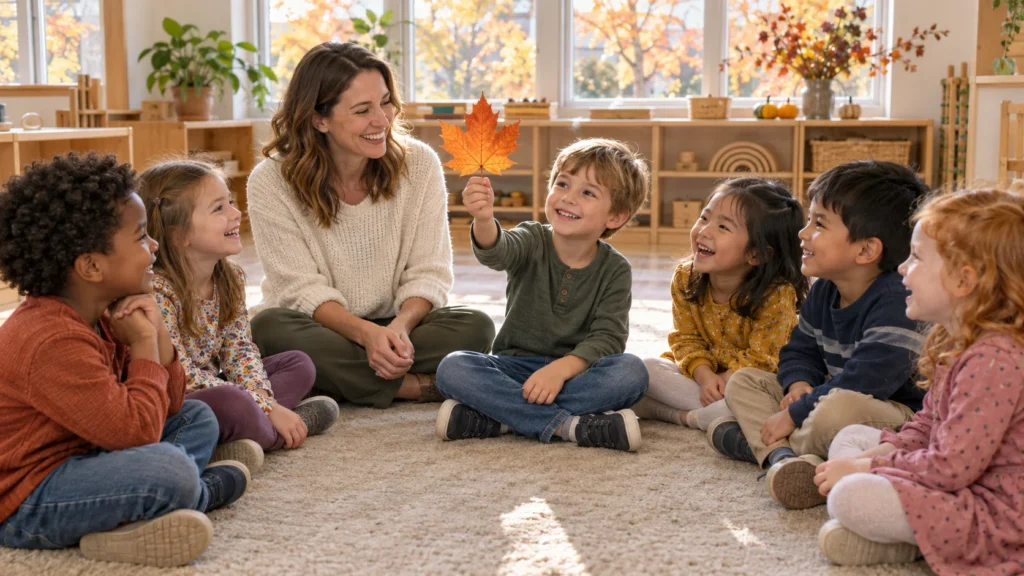
15. Pass-the-leaf gratitude circle. Sit in a circle with one large paper or real leaf. Whoever holds the leaf says one thing they are thankful for, then passes it on. Children may pass without speaking. End with the class repeating a few answers back, which builds listening as well as speaking. Time: about ten minutes for a class of twenty.
For the holiday itself, families looking for something to do with mixed ages around the table can pick from our Thanksgiving games with full rules, which includes games made for children.
A Five-Day Thanksgiving Plan
If you want a ready order, this example spreads the fifteen activities over one school week. Move days around to fit your schedule and any early dismissal before the break.
| Day | Main focus | Activities |
|---|---|---|
| Monday | Counting and graphing | Make-ten turkey, class side-dish graph, countdown chain |
| Tuesday | Writing and sounds | Favorite food page, harvest sound sort, thankful strips |
| Wednesday | The 1621 story | What do we know chart, harvest seed look, taller or shorter line |
| Thursday | Science and senses | Will it float, sorting by senses, first next last |
| Friday | Cooking and community | Shake-a-jar butter, freeze dance, gratitude circle |
At home, one activity a day is plenty. A parent can run the make-ten turkey at the kitchen table, the will-it-float test in the sink and the gratitude circle at dinner with no extra materials. Keep the finished pages in a folder rather than on the fridge, and let the child choose one to show relatives on the holiday.
Give Families One Place to Look
A VISU Link page at visu.to/<username> can collect the resources, reading list and schedule links you want families to find, all behind a single address.
Frequently Asked Questions
When is Thanksgiving in 2026?
In the United States, Thanksgiving Day 2026 is Thursday, November 26, according to the federal holiday calendar published by the Office of Personnel Management. The holiday is always the fourth Thursday of November.
What are good Thanksgiving activities for kindergarteners?
Activities that practice one skill work best: a make-ten turkey for counting, a class graph of favorite foods, a drawn and dictated opinion page, a sink-or-float test with harvest foods and a gratitude circle.
How do I explain the first Thanksgiving to kindergarteners?
Keep to what the only eyewitness account supports: English colonists and Wampanoag people shared a three-day harvest meal in 1621 with deer and wildfowl. Mention that Wampanoag people still live there today and skip costumes and headdresses.
Are food activities safe for kindergarten?
They can be with limits. Wash hands before and after, check allergies with families and the school, and follow the American Academy of Pediatrics list of choking-risk foods, letting an adult decide for each child.
Do these activities connect to kindergarten standards?
Several map to Common Core kindergarten standards for counting, adding within 10, sorting by category and writing by drawing, dictating and writing. Check your own state's standards before labeling a lesson.
Can I do these Thanksgiving activities at home?
Yes. The counting turkey, the float test, the favorite food page and the gratitude circle need only paper, water and a few harvest foods, and one activity a day is enough for a single child.
References
- National Archives: Congress Establishes Thanksgiving
- U.S. Office of Personnel Management: Federal Holidays
- Plimoth Patuxet Museums: Eye-Witness Account of the 1621 Harvest Celebration
- Plimoth Patuxet Museums: What Did They Eat at the 1621 Harvest Celebration?
- Mashpee Wampanoag Tribe
- Common Core: Kindergarten Counting and Cardinality
- Common Core: Kindergarten Operations and Algebraic Thinking
- Common Core: Kindergarten Measurement and Data
- Common Core: Kindergarten Writing
- American Academy of Pediatrics: Choking Prevention
- CDC: About Handwashing