

A full house, an oven that will not be rushed, and a room that holds three generations at once. These are games with a setup, a turn, an ending and a winner, sorted by the moment of the day they fit: while the food cooks, at the table, after dinner, and a few made for the children.
Nothing below needs anything you would have to buy. Paper, a pen, a bowl, some dried beans, napkins and paper cups cover all of it, and several need nothing at all. Group sizes and running times are design estimates, so treat them as a starting point rather than a measurement.
One Link for the Whole Day
A short address you control, holding the plan, the photos and the rules your family settled on, ready to share with everyone who was there.
Pick by Moment
The day has a shape. Early on, the cook is busy and everyone else is in the way. At the table, people are seated and cannot move around. After dinner, nobody wants to stand up. The game has to match the moment, not the other way round.
| Moment | What it needs | Start with |
|---|---|---|
| Food in the oven, people arriving | Joinable at any point, no attention from the cook | Serving Time Sweepstake |
| Seated, plates full | No standing, no equipment beyond paper | Three Word Toast |
| After dinner, sofa and floor | Mixed ages, short rounds | Paper Telephone |
| Children restless, adults still talking | Runs with one adult supervising | Feather Letters |
| Grandparents and small children together | No speed, no reading required | Museum Guard |
One rule for every game here: say the ending out loud before the first turn. A game with no agreed end does not finish, it just fades out while someone clears the plates.
While the Food Is in the Oven
These three run in the background. They need one minute to set up, they can be joined by whoever walks in the door, and none of them asks the cook to stop what they are doing.
1. Serving Time Sweepstake. Put a bowl, a stack of paper slips and a pen near the door. Every person who arrives writes their name and the exact time they think the main course will actually land on the table, then folds the slip into the bowl. Nobody may change a slip once it is in. When the first serving dish touches the table, the host reads every slip aloud. The closest guess wins; if two guesses are equally close, the earlier time wins, because optimism should be rewarded once a year. Players: everyone, any number. Needs: paper, pen, bowl. Runs: the whole afternoon, with thirty seconds of attention per person. Why it works: it turns the question everyone asks the cook into something with a payoff.
2. Smell Test. The cook, or whoever is already in the kitchen, puts six things from the meal into six cups and covers each with a folded napkin: a piece of orange peel, a pinch of cinnamon, a sprig of rosemary, ground coffee, a splash of vinegar, a spoon of cranberry sauce. Only cold or room temperature items, nothing hot and nothing sharp. One at a time, each guesser lifts the napkin edge without looking, sniffs, and writes a guess. One point per correct cup. If two players tie, the host produces a seventh cup for sudden death. Players: two to eight, one guessing at a time. Needs: six cups, six napkins, paper. Runs: ten minutes. Why it works: the covered cup means nobody has to close their eyes, so the rule enforces itself.
3. The Bean Tax. Before anyone arrives, agree three words the day will make everyone want to say. Turkey, hungry and when are the classic set. Every person gets five dried beans when they walk in. If you hear someone say a banned word, you say "tax" and they hand you one bean. If you accuse someone who did not say it, you pay them a bean instead. The game ends when the food is served; whoever holds the most beans wins. Players: everyone, any number, works from about six upward. Needs: a handful of dried beans or coins. Runs: until dinner. Why it works: the false accusation penalty stops the game becoming a shouting match, and it gives children a legitimate reason to listen to adult conversation.
At the Table
The constraint here is fixed: people are seated, hands are busy, and the game has to fit between courses without stopping the meal.
4. Whose Thanks Is This. Before dessert, pass out one slip of paper per person. Everyone writes one thing they are thankful for this year, specific enough to be a clue but without their name, and drops it in a bowl. The host shuffles and reads one slip aloud. Going around the table, each person names who they think wrote it. Then the writer reveals themselves. The writer scores one point for every wrong guess; each correct guesser scores one point. Read all the slips, then total. Players: four to twelve. Needs: paper, pen, bowl. Runs: fifteen minutes. Why it works: the scoring rewards a thanks that is true but not obvious, so people write something better than the first thing that comes to mind.
5. Table Detective. The host sets the table, then makes exactly one deliberate change that a guest could notice from their seat: a fork on the wrong side at one setting, a candle moved to the far end, one glass turned upside down, a chair from another room. Guests are told there is one change but not what it is. Anyone may accuse once per course; a right accusation wins, a wrong one costs that player their remaining accusations. If nobody has spotted it by dessert, the host wins. Players: everyone at the table. Needs: nothing extra. Runs: the length of the meal, in the background. Why it works: the one-accusation-per-course rule stops guessing at random, and it gives the person who set the table a stake in the game.
6. First Empty Dish. As the serving dishes go down, each guest names aloud which one will be empty first. Two people may not pick the same dish; the person seated nearest the kitchen picks first. The first dish to be completely empty settles it. Scraping a dish empty on purpose disqualifies the person who did it. Players: everyone at the table, up to the number of dishes. Needs: nothing. Runs: the main course. Why it works: the no-scraping rule is the whole game, because without it the meal turns into a race.
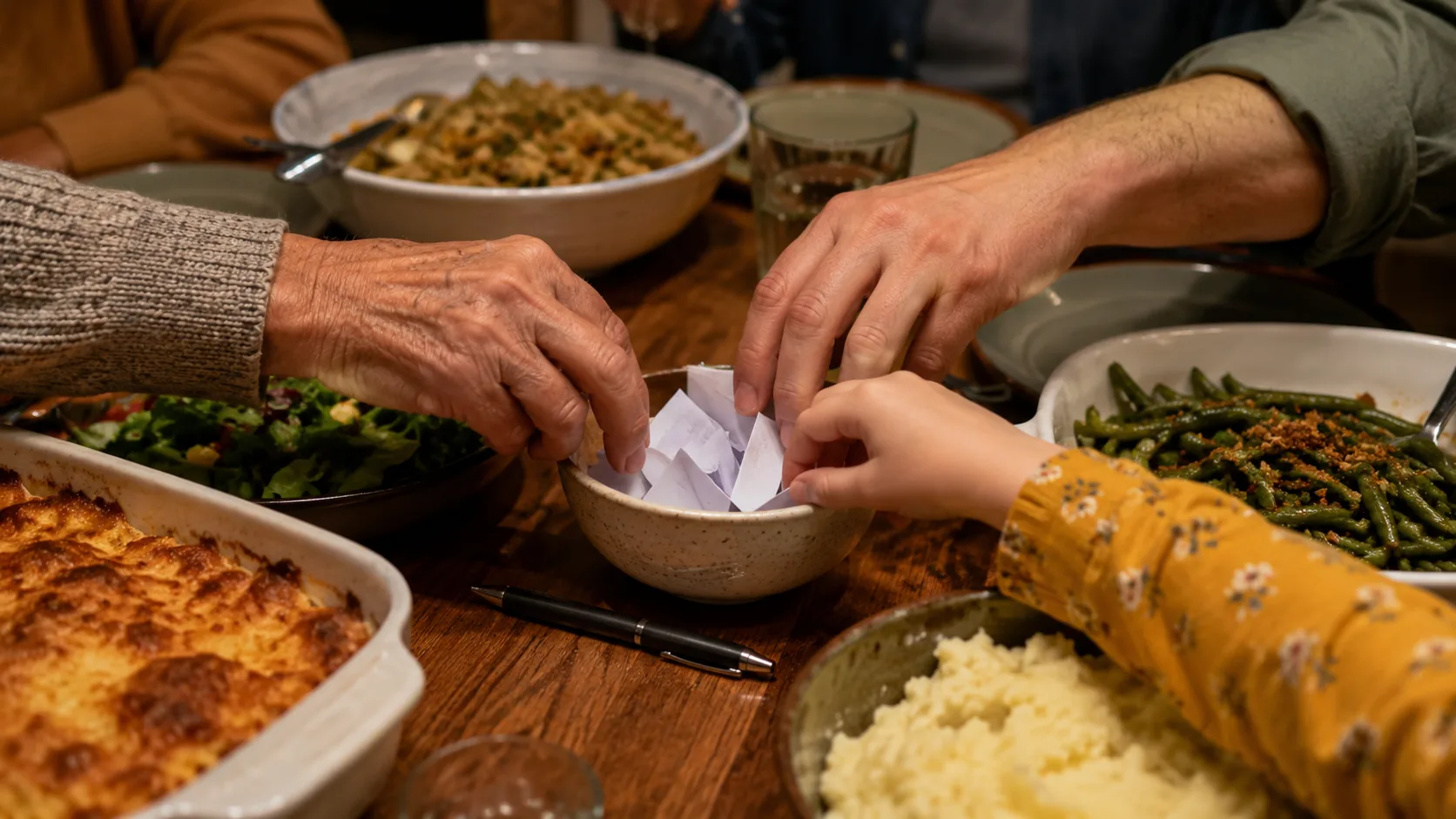
7. Three Word Toast. Going around the table, each person raises a glass and gives a toast of exactly three words. The next toast must reuse one word from the toast before it, and may not repeat any toast already given in full. A toast with two or four words, or one with no shared word, is out. Continue around until one person remains, or until three full circuits are done, in which case the whole table wins together. Players: four to twelve. Needs: nothing. Runs: five minutes. Why it works: three words is short enough that nobody has to perform, and the shared-word rule forces each toast to answer the last one.
Keep the Slips
Photograph the thanks slips and the winning sweepstake guess, and keep them behind a single address you can share with everyone who sat at the table.
After Dinner, the Whole Room
Nobody wants to stand up, and the room now includes people who are eight and people who are eighty. These four are played from the sofa and the floor, with paper and whatever is left on the table.
8. Family Timeline. Each person writes one event from the family's shared past on a slip: the year the dog got out, the move, a wedding, the storm that took the fence. No dates on the slip. Shuffle and deal the slips out face up. As a group, without the writers helping, arrange all the slips in order from oldest to most recent. When the group commits to an order, the writers reveal the real years. Score one point for every slip in the correct position. Play again to beat the score. Players: four to fifteen. Needs: paper, pen. Runs: fifteen minutes. Why it works: the people who remember the event are the ones who cannot speak, which reverses who is usually in charge.
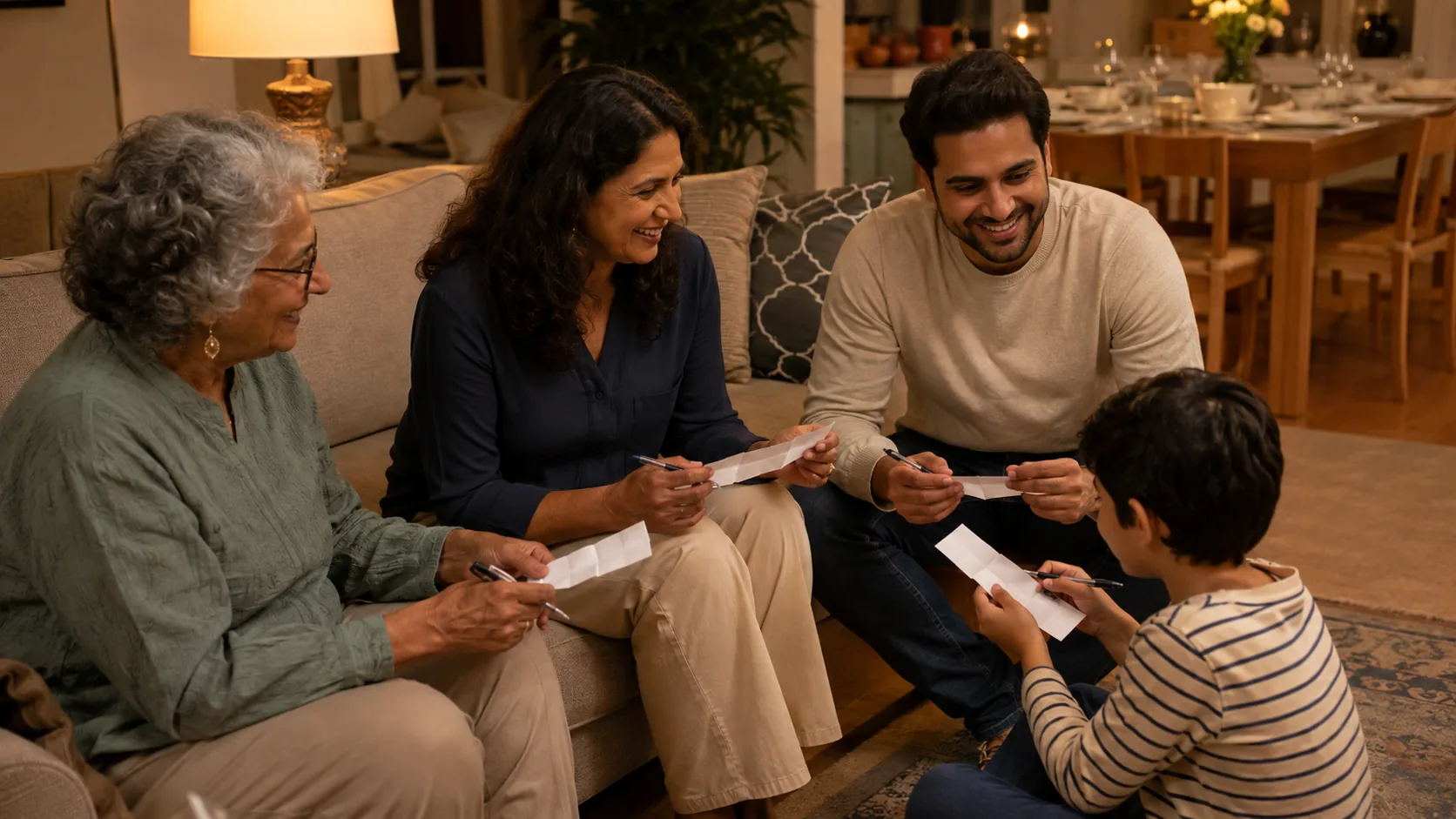
9. Paper Telephone. Everyone gets a strip of paper and writes a short sentence at the top, then passes it to the left. The receiver draws the sentence below it, folds the sentence out of sight so only the drawing shows, and passes again. The next person writes a sentence describing the drawing, folds the drawing away, and passes. Alternate writing and drawing until each strip comes back to its owner, then unfold and read every strip aloud from the top. Players: five to ten. An odd number of players makes every strip end on a sentence; with an even number, the owner writes one last sentence for the final drawing before unfolding. Needs: paper, one pen per person. Runs: fifteen minutes. Why it works: nobody is judged on drawing ability, because a bad drawing makes the final reading better.
10. One Minute Museum. Everyone has sixty seconds to fetch one object from the house and bring it back to the room. In turn, each person holds up their object and gives a twenty-second museum guide talk about it containing exactly two facts: one true, one invented. The room votes on which fact is invented. The speaker scores a point for every wrong vote; every correct voter scores one. Objects go back where they came from before the next round. Players: four to twelve. Needs: nothing beyond what the house already holds. Runs: one minute per speaker. Why it works: a household object comes with a real history somebody in the room knows, which makes the invented fact harder to hide.
11. Ten Second Tower. Split into teams of two or three. Each team gets the same pile: ten paper napkins and six paper cups. Three minutes to build the tallest freestanding structure. When time is called, hands off, and the host counts ten seconds out loud. Any tower still standing at ten is measured against the others; a tower that falls during the count scores nothing. Tallest survivor wins. Players: four to twelve, in teams. Needs: paper napkins, paper cups. Runs: five minutes per round. Why it works: the ten-second count punishes the tallest wobbly tower, so teams have to choose between height and stability.
Made for the Children
These need one adult to run them and nothing that a small child could put in their mouth: paper, paper cups, and their own bodies. They also work as a way to give the children a job while the adults are still at the table.
12. Feather Letters. Before dinner, cut eight feathers out of paper and write one letter on each so that together they spell a word tied to the meal, such as PIE TIME or PUMPKIN. Hide the feathers around one room, at child height. On the word go, the children search. Each feather found is brought back to the adult and laid on the table. When all eight are back, the children work out the word together. If there is more than one child, the finder of the most feathers gets to say the word aloud first. Players: one to six children. Needs: paper, scissors used by an adult, a pen. Runs: ten minutes. Why it works: the word can only be solved once every feather is back, so a child who found none still has a part at the end.
13. Museum Guard. The children are statues in a museum and choose a pose: a dish from dinner, an animal, a famous painting. One person, adult or child, is the guard. The guard walks the museum and may do anything to make a statue move or laugh except touch it or make a sound louder than talking. A statue that moves or laughs becomes a second guard. The last statue standing is the new guard for the next round. Players: three to ten. Needs: nothing. Runs: five minutes per round. Why it works: the no-touching rule keeps it calm enough for a room full of plates, and the eliminated player joins the guards, so nobody is left sitting out.
14. Cup Pyramid Countdown. Each child gets six paper cups. On go, the adult counts down from twenty aloud. The child must build a pyramid of three, two and one, then take it down into a single stack, before the count reaches zero. Anyone who finishes in time earns a point; if everyone finishes, the count drops to fifteen for the next round, then ten. The last child to beat the count at the lowest number wins. Players: one to six. Needs: six paper cups per child. Runs: five minutes. Why it works: the shrinking count makes each round a new challenge without changing the rule.
Running Games Across Three Generations
Explain the rule once, in under thirty seconds, and start. If it takes longer than that to explain, simplify the rule before the first turn. Fix the details during round one.
Never let a game depend on speed or reading. Where a game above has a timed element, the timer applies to the whole group, not to a single person's turn. Museum Guard, Family Timeline and Whose Thanks Is This need no reading from the youngest player, because an adult can read the slips aloud.
Give the slow elimination games to small numbers only. Three Word Toast and Museum Guard knock players out, but a round lasts minutes and the eliminated player has a job: watching for mistakes, or guarding. In a room of fifteen, prefer Family Timeline or Ten Second Tower, where everyone plays at the same time.
Put the host in the game, not above it. Table Detective and Serving Time Sweepstake are built so that the person who cooked has a stake without having to stop cooking.
Take one photo of the table before the first serving spoon goes in. It is the only moment the whole spread is intact, and it is the picture people ask for afterwards. If you want it to look like the table and not like a snapshot of a plate, the basics are in our guide to photography for beginners.
Stop while it is still working. The right moment to change games is one round before people tire of it, not two rounds after. Three games of ten minutes beat one game stretched to forty.
FAQ
What games can you play at Thanksgiving with no preparation?
Three Word Toast, First Empty Dish, Museum Guard and One Minute Museum need nothing at all. Table Detective needs one deliberate change by whoever sets the table. Everything else needs paper and a pen.
Which games work for both kids and adults?
Paper Telephone, Family Timeline, Ten Second Tower and The Bean Tax are played by the whole room with the same rule for every age. The three games in the children's section are built to run with one adult and no reading.
What can we play while sitting at the table?
Whose Thanks Is This, Table Detective, First Empty Dish and Three Word Toast are all played seated, between courses, with nothing more than a pen and a bowl passed around.
Is there a gratitude game that is not just going around saying what you are thankful for?
Whose Thanks Is This turns it into a guessing game with points: everyone writes one anonymous thanks, the host reads them, and the table guesses who wrote each. The writer scores for every wrong guess.
How long should each game last?
The running times above are estimates from the design of each game, not measurements. As a rule, plan for ten to fifteen minutes and stop while people still want another round.
When is Thanksgiving?
In the United States it falls on the fourth Thursday of November. According to the National Archives, Lincoln's 1863 proclamation fixed it on the last Thursday of November, and a joint resolution signed in December 1941 established the fourth Thursday as the federal holiday.
What if someone does not want to play?
Let them watch. Serving Time Sweepstake and Table Detective run in the background without asking anyone to take a turn, and both are easy to join late.
References
- U.S. National Archives, Center for Legislative Archives: Congress Establishes Thanksgiving. The 1863 proclamation and the 1941 joint resolution fixing the fourth Thursday of November.
The rules of the fourteen games are original to this article, or open variations of folk mechanics, and are meant to be verified by playing them.
Keep the Day in One Link
The photos, the winning guesses and the rules your family changed, all behind a single address you can share.