


Friendsgiving is a potluck with friends, not a family dinner with a smaller guest list. These twelve games are built for that: adults who bring the food, friends who may not know each other yet and a host who also wants to sit down and eat. Each one has a setup, a turn, an ending and a winner, and none of them needs alcohol or anything you would have to buy.
Put the Friendsgiving Plan in One Place
A VISU Link page can hold the address, the map and your links to an external potluck sign-up sheet or shared playlist, all behind one short link.
What Makes a Friendsgiving Game Different
Dictionary.com defines Friendsgiving as a gathering of friends to celebrate Thanksgiving with a feast, held on or near Thanksgiving Day, in contrast to the traditional family celebration. It also notes that these gatherings are often held on other days near the holiday, especially the day or night before. Thanksgiving itself has been fixed by federal law on the fourth Thursday of November since 1941, which puts it on November 26 in 2026.
That shape changes what a good game looks like. At a family Thanksgiving, the room already shares a history, the cook runs the kitchen and the children need something to do. At Friendsgiving, three things are usually different:
- Everyone brought something. The dishes are the natural material for games, and people like to see their contribution noticed.
- Not everyone knows each other. A roommate brings a coworker, a partner brings an old college friend. The first hour needs games that create conversation without putting anyone on the spot.
- The host is also a guest. Nobody wants to spend the evening refereeing. The best games explain themselves in thirty seconds and run without a leader.
If your gathering is a mixed family table with grandparents and small children, our guide to Thanksgiving games for a full house is the better fit. The games below assume a room of adults and a table full of potluck dishes.
Games Built Around the Potluck
These four use the food itself. They need paper, a pen and a bowl, and they reward the people who cooked.
Before serving, every cook should display the full ingredient list and flag allergens for their dish. Guests with food allergies should check ingredients and possible cross-contact directly with the cook before choosing food. Nobody has to taste a dish to join these games; use the ingredient card, presentation or description instead.
1. Whose Dish Is It?
Allergy questions take priority over the guessing game: before anyone chooses a serving, the host privately identifies the cook to any guest who needs to ask about ingredients or cross-contact. That guest may skip guessing that dish.
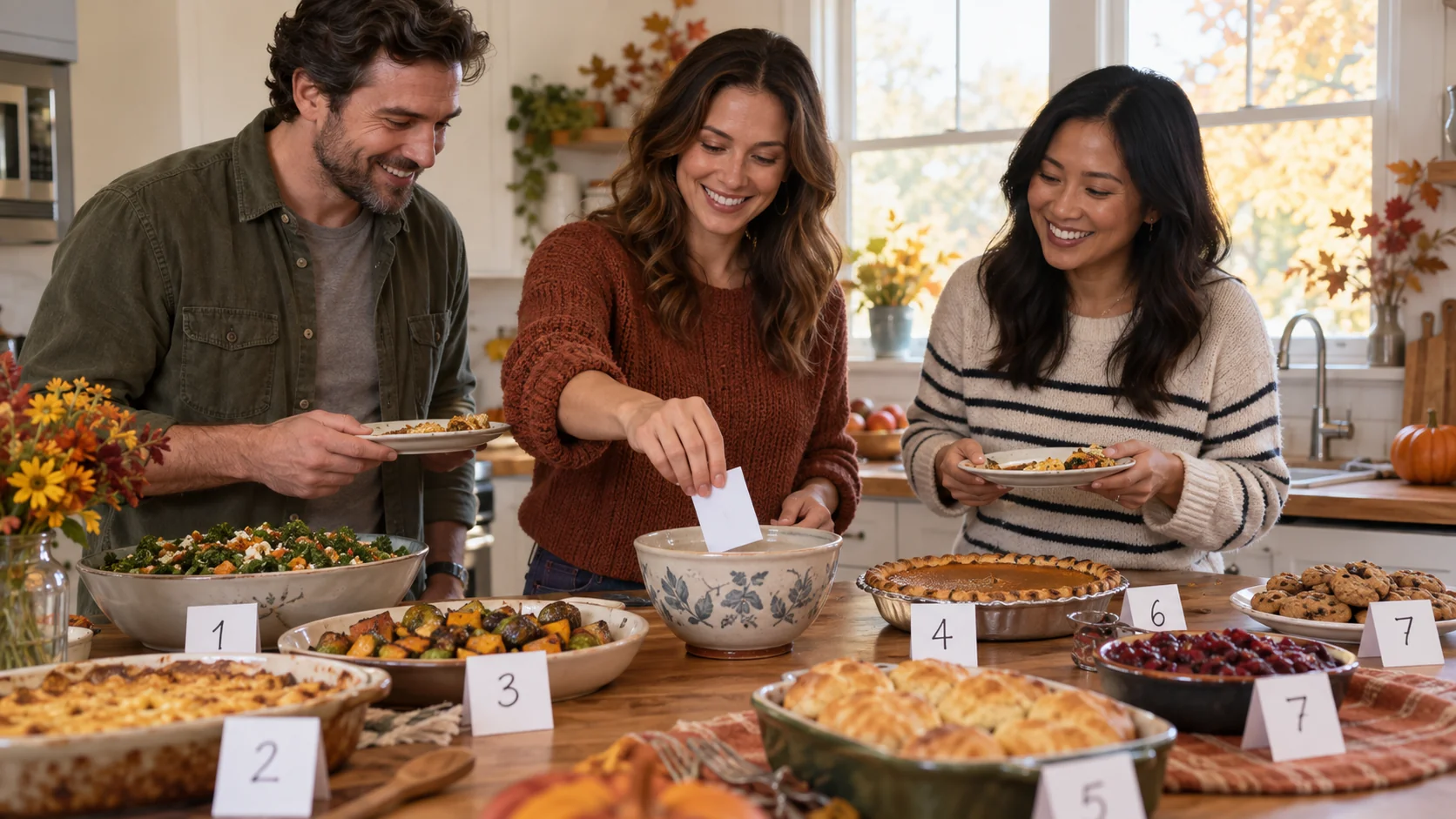
As each guest arrives, the host takes their dish, gives it a number on a folded card and sets it on the table without saying who made it. The cook writes their name and dish number on a slip and hands it privately to the host. Once everything is out, each guest gets a ballot listing the dish numbers and writes who they think made each one. Guests skip their own dish. When plates are full, the host reads the answers. One point per correct match; the cook whose dish fooled the most people wins a separate prize for best disguise.
Players: six to twenty. Needs: numbered cards, ballots, pens. Runs: through the first plate. Why it works: people talk about the food while they eat it, and the dish that nobody could place starts a conversation.
2. Potluck Awards
Before dinner, the host writes five award categories on a sheet by the door: Best Side, Most Unexpected, Best Comfort Food, Most Likely to Be Requested Again and Best Presentation. After everyone has eaten, each guest gets one secret vote per category and may not vote for their own dish. The host counts at dessert and announces the winners with as much ceremony as the room can stand.
Players: any number. Needs: paper ballots, a bowl. Runs: ten minutes to count. Why it works: five categories means several people win something, and "most unexpected" gives the adventurous cook a route to a prize.
3. The Secret Ingredient
Each cook displays the full ingredient list before serving, then secretly chooses one ingredient from that public list as the game answer and writes it on a folded card. During the meal, guests guess which listed ingredient the cook chose; they can use the dish description or appearance without tasting it. At dessert, the cards are turned over. Each correct guess scores one point for the guesser, and every cook whose chosen ingredient nobody guessed scores two. Keep every ingredient and allergen visible throughout the game.
Players: four to twenty. Needs: cards, pens. Runs: the length of the meal. Why it works: it slows people down and makes them notice what they are eating, which is the compliment every potluck cook wants.
4. The Leftover Draft
Ask guests in advance to bring an empty container. When the meal winds down, everyone draws a number from the bowl. In number order, each person picks one dish to take a portion from, then the order reverses for the second round, so the person who picked last in round one picks first in round two. A cook may not pick their own dish in the first round. The game ends when every container is filled or the dishes are empty.
Players: any number. Needs: numbered slips, containers. Runs: ten minutes. Why it works: it clears the table fast, and it settles the eternal question of who gets the last of the good stuffing. Run it early rather than late. The FDA advises refrigerating perishables within two hours of cooking, or within one hour when it is above 90 °F, so the draft should happen while the food is still inside that window.
Icebreakers for Friends of Friends
These three solve the specific Friendsgiving problem: half the room knows each other well, and the other half knows one person. None of them asks anyone to perform alone.
5. Connection Hunt
Pair up guests who have not met, ideally by drawing names. Each pair has five minutes to find three things they share that are not visible from across the room: the same hometown, the same worst job, the same childhood pet name. Obvious answers such as "we both like food" do not count. Each pair reports its best connection to the room, and the group votes on the most surprising one.
Players: six or more, in pairs. Needs: nothing. Runs: ten minutes. Why it works: it gives strangers a reason to ask real questions and gives the room a handful of stories to return to later.
6. Friendsgiving Bingo
When you send the invitation, ask each guest one question: tell me one true thing about you that most people here would not know. The host builds a simple bingo grid from the answers, without names, one fact per square. Guests mingle and find the person who matches each square, writing the name in. Each person may sign only one square on any single card, so you have to talk to many people. First complete row wins; the game keeps going for anyone who wants a full card.
Players: eight to thirty. Needs: printed or handwritten grids, pens. Runs: the first forty minutes, in the background. Why it works: it is mingling with a purpose, and the facts come from the guests themselves, so nothing feels generic.
7. The Dish That Describes You
Everyone writes, anonymously, which dish on the table best describes them and one sentence explaining why. The host reads each card aloud and the room guesses the writer. A correct guess scores one point for the guesser; the writer scores one point for each wrong guess. The best explanation, voted at the end, earns a bonus point.
Players: five to fifteen. Needs: paper, a bowl. Runs: fifteen minutes. Why it works: self-description through food is low-stakes and funny, and people learn more about each other than a round of introductions would reveal.
Share Everything Guests Need With One Link
Keep the address, parking notes and your external sign-up form on one VISU Link page, and share it by link or QR code on the invitation.
Table Games Between Plates
Once people are seated with full plates, games have to work with hands busy and nobody standing. These three run between courses.
8. Hot Take Court
Each guest writes one food opinion they will defend on a slip: canned cranberry sauce is better than homemade, pie is overrated, stuffing should never be inside the bird. The host draws a slip and the writer argues for it in thirty seconds. Someone else volunteers to argue against it for thirty seconds. The table then votes by raising a fork. If the writer wins the vote, they score a point. Keep it to food; a rule on the card at the start of the night keeps politics off the table.
Players: five to fourteen. Needs: slips, a timer on anyone's phone. Runs: fifteen to twenty minutes. Why it works: strong opinions about harmless topics are fun to hear, and the sixty-second limit keeps any one debate short.
9. Stuffing Letters
Pick five categories that fit the evening: a side dish, a dessert, a movie, a city, something you are thankful for. Roll a die on a letter chart or simply open a book at random and take the first letter on the page. Everyone has two minutes to write one answer per category starting with that letter. Answers that nobody else wrote score two points; shared answers score one; blanks score zero. Play three letters.
Players: three to twelve. Needs: paper, pens. Runs: fifteen minutes. Why it works: it works at the table with no standing, and the reading of answers creates as much conversation as the writing.
10. Story Potluck
One person starts a story with one sentence that includes a dish on the table. The next person adds one sentence that must also mention a dish, and must not reuse a dish already used. Anyone who cannot continue within ten seconds, or reuses a dish, is out of the story but stays at the table as a judge. The last storyteller in wins, and the judges vote on whether the story earned a proper ending.
Players: four to twelve. Needs: nothing. Runs: ten minutes. Why it works: the potluck gives everyone the same limited vocabulary, which makes the story strange quickly.
After Dinner on the Couch
By now people are full and relaxed. These two carry the rest of the evening and scale to whoever is still awake.
11. Fishbowl, Friendsgiving Edition
Each person writes five nouns on separate slips: dishes from tonight, shared memories, people everyone in the room knows. All slips go into a bowl. Split into two teams. In round one, a player has one minute to get their team to guess as many slips as possible using any words except the one on the slip. In round two, the same slips go back in and clues are limited to one word. In round three, clues are mimed with no sound. Teams keep a running total across all three rounds.
Players: six to sixteen, in two teams. Needs: slips, a bowl, a timer. Runs: thirty to forty minutes. Why it works: by round three everyone knows the slips, so the jokes build on each other and even quiet guests get laughs.
12. Blind Portraits
Pair up. Each person draws their partner's face for sixty seconds without looking at the paper, keeping their eyes on their partner the whole time. Then swap. Line the portraits up on the table and everyone votes for the best likeness and the most artistic disaster. Two winners, two small prizes, usually the first pick of dessert.
Players: four or more, in pairs. Needs: paper, pens. Runs: ten minutes. Why it works: nobody can be good at it, so nobody is embarrassed, and the portraits are a better souvenir than any group photo.

Running the Night When the Host Is Also a Guest
A Friendsgiving host usually does not want to lead games all night. A few habits keep the evening moving without a referee. If the group wants more options that need nothing at all, pick from our list of games to play with friends without anything.
- Plan three games, not twelve. One background game for arrivals, one at the table and one on the couch. Keep one spare in case something falls flat.
- Prepare the paper before guests arrive. Ballots, bingo grids, slips and pens in a basket by the table. Setting up during the party is what turns the host into staff.
- Make every game opt-in. A guest who would rather watch is still part of the evening. Give them the job of timekeeper or judge.
- Keep drinking out of the rules. None of these games uses drinking as a penalty or a prize, so guests who do not drink are never left out.
- Watch the food clock. Games stretch dinner. Put perishables away within the two-hour window the FDA recommends and bring dessert out as the next dish instead of leaving everything on the table.
- Stop while it is still working. End a game at the high point and move on, rather than playing until people drift away.
Keep the Evening's Links Together
After the party, a VISU Link page can point friends to the shared photo album and the recipe links you collected, in one place you control.
Frequently Asked Questions
What is Friendsgiving?
Dictionary.com defines it as a gathering of friends to celebrate Thanksgiving with a feast, held on or near Thanksgiving Day, as opposed to the traditional family celebration. It is often a potluck where each guest brings a dish.
When do people usually hold Friendsgiving?
There is no fixed date. Dictionary.com notes that gatherings are often held near the holiday, especially the day or night before Thanksgiving, which falls on November 26 in 2026. Pick the date that works for your group.
Can Friendsgiving games work without alcohol?
Yes. Every game in this guide scores with points, votes or small prizes such as the first pick of dessert, so no one has to drink to take part or to lose a round.
What games work when guests do not know each other?
Start with Connection Hunt or Friendsgiving Bingo. Both give people a specific reason to talk one on one, and neither asks anyone to perform in front of the whole room.
How many games should a Friendsgiving host plan?
Three is usually enough: one for arrivals, one at the table and one after dinner, plus a spare. More than that tends to turn the host into a full-time organizer.
How long can potluck food sit out while we play?
The FDA advises refrigerating perishable food within two hours of cooking, or within one hour when the temperature is above 90 °F. Schedule longer games after the food has been put away.