

A Halloween party for adults does not need a drinking game to work. It needs one game long enough to become the evening, and a few short ones to fill the gaps around it. Every game below has a full rule, a way to win and a group size, and none of them depends on a drink, a bought kit or a character from a film.
The list runs from a hosted murder mystery you write yourself, through social deduction, stories with a rule, themed mime, a treasure hunt in the dark and a board game drawn on paper. Safety comes first, because most of these are played with the lights low.
One Link for the Whole Night
A short address you control, holding the role cards, the clue list and the photos from the party, ready to share with the guests afterwards.
Before You Pick a Game
This is a list for a party where everyone is an adult. That changes three things compared with a family party: the games can be longer, the rules can carry a hidden role for half an hour, and the scares can be a little sharper: a hand on a shoulder in a dark hallway, a story that ends badly, a lantern that goes out on cue. Nothing here goes further than that.
What does not change is the material: paper, pens, a few battery lanterns and things already in the house. Each entry gives the setup, the material, the full rule, the turn, the ending, the group size and roughly how long it takes. The times are design estimates, not measurements.
If children are at the party too, this list is for the hours after they have gone to bed. Everything here assumes a room of adults who have agreed to be scared a little.
Safety With the Lights Low
Half of these games are played in low light. These are the practical choices, and the ones with a source are attributed.
No flame, anywhere. The American Academy of Pediatrics' HealthyChildren.org advises: "Consider using a battery-operated flameless candle, flashlight or glow stick instead of a candle to light your jack-o'-lantern." At an adult party with people walking through dark rooms in long costumes, the same rule covers every candle in the house. Battery lanterns and LED tea lights do the same job.
Steps and thresholds stay lit. Before you lower the lights, walk the route every game uses and put an LED light at the foot of each staircase, on each step down between rooms and beside any rug edge that lifts. The scare belongs in the game, not on the stairs.
Costumes that let you see and walk. HealthyChildren.org says: "Costumes should be short enough to prevent tripping and avoid catching on objects." For the hunt and the corridor games, masks that narrow the field of view come off, and capes that trail on the floor are pinned up or removed.
Face paint gets a test. The FDA advises: "Test the makeup you plan to use at least 24-48 hours in advance," on a small area of skin, and treats redness or swelling as "a sign of a possible allergy." Ask guests to do this the day before, and keep water and a towel where makeup can be washed off quickly.
Know who is not playing. Anyone who does not want to be touched, surprised or left alone in a dark room says so before the first game, and the host makes that a rule for everyone.
A Murder Mystery You Write Yourself
The centrepiece. The frame below is generic and you fill it with your own names; it uses no characters from anywhere else.
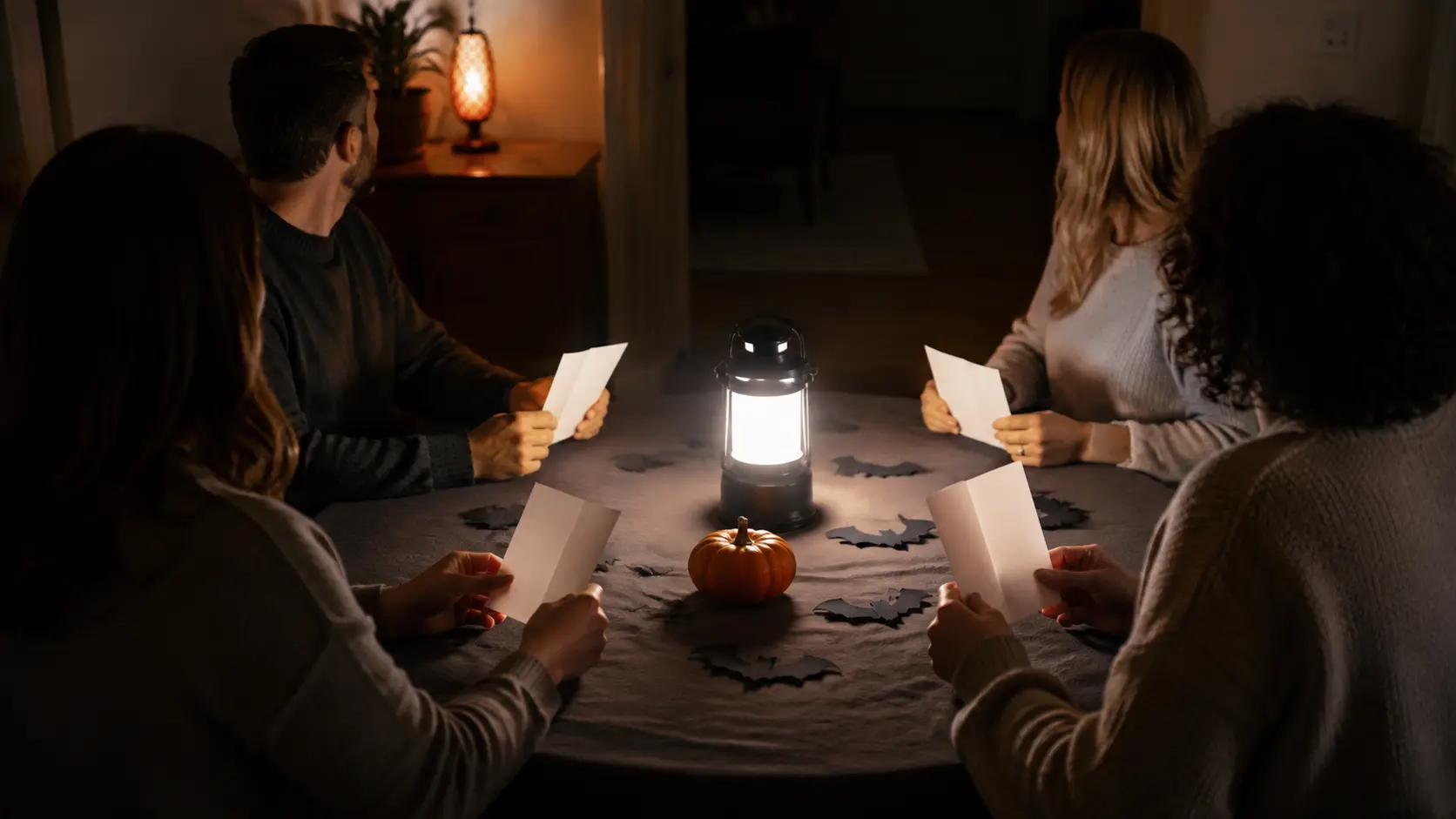
1. The Last Supper at the Old House. The story: a wealthy recluse has died at dinner in a locked house, and every guest at the table had a reason. The host does not play. Before the party, the host writes one card per guest with three things on it: a name and a role in the house (the heir, the doctor, the cook, the lawyer, the old friend, the stranger nobody invited), a secret that would look bad if it came out, and one true fact they know about another guest. One card also says "you did it" and gives the method and the room. The host also writes six clue cards, each pointing at a place in the house (under the stairs, inside the oven, behind the mirror) and hides them there before guests arrive.
Setup: dim the main room, one LED lantern on the table, cards face down at each seat. Material: paper cards, a pen, a lantern. Players: six to twelve. Runs: about an hour.
Play: the host reads the story aloud, then everyone reads their own card silently. Three rounds of about fifteen minutes follow. In each round, players mingle; any player may ask any other one direct question per round, and the answer must be true except for the murderer, who may lie once per round. At the end of each round the host reveals the location of two clue cards, and the first player to reach and read one aloud earns it. Clues never name the murderer; they point at a method, a room or a time.
Turn: there is no fixed order inside a round; the host calls time. Ending: after round three, everyone writes one name on a slip. Slips are read aloud. If the majority names the murderer, the table wins and the murderer confesses the method. If not, the murderer stands up, reveals the card and wins alone. Secrets that never came out are read by the host at the end.
Keep the Cards You Wrote
Photograph the role cards and the wills before they get thrown out, and keep them at one link so next year's party starts from something.
Social Deduction on Paper Slips
These three run on hidden roles and voting. They need paper slips, a bowl to draw from and a room where everyone can see everyone.
2. The Coven. Slips go in a bowl: two say "witch", one says "warden", the rest say "villager". Everyone draws and keeps the slip hidden. The host calls night: all eyes close, the witches open theirs, silently agree on one villager to curse, and close again. The warden then opens their eyes and points at one player; the host nods yes or no for "witch". Day: the host names who was cursed, and that player is out and stays silent. The living discuss for three minutes and vote one player out. Repeat.
Setup: chairs in a circle. Material: slips, bowl. Players: seven to fourteen. Runs: about twenty-five minutes. Ending: villagers win when both witches are out; witches win when they equal the villagers in number.
3. The Changeling. The host writes the same Halloween word on every slip but one, which says "changeling". Everyone draws. Going round the circle, each player says one word that relates to the secret word without saying it. The changeling, who does not know the word, has to bluff a word that fits what they have heard. After two rounds everyone points at once at who they think the changeling is.
Setup: none. Material: slips. Players: five to twelve. Runs: about ten minutes per round. Ending: if the majority points at the changeling, the changeling gets one guess at the word; a correct guess steals the win. Otherwise the changeling wins outright.
4. Last Will and Testament. Each player writes, secretly, one line of a will: "I leave my collection of broken clocks to the person who never returned my ladder." The host collects and shuffles. Each will is read aloud, and the group votes on who wrote it. The writer scores a point for every wrong guess; guessers score a point for every right one.
Setup: pens at the table. Material: paper, pen. Players: four to ten. Runs: about twenty minutes. Ending: highest score after every will is read; ties are broken by a second will of one line each, read by the host, voted on by the rest.
Horror Stories With a Rule
Two ways to tell scary stories with a rule, so it does not become one person's monologue.
5. The Lantern Passes. Lights off except one battery lantern. Whoever holds the lantern tells the story. They may speak for at most a minute, counted quietly by the host, and must stop on a cliffhanger, then hand the lantern to the person on their left, who continues from that exact moment. A teller who repeats a plot point already used, or resolves the story instead of raising the stakes, hands the lantern over early and is out of the rotation.
Setup: seated circle. Material: one lantern. Players: four to twelve. Runs: about twenty minutes. Ending: after the lantern has gone round three times, the group votes on the single best minute. That teller starts the next story.
6. The Unreliable Witness. One player is the witness to something terrible that happened last night and tells it in two minutes. Then each other player asks exactly one question about a detail: what colour the door was, who else was in the house, what time the clock said. The witness must answer every question instantly. Any player who catches the witness contradicting an earlier answer calls "liar" and, if the group agrees, wins the round.
Setup: none. Material: none. Players: three to eight. Runs: about ten minutes per witness. Ending: the witness wins by surviving every question without a contradiction; the round then passes to the player on the left.
Share the Rules, Not a Screenshot
Put the clue list, the card words and the team scores at one short link, so whoever hosts next time does not start from a blank page.
Mime and Charades, Halloween Cut
The loud, standing games. They need space to move and a wall to throw a shadow on.
7. Cause of Death. Each player writes a way a ghost might have met its end on a slip: struck by a falling piano, ate the wrong mushroom, tripped over the cat. Slips go in a bowl. One at a time, a player draws a slip and mimes it in silence while the others shout guesses. Speaking, mouthing words or pointing at objects is forbidden.
Setup: a clear space. Material: slips, bowl. Players: four to fourteen, in two teams if more than eight. Runs: about twenty minutes. Ending: sixty seconds per slip; a correct guess scores a point for the guesser and a point for the mime. Highest total after the bowl is empty wins.
8. Shadow Creatures. Stand a battery lantern on the floor facing a blank wall and put the room in the dark. One player stands between the lantern and the wall and makes a creature with hands, arms, a coat or any object, and the others guess what it is: spider, bat, wolf, hunched old witch. The creature may move but not speak.
Setup: lantern on the floor, blank wall. Material: lantern, objects. Players: three to twelve. Runs: about ten minutes. Ending: each player makes one creature; the group votes for the most convincing and the funniest, and no player may win both.
9. The Forbidden Word. One player draws a card with a Halloween word on top (graveyard) and four forbidden words under it (cemetery, dead, stone, buried). They must get their team to say the top word without saying any of the five, in sixty seconds, while the other team watches the card and buzzes any slip.
Setup: cards written in advance by the host, ten to twenty. Material: cards. Players: six to twelve, two teams. Runs: about fifteen minutes. Ending: a point per word guessed; a buzz ends the turn with no point. Highest total after all cards are used wins.
Treasure Hunt in the Dark
Two games for the whole house, lights off, one torch per team. Walk the route in the light first and put an LED marker on every step.
10. Lantern Hunt. The host hides eight numbered clue cards around the house before the party. Each card holds a riddle pointing to the next hiding place and one letter. Teams of two or three get one torch and the first riddle, and set off in the dark. Teams may not move a card; they read it, note the letter and leave it. The letters, in order, spell a word.
Setup: cards hidden, route lit at steps. Material: cards, one torch per team, paper. Players: four to twelve in teams. Runs: about twenty-five minutes. Ending: the first team back in the main room that says the word aloud wins. A team that says a wrong word waits one minute before trying again.
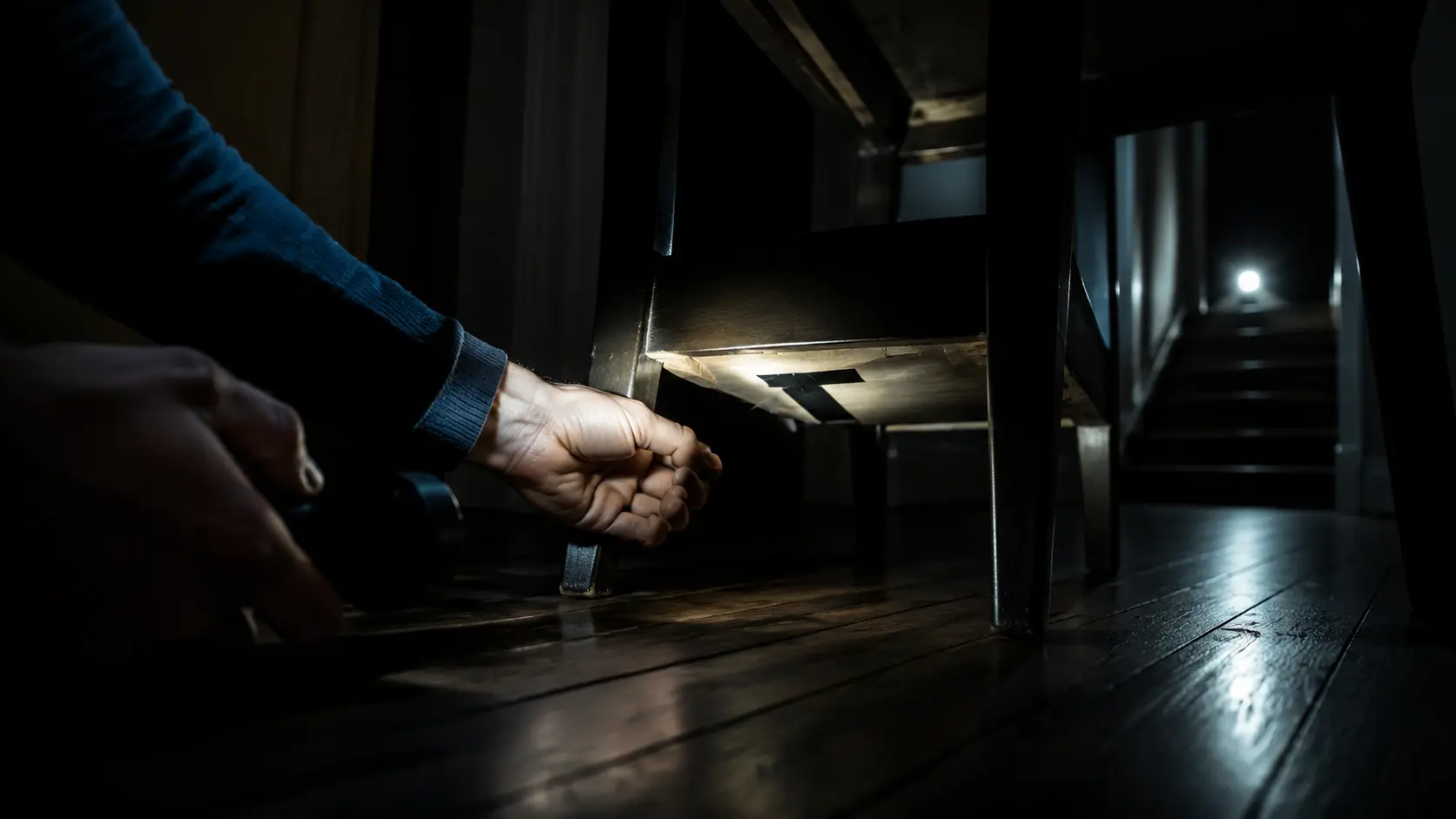
11. Grave Markers. The host cuts twenty small paper shapes in three colours: ten white, six grey, four black. Before the party they are taped in low, awkward places around two dark rooms: under a chair, behind a curtain, inside a shoe. Players enter one at a time with a torch and have ninety seconds to find and collect as many as they can. White scores one, grey scores three, black scores five, and a player who returns after the ninety seconds are up loses their whole find.
Setup: markers taped, timer with the host. Material: coloured paper, tape, one torch. Players: any number, one at a time. Runs: about two minutes per player. Ending: markers go back between players; highest score wins, ties settled by a thirty-second round.
A Board Game Drawn on Paper
One game that needs a board, drawn in five minutes on a large sheet. If drawing the board is half the fun for your group, the easy drawing ideas list has simple shapes for the rooms. Dice are replaced by six slips numbered one to six, drawn from a cup and returned.
12. The Long Corridor. Draw a track of forty squares winding across the sheet, from the door of a house to the attic. Mark eight squares as rooms and write a rule on each: "the kitchen: go back three", "the study: draw again", "the cellar: skip a turn", "the mirror: swap places with the player behind you". Each player has a coin or a button as a piece. On your turn, draw a slip, move that many, obey the room you land on.
Setup: draw the track. Material: large sheet, pen, slips, cup, one token each. Players: two to six. Runs: about twenty minutes. Ending: the first to reach the attic exactly wins; a draw that overshoots means the piece does not move.
How to Run the Night
One long game, several short ones. Put the mystery in the middle of the evening and the short games either side of it. Do not start it until every guest is there, because a late arrival has no card.
Explain in thirty seconds, then start. Read the rule, play one round that does not count, and only then keep score.
Say the ending out loud before you start. A game whose ending is known stops when it should.
The host stays out of the hidden-role games. Someone has to know who the witch is and keep a straight face, and someone has to watch the door and the stairs. Both are the host.
Photograph the setup before the guests arrive. The table with the cards, the wall of shadow creatures, the track drawn on paper: nobody takes those once the game is running. Low light is hard on a phone camera; the basics in photography for beginners cover it.
FAQ
What Halloween games can adults play without drinking?
Every game on this page. The mystery, the deduction games, the stories and the paper board game all run on hidden information, bluffing and voting; none of them uses a drink as a rule or a penalty.
How do I host a murder mystery without buying a kit?
Write one card per guest with a role, a secret and a true fact about someone else, mark one card as the murderer, hide six clue cards around the house, and run three rounds of questions ending in a vote. Game 1 above gives the full rule.
Are candles safe for a Halloween party?
HealthyChildren.org recommends a battery-operated flameless candle, flashlight or glow stick instead of a candle for a jack-o'-lantern. With dark rooms and long costumes, keeping all flame out of the house is the simplest rule.
What if a guest does not want to be scared?
Ask before the first game, and make it a rule that anyone can sit out any dark game without explaining. Give them a role: timekeeper, mime judge, or reader of the wills.
Does this work where Halloween is not a tradition?
As a themed party among friends, it works the same as any costume party. Nothing on this list depends on a tradition: it is paper decoration, low light and a game rule.
References
- American Academy of Pediatrics, HealthyChildren.org: Halloween Fun and Safety Tips. Battery-operated flameless candles instead of flame, and costumes short enough to prevent tripping.
- U.S. Food and Drug Administration: Halloween Safety, Costumes, Candy and Colored Contact Lenses. Testing makeup 24 to 48 hours in advance and what counts as a sign of a possible allergy.
Keep the Night at One Link
The cards, the clue riddles, the scores and the photos, at one short address you can hand to every guest.