

The hardest part of drawing is deciding what to draw. Skill grows with pencil mileage, and mileage only accumulates when starting is easy. This is a working list of easy drawing ideas, organized so you can open it, pick one and be sketching in under a minute.
Blank-page paralysis kills more sketchbooks than lack of talent ever has. The fix is boring and effective: keep a list of subjects simple enough that failure is cheap, draw daily-ish, and let difficulty rise on its own. Below are dozens of ideas grouped by what is in front of you, plus a way to practice that actually builds skill instead of frustration.
One Link for Everything You Make
A short address you control, pointing to your sketches wherever they live.
Why Easy Subjects Build Skill Faster
Every drawing is two skills stacked: seeing shapes accurately, and moving the pencil where you intend. Complex subjects overload both at once, which is why the dragon attempt on day two ends sketchbooks. Simple subjects isolate the skills, a mug is an ellipse and a cylinder, a leaf is one curve mirrored, and every finished simple drawing deposits confidence you will spend on harder subjects later.
Finished matters more than good. Ten completed five-minute sketches teach more than one abandoned masterpiece, because each completion closes the loop from looking to drawing to judging. Keep the loop short and run it often.
Things Already on Your Desk
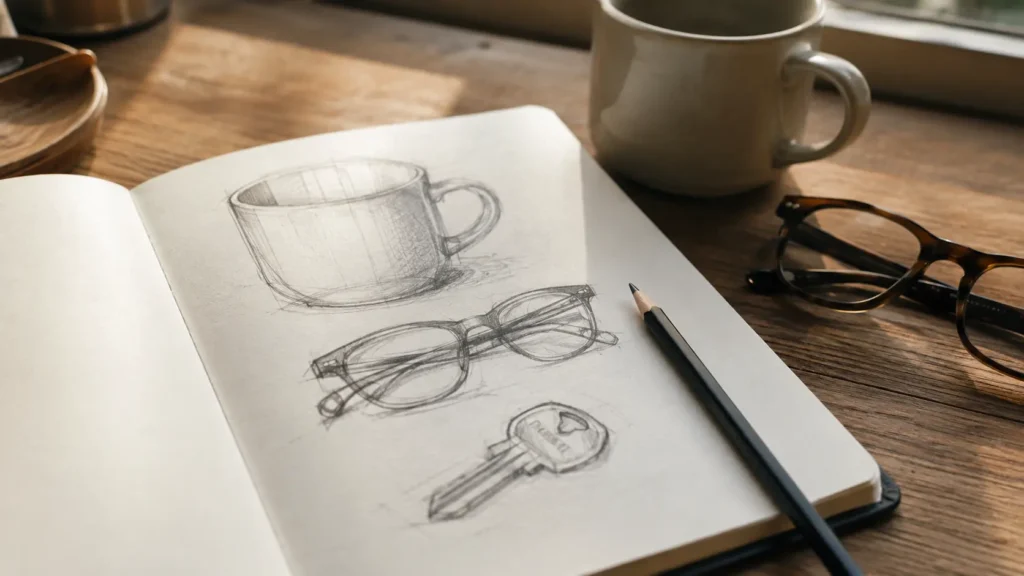
Household objects are the perfect first subjects: they hold still, they have simple geometry, and nobody judges a drawing of a mug.
- A coffee mug, from slightly above, so the ellipse of the rim shows
- Your glasses, folded on the table
- A key, enlarged four times, the teeth are a shape puzzle
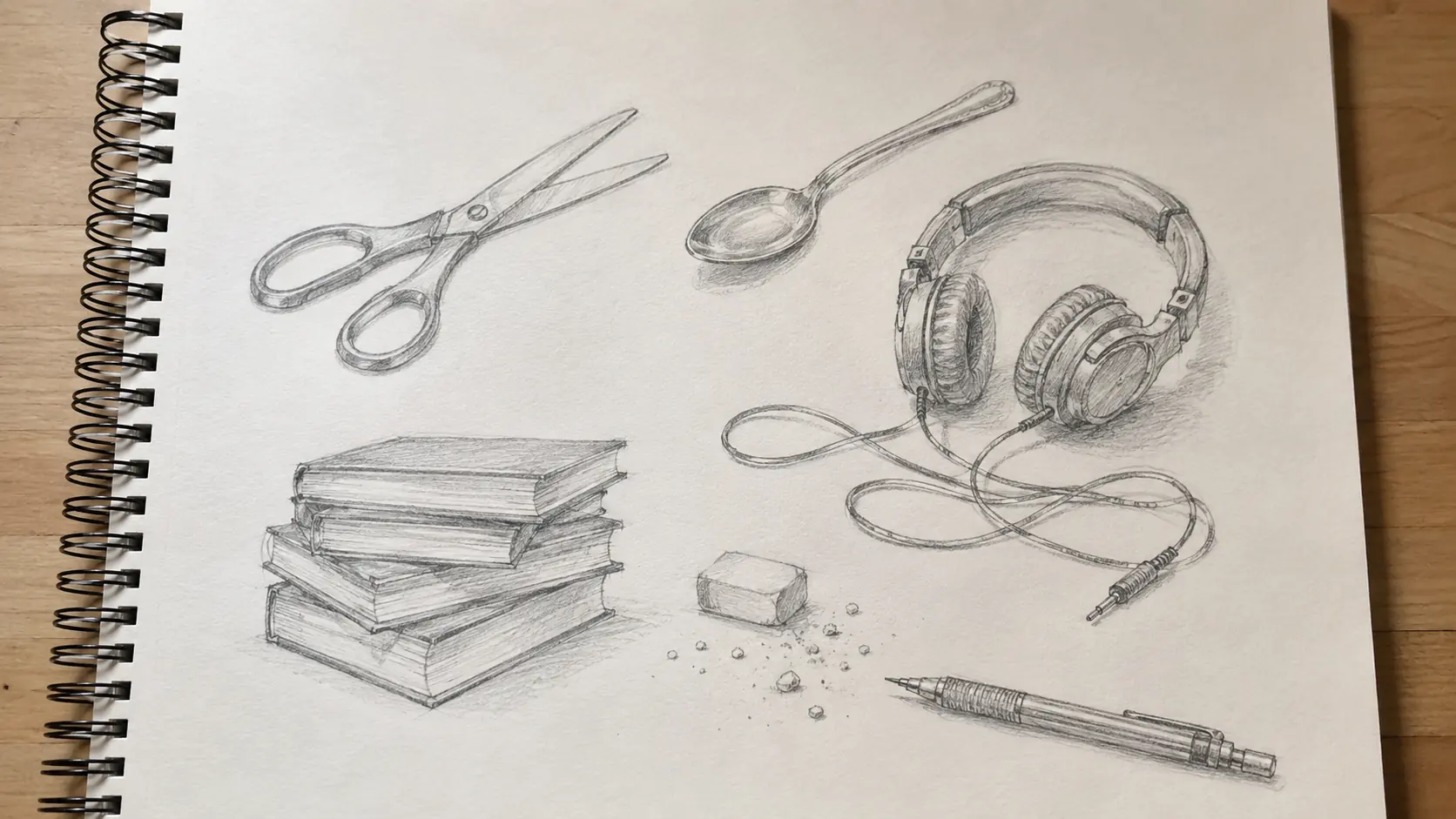
- Scissors, open and closed, two drawings, one object
- A crumpled receipt, pure practice in shadow shapes
- Headphones with the cable making loops
- A stack of three books, slightly misaligned
- The chair across the room, legs are harder than they look
- A spoon, and the warped reflection in it if you are feeling brave
- Your non-drawing hand, relaxed, the classic for a reason
Nature: Leaves Before Landscapes
Nature rewards drawing small. A whole landscape asks for composition, perspective and atmosphere at once; a single leaf asks for one contour and some veins, and teaches more per minute.
- One leaf, any leaf, then the same leaf flipped
- A feather, the spine first, then the barbs as texture
- A pinecone's overlapping scales, slow but hypnotic
- A seashell spiral, one continuous line if you can
- Clouds from your window, edges soft, bottoms flatter
- A potted plant, drawn as big simple masses before any leaf detail
- A mushroom, cap and stem, two shapes and done
- The moon tonight, with whatever shading you can manage
- A single flower head-on, then in profile
- A rock with one strong shadow, the cheapest lesson in light there is
Food: The Friendliest Still Life
Food combines simple shapes with strong recognizability, even a rough sketch of a croissant reads as a croissant, which keeps morale high.
- An apple with its stem, one highlight, one shadow
- A banana, three curves and it exists
- An egg, the softest shading exercise available
- A slice of pizza, triangle plus toppings
- A donut, two ellipses and glaze
- A soda can, cylinder practice with a logo you can fake
- An ice cream cone, sphere on a cone, textbook form drawing
- A croissant, crescent plus segment lines
- A halved avocado, bowl shape with a sphere in it
- Your actual breakfast, before you eat it, a daily ritual with built-in deadline
Turn Your Sketchbook Into a Gallery
One link collects your pages, your process shots and where people can follow you.
Animals, Simplified into Shapes
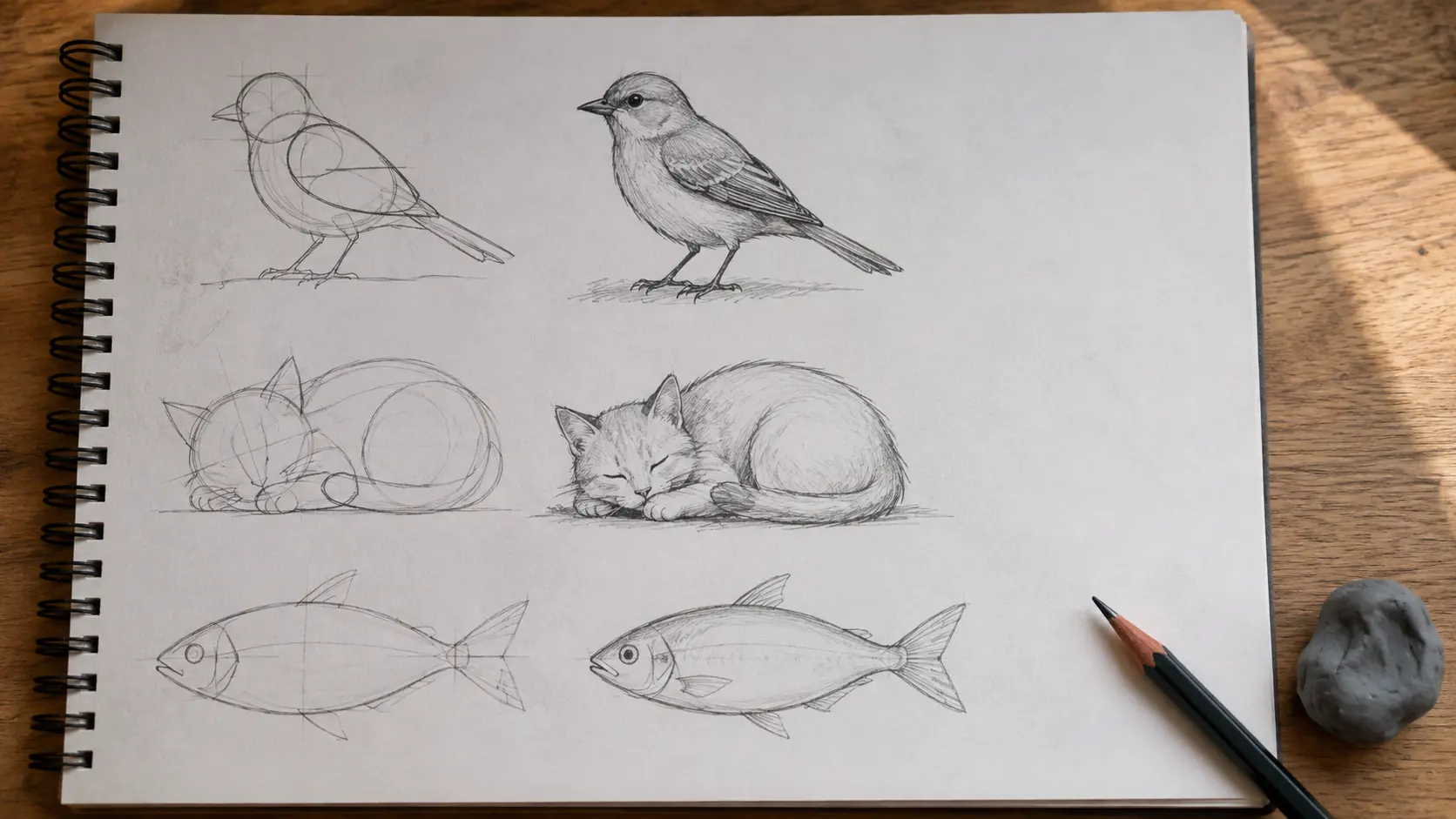
The trick with animals is refusing detail until the big shapes sit right. A cat is a circle on an oval; a bird is an egg with a smaller egg for a head. Build the toy version first, then decide how far to push it.
- A sleeping cat, which conveniently hides the legs
- A round bird on a wire, egg, beak, stick legs
- A fish, one almond shape plus fins
- A snail, spiral on a slug, geometry with a face
- A jellyfish, bell plus wavy lines, impossible to get wrong
- A turtle from above, one big oval, pattern practice on the shell
- A penguin, bowling pin with a beak
- A ladybug on a leaf, two ideas from this list combined
- Your pet asleep, harder, but they finally hold still
- A rubber duck, the animal that is already a simplified shape
Patterns and Doodles That Fill Pages
Pattern drawing is skill-building disguised as relaxation: line control, spacing and pressure, with zero pressure about likeness. Perfect for the days you want to draw but not to try.
- Rows of overlapping circles, then shade where they overlap
- A page of parallel lines that bend around an invisible bump
- Simple mandala: one circle, divide, repeat a motif per ring
- Brick wall, then make some bricks broken
- Scales, fish or dragon, one row at a time
- A ribbon that folds over itself across the page
- Cubes in a stack, the classic isometric doodle
- Waves in the style of a woodblock print, stylized curls
- Your name in bubble letters, then in sharp letters
- Fill any awkward leftover corner of the page with tiny stars
A Practice Loop That Works
Pick fast, draw small, finish. Choose from the lists above in ten seconds, draw at postcard size or smaller, and define done before you start: contour only, or contour plus one shadow. Small and finished beats large and abandoned.
Five minutes counts. A daily five-minute sketch outperforms a two-hour session every second Sunday, because seeing improves with frequency, not intensity.
Date every page. Progress in drawing is invisible day to day and unmistakable month to month. The dated sketchbook is the only progress bar you need.
Repeat subjects. Draw the same mug on day one and day thirty. The pair will teach you more about your own progress than any tutorial can.
Show Your Month-Thirty Mug to the World
A VisuLink puts your gallery, your socials and your story behind one short address.
FAQ
What should a complete beginner draw first?
Household objects with simple geometry: a mug, a key, folded glasses, a spoon. They hold still, their shapes are honest, and finishing them builds the habit that everything else depends on.
What are easy things to draw when bored?
Patterns and doodles: overlapping circles, simple mandalas, stacked cubes, scales, bubble letters. They need no reference, fill pages quickly and quietly train line control.
How do I get better at drawing as a beginner?
Short, frequent, finished: pick a simple subject fast, draw small, define done before starting, and sketch most days even if only for five minutes. Date the pages and repeat subjects monthly to make progress visible.
Are drawing ideas lists actually useful?
Yes, for one specific problem: decision fatigue at the blank page. The list does the choosing so your energy goes into the drawing. Skill still comes from the practice itself.
Do I need special supplies to start drawing?
No. Any pencil and any paper start the habit. Better tools refine results later, but the early gains come from mileage, not materials.