
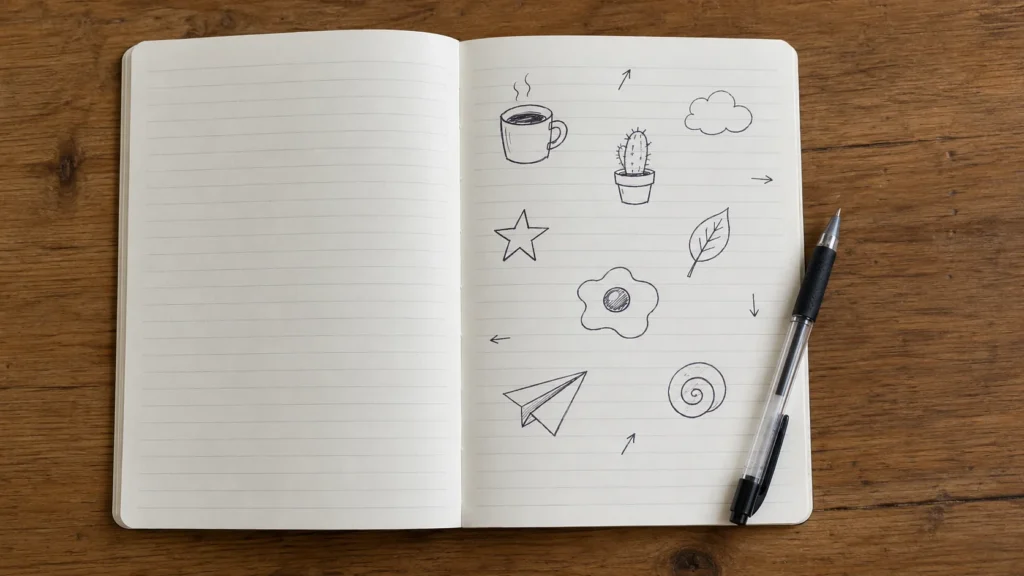
A doodle is a small drawing you finish before you have time to judge it. That is the whole appeal, and it is also the method: pick something built from two or three simple shapes, draw it in under a minute, then draw it four more times. This is a working list of easy doodles organized by the shape they start from, plus what to do with a page once you have filled it.
Doodles are the smallest unit in our drawing series. If you want repeating fills for borders and backgrounds, that is a different job and it lives in easy patterns to draw. If you want a longer list of subjects to work through, the easy drawing ideas hub covers it.
One Link for Your Sketchbook
A short address you control, pointing to your drawings, your pages and everything else you share.
What Counts as a Doodle
A doodle is small, fast and finished. It is not a study, it is not a sketch toward something else, and it does not need to be good. Three properties make a subject a good doodle:
- It reduces to two or three shapes. A cactus is a rounded rectangle with two smaller rounded rectangles stuck on it. That is drawable in seconds.
- It survives being drawn badly. A wobbly cloud still reads as a cloud. A wobbly hand does not read as a hand.
- It is recognizable without detail. If it needs shading to be identified, it is not a doodle yet.
One useful distinction before the lists: a doodle is an object, a pattern is a fill. A little potted plant is a doodle. A page of repeating scallops is a pattern. They serve different purposes and the patterns have their own guide, linked above. Everything below is objects.
Doodles That Start From a Circle
The circle is the starting shape this guide uses most because so many things are round or nearly round, and because a bad circle still reads as a circle.
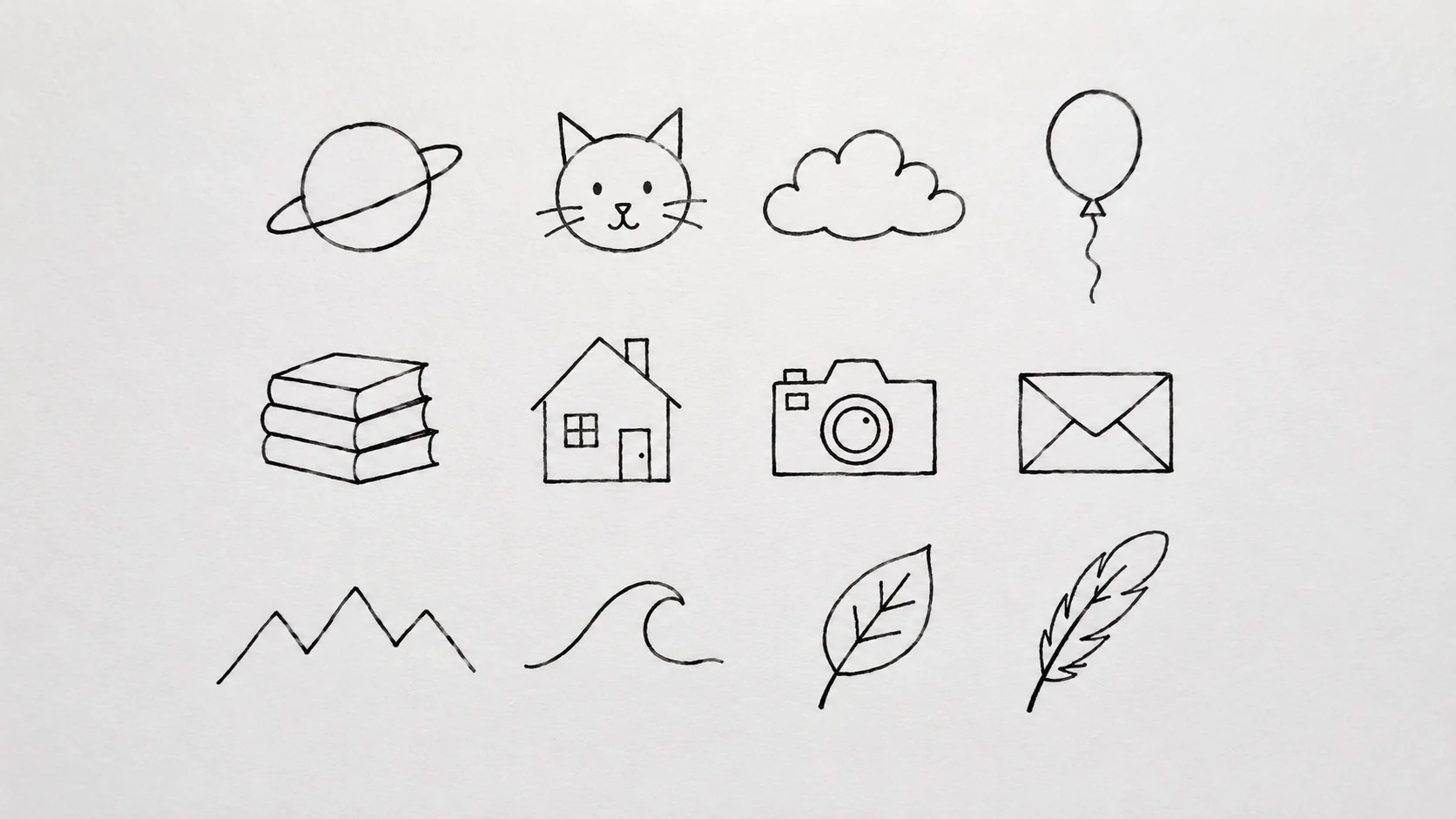
- Planet: circle, then one flattened ellipse crossing behind it for the ring.
- Hot air balloon: circle, three curved lines down it for the seams, a small trapezoid basket hanging below on two short lines.
- Cat face: circle, two triangles on top, two dots, a small upside down triangle nose, three whiskers each side.
- Avocado half: a rounded pear shape, a smaller circle inside for the pit, a thin border line following the outer edge.
- Cloud: three or four overlapping circles along the top, one flat line closing the bottom.
- Wall clock: circle, smaller circle inside, two hands, four dots at the quarters.
- Balloon: circle with a small triangle knot at the bottom and one long curling string.
- Snail: a spiral, then a simple curved body shape underneath it and two dot eyes on stalks.
Draw a whole row of one of these across a page, then compare the first with the fifth.
Doodles That Start From a Square
Squares and rectangles handle everything man made.
- Stack of books: three or four flat rectangles, each slightly offset, one thin line inside each for the pages.
- Little house: square, triangle roof, one door, one window with a cross in it.
- Camera: rounded rectangle, circle in the middle, small rectangle bump on top.
- Envelope: rectangle, then a wide V from the top corners meeting in the middle.
- Suitcase: rounded rectangle, a handle arc on top, two small circles for latches.
- Phone: tall rounded rectangle, a thin bar at the top, a small circle at the bottom.
- Gift box: square, a ribbon crossing both ways, a bow made of two loops.
- Window with a view: square divided into four panes, then two hills and a sun inside it.
Doodles That Start From a Single Line
These are the fastest of all, useful when you have four seconds and a pen.
- Mountain range: one zigzag, then a small line under each peak for snow.
- Wave: one long S curve, then two shorter ones under it.
- Leaf: a pointed oval, one line down the middle, four short veins off it.
- Feather: a curved line, then short strokes off both sides, shorter near the tip.
- Lightning bolt: one sharp zigzag closed into a shape.
- Paper plane: three straight lines forming a narrow arrow, one line inside for the fold.
- Ribbon banner: two horizontal lines, notched V at both ends, small folded corners.
- Arrow: a line with a head, then curve it, loop it, make it dashed. Arrows are endlessly variable and always useful in notes.
Faces and Characters in Four Marks
In these four-mark faces, expression is carried by the eyebrows and the mouth. Keep the eyes as two identical dots and change only those two things, and you get a full emotional range out of one face shape.
| Feeling | Eyebrows | Mouth |
|---|---|---|
| Happy | none, or gently raised | upward curve |
| Sad | inner ends up | downward curve |
| Angry | inner ends down, sharp | short flat line |
| Surprised | both high and rounded | small circle |
| Bored | flat | flat, slightly off centre |
| Smug | one raised | curve rising on one side |
Draw the same blank circle six times and run the table. It takes two minutes and it is the most immediately useful thing on this page, because a face with the right expression carries a whole note or card by itself.
Keep the Whole Sketchbook Behind One Link
Your doodle pages, your finished pieces and everything else you share, at one short address.
Food Doodles
For these food doodles, variation is part of the exercise. Do not worry about matching one exact croissant shape.
- Coffee cup: a trapezoid, a handle, three wavy steam lines.
- Ice cream cone: triangle with a crosshatch, two or three bumps on top.
- Slice of cake: a wedge seen from the side, two horizontal lines for layers, a dot on top.
- Donut: circle, smaller circle inside, a wavy line for icing, four short dashes for sprinkles.
- Fried egg: a wobbly blob with a circle inside it. Impossible to get wrong.
- Cherries: two circles, two curved stems meeting at a point, one small leaf.
- Toast: a square with one rounded top corner, then a smaller rounded square inside for the butter.
Lettering as a Doodle
Words are shapes too, and lettering is the doodle that ends up being genuinely useful in notes and cards.
The easiest upgrade is faux calligraphy and it takes one pass. Write a word in ordinary cursive. Then go back and thicken only the downstrokes, the parts where your pen was travelling downward. Fill those thickened areas in. That is it: the contrast between thick and thin is what reads as calligraphy, and you do not need a special pen.
Two more, both one step each. Bubble letters: write the word, then draw a rounded outline around each letter and erase the original. Shadow letters: write the word in plain block capitals, then add a short line down the right side and along the bottom of every stroke, always the same side. Consistency of the shadow direction is the only rule that matters.
Margin Doodles for Meetings and Notes
These are the ones that have to survive being drawn without looking at the page.
- Stars, from a simple five point to a four point sparkle
- Boxes and checkboxes, some ticked
- Chains of overlapping circles down the margin
- Small numbered flags for marking sections
- Curly brackets grouping lines of text
- A row of tiny triangles as a divider
- Speech bubbles, empty or with a single word
Speech bubbles and arrows are worth practising deliberately, because they cross over from decoration into function.
Turning Scattered Doodles Into a Page
Individual doodles are easy. A page that looks composed rather than random is a slightly different skill, and three rules get you most of the way.
Vary the size deliberately. One large doodle, three medium, and a scattering of small ones reads as designed. Fifteen doodles all the same size reads as a worksheet.
Let things touch and overlap. Objects that overlap create depth and make the page feel intentional. Objects floating in isolation with even gaps look like clip art.
Leave one area empty. A page filled corner to corner has nowhere for the eye to rest. One clear patch, off centre, makes everything around it look more deliberate.
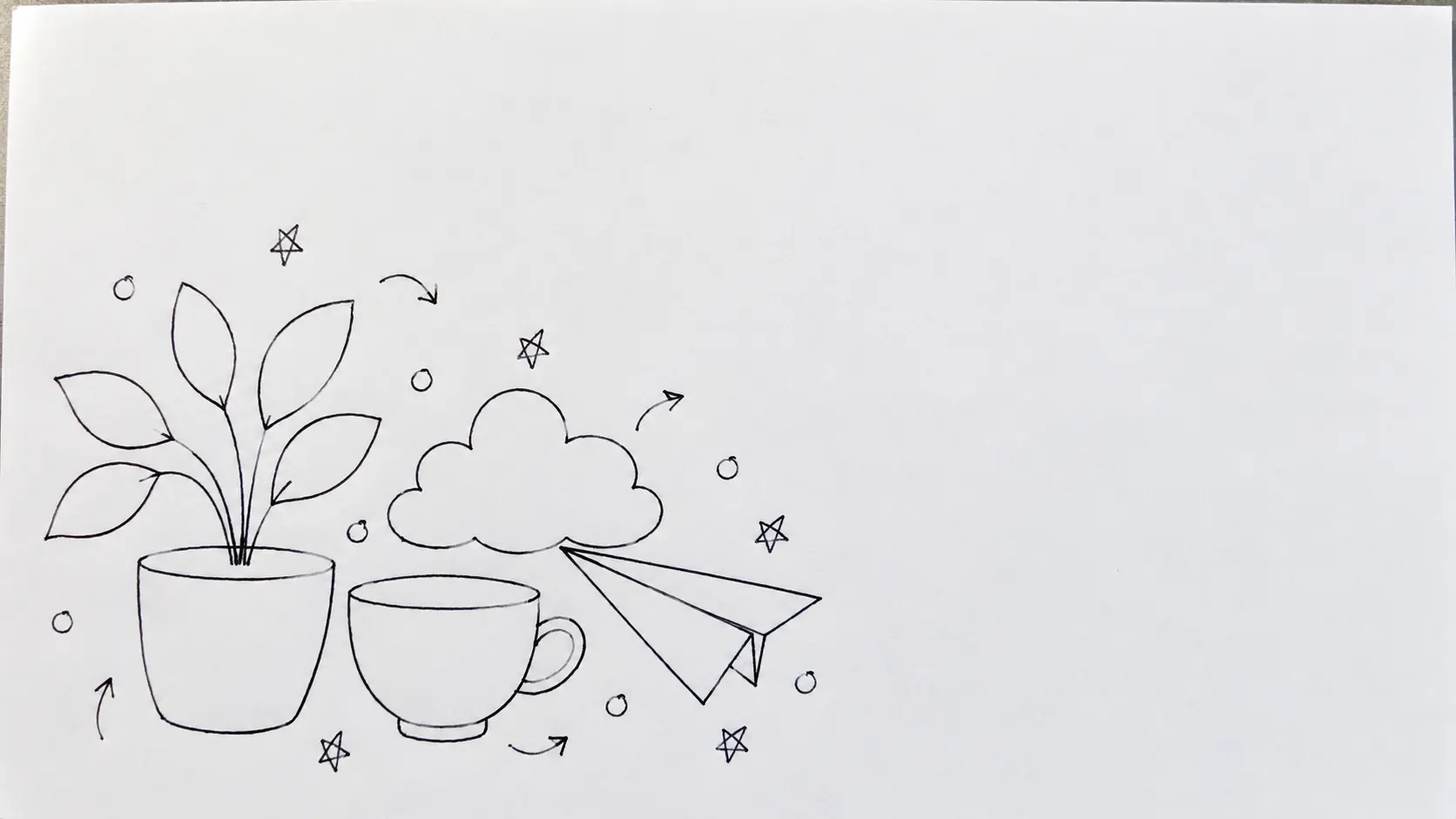
A useful exercise: pick one theme, plants for example, and fill a page using only the three rules above. The constraint removes the hardest decision, which is what to draw, and leaves you practising the composition.
Does Doodling Help You Focus?
The claim that doodling improves memory comes from one specific study, and the evidence since then is mixed.
In 2010, a study published in Applied Cognitive Psychology asked 40 participants to monitor a monotonous mock telephone message for names. Half were given shapes to shade in while they listened. The abstract reports that the doodling group "performed better on the monitoring task and recalled 29% more information on a surprise memory test." The original study reported 29% more recall on a surprise memory test.
The complication: a much larger 2024 study published in the Quarterly Journal of Experimental Psychology, using lecture material instead of a telephone message, ran two experiments with 222 participants total and did not find the effect. Its conclusion is blunt: across those studies, doodling "neither reduced boredom or mind-wandering nor increased attention or retention of information compared with other conditions." The same paper notes that boredom "was never intentionally induced or measured" in the original 2010 work.
So the accurate statement is that one small, widely cited study found a benefit and a larger, more recent one did not. Treat the memory claim as unsettled rather than established. Doodle because a page of small finished drawings is satisfying, and use the repetition here to practise line control.
Show the Pages You Filled
One VisuLink holds your sketchbook, your pages and everything else you share.
FAQ
What are some easy doodles for beginners?
Start with subjects that reduce to two or three shapes: clouds, coffee cups, cacti, stacks of books, leaves, stars, simple faces and fried eggs. The test is whether the thing is still recognizable when drawn badly. A wobbly cloud still reads as a cloud, which is what makes it a good beginner doodle.
What is the difference between a doodle and a pattern?
A doodle is an object, like a small plant or a cup. A pattern is a repeating fill used to cover an area, like scallops or a grid. Doodles are drawn once and finished; patterns are repeated until the space is full. They are separate skills and this guide covers only the objects.
How do I doodle if I cannot draw?
Pick a subject made of two or three simple shapes and draw it five times in a row rather than once carefully. Doodling is not a test of talent; it is repetition at a small enough scale that mistakes cost nothing. Compare the first attempt with the fifth.
Does doodling actually improve memory?
The evidence is mixed. A frequently cited 2010 study of 40 people found doodlers recalled 29% more from an audio message, but a larger 2024 study with 222 participants, using lecture material, found no benefit to memory, attention or boredom. Treat it as an open question rather than a settled fact.
What pen should I use for doodling?
Whatever is already in your hand. A regular ballpoint is genuinely fine and its inability to be erased is useful, because it stops you fixing things. If you want cleaner lines later, try a fine tip fineliner. Filling a few pages is what this guide recommends, whatever the pen.
How do I make a doodle page look good instead of messy?
Three things. Vary the sizes so one drawing anchors the page. Let some objects overlap instead of floating apart. Leave one area deliberately empty so the eye has somewhere to rest. Those alone turn a scattered page into one that looks composed.