

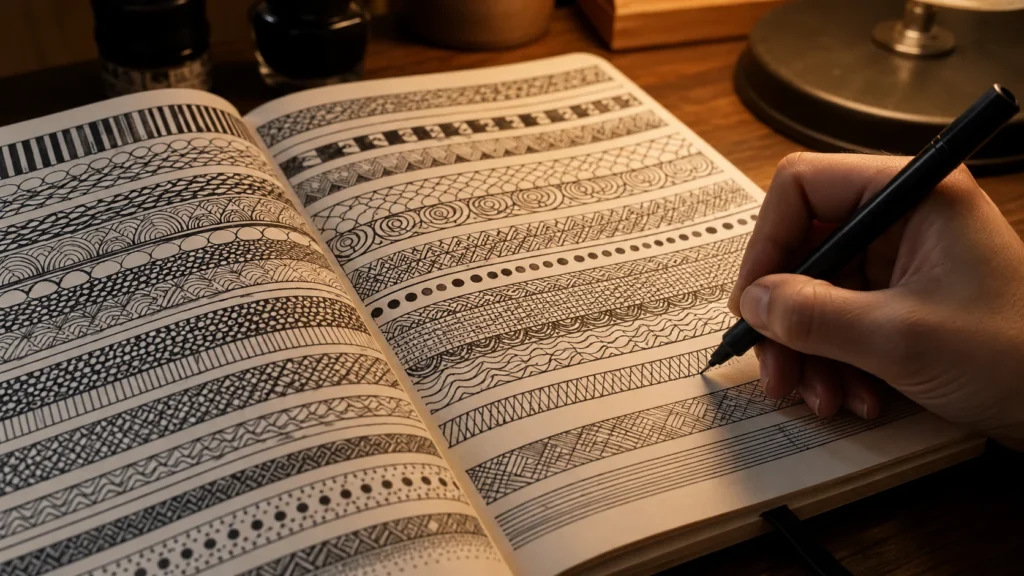
Patterns are the drawing hack nobody gatekeeps. A pattern asks you to repeat one small move, and repetition is exactly what untrained hands are good at learning. This guide gives you 16 easy patterns to draw with plain construction steps, ordered from the first-minute ones to the ones that quietly look professional.
No special tools, no talent test: any pen, any paper. Patterns fill notebook margins, decorate bullet journals, calm a restless meeting hand, and dress up drawings you already make, and every one below is a generic, classic pattern type that belongs to everybody. If you want subjects to draw rather than fills, the easy drawing ideas hub is the companion page.
One Link for Everything You Draw
A short address you control, pointing to your sketch photos and pages wherever they live.
What Makes a Pattern "Easy"
An easy pattern has three properties: one repeated stroke, a forgiving structure where small wobbles read as charm instead of error, and no planning beyond the first mark. That is why patterns beat "draw a horse" for a beginner: the pattern never asks your hand to do something it has not done three strokes earlier.
The list below runs in difficulty order, 1 to 3. Difficulty 1 patterns work in the first minute. Difficulty 3 patterns are still beginner territory, they just reward a light pencil guideline first. Work down the list and you are also, quietly, running a line-control curriculum: every pattern trains a specific motor skill, and they stack.
The Simplest Six: Lines, Dots and Zigzags
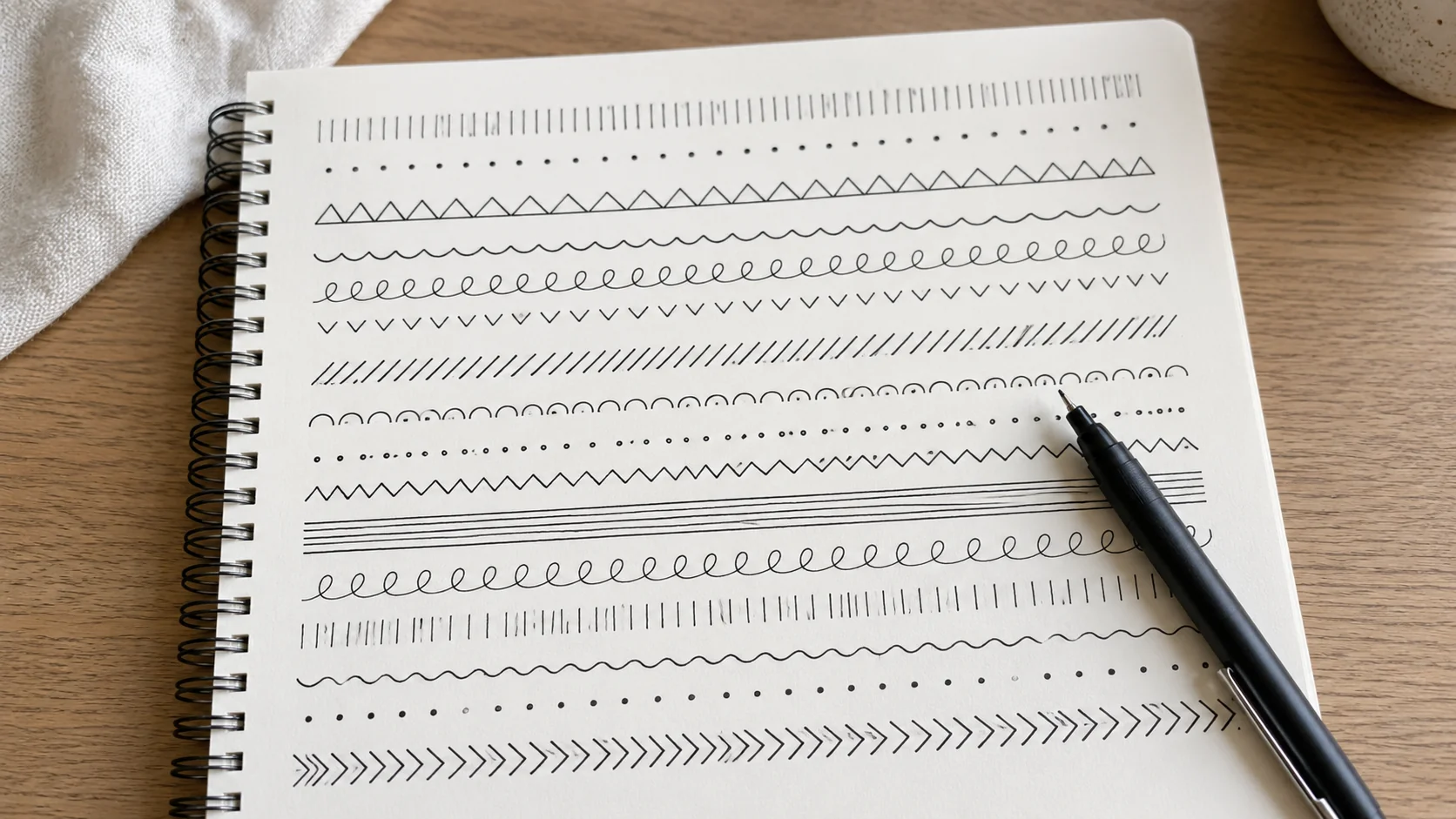
1. Stripes (difficulty 1). Evenly spaced parallel lines. Keep the pen moving in one direction and rotate the paper instead of twisting your wrist. Trains steady line control and spacing, the base skill under everything else here.
2. Crosshatch (difficulty 1). One layer of parallel lines, then a second layer crossing at an angle; add a third layer where you want darkness. Trains angle consistency, and teaches shading-by-density for free.
3. Dot fill (difficulty 1). Tap dots at even intervals. Cluster them tight for shadow, loose for light. Trains pressure consistency; a patch of gradient dots looks far more skilled than it is.
4. Waves (difficulty 1). One smooth S-curve across the space, then repeat parallel lines echoing its peaks and troughs. Trains continuous curves and tracking a previous line.
5. Zigzags and chevrons (difficulty 1). Up-down strokes at a fixed angle across a row; stack rows with the Vs aligned and you have chevrons. Trains angle repetition and row alignment.
6. Loops (difficulty 1). Connected cursive-style loops across a row without lifting the pen, like a line of lowercase e's. Trains flow and a relaxed wrist, the best warm-up stroke on this page.
Grid Patterns: Bricks, Checkers and Honeycomb
7. Brick (difficulty 1). Rule light horizontal rows, then add vertical dividers offset by half a brick each row. Trains grid discipline and offset logic, the same logic real bricklayers use.
8. Checkerboard (difficulty 1). A square grid with alternating squares filled solid. Trains grid accuracy and the patience of clean solid fills; sloppy fills are what make checkerboards look rushed, so slow down on the coloring.
9. Honeycomb (difficulty 2). A row of hexagons sharing edges, with the next row nested into the notches. Easiest built over a light triangular dot grid. Trains repeating one fixed shape at a fixed size, which is the doorway skill to all tessellation patterns.
Keep Your Sketch Progress in One Place
Link your pattern pages, favorite exercises and finished pieces from one short address.
Curves and Nature: Scallops, Spirals and Vines
10. Scallops and fish scales (difficulty 2). A row of half-circle arcs; start the next row's arcs centered on the gaps above so they overlap like roof tiles. Trains the half-drop repeat, the single most useful offset in decorative drawing.
11. Spirals (difficulty 2). Coil outward from a center point keeping the gap between coils constant, then repeat spirals across the space. Trains rotation control; the constant gap is the entire challenge and the entire look.
12. Concentric rings (difficulty 2). A small circle, then progressively larger circles around it at even gaps; scatter clusters of them to fill a field. Trains roundness and even offset, and overlapping clusters make a great background texture.
13. Leaf vine border (difficulty 2). A wavy stem line with matching leaves alternating on either side at even intervals. Trains repeating a shape along a curve, and it is the pattern people most often ask to learn after seeing it in a journal margin.
The Showpieces: Mandalas, Weaves and Mosaics
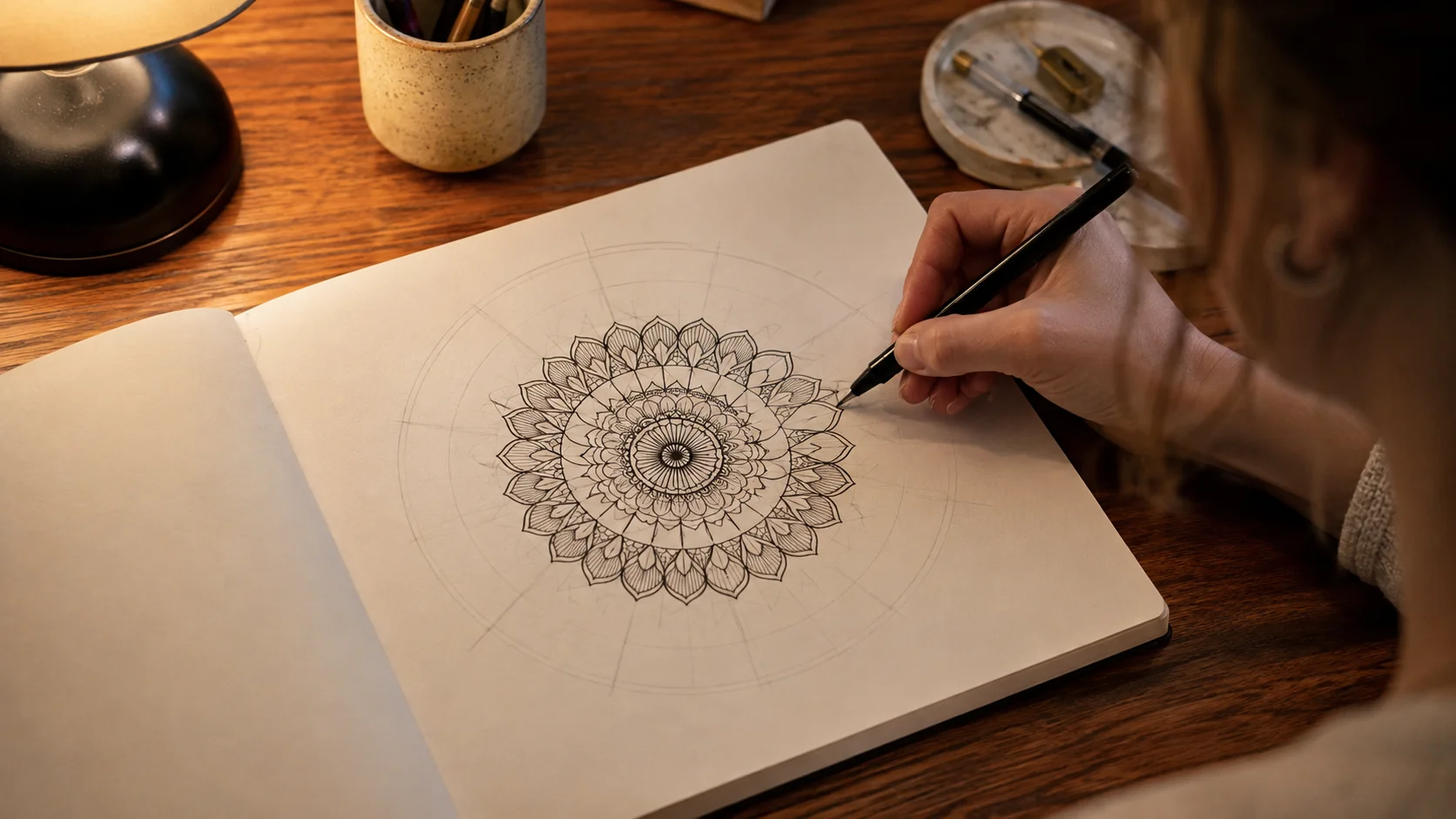
14. Mandala rings (difficulty 3). Mark a center dot, draw light guide circles around it, divide into equal wedges with faint spokes, then repeat one small motif per wedge, ring by ring. Trains radial symmetry and planning. The secret nobody says out loud: the guidelines do most of the work, and light pencil guides erased later are not cheating, they are the method.
15. Basket weave (difficulty 3). Pairs of parallel lines in small blocks, alternating horizontal and vertical, skipping lines where a strand passes under. Trains over-under logic and gives flat drawings implied depth.
16. Mosaic fill (difficulty 2). Divide any shape with wandering lines into irregular cells, then fill each cell with a different pattern from this list. Trains composition and pattern mixing, and turns the other fifteen entries into one finished-looking artwork.
How to Keep Patterns Even
Rotate the paper, not your wrist. Your hand draws certain angles better than others. Professionals turn the page constantly so every stroke happens in the hand's comfortable zone.
Use light guidelines without guilt. Faint pencil rows, grids and circles, inked over and erased after, are how even patterns get even. The pen performs; the pencil directs.
Slow is smooth. Wobbly lines are almost always speed, not skill. Halve your stroke speed and most of the wobble disappears the same day.
Accept the drift. Hand-drawn patterns drift a little, and that drift is what makes them warmer than printed ones. Perfection is what the ruler section of a stationery store is for.
Where to Use Them
Borders and corners of journal pages are the classic home. Backgrounds behind lettering give titles instant weight. And filling a drawing you already made is the most satisfying use of all: pattern a collar, a blanket or the fur shading in your dog drawing and watch a simple sketch turn decorative.
For a daily habit, run a ten-minute drill: rule four bands on a page, fill each with a different pattern from a different section of this list, date the page. Two weeks of pages become a visible record of your line control improving, and many people find the repetition genuinely calming, a bonus on top of the skill.
Share the Pages, Not Ten Different Links
One VisuLink holds your sketch gallery, your pattern library and everything else you share.
FAQ
What is the easiest pattern to draw?
Stripes, dots and loops: one repeated stroke each, working in the first minute. They are also the best warm-ups before any drawing session.
Do I need special pens for pattern drawing?
No. Any pen and paper start the habit. A fineliner gives crisper lines and a pencil helps with light guidelines, but neither is required for anything on this page.
How do I make my patterns look less wobbly?
Slow your strokes down, rotate the paper so every line sits in your hand's comfortable angle, and use faint pencil guides. Most wobble is speed, not ability.
Are these patterns copyright-free?
The generic pattern types here, stripes, scallops, spirals, mandala rings and the rest, are classic common-property motifs no one owns. Specific branded pattern systems and named pattern sets from books or courses are different; this page deliberately sticks to the generics.
What should I draw after patterns?
Point the new line control at simple subjects: household objects, plants, then favorites like animals. The easy drawing ideas hub on this site is organized exactly for that next step.