

Seventy-five food trivia questions with answers, sorted by theme and difficulty, ready for a party, a quiz night or a family dinner. Every origin, date and chemical fact below was checked against Encyclopaedia Britannica's articles, so you can read the answers out loud with confidence.
The questions run from freebies any eater gets to stumpers that settle tiebreakers. If your table wants variety beyond food, our full set of fun trivia questions for adults covers every other category, and none of the questions below repeat it. There are themed sets too: movie trivia, music trivia and sports trivia.
One Link for Your Whole Quiz Night
A short address you control, pointing to your quiz sets, party pages and everything else you share.
How to Use This Quiz
Three formats that work. Party mode: one reader, teams shout answers, one point each, start with the kids section and the dishes of the world so nobody checks out early. Quiz night: pick 5 questions per section, answers written on paper, the tiebreaker list decides ties. Family dinner: one question between courses, alternating easy and medium so every generation scores. Questions are numbered 1 to 75; the answer follows each question, so the reader should keep the screen to themselves.
Where Food Comes From (Origins and Domestication)
1. In which region of the world was corn domesticated, and roughly how long ago? In southern Mexico, about 10,000 years ago, per Britannica.
2. From which wild grass is modern corn believed to descend? The Balsas teosinte (Zea mays parviglumis).
3. What is the name of the Indigenous Mesoamerican system that interplants corn, squash and beans? Milpa, also known as the Three Sisters.
4. Which South American region is the potato native to? The Peruvian-Bolivian Andes, per Britannica.
5. What is the traditional Andean freeze-dried potato product, made by exposing tubers to cold nights and intense daytime sun? Chuño.
6. In which century did the Spanish introduce the potato to Europe? The second half of the 16th century.
7. In which region has quinoa been a staple crop for millennia? The Andean region of South America; most of it is still grown in Peru and Bolivia.
8. Is quinoa a true cereal? No. Britannica records that quinoa is not a true cereal; its protein-rich seeds just get used like one.
9. In which part of the Americas does cassava grow as a native wild plant? The American tropics.
10. Which people, according to Britannica, probably first cultivated cassava, and where? The Maya, in Yucatán.
11. Where are avocados native to? The Western Hemisphere, from Mexico south to the Andean regions.
12. Where is the peanut native to? Tropical South America.
Fruits, Vegetables and the Botany Fight
13. Botanically, which plant family does the tomato belong to? The nightshade family (Solanaceae), same as the potato, per Britannica.
14. Where did the wild species of tomato originate? In the Andes Mountains of South America, probably mainly in Peru and Ecuador.
15. Besides vitamin C, which phytochemical are tomatoes a good source of? Lycopene.
16. Is the peanut a true nut? No. It is a legume of the pea family (Fabaceae), per Britannica.
17. What is the name of the phenomenon by which peanuts ripen underground? Geocarpy.
18. Which stalk-like structure carries the peanut's fertilized ovules down into the soil? The peg (the gynophore).
19. When early European chroniclers found pineapple growing in the West Indies, what was it being used for? Food and wine making.
20. Botanically, what kind of fruit is a pineapple classified as? A multiple fruit, formed from the fusion of many flowers.
21. Do modern domesticated bananas have functional seeds? No. They are essentially sterile and are propagated from shoots of the rhizome.
Grains, Breads and Pasta
22. Which type of wheat is dry Italian pasta, such as spaghetti and macaroni, made from? Durum wheat (Triticum durum), per Britannica.
23. What is the granular product of the durum wheat endosperm, the basis of pasta, called? Semolina.
24. In extrusion, what makes macaroni different from spaghetti? Macaroni comes out through perforations fitted with steel pins, forming tubes; spaghetti comes out through smaller holes without pins, forming solid strands, per Britannica.
25. What does the Italian word "vermicelli", the name of a very thin pasta, literally mean? "Little worms".
26. And "spaghetti", also from Italian, literally means what? "Little string".
27. Which wheat species is the one used to make common bread? Common wheat (Triticum aestivum).
28. What gives sourdough bread its sour flavor? Yeasts naturally present in the air, which ferment the flour-and-water mixture over several days, per Britannica.
29. Which spongy flatbread, common in Ethiopia and Eritrea, is made from teff, wheat or sorghum? Injera.
30. Which grain are tortillas and arepas made from? Corn.
31. Which cereal is the raised black bread of Germany, Russia and Scandinavia chiefly made from? Rye.
Herbs and Spices
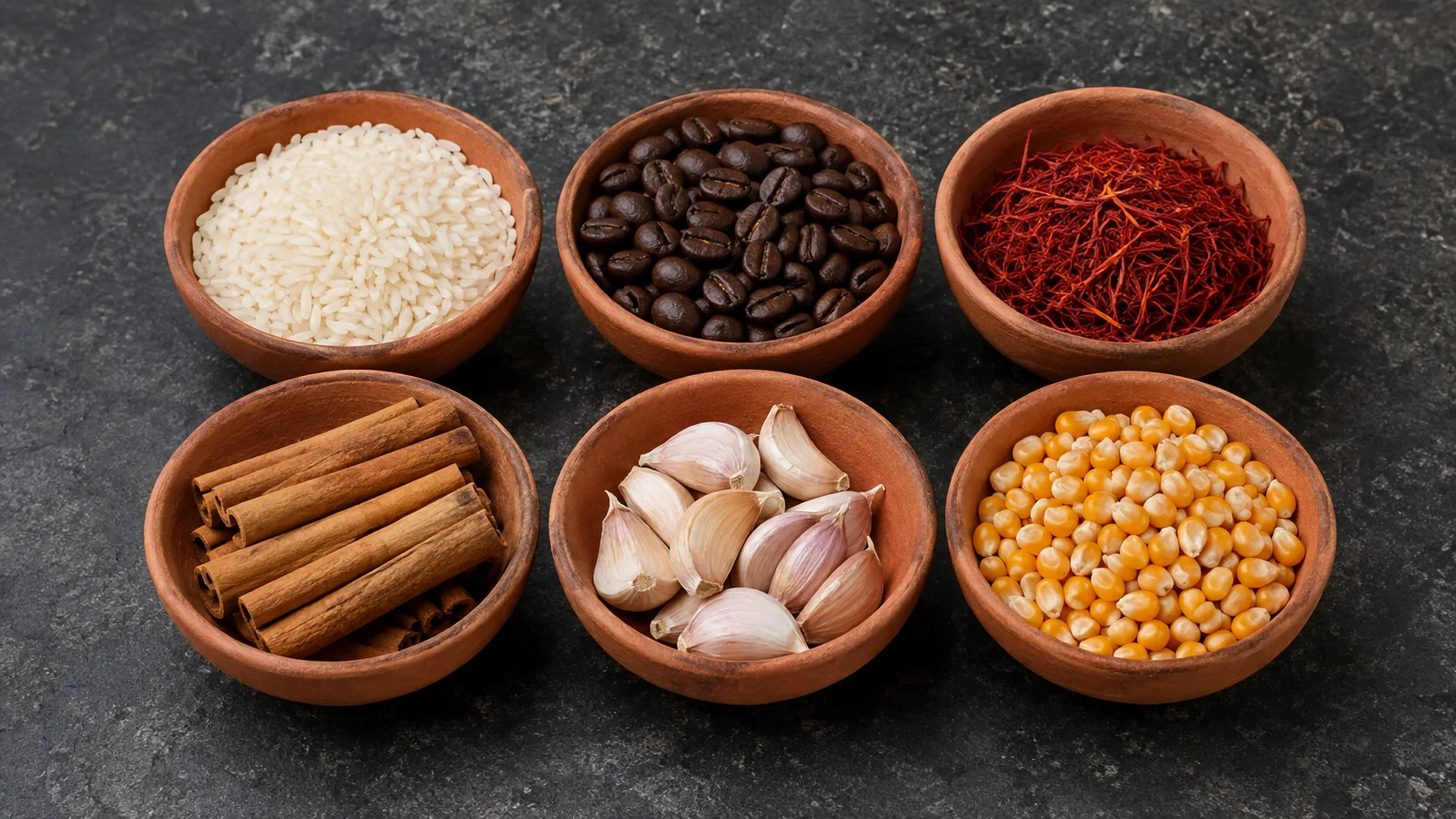
32. Which part of the saffron crocus flower does the spice come from? The stigmas, the pollen-receiving structures, handpicked and dried. There are three per flower, per Britannica.
33. How many blossoms does it take to produce one pound (0.45 kg) of saffron? 75,000.
34. Which spice does Britannica describe as the most expensive in the world? Saffron.
35. Which part of the tree does cinnamon come from? The dried inner bark, reddish brown in color.
36. Which country is the cinnamon tree Cinnamomum verum native to? Sri Lanka (formerly Ceylon), along with the neighboring Malabar Coast of India and Myanmar.
37. What is the principal component of cinnamon's essential oil? Cinnamic aldehyde.
38. Which botanical family does garlic belong to? The amaryllis family (Amaryllidaceae), per Britannica.
39. What are the small edible bulblets inside a head of garlic called? Cloves. One head can hold up to 20.
40. Which region is garlic native to? Central Asia, though it grows wild in Italy and southern France.
Host the Night, Share One Link
Your quiz sets, your recipes and your party page behind a single short address.
Drinks
41. Which plant does tea come from? Camellia sinensis, whose young leaves and leaf buds are steeped in freshly boiled water, per Britannica.
42. What are the two main varieties of the tea plant? The small-leaved China variety (C. sinensis var. sinensis) and the large-leaved Assam variety (var. assamica).
43. In what year did the Dutch East India Company carry the first consignment of China tea to Europe? 1610.
44. Which two coffee species supply almost all of the world's consumption? Coffea arabica and Coffea canephora, the latter known for the robusta variety, per Britannica.
45. Which of the two has twice the caffeine content of the other? Robusta, with twice the caffeine of arabica.
46. Where did the wild coffee plants taken to Arabia in the 15th century probably come from? Kefa (Kaffa), Ethiopia.
47. Which alkaloid gives coffee its invigorating effect? Caffeine.
48. Which fermented beverage was made from honey in antiquity? Mead.
49. Besides sugar and molasses, which two spirits does Britannica list as sugarcane products? Rum and cachaça, the Brazilian spirit.
Kitchen Chemistry and Science
50. What does the scientific name of cacao, Theobroma cacao, mean in Greek? "Food of the gods", per Britannica.
51. Which two stimulating alkaloids are present in small amounts in chocolate? Caffeine and theobromine, the latter highly toxic to dogs.
52. Which toxic substances occur in most varieties of cassava and must be removed in preparation? Cyanogenic glucosides, cyanide-producing sugar derivatives.
53. What is the chief protein in milk, the one that forms the curd of cheese? Casein, per Britannica.
54. Where does the rennet traditionally used in cheesemaking come from? The stomach of young calves, in a brine extract.
55. Roughly how many volumes of milk does it take to make one volume of cheese? About ten.
56. Why does popcorn pop? Because heating makes the moisture inside the cells expand until the kernel explodes; popcorn is a type of flint corn devoid of soft starch.
57. Do fresh vanilla beans have any aroma when harvested? No. The characteristic aroma only appears after curing, through enzymatic action.
Dishes of the World
58. Which classic pizza is topped only with tomato, mozzarella and basil? The Margherita, per Britannica.
59. According to the popular legend Britannica records, what do the Margherita's topping colors represent? The colors of the Italian flag: green, white and red.
60. Which queen does the legend say the Margherita pizza was named for? Queen Margherita, wife of Umberto I.
61. In which US city did the first pizzeria appear, around the turn of the 20th century? New York City.
62. Which specific cheese defines traditional Neapolitan pizza? Buffalo mozzarella, made from the milk of Italian Mediterranean buffalo, or fior di latte.
63. What is the rice in sushi flavored with, the seasoning that defines the dish? Vinegar, per Britannica.
64. What is the sushi style where a sheet of nori is rolled into a cylinder and sliced called? Maki-zushi.
65. And the hand-formed oblong of rice topped with sliced raw seafood? Nigiri-zushi.
66. Which pickle is the traditional palate-clearing accompaniment between pieces of sushi? Vinegar-pickled ginger root (sūshoga).
67. In which French dish is saffron an important ingredient? Bouillabaisse.
Easy Ones for Kids
68. Which yellow, curved fruit do the monkeys eat in cartoons? The banana.
69. Which long orange vegetable do rabbits love to nibble? The carrot.
70. Which small red fruit wears its tiny seeds on the outside? The strawberry.
71. Which white food comes from the cow and is used to make cheese and yogurt? Milk.
72. Which soft yellow food do we spread on bread in the morning, made from churned milk? Butter.
73. Which round food does the hen lay? The egg.
74. Which sweet frozen treat do we eat for dessert on a hot day? Ice cream.
75. Which grain pops and turns into a white fluffy handful when heated? Popcorn.

The Hard Ones (Tiebreakers)
When two teams tie, pull from these eight, already listed above and chosen for their miss rate: 2 (the Balsas teosinte), 17 (geocarpy), 24 (the steel pins), 33 (the 75,000 blossoms), 37 (cinnamic aldehyde), 52 (the cyanogenic glucosides), 56 (why popcorn pops), 64 (maki-zushi). Read the question, not the number, and give teams thirty seconds flat.
Share the Scoreboard, Not Ten Links
One VisuLink holds your quiz sets, your recipes and everything else you share.
FAQ
How many food trivia questions are in this list?
Seventy-five, numbered straight through and grouped into eight themed sections, from origins and botany to kitchen chemistry and a kids section, with eight flagged as tiebreakers.
Are the answers verified?
Every origin, date, chemical compound and definition was checked against Encyclopaedia Britannica's articles, read in full. Questions in the kids section rest on common knowledge that needs no citation.
Why is there no "is a tomato a fruit or a vegetable" question?
Because it has two defensible answers: botanically it is a fruit, in the kitchen and in trade it is treated as a vegetable. A trivia question needs one correct answer, so this list asks about the tomato's botanical family instead, which has exactly one.
What is a good format for a food quiz night?
Five questions per themed section, written answers, one point each, and the tiebreaker list held in reserve. Starting with the kids section and the dishes of the world keeps casual players in the game; ending on kitchen chemistry rewards the cooks.