

A fall festival is not a party where everyone plays one game together. It is a field of booths, and each booth has to swallow a line of strangers, give each a turn of about a minute, and send them off happy. That constraint decides which games work and which jam the field.
Wikipedia describes a harvest festival as an annual celebration that occurs around the time of the main harvest of a given region. That is where a school or church fall festival borrows its vocabulary: corn, hay, apples, scarecrows. This guide turns that vocabulary into booth games, each with the details usually discovered on the day: what the station is built from, how long a turn runs, how many it serves at once, who runs it, and how it scores without stopping the line.
When the Whole Thing Happens Somewhere on the Map
A festival is a crowd arriving at one place on one afternoon. VISU works on exactly that: at a partner location, scanning the code turns the visit itself into a small reward. The event stays yours, the bonus is an extra.
The Booth Rule: One Minute, One Person, No Fixed Teams
Before a game goes on the list, hold it against one test. A person walks up alone or with a parent, waits behind a handful of others, plays, leaves. Nobody waits for a team to assemble or a round to finish. A game needing eight players in place belongs at a birthday party, not at a station.
That rules out a lot of favourites. Relay races, tug of war, field wide scavenger hunts: fine as a scheduled centrepiece over the speaker, useless as a booth, because a booth that stops sends its line next door. Every game below is written the same way, because these five details are improvised badly at four in the afternoon:
- Station. What it is built from, using what the venue already owns or can borrow.
- Turn. How long one person occupies the booth.
- At once. How many can play simultaneously, the real throughput number.
- Operator. Who is needed and what they actually do.
- Scoring. How a result is recorded and handed off in seconds.
Settle the age spread in advance. A festival line has a four year old, a nine year old and a teenager one behind the other. The fix is never a kiddie version announced aloud: it is a second, closer throwing line on the grass, chosen silently by whoever steps up.
Tossing Stations Built From Corn, Beanbags and Buckets
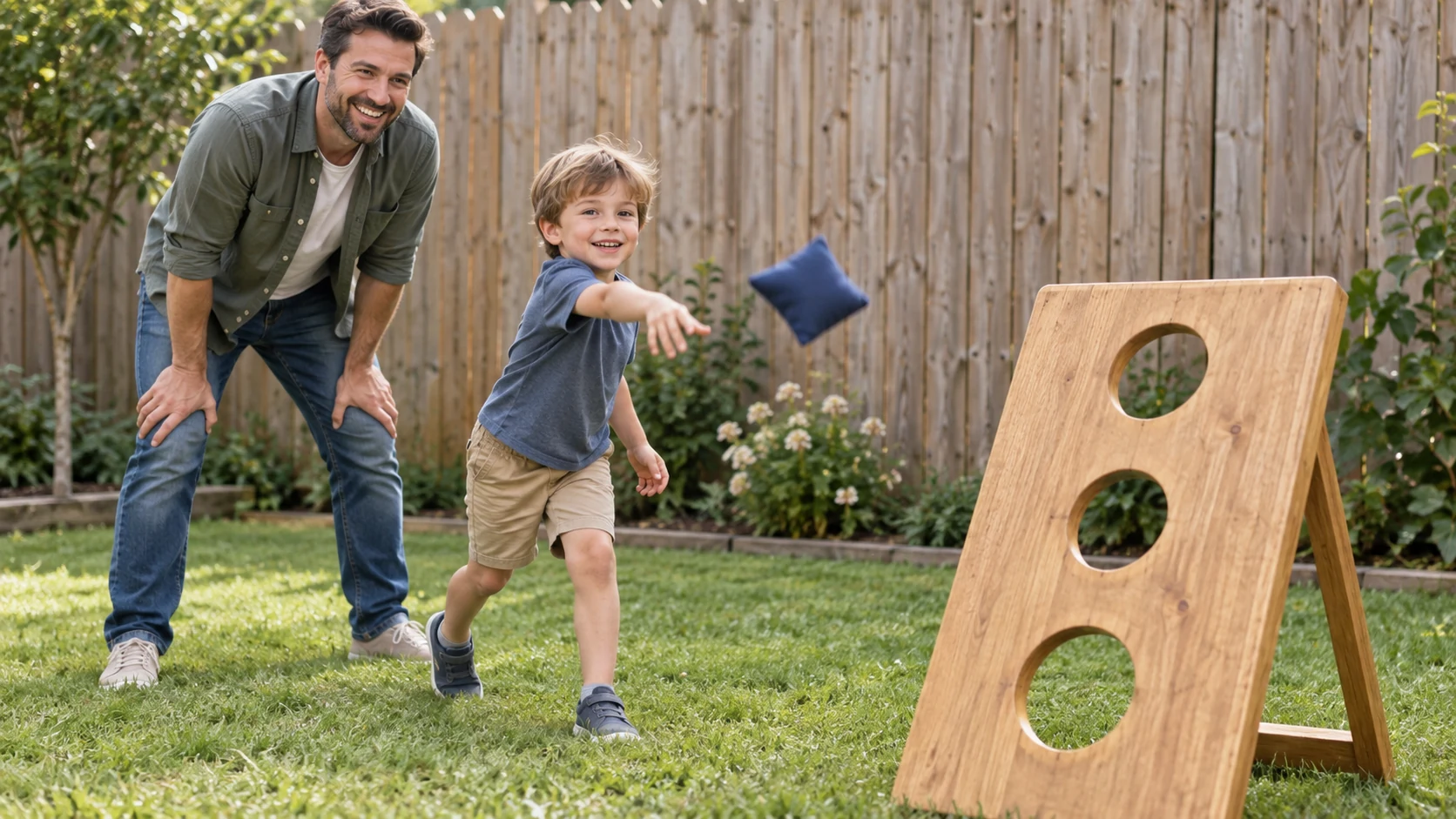
Corn Sack Toss. Station: plywood leaned on a hay bale with three holes cut in it, plus six small fabric sacks filled with dried corn. Turn: three throws, forty seconds. At once: one thrower, one on deck. Operator: one adult who gathers sacks and calls the count. Scoring: holes worth one, three and five by size, marked on the visitor's card.
Bucket Ladder. Station: five buckets in a line, near to far, a number chalked on each, and three small dried gourds. Turn: three throws, thirty seconds. At once: one, or two with two lanes. Operator: one, and a teenager can hold it. Scoring: the number on the bucket that catches the throw, with the far bucket nearly impossible on purpose.
Feed the Scarecrow. Station: a scarecrow of broomstick, straw and old clothes, with a wide basket hung at chest height. Turn: four throws, forty five seconds. At once: one. Operator: one, standing to the side, never behind the target. Scoring: a landed throw is one point, the hat on top three.
Ring the Cornstalk. Station: three dried cornstalks pushed upright at different distances, five rings cut from stiff rope. Turn: five rings, one minute. At once: one. Operator: one, resetting rings between turns. Scoring: near stalk one, middle three, far five.
The failure mode of every tossing booth is the retrieval walk: if the operator crosses the throwing line to pick things up, the booth loses half its capacity. Put a low box behind the target and keep two full sets, so the next visitor throws while the last set is collected.
Hay Bale Stations for Wide Open Grass
Bale Vault. Station: three bales in a row with a gap between each, and a chalk start line. Turn: one run through, twenty seconds. At once: one runner, the next at the line. Operator: one adult at the far end, with a stated rule that bales are climbed over, never jumped from. Scoring: skip the stopwatch, completing the run is the reward.
Bale Maze. Station: eight to twelve bales arranged into a short corridor with two turns and a dead end, marked with paper arrows. Turn: a minute for a small child. At once: three or four inside at a stagger, the highest throughput on the field. Operator: one at the entrance counting people in, one at the exit if the maze is big enough to lose a toddler in. Scoring: a stamp at the exit.
Hay Needle Hunt. Station: one opened bale spread inside a shallow tub, twenty numbered wooden pegs hidden in it. Turn: thirty seconds of digging. At once: two or three around the tub. Operator: one, rehiding pegs and enforcing the time. Scoring: pegs found, then dropped back into the straw.
Straw scratches and travels, so keep the hunt tub away from the food area, and put a broom at the station from the start rather than borrowing one at the end.
Let the Place Count for Something
VISU connects rewards to verified presence at partner locations. If the community is already gathering somewhere on the map, the bonus comes from showing up, not from spending more.
Apple and Orchard Stations Without a Water Barrel
Apples carry the season better than anything on the table, but the barrel of shared water is a conversation most organisers would rather skip. These three use the fruit without it.
Hanging Apple Bite. Station: a broomstick laid between two chairs, three apples on strings at different heights. Turn: fifteen seconds, hands behind the back. At once: three. Operator: one, swapping in a fresh apple for each new player. Scoring: a bite taken is a win, no points needed.
Apple Roll. Station: a plank propped on a bale, a chalk target circle at the bottom, three apples. Turn: three rolls, forty seconds. At once: one. Operator: one at the bottom returning apples. Scoring: inside the circle three points, on the line one. Apples roll unpredictably, which is why it works.
Apple Stack. Station: a flat board on the grass and a crate of firm apples. Turn: sixty seconds to stack as high as possible. At once: two, on separate boards. Operator: one, counting the standing apples as they collapse. Scoring: the day's highest count on a whiteboard, so people come back later.
Bruised apples from a local grower work for everything except the biting station, which needs firm clean fruit and a bin beside it.
Scarecrow and Dress Up Stations That Reset in Seconds
The scarecrow is the character the season owns outright, and dress up stations are the ones parents photograph. The design problem is the reset: a station taking two minutes to rebuild cannot hold a line.
Dress the Scarecrow Race. Station: two identical piles of oversized clothes, a hat and a scarf on separate tables, a broom handle stand for each. Turn: ninety seconds. At once: two, racing side by side. Operator: one, tipping both piles back into shape as the next pair steps up. Scoring: first fully dressed figure wins.
Scarecrow Says. Station: a marked square of grass, nothing else. Turn: two minutes for a whole group. At once: ten to twenty, the pressure valve when a neighbouring booth backs up. Operator: one volunteer with a loud voice. Scoring: last three standing get a stamp, then restart with whoever is there.
Photo Corner. Station: a bale, a scarecrow, a few gourds and a painted board with face openings cut into it. Turn: forty seconds. At once: one family. Operator: none, or one at peak. Scoring: none, and the station with no game is reliably among the busiest.
Leaf and Foraging Stations for the Youngest Line
You need stations a three year old finishes without help. Leaves, acorns and pinecones cost nothing, and the youngest visitors give up on the field entirely if every booth defeats them.
Leaf Match. Station: ten pressed leaves taped in a row on a table and a basket of loose matching leaves. Turn: thirty seconds to match five. At once: three or four along the table. Operator: one, returning leaves to the basket. Scoring: a stamp for finishing.
Acorn Scoop. Station: a tub of acorns, a wooden spoon, an empty jar a step away. Turn: thirty seconds, one spoonful at a time. At once: two, with two tubs. Operator: one, resetting the jar. Scoring: acorns in the jar, counted aloud, which small children enjoy more than the game itself.
Pinecone Bowling. Station: ten plastic bottles part filled with sand as pins, two large pinecones as balls. Turn: two rolls, forty seconds. At once: one lane, two with space. Operator: one resetting pins, the job for a volunteer who wants to sit. Scoring: pins down.
If weather forces the festival indoors, our list of indoor activities for kids covers the same age band with what a hall already has.
Quiet Stations for the Corner With No Traffic
Harvest Word Table. Station: printed word grids and pencils. Turn: as long as they want. At once: six or eight seated. Operator: one handing out sheets. Scoring: none. It is a rest station wearing the costume of a game, and a jar of prompts such as these would you rather questions for kids keeps the table busy without a volunteer.
Guess the Gourd. Station: five squashes on a table with a scale and numbered cards. Turn: thirty seconds. At once: three. Operator: one, revealing weights on the hour. Scoring: order the gourds by weight, a stamp for a correct order.
Scoring, Tickets and Prizes That Do Not Stall the Line
The fastest system is a card the visitor carries: one index card per person, gridded with station names, marked by each operator with a stamp or a cross. No names, no totals, no arithmetic at the booth. A full card, or any eight stations, is exchanged at one central table where counting happens away from the games. If you sell tickets to fund the event, sell them at the gate and let each station drop one per turn into a tin: the moment a booth makes change it stops being a game station.
Keep prizes small and non competitive. A single item chosen from a bin beats a tiered prize wall, because tiers create negotiation exactly where the day should end smoothly. For a headline prize, run one draw at an announced time, free to enter with a completed card, never one that requires buying an entry.
Announce last call for stamps fifteen minutes before the prize table closes, or the final rush hits one volunteer all at once.
Running the Field: Volunteers, Layout and Weather
Assume one adult per station and build every game to survive that. The operator keeps the line in one visible file, explains the rules in under ten seconds, resets the equipment, marks the card. Write the rules on a card taped to the table anyway: it halves the explaining and lets a substitute take over cold. Schedule breaks in ninety minute blocks and appoint one floater who walks the field and stands in, or you lose stations one by one from the second hour. Teenagers run the mechanical stations well; keep adults on the youngest children, the biting station and the prize table.
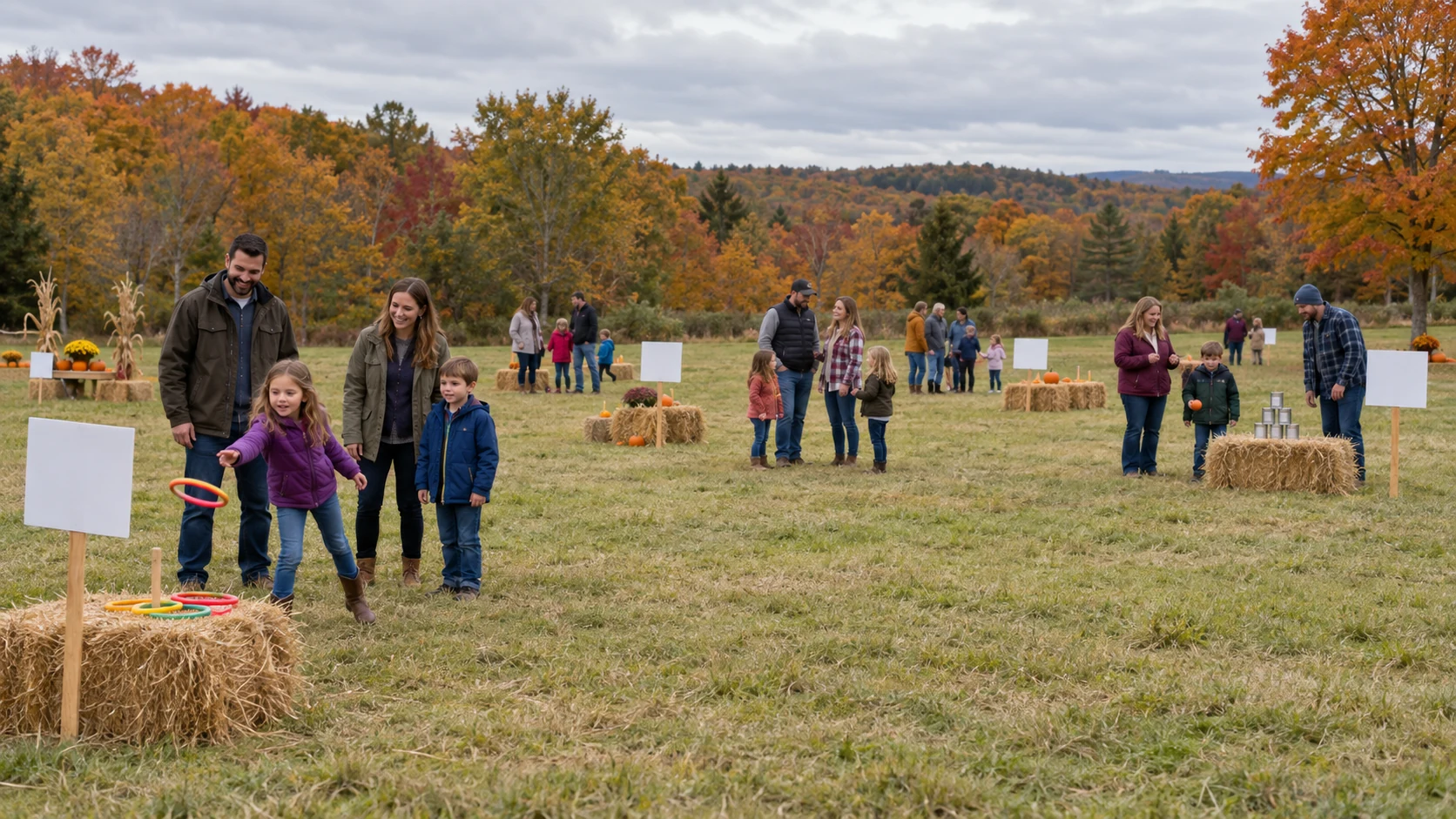
Draw the field on paper before anyone carries a table. The most common mistake is placing the two most popular stations side by side, merging their lines into a crowd where nobody knows what they are waiting for. Spread the favourites to opposite ends, mark each line direction away from walkways, and leave a wide central lane so strollers and wheelchairs cross without threading through a queue. Put throwing stations along one edge with their backs to a fence, never where a stray throw lands in another line. One sign per station plus a numbered map at the entrance is half the layout.
Autumn afternoons turn, so decide in advance which stations survive rain: paper stations and guessing jars go first, tossing and hay stations carry on. Wind is the underrated one, since signs fly and light targets fall on their own. If the festival runs to dusk, schedule the stations needing aim early. Plan teardown as a station of its own, with named people, before the first visitor arrives.
A Reward Tied to Showing Up
VISU is built around presence: a code at a partner location, a scan, a small reward for having been there. No purchase, no receipt, no profile to fill in first.
FAQ
How many game stations does a fall festival need?
Count on one station per twenty five to thirty expected visitors to keep lines under five minutes, plus a low equipment station like the word table that absorbs overflow without taking ground.
What makes a game unsuitable for a festival booth?
Fixed teams, a long round, or a rule taking more than ten seconds to explain. Those three turn a booth into a bottleneck.
How do you handle very different ages in the same line?
Give the station two throwing lines or two target sizes and let people choose without asking. Announced kiddie versions get refused by exactly the children who need them.
What can you use instead of apple bobbing in a barrel?
Hang apples on strings and swap in a fresh one for each player, or use rolling and stacking games that keep the fruit dry.
Do you need prizes at every station?
No. One stamp per station and one prize table at the end is faster to run and easier to fund.
How long should a fall festival run?
Two to three hours lets visitors complete a card without the volunteers burning out, and finishes before the light goes.
Can these games run indoors?
Tossing, bowling, matching and guessing stations move indoors with shorter distances. Hay stations and anything scattering straw are better left outside.
References
- Harvest festival, Wikipedia. Supports the statement that a harvest festival is an annual celebration that occurs around the time of the main harvest of a given region, and that such festivals fall at various times in different places because climate and crops differ around the world.
- The games, station specifications, staffing model, layout guidance and scoring system are original editorial material written for this article. They make no statistical, psychological, developmental or health claim, and no product, brand, store or price is named.