

A Halloween activity for a three-year-old is not a craft and not a party game: it is a station in the room where a child moves, touches, sings, listens or helps, and the result is the doing, not an object to take home. This list is built the way a preschool day is built, by station and by centre, for children roughly three to five.
Each activity below has a setup, what the adult does, what the child does, the materials, and a time that is an estimate, not a rule. Everything comes from the kitchen, the classroom cupboard or the garden. Nothing here needs a costume, a candle or a scary voice: the tone is pumpkins and bats, not fright.
One Link for the Whole Halloween Morning
A short address you control, holding the photos of the stations and the list of what you want to run again next year.
Before You Start: Ages, Rooms and Safety
Three to five is a wide band. A three-year-old at the pumpkin table will mostly scoop and squeeze; a five-year-old will count seeds and want to run the station. The adult adjusts the ask, not the material. Where an activity needs one more year, it says so.
The safety rules followed on every station are specific, and they come from sources, not from feel.
Small parts. Penn State Extension's Better Kid Care programme gives the limit: "All items used for children under three years of age and any children who put toys in their mouths should be at least 1¼ inch in diameter and between 1 inch and 2¼ inches in length." Note the second condition. It covers any child who still mouths things, whatever their age. The same source names items that "should not be accessible to children under three," including "button batteries, magnets, plastic bags, styrofoam objects, coins, balloons, latex gloves, and glitter." So there are no balloons and no glitter at any station here.
Seeds and food. The American Academy of Pediatrics lists "nuts and seeds (especially sunflower seeds)" among foods to avoid or modify for young children and advises keeping high-risk foods from children "until 4 years of age or older, depending on each child's development and maturity level." At the pumpkin station, seeds are for scooping and looking, and the adult holds the bowl. They are not for eating on the day.
Knives and candles. The AAP's Halloween guidance is to "allow small children to decorate (not carve) pumpkins" and to "leave the carving and cutting to the adults," and to "consider using a battery-operated flameless candle, flashlight or glow stick instead of a candle." Here the adult opens the pumpkin before the children arrive, and there is no flame anywhere in the room.
Floor and running. Movement stations are walking stations. Nothing below is a race, and the floor is cleared before the first monster walks.
Movement Stations
Big-space stations. Clear a lane the length of the room, or use the hall or the yard.
1. Monster Walk. Setup: tape a start line and a finish line on the floor, a room apart. Materials: masking tape. The adult stands at the finish and calls a creature, one at a time: a slow mummy with straight legs, a cat on all fours, a bat with arms wide, a giant pumpkin rolling on the spot, a tiny spider low to the ground. The children cross the room as that creature and wait for the next call. The adult ends with "sleepy ghost", the slowest of all, so the group arrives calm. Estimated time: 10 minutes. Works from age three.
2. Pumpkin Carry. Setup: a basket of small pumpkins or oranges at one end of the lane, an empty basket at the other. Materials: two baskets, one small pumpkin per child, a tray or a wooden spoon for the older ones. The adult shows the walk once: two hands under the pumpkin, walking, never running. The child carries a pumpkin to the far basket and walks back for the next. Four-year-olds can carry it on a tray; five-year-olds can balance a satsuma on a spoon. It is not a race, and it ends when the first basket is empty. Estimated time: 10 minutes.
3. Bat Wings. Setup: a scarf or a strip of light fabric for each child. Materials: scarves, tea towels or lengths of old sheet. The adult holds two corners of a scarf at shoulder height and shows "wings down, wings up" without letting go. The children copy, then fly a slow lap of the room, then hang upside down (bend over, arms dangling) when the adult says "bats sleep". Repeat with "bats wake up". Estimated time: 8 minutes. Works from age three.
Exploring the Pumpkin
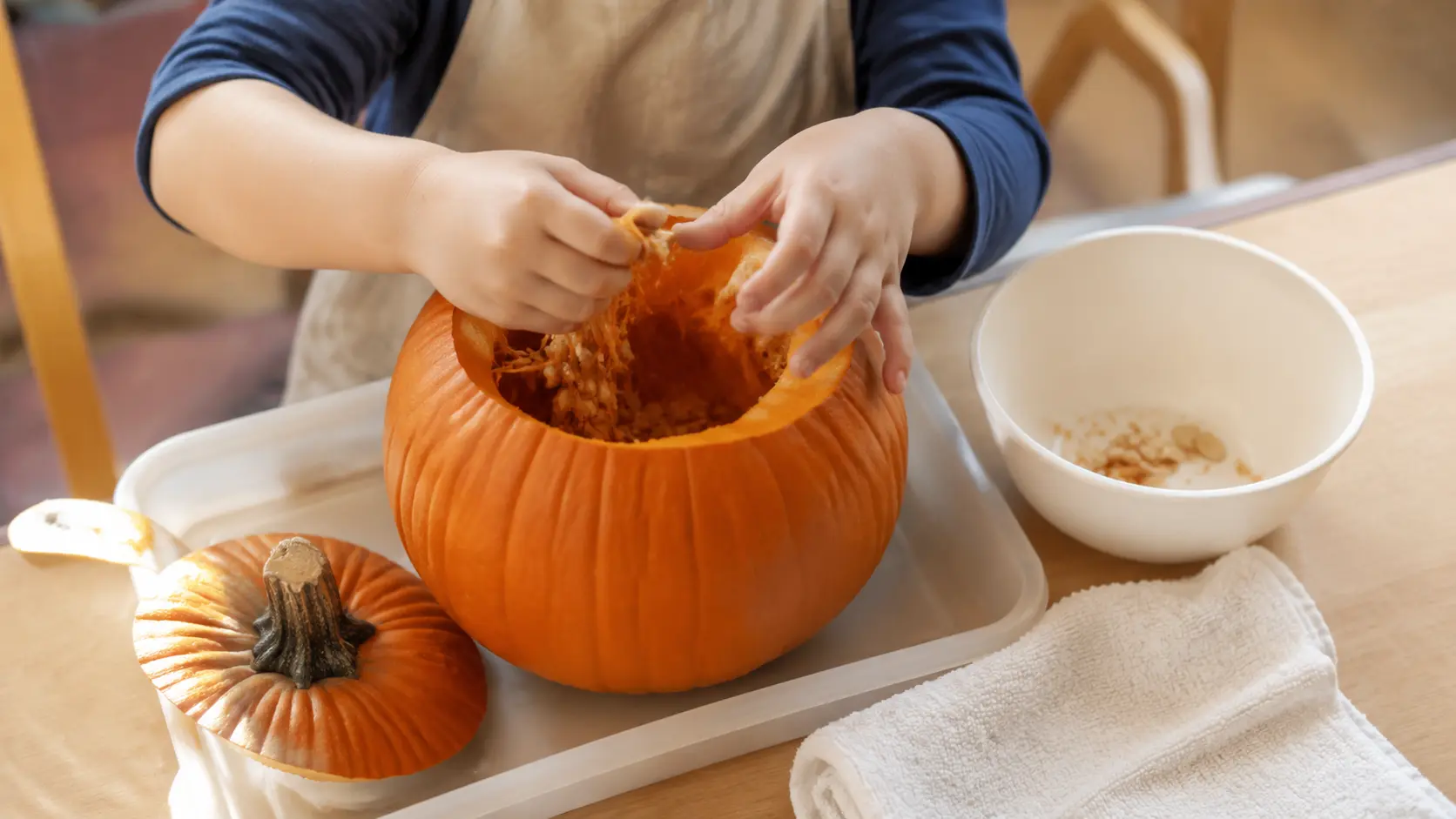
One real pumpkin, opened by the adult before the group arrives, and several small ones that stay whole. This is the wettest station: tray, towel and a bowl of water nearby.
4. Inside the Pumpkin. Setup: the adult cuts the lid off a medium pumpkin at home or before the session, using a proper knife, with no children present, and puts the pumpkin on a large tray. Materials: one pumpkin, a tray, big spoons, a bowl for seeds, a bowl for the stringy flesh, a towel. The adult opens the lid, describes what is inside in plain words (wet, stringy, cold, seeds), and keeps the seed bowl on their own side of the table. The child scoops with a spoon or with hands, pulls the strings apart, drops seeds into the seed bowl and flesh into the other. Seeds go to the adult and are not eaten on the day (see the safety section). Estimated time: 15 minutes per group, and the pumpkin lasts the whole morning.
5. Pumpkin Wash. Setup: a washing-up bowl a third full of water on a towel, three or four small pumpkins that stay whole, and a vegetable brush or nailbrush per child. Materials: bowl, water, small pumpkins, brushes, a towel for drying. The adult sets the bowl low and shows "brush, dip, brush". The child scrubs the pumpkin, turns it, and puts it on the towel when it is clean. The pumpkins from this station go to the carry station or to the display afterwards. Estimated time: 10 minutes. Works from age three.
Keep the Stations You Will Run Again
Photograph the setup, note what worked with your group, and keep it behind one address you can share with the other adults.
Music and Circle Time
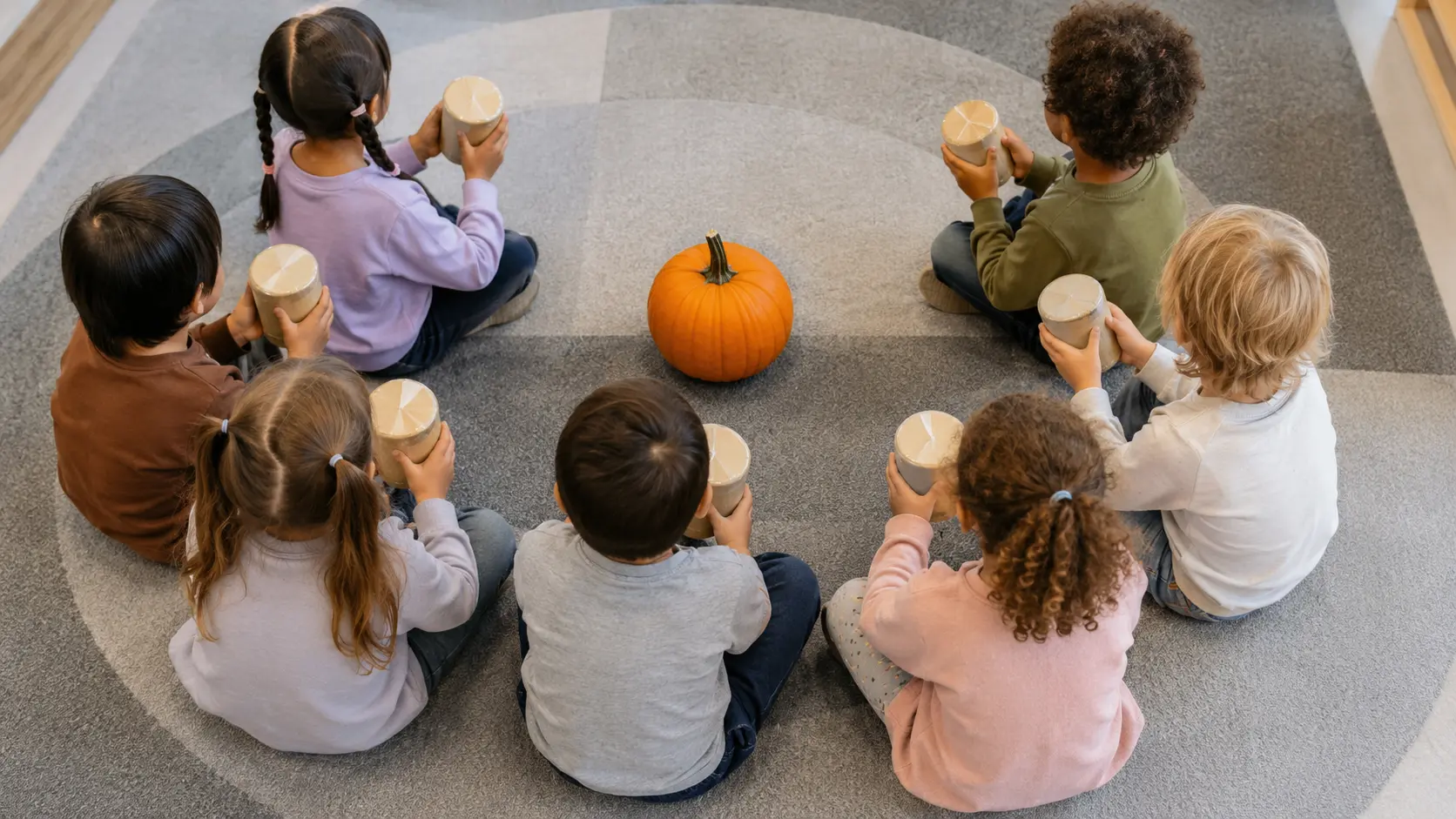
Circle stations need a rug and a group that sits. None of them needs a recording or a bought instrument: pots, spoons and rice in a sealed tub cover all of it.
6. Loud Monster, Quiet Ghost. Setup: a shaker per child, made in advance by the adult from a screw-top tub with a handful of rice inside and the lid taped shut. Materials: small tubs with lids, rice, tape. The adult holds up a picture of a monster (or just says the word) and the children shake as loud as they can; then the ghost, and they shake as softly as they can while still making a sound. The adult ends on the ghost and every shaker goes on the floor. The tape stays on the lids and the adult checks it after each group. Estimated time: 8 minutes. Works from age three.
7. Cauldron Rhythm. Setup: a large pot upside down in the middle of the circle and a wooden spoon for the adult. Materials: a pot, wooden spoons, the children's laps or the floor for the copy. The adult taps a short pattern on the pot (one, two, one-two-three) and the children tap it back on the floor. Older children take turns being the one at the pot. The pattern never gets longer than four beats. Estimated time: 8 minutes.
8. Ring Around the Pumpkin. Setup: one pumpkin in the middle of the rug, the children in a circle holding hands. Materials: one pumpkin. Everyone walks round the pumpkin while the adult sings any tune the group already knows with the words swapped for pumpkins and bats. When the adult calls "pumpkins fall down", everyone sits. When the adult calls "pumpkins grow up", everyone stands and the circle turns the other way. Estimated time: 6 minutes. Works from age three.
Story Time With a Part for Everyone
A story at this age holds the group when every child has a job in it. The stories below are told by the adult, not read, so any short plot works: a pumpkin looking for a friend, a bat who lost its cave, a cat walking through a house at night.
9. Sound Jobs. Setup: the adult decides on three or four sounds the story will need and gives each child one: the wind ("whoosh"), the owl ("who"), the door ("creeeak"), the cat ("meow"). Materials: none. The adult tells the story and pauses at each cue with a look at the child who owns it; that child makes the sound and the story goes on. With a group of more than six, two or three children share a sound. Estimated time: 10 minutes. Works from age three.
10. The Feely Bag. Setup: a cloth bag or a pillowcase with five objects inside that appear in the story: a small pumpkin, a dry leaf, a scrap of soft fabric for the ghost, a smooth stone, a pine cone. Materials: a bag and five objects, each bigger than the small-parts limit in the safety section. The adult tells the story, and when an object appears in it, a child reaches into the bag without looking and finds it by touch. The adult gives a clue ("it is cold and smooth") if the hand comes out with the wrong one. Estimated time: 10 minutes.
The Photos From the Day, in One Place
One link that the other adults can open on a phone, with the stations, the story and the pumpkins on the windowsill.
Simple Cooking With an Adult
Kitchen stations here have no oven, no knife in a child's hand and no recipe longer than three steps. Before the day, the adult asks every family about food restrictions and plans the plates around the answers.
11. Fruit Faces. Setup: a plate per child and bowls of prepared fruit: satsuma segments, banana slices, thin apple slices cut by the adult, and halved grapes cut lengthways by the adult. Materials: fruit, plates, spoons. The adult does all the cutting in advance, following the AAP guidance that round, firm foods such as grapes "can be served if completely chopped into tiny pieces," and puts one bowl of each fruit in the middle. The child builds a face on the plate: a satsuma segment for a mouth, banana slices for eyes. Then eats it. Estimated time: 12 minutes. Works from age three with the adult doing every cut.
Simple Hunts Around the Room
Hunts for this age are short, in one room, with the things hidden at child height, in plain sight or nearly.
12. Ten Pumpkins. Setup: the adult cuts ten orange paper circles the size of a hand before the session and tapes them around the room, half fully visible, half tucked behind a chair leg or under a table edge. Materials: orange paper, tape, a basket. The children find them and bring each one to the basket. The group counts the basket together after every find, and stops at ten. Estimated time: 8 minutes. Works from age three.
13. Where Is the Shaker? Setup: the children cover their eyes on the rug while the adult hides one shaker from the circle station somewhere in the room. Materials: one shaker. The adult gives it a single shake from the hiding place, then the children look. Whoever finds it hands it to the adult, and the adult hides it again. Three rounds and the station ends. Estimated time: 6 minutes.
If Halloween Is New Where You Live
None of these stations depends on trick-or-treating, a costume parade or a neighbourhood that decorates. They are a morning of pumpkins, bats and cats in a room, and they run as an autumn week in any preschool or as a themed morning at home with two or three families.
If the date is not marked where you live, the same stations run as an autumn theme without the word Halloween: the pumpkin table, the leaf in the feely bag and the fruit faces are seasonal, and the monster walk is a slow-animal walk with the mummy left out.
Running the Stations: Rotation, Time and Cleanup
Four stations, not thirteen. Pick one from each of four categories for a single session: one movement, one pumpkin, one circle, one story or kitchen. Thirteen is a menu for the season, not a morning.
Rotate in small groups. Four to six children per station, an adult at the wet station and the kitchen station, and the movement station last so the group is not asked to sit still after it.
Say the end out loud. Every station above has an ending built in: the basket is empty, the tenth pumpkin is found, the shaker has been hidden three times. Say it before starting, so nobody has to be pulled away.
Wet station on a towel, on a hard floor. Pumpkin flesh on a rug is the one cleanup that takes longer than the activity.
Reset between groups. Carry the pumpkins back and refill the fruit bowls; the older children can do it with you.
Photograph the setup, not the faces. A photo of the pumpkin table before the first group arrives is what you need to run it again next year, and it needs no permission from any family. The basics of framing apply as much to a classroom table as to anything else.
FAQ
What are good Halloween activities for preschoolers?
Station activities where the child moves, touches or joins in: a monster walk, scooping a pumpkin the adult has opened, a circle game with shakers, a story with a sound for every child, and a short hunt for paper pumpkins around the room. Each one above has a setup, an adult role and a child role.
What Halloween activities can a three-year-old do?
The ones marked "works from age three": the monster walk, bat wings, the pumpkin wash, loud monster and quiet ghost, ring around the pumpkin, sound jobs, fruit faces with the adult cutting, and the ten pumpkins hunt.
Can preschoolers carve a pumpkin?
No. The American Academy of Pediatrics advises letting small children decorate rather than carve and leaving the carving and cutting to adults. Here the adult opens the pumpkin before the session and the children scoop.
Can preschoolers eat the pumpkin seeds?
Not at the station. The AAP lists nuts and seeds among foods to avoid or modify for young children and advises keeping high-risk foods from children until four years of age or older, depending on the child. The seeds stay in the adult's bowl.
Are Halloween activities for preschoolers too scary?
They do not need to be. Nothing above uses a dark room, a scream or a jump. The creatures are pumpkins, bats, cats, owls and a sleepy ghost, and the stories are told by the adult, who can drop anything a particular child does not like.
How long should a Halloween session last for preschoolers?
Four stations of eight to fifteen minutes each, with a rotation, fills about an hour including resets. The times above are estimates; the ending of each station is what tells you it is done, not the clock.
References
- Penn State Extension, Better Kid Care: Arts and creativity in three- and four-year-olds. The small-parts size limit for children under three and any child who mouths objects, and the list of items that should not be accessible to them, including balloons and glitter.
- American Academy of Pediatrics, HealthyChildren.org: Halloween Safety Tips. Small children decorate rather than carve pumpkins, carving and cutting left to adults, and flameless lights instead of candles.
- American Academy of Pediatrics, HealthyChildren.org: Choking Prevention. Nuts and seeds among foods to avoid or modify for young children, high-risk foods kept from children until four or older, and round firm foods such as grapes served only chopped into tiny pieces.