
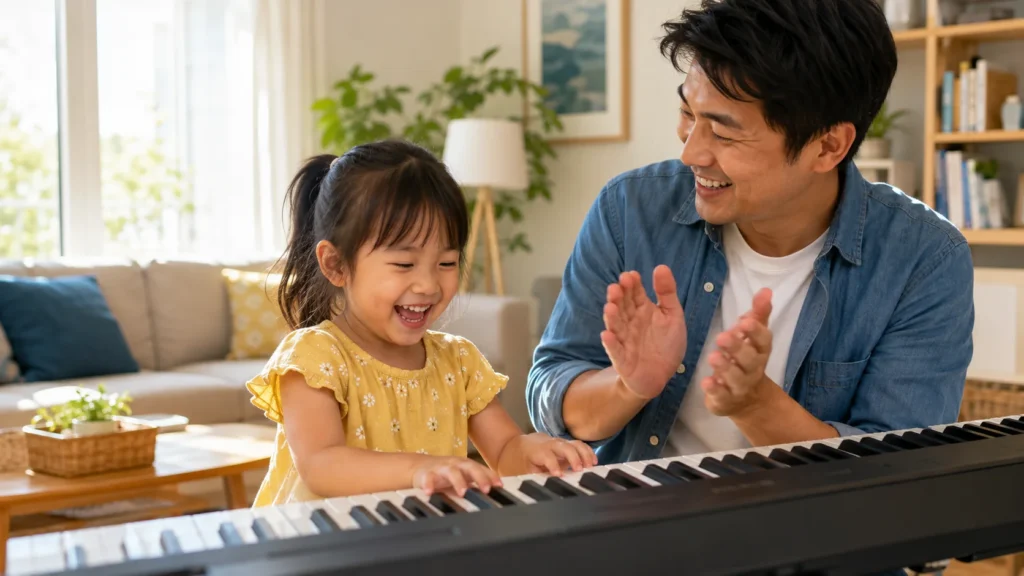
A song that is easy for an adult beginner is not automatically easy for a child. Small hands, short attention spans and ears that already know certain tunes change the answer completely. This guide organizes easy piano songs by the child's stage rather than by difficulty level, and adds the practice games that keep a six-year-old at the keyboard after the novelty wears off.
Every song here is either a verified traditional tune, where we can show you the opening notes, or a modern title named for reference only, to be learned from a licensed beginner arrangement. For the general path that adult beginners follow, and everything about fundamentals, our level-by-level guide to easy piano songs is the parent page of this one.
One Link for the Whole Family's Music
A short address you control, pointing to recital clips, practice videos and pages wherever they live.
What Makes a Song Easy for a Child, Specifically
The checklist is physical and cognitive, not musical. Hand span: a child's hand may not reach an octave, so any song demanding stretches beyond five adjacent keys is out, no matter how few chords it has. One five-finger position: a melody that lives under one resting hand removes the hardest early skill, shifting, entirely. Stepwise motion: neighboring notes beat leaps, because a small hand does not have to relocate and re-aim. Repetition: a repeating phrase means the child learns one thing and receives a whole song; repetition is motivation, not laziness. Already known by ear: a child who can sing the tune self-corrects, and this is the single biggest predictor of a song getting finished. It is also why the songs a child already sings at school beat any imported list. Short: a piece that ends before attention does gets finished, and a finished song is the reward loop. And one hand at a time is fine; insisting on two hands early is an adult-shaped expectation.
Before the First Song: What a Child Actually Needs
Surprisingly little. Seat height matters more than the instrument: forearms roughly level with the keys, feet supported, so the hand rests on the keyboard instead of hanging from it. A full 88-key instrument is not required for anything on this page, and weighted keys, valuable later, are not what decides whether a five-year-old comes back tomorrow. Reading notation is not a prerequisite either; every early song here can be learned by ear and by watching. When the fundamentals questions get bigger than that, they belong to the beginner pillar, not to this page.
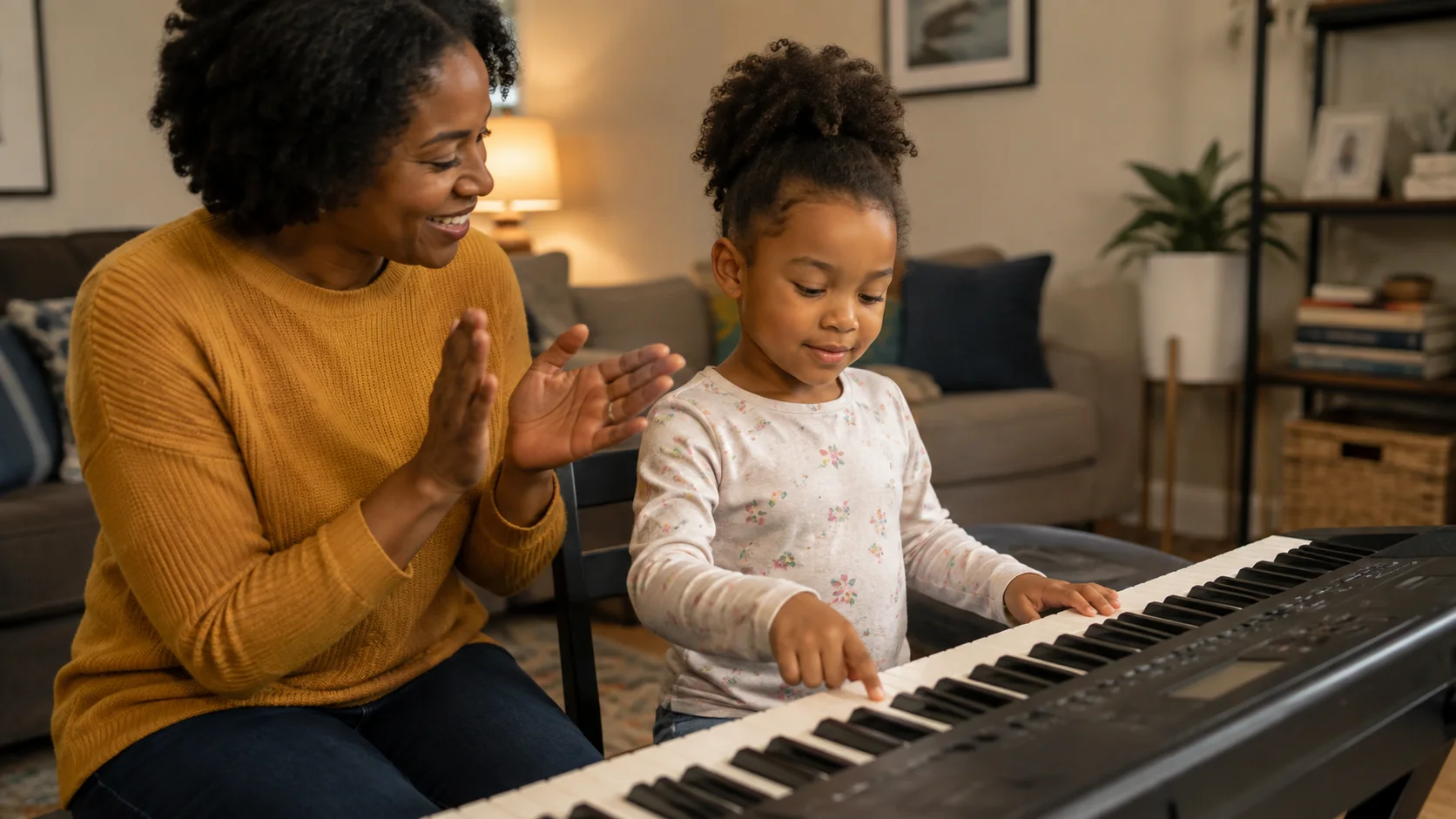
Roughly Ages 3 to 5: Exploring, Not Studying
A rough orientation, not a threshold: children vary widely, and a nine-year-old starting from zero happily begins here too. At this stage the goal is keyboard familiarity and pattern play, framed as games with a musical outcome. The tunes are traditional, tiny and singable:
"Hot Cross Buns." Three neighboring notes, and the hand never moves. Opening phrase: E, D, C. The canonical first tune for exactly that reason. "Mary Had a Little Lamb." Lives inside one five-finger position, all steps, and nearly every child already sings it. Opening: E, D, C, D, E, E, E. "Twinkle, Twinkle, Little Star." The melody is the 18th-century French tune "Ah! vous dirai-je, maman," the same one Mozart wrote variations on, and it carries different words in different languages, a fun fact children love. Opening: C, C, G, G, A, A, G. "Row, Row, Row Your Boat." Short, repetitive, singable while playing, and being a round it invites turn-taking with an adult. Opening: C, C, C, D, E.
Roughly Ages 6 to 8: The First Real Songs
Around here a full simple melody in one hand becomes achievable, and a very simple left hand can join in. The picks keep the five-finger bias and add length through repetition:
"Frère Jacques." Four short phrases, each sung twice: learn a quarter of the song and own half of it. Opening: C, D, E, C. "Old MacDonald Had a Farm." Built-in participation loop; the animal sounds keep a young child engaged where a through-composed tune loses them. "London Bridge Is Falling Down." Compact range, repeating phrase, known by ear. "This Old Man." The refrain returns identical every verse, a long song for a short amount of learning. "Au clair de la lune." An 18th-century French song with a very small, slow, stepwise melody, and a strong candidate for a first two-hands attempt because the right hand asks for so little.
Keep the Practice Wins in One Place
Link recital clips, progress videos and favorite tutorials from one short address.
Roughly Ages 9 and Up: Two Hands and Real Pieces
Hand span is usually adequate now, attention is longer, and the motivator changes: a nine-year-old wants to play something that sounds like a piece, not a nursery rhyme. "When the Saints Go Marching In" is the bridge, brisk and satisfying, the first tune on this list that feels like a performance. "Ode to Joy," the theme from Beethoven's Ninth Symphony of 1824, is the payoff pick: for an older child, playing recognizable Beethoven delivers a motivational jolt no exercise can, and the melody stays almost entirely stepwise inside one position. "Alouette" adds a brisk, cumulative French singalong known across markets.
And yes, at this age children start asking for current songs. "Let It Be" (The Beatles) works because it is commonly played in C major with a small chord set and a left hand that can stay put, small-hand friendly. For modern songs, get a properly licensed beginner arrangement, from a method book, a licensed digital sheet service or the child's teacher, and see our easy pop songs on piano list for where that road leads next. For public-domain repertoire, the IMSLP library is the honest free source.
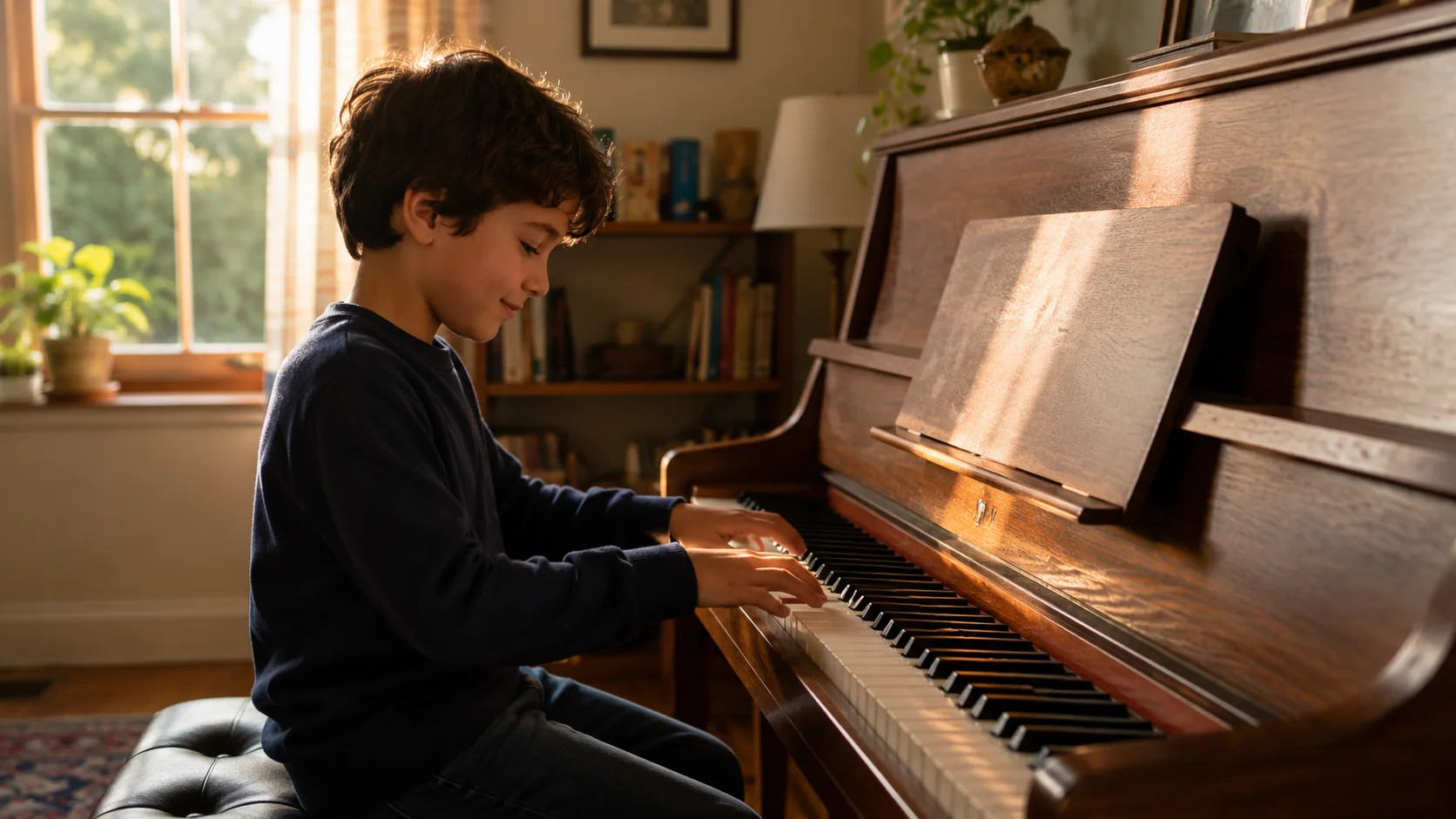
Practice Games That Work With a Short Attention Span
Give practice a finish line. A game with a visible end gets finished; open-ended "go practice" does not. Play along, do not supervise. The adult plays one phrase or one hand and the child answers; turn-taking keeps a child engaged long after solo repetition loses them. Echo games: play a short phrase, the child repeats it by ear, listening before reading, no notation needed. This is the same instinct behind the ear-first Suzuki method. Name-the-key race: call a key, the child finds it fast, and keyboard geography becomes a race instead of a drill.
Sing it first, play it second: if the child can sing the phrase, the hand has a target. Loop the hard spot, not the whole song: restarting from the top after every mistake practices the opening ten times and the hard bar once. Stop while it is still going well: ending on a success is what makes the child want the next session. Let the child pick from a shortlist you curated; ownership of the choice is most of the motivation. On session length, keep it qualitative and honest: short and frequent beats long and rare, several small sessions across a week beat one big one, and stopping before the child wants to stop is the whole trick.
When to Start Lessons, and the Mistakes That Make Children Quit
Readiness shows up as observations, not test scores: the child returns to the instrument unprompted; can follow a two-step instruction; gets frustrated at not sounding like what they hear, which is a good sign, because it means an internal standard exists. When those appear, a teacher multiplies progress, and a directory like the Music Teachers National Association is a reasonable place to start looking. How long the whole journey takes varies so much per child that any number would be a guess, and we will not guess.
The quitting patterns are predictable: pushing two hands too early; correcting every wrong note; choosing the parent's favorite song over the child's; turning practice into a chore with a required duration; letter-note stickers and letter-note tutorials, a shortcut that transfers nothing to the next song; comparing siblings; and abandoning a song as "too easy" when repetition is exactly what is building the hand. A child who quits has not failed, and neither have you; usually the game just needs changing. For the fundamentals behind all of it, the level-by-level beginner guide is the next read, and when December comes, the easy Christmas piano songs list runs on these same small hands.
Share the Recital, Not Ten Links
One VisuLink holds the practice clips, the recital video and everything else you share.
FAQ
What is the easiest song for a child to play on piano?
"Hot Cross Buns": three neighboring notes, one hand, and the hand never moves. "Mary Had a Little Lamb" follows immediately, still inside one five-finger position and already in most children's ears.
At what age can a child start learning piano?
There is no threshold. Around ages 3 to 5 the keyboard works as guided play; around 6 to 8 most children manage their first full melodies; formal lessons make sense when the child returns to the instrument unprompted and can follow two-step instructions. Children vary widely, and starting later loses nothing.
Should kids use letter stickers on the piano keys?
They feel helpful and teach the wrong skill. A child who reads stickers learns sticker positions, not music, and nothing transfers to the next song. Ear-first games and, later, real notation both transfer; stickers do not.
Why is "Happy Birthday" not on this list?
Its copyright story is genuinely messy: a 2015 US ruling found the claimed lyric copyright unproven, but the song was never simply declared public domain. Rather than wade into that, this list sticks to tunes whose traditional status is verifiable.
How long should a child practice piano each day?
Short and frequent beats long and rare, and the honest answer is qualitative: several small sessions across a week, each ending while it is still going well. A required daily minute count turns music into a chore, which is the fastest way to lose a child.