

The fastest way to quit piano is to pick the wrong first songs. The right ones sit under five fingers, repeat their patterns honestly and sound like music on day one. This guide organizes genuinely easy piano songs by level, from the first afternoon to the first recital-worthy piece, and explains what each one quietly teaches.
A note on how this list works: it names songs and tells you why each is easy, what hand position it wants and what skill it builds. It does not reproduce sheet music. The early levels lean on folk tunes and classical themes old enough to belong to everyone; for modern songs, look up a licensed beginner arrangement of the title once you know what to search for.
One Link for Your Whole Music Journey
A short address you control, pointing to your practice videos, recordings and pages wherever they live.
Level 1: The First Afternoon
Day-one songs share one trait: the right hand sits in C position, thumb on middle C, one finger per key from C to G, and never has to move. That constraint is a feature; with the hand parked, all attention goes to reading rhythm and pressing evenly.
"Ode to Joy" (Beethoven's theme) is the classic first melody for a reason: it starts on the third finger, moves in steps, and its opening phrase, E E F G G F E D, repeats immediately, so learning four bars gives you eight. "Mary Had a Little Lamb" and "Hot Cross Buns" are even smaller, three notes each, useful as the very first thing fingers ever play. "Twinkle, Twinkle, Little Star" adds the one octave-position stretch of the group and teaches the most common shape in folk melody: statement, answer, return.
Spend a few days here, not weeks. The goal of Level 1 is a hand that trusts its position and a rhythm sense that survives without stopping.
Level 2: The First Weeks, One Hand Leads
Level 2 keeps the melody in the right hand and adds the left hand in its gentlest form: single held notes or simple two-note intervals under the tune, changing once per bar at most.
"When the Saints Go Marching In" swings, which makes rhythm practice fun instead of dutiful, and its melody outlines the notes of a chord, quietly preparing harmony. "Amazing Grace" introduces triple meter, three beats per bar, and long sustained notes that teach counting through the note instead of past it. "Jingle Bells" earns its place as the first song most beginners can play for other people to applause, which matters more for motivation than any exercise.
Level 3: Both Hands Join
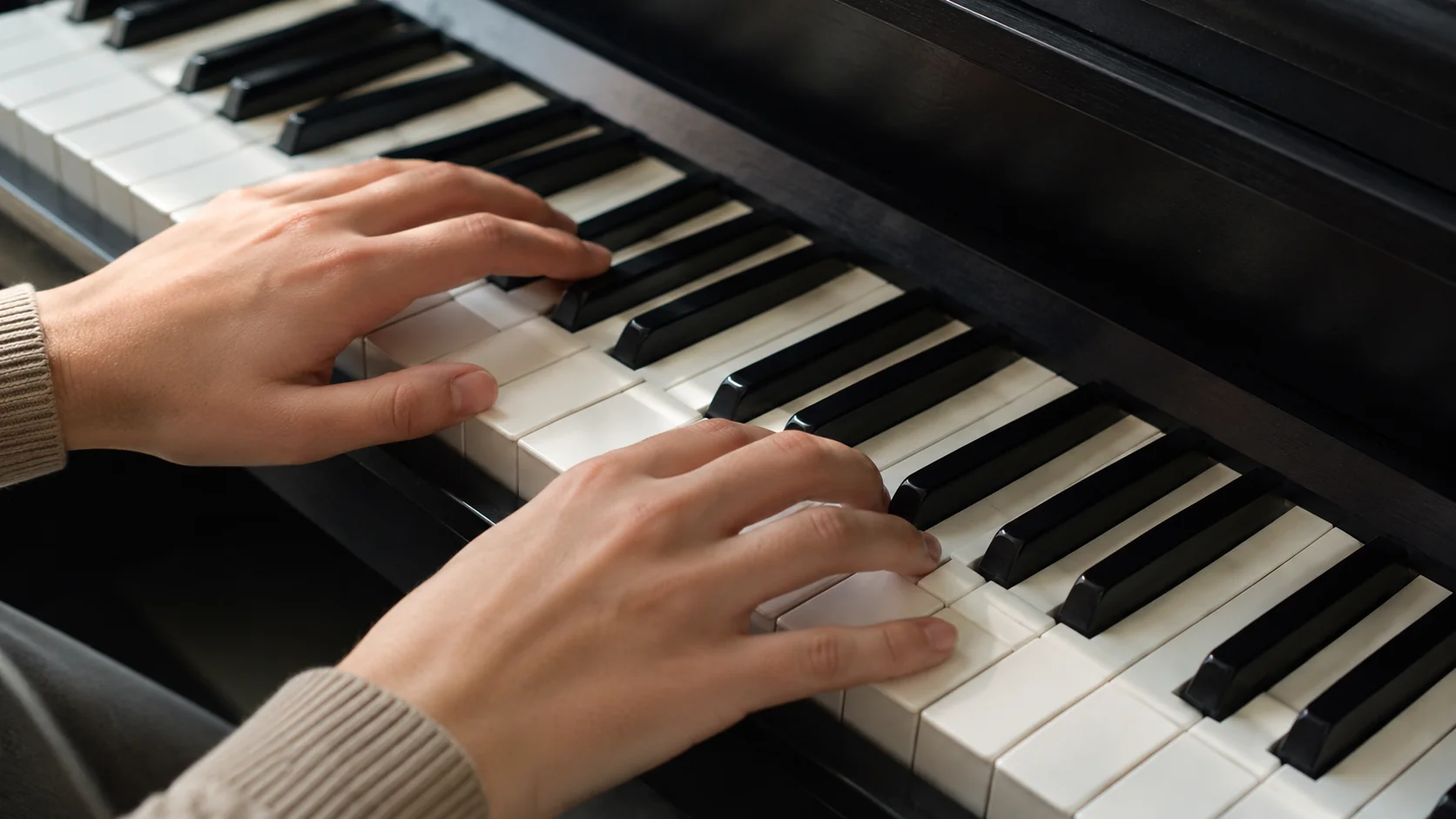
The wall every beginner hits is hands together, and the songs that get you over it are the ones where the left hand moves so simply it can run on autopilot.
"Scarborough Fair" uses a spare, haunting left hand under a stepwise melody, and sounds far more advanced than it is, the best effort-to-beauty ratio at this level. "Greensleeves" continues triple meter with a left hand of broken chords, arpeggiated one note at a time, the pattern that unlocks half of all pop accompaniment. "House of the Rising Sun" (the traditional song) runs the same broken-chord engine in a minor key with real drama. And "Silent Night" is the gentlest full hands-together piece in the common repertoire, slow enough that coordination has time to happen.
Keep Your Practice Log in One Place
Link your recordings, progress clips and favorite tutorials from one short address.
Level 4: The First Real Classics
These are the pieces that make a beginner feel like a pianist, and each has a famous section that is much easier than its reputation.
"Für Elise" (Beethoven), the opening section: the E to D-sharp alternation and the rolling phrase that follows lie beautifully under the fingers, and the right hand does most of the work over a sparse left. The full piece has harder middle episodes; the opening theme alone is a legitimate and complete-sounding goal. Pachelbel's "Canon in D" in a simplified arrangement: the left hand repeats the same eight-bass-note cycle for the entire piece, the definition of learn once, use forever. Satie's "Gymnopédie No. 1": slow, spacious and forgiving, its difficulty is patience rather than speed, and it teaches quiet control no fast piece can.
Level 5: Pop Songs That Actually Work for Beginners
Most pop music is friendlier to beginners than classical, for a structural reason: it is usually four chords cycling under a singable melody. The titles below are beginner staples because their piano parts are central and pattern-based; search each with "easy piano arrangement" and use a licensed beginner version.
"Let It Be" (The Beatles) is the canonical four-chord piano song, steady block chords under a melody everyone already knows. "Someone Like You" (Adele) runs a repeating broken-chord figure in the right hand that sounds impressive and loops all song. "Clocks" (Coldplay) is one arpeggiated pattern repeated with small changes, pure muscle memory. "All of Me" (John Legend) and "A Thousand Years" (Christina Perri) both build from slow broken-chord accompaniments that Level 3 already trained.
The skill this level really teaches is chord fluency: seeing C, G, Am, F and landing them without looking. That vocabulary, not any single song, is what lets you open a lyrics-and-chords page and simply play.
How to Practice a Song Without Hating It
Split by hands, then by phrases. Right hand alone until comfortable, left alone until boring, then together at a fraction of the target speed. Slow practice is not the punishment; it is the method.
Loop the hard two bars, not the whole song. Playing the piece from the top every time practices the parts you already know and rehearses the mistake at the same spot. Isolate the trouble bars, repeat them until smooth, then stitch them back in.
Finish sessions with something you can already play. Ending on a struggle files piano under frustration; ending on music files it under joy. Fifteen focused minutes most days beats a heroic weekend hour, every time.
Share Your Progress, Not Ten Links
One VisuLink holds your practice clips, your repertoire list and everything else you share.
FAQ
What is the easiest song to play on piano?
"Hot Cross Buns" or "Mary Had a Little Lamb": three notes, one hand position, learnable in minutes. "Ode to Joy" is the best first song that still feels like real music, stepwise, repetitive and instantly recognizable.
Can I learn these songs without reading sheet music?
You can start: the Level 1 tunes are learnable by ear and letter names, and this page gives the opening of Ode to Joy that way. Reading opens every level above it, and beginner arrangements are the gentlest place to learn it, so start reading with Level 2.
Is Für Elise really a beginner piece?
The famous opening section is within reach of a motivated beginner after a few months and sounds complete on its own. The full piece has middle sections that are genuinely harder. Learning the opening theme first is the standard and satisfying path.
How long until I can play a real song?
Something recognizable on day one with a Level 1 tune. A hands-together piece that sounds like music to other people typically arrives within the first weeks at Level 2 to 3, with short daily practice mattering far more than long rare sessions.
Do I need a full piano to start?
A 61-key keyboard covers every song on this list. Weighted 88-key instruments become worth it as dynamics and classical repertoire grow, but no Level 1 to 5 song here requires one to learn.