

Halloween Minute to Win It games turn paper cups, dish towels, cardboard and kitchen tools into a full set of sixty-second challenges. Every game below is designed for a home party, classroom or small group, with one clear rule and a finish that arrives when the timer rings.
The challenges are organized by material, so one supply box can serve several rounds. Each entry includes players, materials, setup, the rule, scoring, a kids' variation, an adults' variation and the space it needs. Pick a handful for a short tournament or set up parallel stations for a larger group.
When the Party Happens Somewhere Else
A Halloween party sometimes moves to a place nearby. At a VISU partner location, scanning the code turns the visit into a reward.
How the Sixty-Second Format Works
Every round uses the same clock: start together, play for sixty seconds and stop immediately at the signal. Explain the rule before starting, demonstrate one legal move, and decide how ties work. A kitchen timer with an audible signal lets players watch the challenge instead of a screen.
Use one of three scoring methods. For count, the largest number of completed moves wins. For finish, a player earns a point by completing the stated target before time ends. For head to head, two players face the same setup and the one further ahead at the signal wins. Every challenge below names its method.
A referee starts the clock, watches the rule and records the result. If an item falls after the signal, use its position at the signal. If the referee cannot tell who won, record a tie instead of changing the rule after the round.
Prepare the Room and Materials
Make a box for each station. Useful household materials include paper cups, paper plates, scrap paper, masking tape, cardboard tubes, clothespins, rolled socks, dish towels, wooden spoons, empty food containers, lids, a laundry basket and small cardboard boxes. Use only clean, dry containers with no sharp edges.
Mark start lines and target areas before anyone plays. Keep walking routes clear, place table stations far enough apart that elbows do not meet, and use the backyard only when the ground is dry and visible. There is no fire, candle or match in any challenge.
For young children, remove loose small items and use large paper pieces, rolled socks and full-size cups instead. An adult handles scissors and prepares any cut shapes. Food challenges need a simple check allergies first rule, and food used in play is not served afterward.
Paper and Cup Challenges
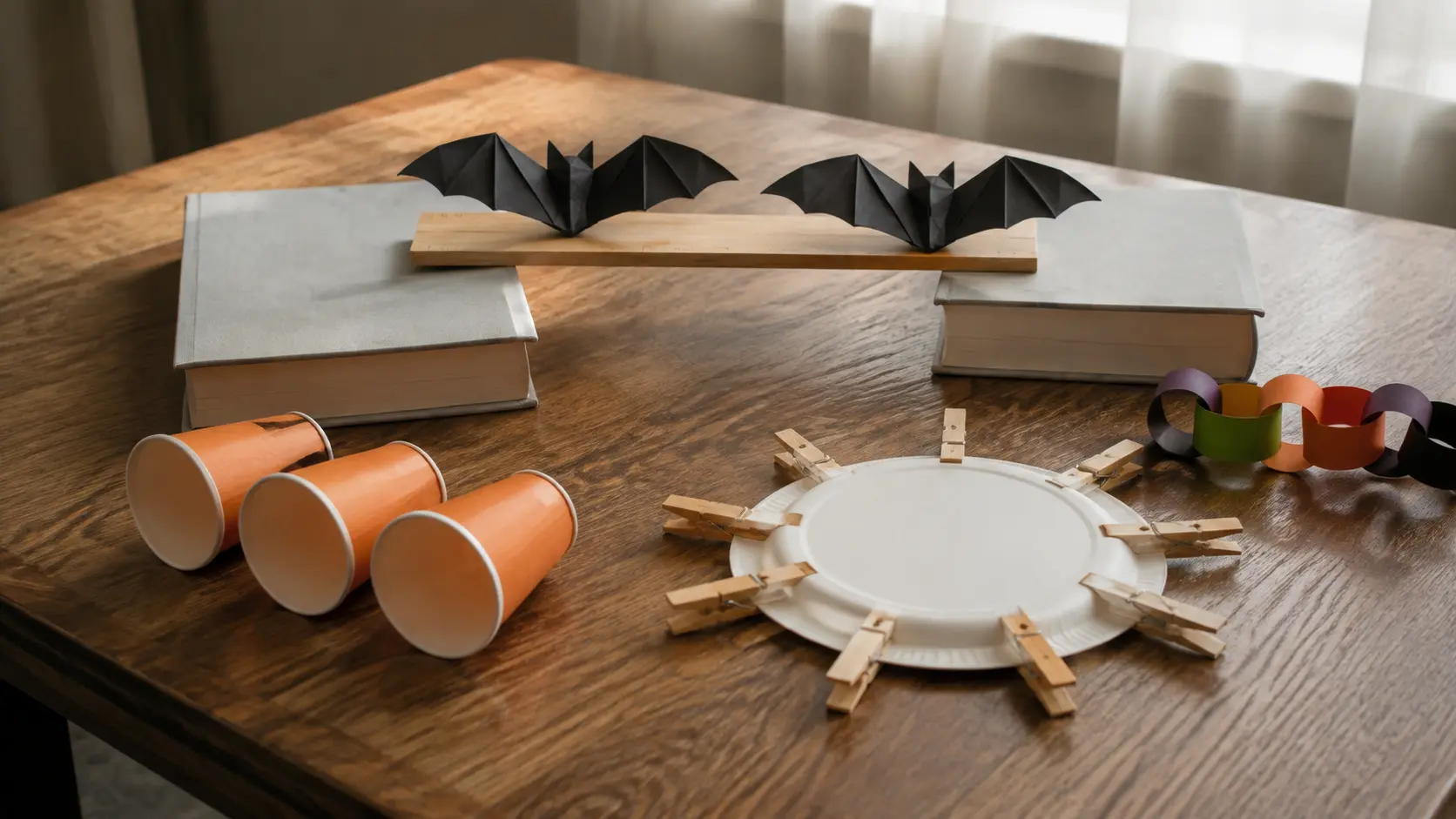
1. Ghost Chain. Players: one per station. Materials: wide paper strips and tape pieces placed along the table edge. Setup: give every player equal piles. Rule: loop one strip through the last and close it with one piece of tape. A closed loop cannot be reopened. Scoring: count complete linked loops at the signal. Kids: use wider strips with tape tabs already lifted. Adults: use the non-dominant hand for tape. Space: table.
2. Pumpkin Cup Flip. Players: one or two. Materials: orange paper cups. Setup: place each cup on its side with its base just over the table edge. Rule: tap the base upward with one finger so the cup turns and lands upright. Reset misses before trying again. Scoring: count upright landings. Kids: any landing on the cup base counts, even if it tips later. Adults: alternate hands after every successful flip. Space: table.
3. Bat Perch. Players: one per station. Materials: a ruler, two sturdy books and large folded paper bats. Setup: bridge the ruler between the books and put the bats beside it. Rule: place bats on the ruler without touching one already perched. A fallen bat stays off the table until the next round. Scoring: count bats still balanced at the signal. Kids: use flat card rectangles. Adults: place with one hand while standing. Space: table.
4. Cobweb Clip Circle. Players: one or two. Materials: a paper plate and full-size clothespins. Setup: put the plate face down and scatter the pins beside it. Rule: attach pins around the entire rim, moving clockwise and leaving no pin touching another. If two touch, remove both. Scoring: count pins attached correctly. Kids: use both hands and skip the spacing rule. Adults: one hand only, starting with pins closed in a bowl. Space: table.
A Night Out That Gives Something Back
When the group celebrates out, the visit itself can be worth something. At a VISU partner location, scan the code and the reward is tied to being there.
Kitchen and Laundry Challenges
5. Midnight Match. Players: one per station. Materials: several clean food containers and their large lids. Setup: separate containers from lids and mix both groups. Rule: choose one lid, test it on containers and close the correct one before taking another lid. Forcing a wrong lid means reopening it before continuing. Scoring: count correctly closed containers. Kids: use clearly different sizes. Adults: wear one oven mitt on the hand that handles lids. Space: table or clean floor.
6. Witch's Pantry. Players: one or two. Materials: wrapped candy, two bowls and an oven mitt. Setup: place the full bowl on one side and the empty bowl an arm's length away. Check allergies first. Rule: wear the mitt and move one piece at a time without lifting either bowl. Dropped pieces stay down. Scoring: count pieces in the second bowl. Kids: replace candy with rolled socks and use a bare hand. Adults: use the non-dominant hand inside the mitt. Space: table.
7. Phantom Fold. Players: one or a pair. Materials: dish towels, pillowcases and a taped rectangle. Setup: make the rectangle slightly larger than a neatly folded dish towel. Rule: fold each item and place it fully inside the rectangle before starting the next. An item crossing the tape does not count. Scoring: count finished folds. Kids: use flat dish towels. Adults: pairs fold a fitted sheet together without stepping inside the rectangle. Space: floor.
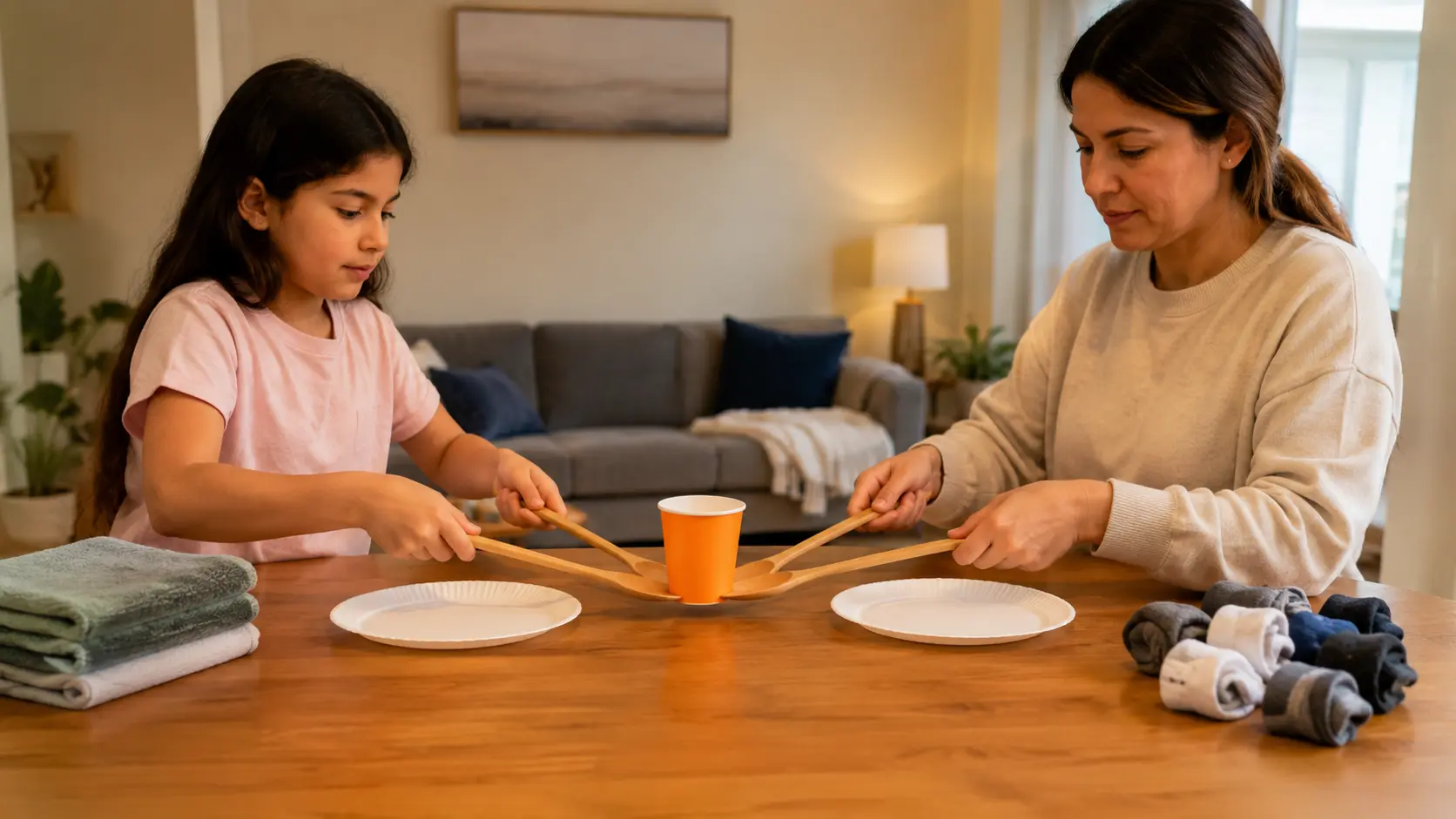
8. Cauldron Carry. Players: one or two. Materials: two wooden spoons, a paper cup and two plates. Setup: put the cup on one plate and the empty plate at the other end of the table. Rule: grip one spoon in each hand, lift the cup between the spoon bowls, carry it and set it upright on the second plate. Hands cannot touch the cup. Scoring: count complete return trips. Kids: carry a cardboard tube with both spoons underneath. Adults: hold spoons at their handle ends. Space: table.
Let the Place You Are In Count for Something
VISU connects rewards to verified presence at partner locations. If everyone is already meeting somewhere, the bonus comes from showing up.
Floor and Backyard Challenges
9. Doorway Ghost Drape. Players: one or two. Materials: light dish towels and a chair. Setup: place the chair beyond a tape line with its back facing players. Rule: toss one towel at a time so it drapes over the chair back with fabric hanging on both sides. Retrieve only after every towel is thrown. Scoring: count towels still draped. Kids: move the line closer and use larger towels. Adults: turn sideways for each toss. Space: clear floor or backyard.
10. Broom Closet Pack. Players: one or a pair. Materials: a laundry basket and empty cardboard boxes in mixed shapes. Setup: place boxes outside the basket and mark a fill line below the rim. Rule: pack every box below the line without crushing, tearing or nesting boxes. Players may rearrange until the signal. Scoring: finish, or count boxes fully below the line. Kids: use fewer boxes with obvious fits. Adults: one hand per player. Space: floor.
11. Moonlit Tube Balance. Players: one at a time. Materials: a cardboard tube and a straight tape line. Setup: clear the route and put the tube on the player's open palm. Rule: walk heel to toe along the line, turn, and return without gripping the tube. If it falls, reset at the start. Scoring: count completed out-and-back trips. Kids: walk normally on a shorter line. Adults: balance the tube on the back of the hand. Space: clear floor or flat backyard.
12. Shadow Sweep. Players: one or two. Materials: a large tissue-paper ball, a paper plate and two tape gates. Setup: make a wide gate halfway down the course and a smaller finish gate. Rule: fan with the plate to move the ball through both gates without touching it. A missed gate sends the ball behind that gate for another try. Scoring: count complete courses. Kids: use two wide gates. Adults: fan with the non-dominant hand from behind a side line. Space: clear floor.
13. Mirror Monster. Players: pairs. Materials: none. Setup: partners face each other inside a marked square. Rule: one leader makes a sequence of three slow monster poses. The mirror repeats the sequence in order, then roles switch. A referee counts only complete, matching sequences. Scoring: count accepted sequences. Kids: copy one pose at a time. Adults: use five-pose sequences and cannot repeat a pose within one sequence. Space: floor or backyard.
14. Monster Echo. Players: two or more. Materials: a table or two paper plates. Setup: choose a caller and a responder. Rule: the caller makes a pattern of taps and claps; the responder repeats it exactly. After a correct echo, add one sound to the next pattern. After a mistake, start again with a new two-sound pattern. Scoring: highest correctly repeated pattern length at the signal. Kids: taps only. Adults: include left-hand and right-hand taps as different sounds. Space: table or floor.
Large Groups Versus One-on-One Play
For a large group, choose challenges that everyone can attempt at once with identical materials: Ghost Chain, Pumpkin Cup Flip, Cobweb Clip Circle, Phantom Fold and Monster Echo. Lay out one place per player or team, start one shared timer and record each result before resetting. Nobody waits through a long ladder of turns.
For one-on-one play, duplicate the station and keep both players in the same sight line. Doorway Ghost Drape, Broom Closet Pack, Shadow Sweep and Cauldron Carry work well this way because progress is visible at the signal. Do not make two players share one pile unless the rule is written as a pair challenge.
When materials are limited, divide the group into teams and rotate. One player competes, one referees, and the rest reset the station. Change roles after each round so the same person does not keep the timer all evening.
Build a Halloween Tournament
Choose six challenges that alternate table, floor and pair play. Put the most delicate setup first while every station is tidy, then move to challenges with towels, boxes and open space. Finish with an all-play round such as Monster Echo so the last result does not depend on waiting for individual turns.
Give one point for finishing a challenge, or rank each round with three points for first, two for second and one for third. Pick one system before play and keep it for every station. For mixed ages, score the kids' and adults' variations as separate lanes, then add each player's lane points to the same team total.
Use a simple rotation: play for sixty seconds, record the score, reset the station, then move clockwise. Write player names down the side of the score sheet and challenge names across the top. If the final totals tie, use one Pumpkin Cup Flip round with equal cups and no variation. Most upright landings wins the tournament.
FAQ
What Are Easy Halloween Minute to Win It Games?
Ghost Chain, Pumpkin Cup Flip and Cobweb Clip Circle need little setup and fit on one table. Each has a visible score at the end of sixty seconds.
What Materials Do I Need?
Start with paper cups, plates, scrap paper, tape, cardboard tubes, clothespins, rolled socks, towels, spoons, empty containers and boxes. Select materials only for the challenges you plan to run.
Can Kids and Adults Play Together?
Yes. Use the kids' and adults' variations as separate lanes, run them on the same timer and add the results to team totals. Young children use large materials without loose small pieces.
How Many Challenges Should I Choose?
Choose enough to alternate materials and spaces without repeating the same motion. The six-round tournament above is a ready structure, while a shorter gathering can use fewer stations.
How Do I Run These Games in a Classroom?
Use table stations, assign one referee and one reset helper to each group, and rotate clockwise. Skip any challenge that needs more floor space than the room provides.
How Do I Keep Score for a Large Group?
Run identical stations simultaneously or rotate teams through them. Record every result before resetting, and use the same points system for the entire tournament.
Are There Safe Options for Young Children?
Use wide paper strips, full-size cups, large card shapes, towels and rolled socks. Keep loose small items away, let an adult prepare cut pieces, and use only clear floor routes.
References
No external references were used. The challenge rules are original instructional designs intended to be verified by playing, and the safety limits are rules for this activity rather than claims about outcomes.