
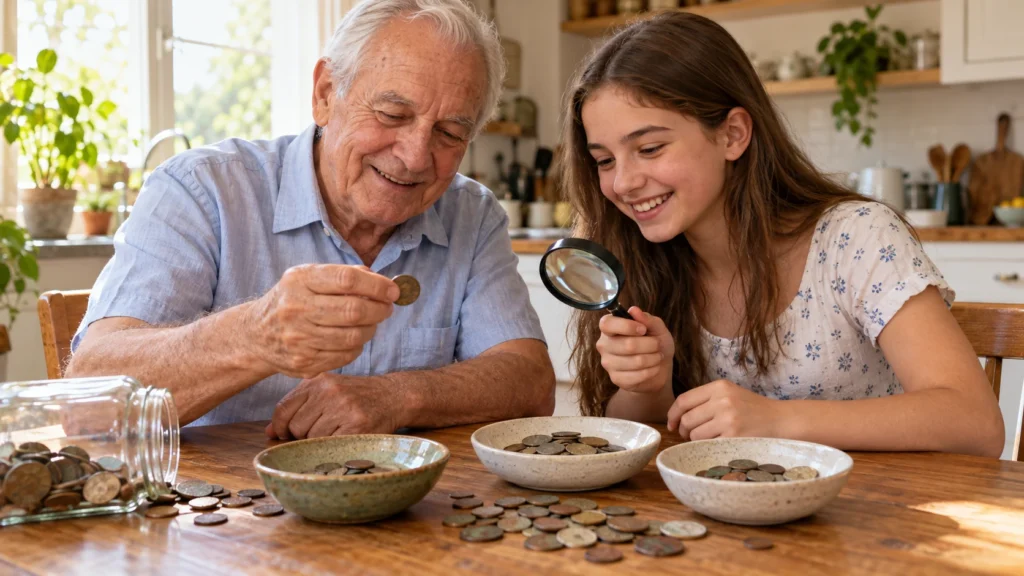
Most coins worth money look exactly like the ones in your pocket, and most coins in your pocket are worth exactly what is stamped on them. The difference sits in a few details you can check at the kitchen table: the metal, the date, a small mint mark, a printing error and, above all, the condition. This guide shows how to sort a jar or an inherited collection in that order, how to find what a coin really sells for instead of what an ad claims, why cleaning a coin can cost you most of its value, and where to sell without getting burned. It does not quote prices, because coin prices move with metal markets and with collector demand. It teaches you how to look them up for the exact coin you hold.
Earn VISU Credits on Your Everyday Routes
Scan eligible QR codes with the VISU app and you can earn VISU Credits, an in-app reward with its own rules and daily limits for each offer. It is not cash, and it does not depend on what your coins are worth.
Why Most Coins Are Worth Face Value
A coin becomes valuable to a collector for three reasons that usually have to work together: few of them exist, the one you hold is in good condition, and enough people want it. Modern circulating coins fail the first test. The US Mint strikes them by the hundreds of millions or billions, so a worn quarter from your change is, almost always, a quarter.
That is also true of pennies. The Mint held a ceremonial final striking of the circulating cent in November 2025. The end of production does not turn the billions of cents already out there into rarities. What can make a cent worth more is the same short list that applies to every coin: its metal, its date and mint, an error, and its condition.
So the realistic goal is not to find a fortune in every jar. It is to pull out the handful of coins that deserve a closer look, and to avoid damaging or underselling them. The next sections follow the order a dealer would use.
Check the Metal First: Silver Coins
The fastest win in an old jar is silver. The Coinage Act of 1965 removed silver from circulating dimes and quarters and cut the silver in the half dollar from 90% to 40%; a 1970 law then removed silver from the half dollar too. Their metal alone gives older silver coins a value above face, and that value rises and falls with the silver price.

| Coin | Dates to look for | Silver content | How to spot it |
|---|---|---|---|
| Dimes and quarters | 1964 and earlier | 90% | Look at the edge: no copper stripe, solid silver color all the way through |
| Half dollars | 1964 and earlier | 90% | Same solid edge as old dimes and quarters |
| Kennedy half dollars | 1965 to 1970 | 40% | The edge looks silvery, with no bright copper stripe |
| "War nickels" | Mid-1942 to 1945 | 35% | A large mint mark above the building on the back |
The edge test works because clad coins made after 1965 are a copper core between copper-nickel layers, and the copper shows as a reddish stripe. To estimate the metal value of a silver coin, check the day's silver spot price on a bullion dealer's site and the coin's silver weight in a coin reference. Dealers usually buy silver coins below that number, because they have to resell them.
Read the Date and the Mint Mark
Two coins with the same design can have very different values because of where and when they were struck. The mint mark is a small letter that shows which Mint made the coin. On current US coins it is P for Philadelphia, D for Denver, S for San Francisco or W for West Point. Older coins can carry marks from Mints that closed long ago, such as CC for Carson City, which collectors look for.
A few rules save time when you read them:
- Where to look. On Lincoln cents the mint mark sits under the date. On other coins it moves around by series and year, so check a reference for the series you hold.
- No mint mark is normal. Most Philadelphia cents carry no mint mark at all, and coins dated 1965 to 1967 were struck without mint marks.
- A key date is a low mintage. Collectors call the scarcest date and mint combinations in a series "key dates". The classic example is the 1909-S VDB Lincoln cent, of which only 484,000 were released, against almost 28 million of the Philadelphia version with the same initials.
Mintage figures for each date and mint are published in coin references and price guides. When a coin in your hand matches a low-mintage combination, it moves to the "look closer" pile. When it matches a date struck in the hundreds of millions, its condition is what decides the rest.
Error Coins and Varieties
Errors are coins that left the Mint with a mistake. A few famous ones are worth a lot, which is exactly why so many ordinary coins get sold online as "errors". Learn the real types before you trust a listing title.
| What you see | What it may be | What it usually turns out to be |
|---|---|---|
| Letters and numbers that look doubled, with clear separation | A doubled die, made when the die itself was struck out of alignment | Often "machine doubling", a flat shelf-like shadow that collectors value far less |
| Design shifted to one side, with a blank crescent | An off-center strike | Can be a real error; compare with verified examples before paying extra |
| A curved bite missing from the edge | A clipped planchet | Sometimes a coin cut or ground after it left the Mint |
| Odd color, a wrong metal or a missing layer | A wrong planchet or a lamination error | Very often heat, chemicals or plating applied later |
Two well-documented cases show the idea. The 1955 doubled die cent came from an obverse die at the Philadelphia Mint that was misaligned during its making, so the date and lettering appear clearly doubled. The 1943 copper cent is rarer still: that year cents were struck in zinc-coated steel to save copper, and an estimated 40 copper examples were struck by mistake, with 13 confirmed to exist.
The steel cent is also the only regular-issue US coin a magnet picks up, which gives you a free first test: a 1943 cent that sticks to a magnet is the normal steel version. One that does not stick is not automatically a treasure, since fakes exist, but it is worth showing to an expert. As a rule, damage done after a coin left the Mint (called post-mint damage) adds nothing, and many "errors" on marketplaces are exactly that.
Condition and the Sheldon Scale
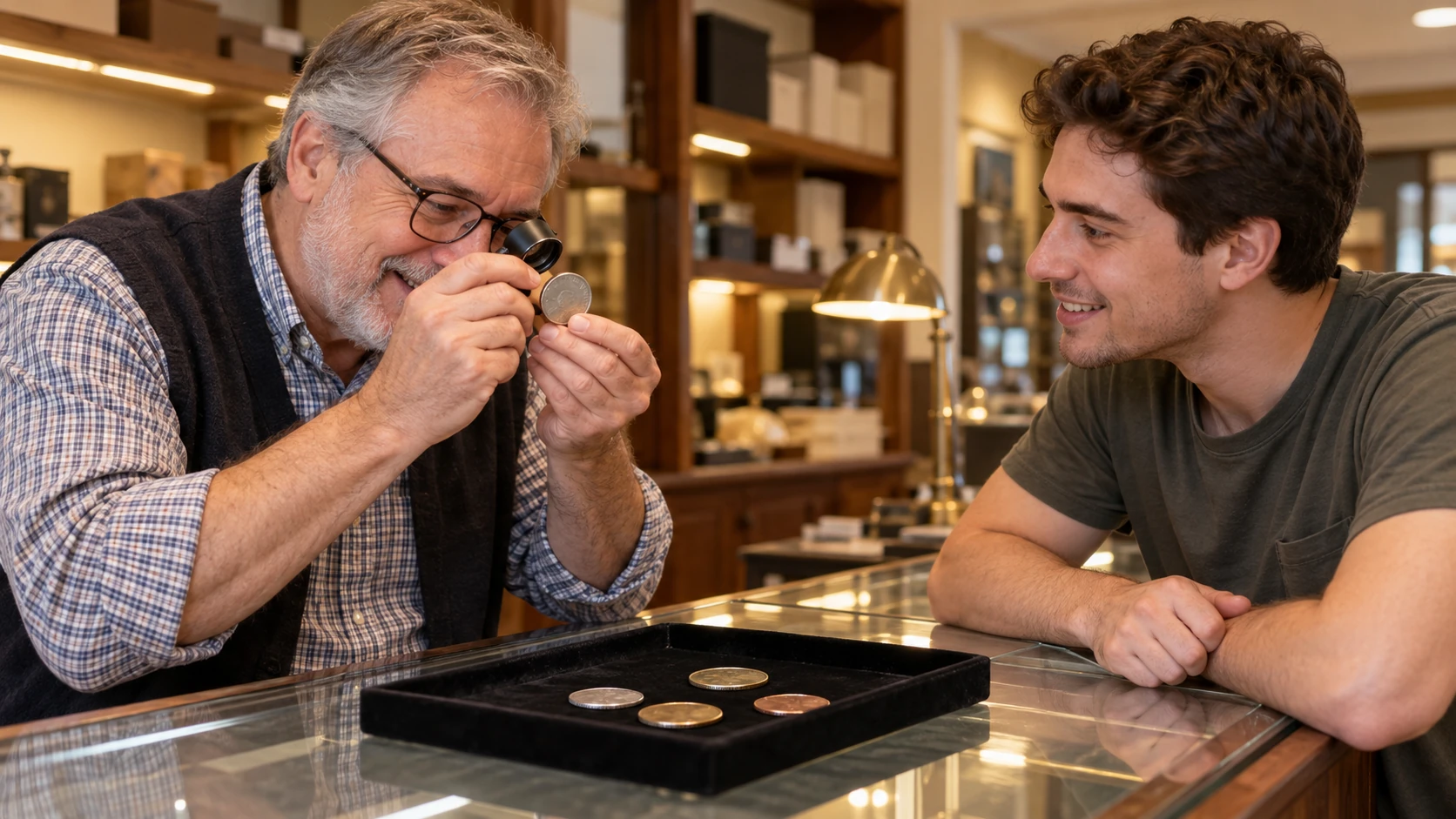
Two coins with the same date and mint can sell for very different amounts because of wear. Collectors describe condition with the Sheldon scale, a 1 to 70 grading scale first used in the United States in the late 1940s. NGC, one of the major grading companies, calls it the industry standard.
| Grade | Short name | What it means in practice |
|---|---|---|
| 4 | Good (G) | Heavily worn, design visible but flat in many areas |
| 12 | Fine (F) | Even wear, all lettering sharp |
| 20 to 35 | Very Fine (VF) | Wear on the high points, most details still clear |
| 40 to 45 | Extremely Fine (XF or EF) | Complete details with light wear on the highest points |
| 50 to 58 | About Uncirculated (AU) | Only slight wear on the highest points |
| 60 to 70 | Mint State (MS) | No wear; the higher the number, the fewer marks |
At the very top, NGC defines a Mint State 70 coin as one with no post-production imperfections at five times magnification. You will not reach that kind of precision at home, and you do not need to. What you can judge is whether a coin is worn flat, lightly worn or looks as if it never circulated, and whether its surfaces have scratches, holes or corrosion.
When Paid Grading Makes Sense
Grading means sending a coin to a company that authenticates it, assigns a grade and seals it in a plastic holder with a certification number. It costs a fee per coin plus shipping and insurance, so it only makes sense when the coin is likely to be worth clearly more than those costs, or when buyers will not trust it without a certificate. For a jar of common coins, the answer is no. For a key date, a confirmed error or a silver coin that looks uncirculated, it is worth asking a dealer whether grading would change the price.
Put Every Coin You Sell on One Page
A free VISU Link page holds the links to your listings, your socials and your contact links, with a QR code you can print for a coin show table.
Never Clean a Coin You Might Sell
The most common way people lose money on old coins is by making them look nicer. Polishing, baking soda, vinegar, wire brushes and jewelry dips all remove metal and the original surface, and collectors can see it. The grading company NGC does not give a numeric grade to coins that have been improperly cleaned, holed or scratched. It assigns a "Details" grade instead and notes the problem on the label, and buyers pay less for those coins.
Handle coins by the edges, over a soft surface, with clean dry hands. Keep them in paper envelopes or holders made for coins rather than loose in a bag where they rub together. Write the date, mint mark and where each coin came from on the envelope. The habits that keep a card collection in shape work here too; our guide on how to start a card collection covers handling, storage and a simple catalogue you can copy.
How to Check What a Coin Is Really Worth
A price is what a buyer actually paid, not what a seller is asking. That one rule filters out most of the noise around coin values. Check these sources, in this order:
- Sold listings. On large marketplaces, filter results to sold or completed items. Compare only coins with the same date, mint mark and a similar condition, and ignore the asking prices of unsold listings.
- Auction archives. The big numismatic auction houses publish past results with photos and grades. They are the best reference for scarce coins.
- Price guides. Printed and online price guides give a range by grade. Treat them as a starting point, because retail guide prices are usually above what a dealer will pay you.
- Two dealer offers. Show the coin to two different dealers and ask each for a written offer. If the offers are far apart, ask why.
For online selling or for asking an expert remotely, photograph both sides on plain white paper in daylight, plus a shot of the edge. Mark your photos with your name or shop name using a free photo watermark tool, so they are not copied into someone else's listing.
Where to Sell Coins
Where you sell depends on what you have. A jar of common coins goes back into circulation or to a bank. A small group of silver coins usually sells fastest to a local coin shop or bullion dealer. Scarce dates, errors and graded coins can bring more from collectors directly, at a coin show, online or, for high-value pieces, through an auction house.
- Local coin shop. Quick and face to face. Expect an offer below retail, and compare two shops.
- Coin shows and collector fairs. Many dealers and collectors in one room, which makes comparing offers easy.
- Online marketplaces. The widest audience, but you handle photos, fees, shipping and buyer questions.
- Auction houses. Worth it for coins with real collector demand; they take a commission and need time.
Every channel takes something, whether it is a dealer margin, a marketplace fee or a commission. The same logic applies to anything you sell, and our comparison of where to sell handmade items shows how to compare channels by what each one keeps.
If you sell at shows, bring a small sign with a QR code that opens your VISU Link page, so buyers can see your other listings and reach you after the event. A free QR code generator and a price list maker cover the table sign. If you run a coin shop, every VISU plan includes a VISU Local listing with opening hours, posts and member reviews.
Scams, Fake Ads and Replicas
Coins attract a steady stream of clickbait. Videos and ads claim that a common penny or quarter "is worth millions", often showing an asking price from a listing that never sold. Others promise to buy your coins for huge sums and then ask for an "evaluation" or "registration" fee first. A real buyer looks at the coin and makes an offer; nobody legitimate charges you to receive money.
- Replicas. Under the US Hobby Protection Act rules, imitation numismatic items made in or imported into the United States must be plainly and permanently marked "COPY". Be wary of an unmarked "rare coin" at a low price from an unknown seller.
- Altered coins. Changing a date or adding a mint mark to fake a rarity is fraud. Federal law makes it a crime to fraudulently alter US coins or knowingly sell altered ones.
- Selling is legal. Buying and selling coins is a normal hobby and business. What matters is honest descriptions and a safe exchange.
For in-person sales, meet in a public place or at the shop, and for valuable pieces ask for payment you can verify before the coin changes hands.
A Ten-Minute Coin Check
- Sort by type: cents, nickels, dimes, quarters, halves, dollars and foreign coins.
- Check edges and dates for silver: dimes, quarters and halves dated 1964 or earlier, halves from 1965 to 1970, and nickels from 1942 to 1945.
- Test any 1943 cent with a magnet.
- Read the date and mint mark of older coins and note any combination with a low mintage.
- Look for clear doubling, off-center strikes and clipped edges, and ignore obvious damage.
- Judge wear: worn flat, lightly worn or no wear at all.
- Do not clean anything. Put interesting coins in labeled envelopes.
- Look up sold prices for the same date, mint and condition.
- Get two dealer offers for anything that looks valuable.
- Ask about grading only when the coin is clearly worth more than the fees.
Keep Earning After the Jar Is Sorted
Rare coins are rare. Scanning eligible QR codes with VISU can earn VISU Credits all year, an in-app reward that follows the rules and daily limits of each offer.
Frequently Asked Questions
How do I know if my coin is worth money?
Check five things in order: the metal (silver dimes, quarters and halves dated 1964 or earlier), the date and mint mark, any real minting error, the condition, and recent sold prices for that exact coin. Most coins fail all five and are worth face value.
Are pennies worth more now that the Mint stopped making them?
Not ordinary ones. The Mint ended circulating cent production in 2025, but billions of cents remain, so a common cent is still worth one cent. Value comes from rare dates, errors, metal and condition.
Should I clean old coins before selling them?
No. Cleaning removes metal and the original surface. Grading services such as NGC give improperly cleaned coins a Details grade instead of a numeric grade, and buyers pay less for them.
Is it worth getting a coin graded?
Only when the coin is likely to be worth clearly more than the grading fee, shipping and insurance, or when buyers will not trust it without a certificate. Ask a dealer before sending a common coin.
Where can I sell coins for the best price?
Compare at least two offers. Local coin shops are fastest, coin shows make comparing easy, marketplaces reach more collectors, and auction houses suit high-value coins. Each channel keeps a margin, fee or commission.
References
- Coinage Act of 1965: silver removed from dimes and quarters, half dollar cut to 40%
- Jefferson nickel: wartime nickels with 35% silver and a large mint mark
- Mint mark: P, D, S and W on current US coins
- Lincoln cent: 1909-S VDB mintage, mint mark location and the 2025 final striking
- 1955 doubled die cent
- 1943 steel cent and the 1943 copper cent
- NGC: Coin Grading Scale (Sheldon 1 to 70)
- NGC: Details Grading for cleaned, holed or scratched coins
- 16 CFR 304.6: imitation numismatic items must be marked COPY
- 18 U.S. Code 331: mutilation, diminution and falsification of coins