

Most houseplants are not killed by neglect; they are killed by care, and the watering can is the usual weapon. This guide starts where plants actually die: how to tell too much water from too little, why the drainage hole is not optional, how to read the light in your room without a meter, and the five plants that forgive beginner mistakes.
This is a care guide for plants you already own, indoors and in pots. If what you want is to grow food in containers from scratch, that is our container gardening pillar, and everything about pot choice and potting mix lives there. Here we keep things alive.
Planning a glass display instead of an ordinary draining pot? The guide to choosing plants for an open or closed terrarium compares vessel types, moisture needs and mature plant size before you put the plants together.
One Link for Your Whole Green Corner
A short address you control, pointing to your plant lists, your pages and everything else you share.
Your Plant Did Not Die of Neglect, It Died of Too Much Care
The University of Illinois Extension, writing about the snake plant, the species sold everywhere as unkillable, puts it in six words: "Over-watering is the main reason for failure." The same extension's watering guide opens with the general version: many houseplants suffer from too much or too little water, and of the two, excess is the one beginners commit. Oklahoma State's houseplant fact sheet goes as far as calling overwatering the chief cause of trouble in pots without drainage, and advises that it is far better to underwater than to overwater.
The cruel part is that a drowning plant and a thirsty plant can look identical, which is why loving owners water a drowning plant even harder. This guide's whole job is to break that loop: diagnose first, then water. One more honest note: a newly bought plant that declines in its first weeks at home is often just acclimatizing to less light; the University of Georgia recommends giving new arrivals a bright spot for three to four weeks before moving them to their final place.
How to Tell Too Much Water From Too Little
Here is the trap, stated by both Oklahoma State and Illinois in nearly the same words: wilting can be caused by lack of water or by too much of it. Yellowing leaves sit in both columns too. The symptom alone does not decide.
| Symptom | Can mean too much water | Can mean too little water |
|---|---|---|
| Wilting | yes | yes |
| Yellowing, dropping leaves | yes (also poor drainage, temperature shock) | rarely alone |
| Brown leaf edges and tips | rarely alone | yes (also too much fertilizer, sun or wind burn) |
| Spotted or faded leaves | yes (also direct sunburn, disease, insects) | sometimes |
The tiebreakers, in order. First, touch the potting mix (the finger test below). Second, if the mix is moist but the plant is wilted anyway, Oklahoma State says to inspect the roots: slide the plant out of its pot and look. Georgia's extension gives the color rule that settles it: healthy roots are white, dead roots are brown. Moist soil plus a wilted plant plus brown roots is overwatering, and more water will finish the job.
The Drainage Hole Is Not Optional
Illinois Extension is blunt: containers with drainage holes are best for most plants, and pots without them carry a much higher risk of root rot and waterlogged soil. If you love a decorative pot with no hole, Oklahoma State's fix is the "pot within a pot": keep the plant in a plain pot with holes and set that inside the pretty one, lifting it out to water.
Two less obvious rules from the same sources. A pot that is too big drowns a small plant: the soil stays wet too long, so move up only one pot size, one to two inches (2.5 to 5 cm) wider, per Illinois. And material matters: unglazed clay dries out faster than plastic, so clay forgives overwaterers and plastic forgives forgetters. For pot choice and potting mix from zero, the container gardening pillar covers it; here the point is only that water must be able to leave.
When to Water: The Finger Test
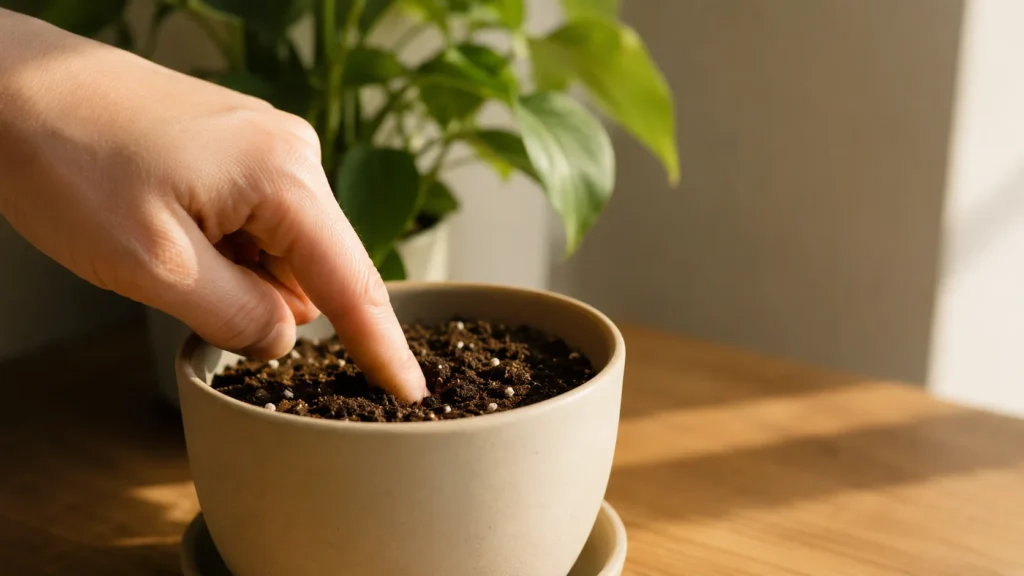
Fixed schedules fail, and Illinois says so directly: people want to water by the calendar, and it usually does not work, because frequency depends on the pot, the mix, the season, the light and the species. The replacement costs nothing: push a finger into the soil, about two inches (5 cm) deep by the Illinois rule, about one inch by Georgia's. Dry at that depth means water; damp means wait.
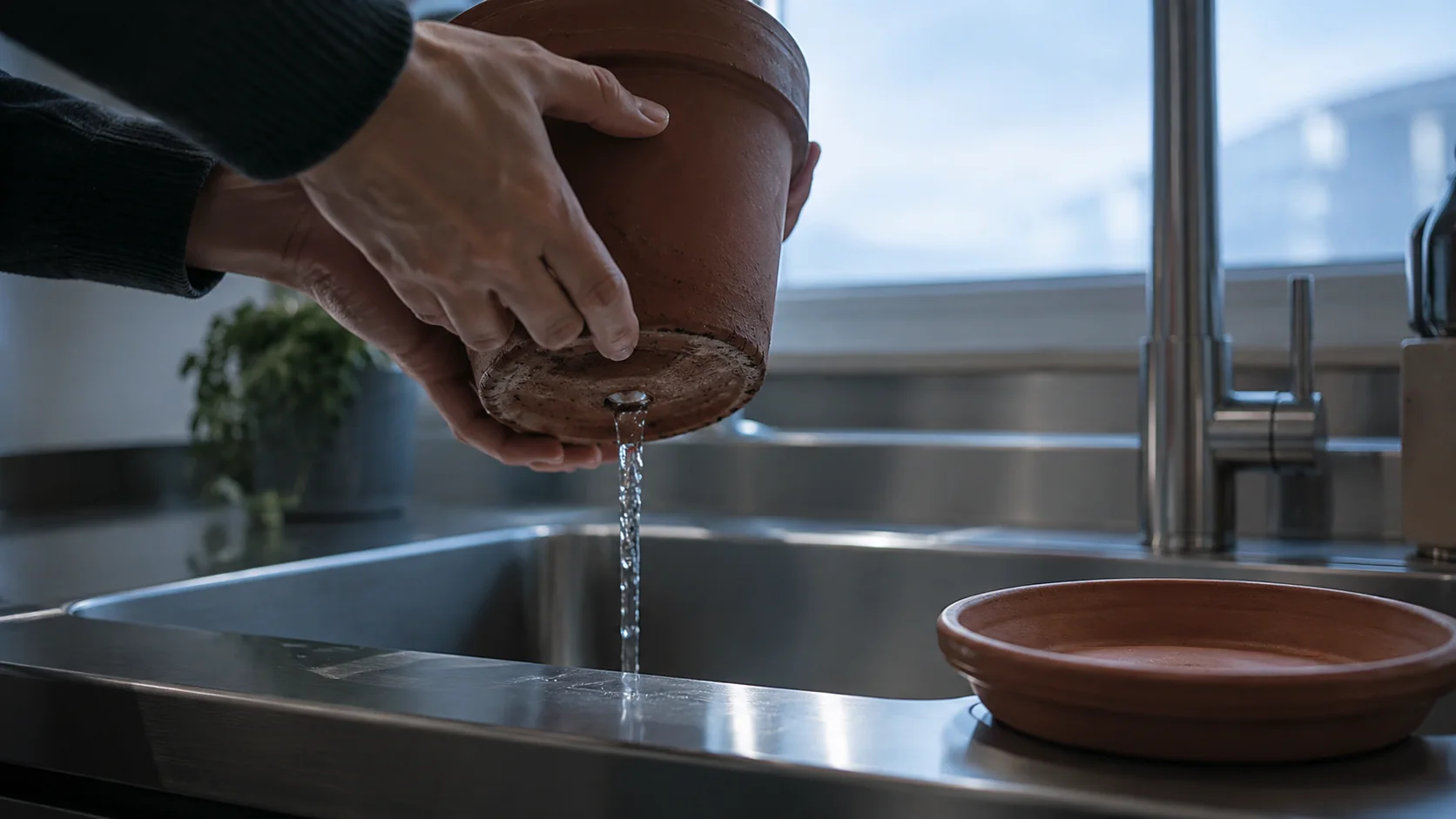
When you do water, do it thoroughly: pour until water runs freely out of the drainage hole, then empty the saucer. Never leave the pot sitting in a saucer of water. Georgia's extension explains why that saucer matters more than it looks: standing water builds up soluble salts from fertilizer, and high salt levels damage roots. Water quality has three easy rules from Illinois: room temperature, never softened water, and letting tap water sit for 24 hours to dissipate chlorine and fluoride.
Reading the Light in Your Room Without a Meter
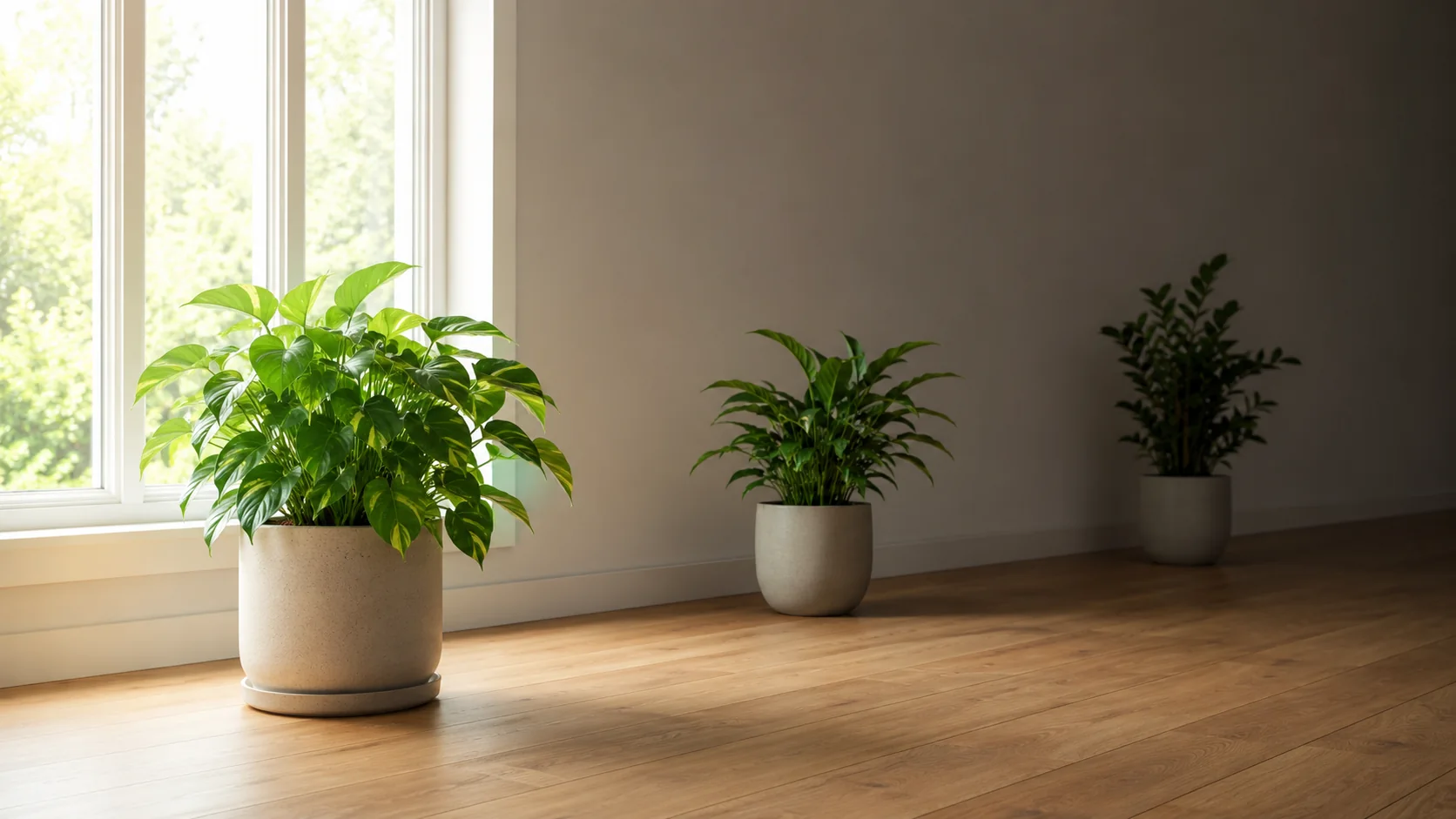
Illinois Extension calls light one of the most limiting factors for houseplant success, and the numbers explain why: outdoor sun runs 10,000 to 12,000 foot-candles, while indoors only a small fraction gets through. The useful part of their guide is a ruler that needs no meter, just your window and a tape measure:
| Light level | North window | East or west window | South window |
|---|---|---|---|
| Low (75 ft-c) | a few feet away | 3 to 10 feet away | 15 to 20 feet away |
| Medium (150 ft-c) | directly in front | a few feet away | 3 to 10 feet away |
| High (300 ft-c) | directly in front | up to 5 feet away | |
| Direct (1,500 ft-c) | directly in front |
Two caveats. This table is written for the Northern Hemisphere, where the south window is the strong one; in the Southern Hemisphere the orientations flip, with the north window strongest. And more light is not always better: Georgia's extension notes that many foliage plants are rainforest natives that are easily injured by strong direct sun. Grow lights exist as a fallback for dark rooms, but position solves most cases. One boundary worth naming: this section is about placing a plant you already own; choosing which edible crops to plant for a shady spot is its own decision, covered in vegetables for shady containers.
Keep the Plant Diary in One Link
Your care notes, your pages and everything else you share, behind one short address.
Humidity: What Works and What Is Ritual
The spray bottle is the ritual. Georgia's extension runs the math: you would need to mist every few minutes, indefinitely, to change the humidity around a plant, and Illinois adds that repeated misting can even increase disease on plants that dislike wet leaves. It feels like care; it mostly is not.
What does work, per all three universities: a tray of moist gravel or pebbles under the pot (with the pot sitting on the pebbles, never in the water), grouping plants together so they build a more humid pocket of air, and a humidifier if you want the real fix. The gap being bridged is real: plants prefer roughly 50 to 60 percent relative humidity by Oklahoma State's figures, while heated and air-conditioned homes run far drier; Illinois puts winter homes with heating below 30 percent, and Georgia measures typical homes at 10 to 20 percent.
Fertilizer: Less Is More
Georgia's extension says gardeners have the same problem with fertilizer that they have with water: they want to give too much. The mechanism is chemical, not moral: every fertilizer dissolves into salts, and too much salt in the soil water pulls water out of the roots and burns them. The visible warning sign is a whitish crust on the soil surface or around the pot rim; that white residue on old clay pots is fertilizer salt.
The rules that prevent it, all from Illinois: fertilize only when the plant is actively growing, no more than once every one to three months during the growing season, and never mix stronger than the label says. In winter, growth pauses and so should the fertilizer. A newly purchased plant needs none at all at first; Georgia notes the grower's dose usually lasts two to three months. And twice a year, leach the pot: pour a large volume of plain water through and let it drain fully, flushing accumulated salts out the bottom.
The 5 Plants That Forgive Beginner Mistakes
Five species, each with a real care sheet at the Illinois Extension and a toxicity verdict at the ASPCA. Short profiles on purpose: light, water, one memorable quirk, one line for pet owners.
Pothos (Epipremnum aureum). Bright indirect light, let the soil dry moderately between waterings. The quirk: it survives dim corners, but its leaf color and variegation fade in low light, so the plant tells you where it is unhappy. Toxic to dogs and cats if ingested (ASPCA).
Snake plant (Dracaena trifasciata, formerly Sansevieria trifasciata). Any light from dim interior to full sun; let the soil dry completely between waterings, and in winter water just enough to keep the leaves from shriveling. The quirk is the warning: Illinois states that overwatering is the main reason this nearly indestructible plant fails. Toxic to dogs and cats if ingested (ASPCA).
Spider plant (Chlorophytum comosum). Prefers bright light but adapts to medium; let the soil dry between waterings. The quirk: it produces plantlets when potbound, so a crowded pot is not an emergency here, it is a nursery. The pet line is the headline: non-toxic to dogs and cats (ASPCA), the only one of the five with an explicit all-clear.
Heartleaf philodendron (Philodendron hederaceum). Keep the soil lightly moist, bright indirect light, no direct sun. Illinois says philodendrons grow better than most other houseplants under the adverse conditions of most homes, which is the whole job description. Toxic to dogs and cats if ingested (ASPCA).
Chinese evergreen (Aglaonema). Keep minimally moist; it does best in soft, shadowless light, the kind of the weakest window in your home, and Illinois describes it as very tolerant, flourishing for years with minimal care. Toxic to dogs and cats if ingested (ASPCA, listed under Aglaonema modestum).
One closing skill: repotting. Illinois lists the five signs (roots out of the drainage holes, roots on the surface, a root-filled soil mass, shrinking new leaves, wilting between normal waterings), says to do it while the plant is actively growing, and both universities agree on the size step: one inch up, not double. Same depth as before, fresh mix, water immediately. When the survivors thrive and you want to grow food next, the container gardening pillar is the next step.
Show Off the Plants That Lived
One VisuLink holds your plant corner, your pages and everything else you share.
FAQ
Why do my houseplants keep dying?
The most common cause is too much water, not too little. University extensions state that overwatering is the main reason for failure, and the symptoms of drowning and thirst look alike, which pushes owners to water a drowning plant even more. Diagnose with the finger test and, if in doubt, look at the roots: white is healthy, brown is dead.
How often should I water houseplants?
Not by the calendar. Frequency depends on the pot, mix, season, light and species, so test instead: push a finger about 2 inches (5 cm) into the soil and water only if it is dry at that depth. Then water thoroughly until it drains from the hole, and empty the saucer.
Do plants really need a pot with a drainage hole?
For most plants, yes: pots without holes carry a much higher risk of root rot. If you love a holeless decorative pot, use the pot-within-a-pot trick: keep the plant in a draining pot and set it inside the decorative one.
Does misting plants actually help?
Barely. Extension sources note you would need to mist every few minutes to change humidity meaningfully, and constant misting can increase disease. A pebble tray with water, grouping plants, or a humidifier are the fixes that work.
Which houseplant is safe for cats and dogs?
Of the five in this guide, only the spider plant carries an explicit non-toxic verdict from the ASPCA for both dogs and cats. Pothos, snake plant, heartleaf philodendron and Chinese evergreen are all toxic if ingested.
References
- University of Illinois Extension, Watering Houseplants
- University of Illinois Extension, Lighting
- University of Illinois Extension, Houseplant Care
- University of Illinois Extension, Repotting
- Oklahoma State University Extension, Houseplant Care (HLA-6411)
- University of Georgia Extension, Growing Indoor Plants with Success (B1318)
- ASPCA, Spider Plant
- ASPCA, Snake Plant